Week-3 Challenge: ADVISOR Tool
ADvance VehIcle SimulatOR-
An advanced vehicle simulator model called ADVISOR has
been developed at the National Renewable Energy
Laboratory to allow system-level analysis and trade-off
studies of advanced vehicles. Because of ADVISOR's fast
execution speed and the open programming environment of
MATLAB/Simulink, the simulator is ideally suited for doing
parametric studies to map out the design space of potential
high fuel economy vehicles (3X) consistent with the goals
of the Partnership for New Generation of Vehicles (PNGV).
Five separate vehicle configurations have been modeled
including 3 lightweight vehicles (parallel, series, and
conventional drivetrains) along with 2 vehicles with 1996
vehicle weights (parallel and conventional drivetrains). The
sensitivity of each vehicle's fuel economy to critical vehicle
parameters is then examined and regions of interest for the
vehicles mapped out through parametric studies. Using the
simulation results for these vehicles, the effect of
hybridization is isolated and analyzed and the trade-offs
between series and parallel designs are illustrated.
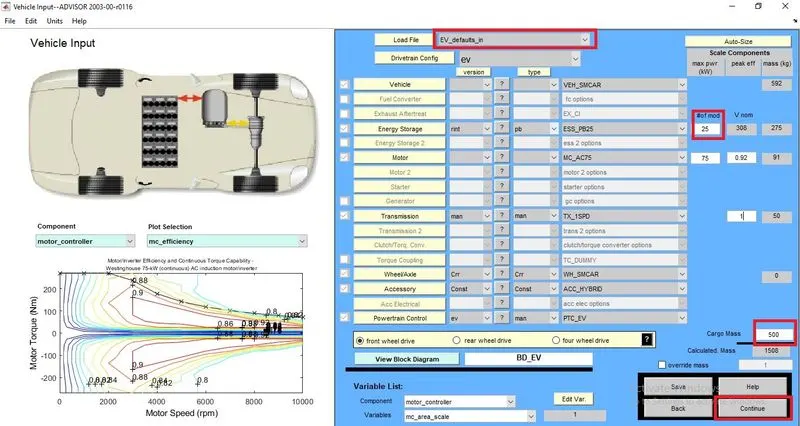
1. For EV_defaults_in file, if cargo mass is 500 kg with all other default conditions, can the vehicle travel for 45 km with FTP drive cycle? Conclude your observations.
Steps-
- Open ADVISOR tool
- Select EV_defualt_in file from load file drop down list.
- Keep all the parameters as default.
- Enter cargo mass 500 kg
- Click continue
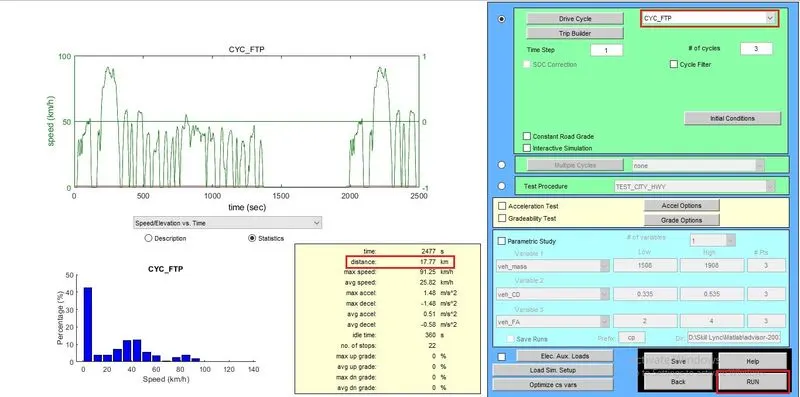
- Select CYC_FTP from drive cycle drop doen list.
- The ditstance covered by the vehicle in this drive cycle is 17.77 km.
- To find the range of the vehicle we need to run the simulation for multiple driving cycles.Thus, enter 3 number of driving cycles here.
- Click on Run.
Result-
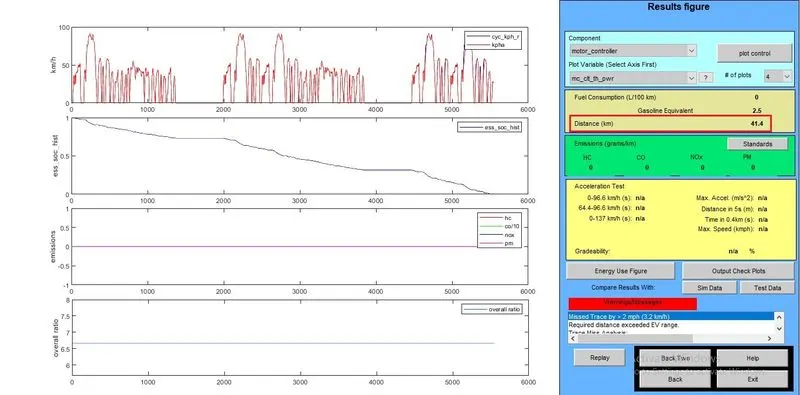
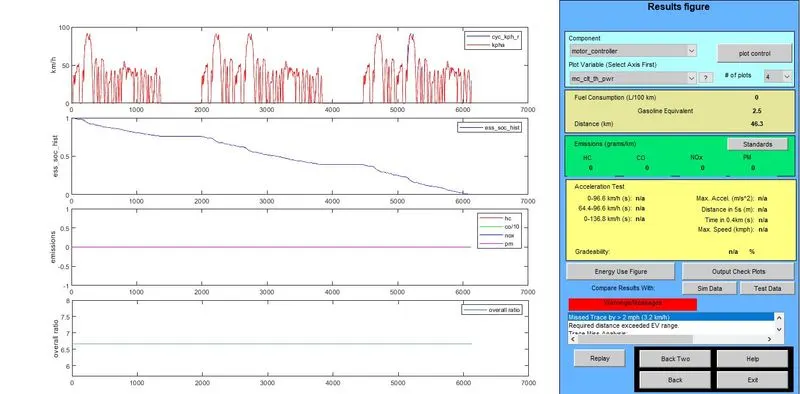
- Figure below shows the result of the simulation.
- As observe from the result window the, the vehicle travles 41.1 km before SOC of the battery reaches to 0.
Conclusion-
The given vehicle with default conditions with FTP driving cycle and 500 kg cargo mass only travels 41.1 km.
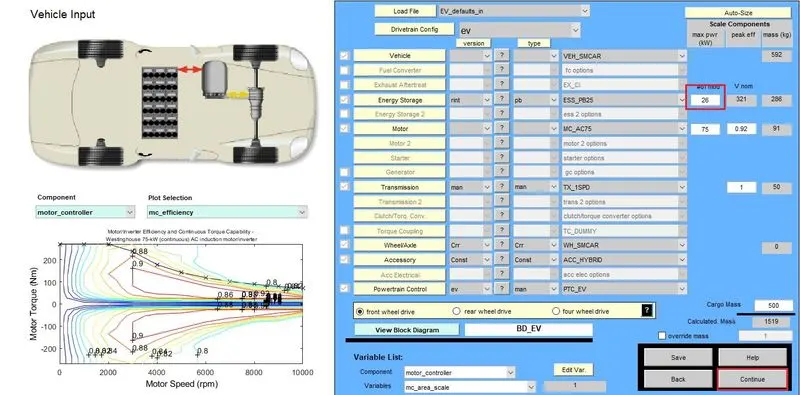
2. In the above case, try changing the battery capacity and repeat the simulation.
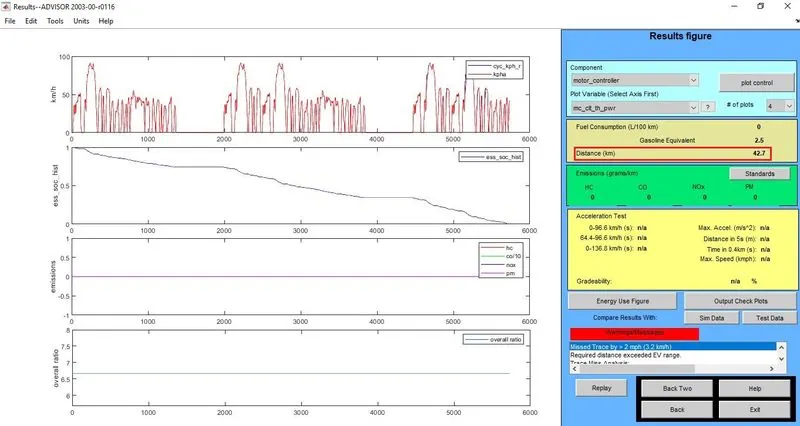
Case 1-
- Enter battery capacity as 26 kW
- Run the simulation
- As observe from the result window, the distance traveled by vehicle becomes 42.7 km
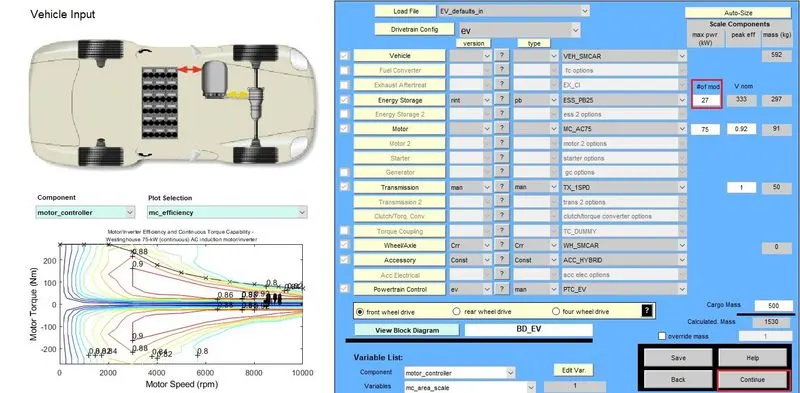
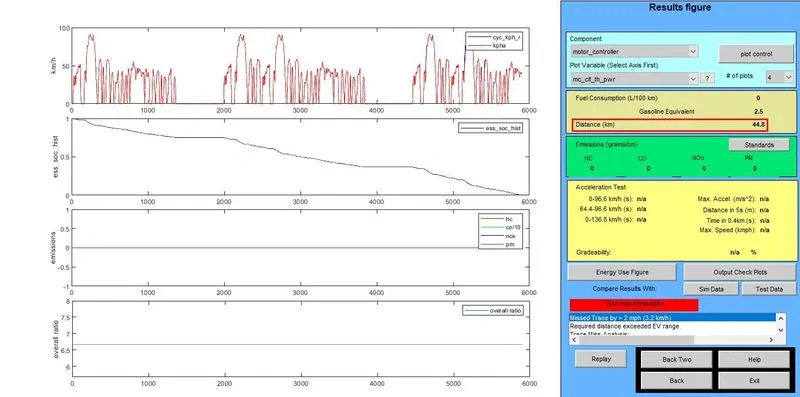
Case 2-
- Enter battery capacity as 27 kW
- Run the simulation
- As observe from the result window, the distance traveled by vehicle becomes 44.8 km
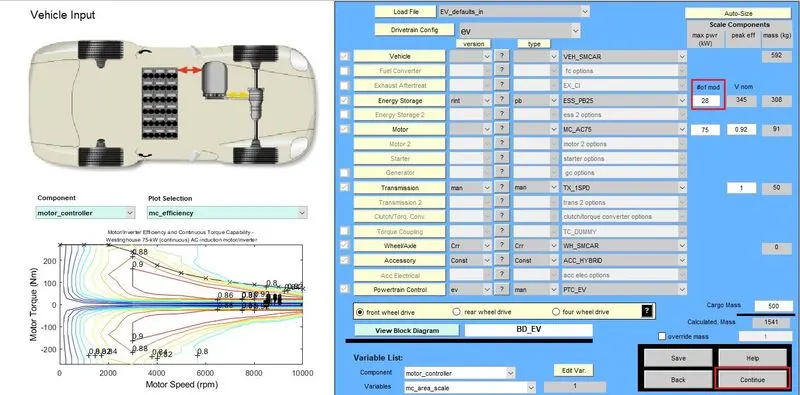
Case 3-
- Enter battery capacity as 28 kW
- Run the simulation
- As observe from the result window, the distance traveled by vehicle becomes 42.7 km
3. Perform gradeability test with PRIUS_Jpn_defaults_in file
Compare your results in table and conclude.
Steps-
- Open ADVISOR tool.
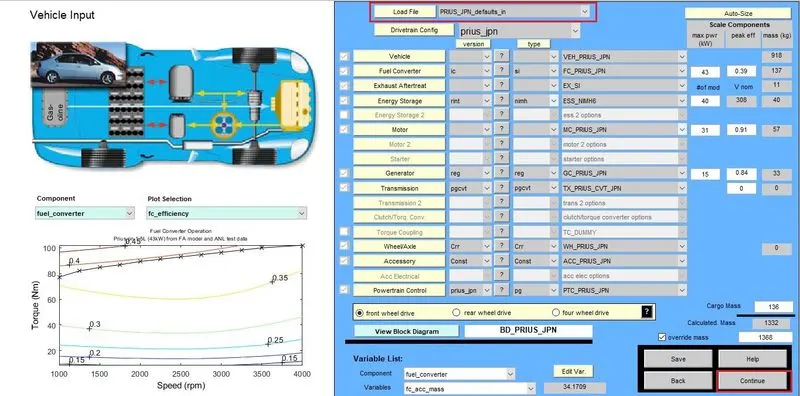
- Select PRIUS_Jpn_defaults_in from load files drop down list.
- Click on continue.
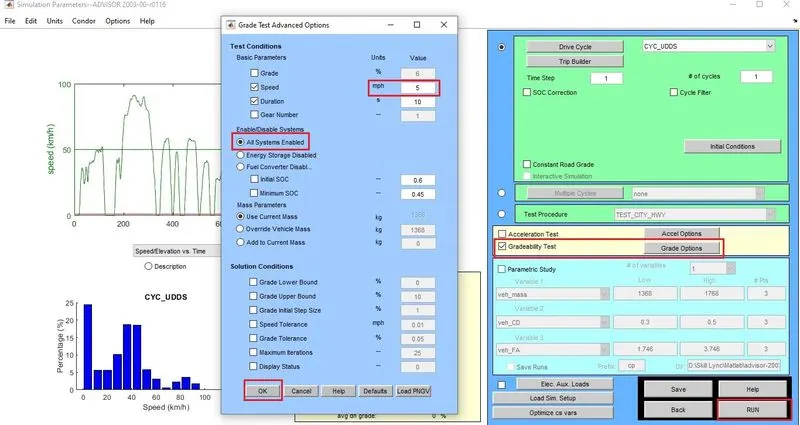
- Check 'Gradeability Test' Box.
- Click on Grade option.A pop up window will open.
- Enter intended speed in mph
- Check 'All systems Enabled'
- Click on Ok.
- Now click on Rum to run the simulation.
Case 1-
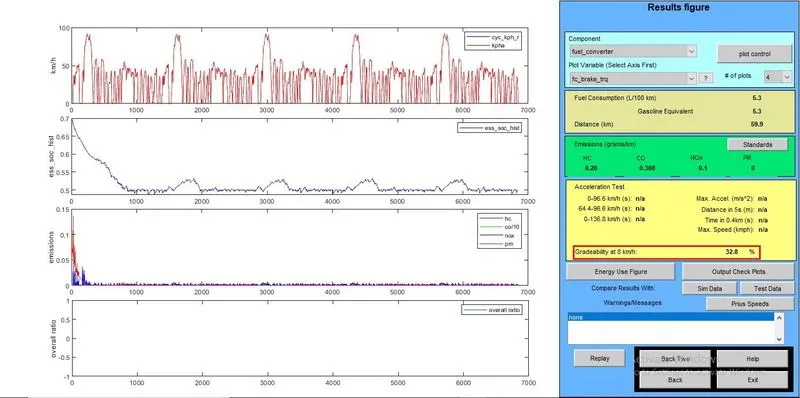
- Enter speed as 5 mph and run the simulation.
- As observed from the result bellow the gradeability at speed 5 mph is 32.8%
Case 2-
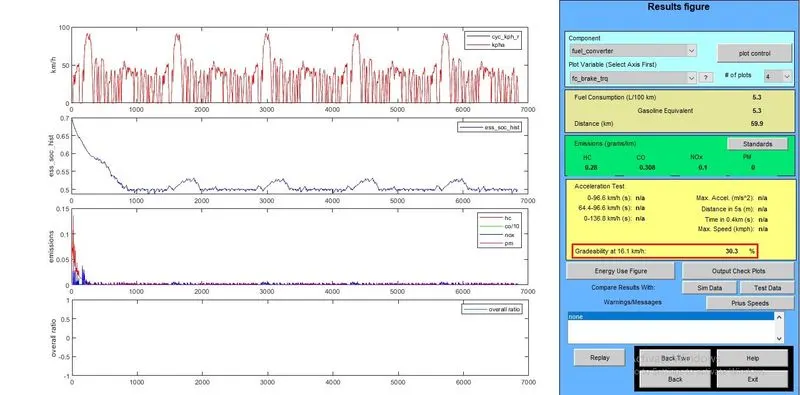
- Enter speed as 10 mph and run the simulation.
- As observed from the result bellow the gradeability at speed 10 mph is 30.3%
Case 3-
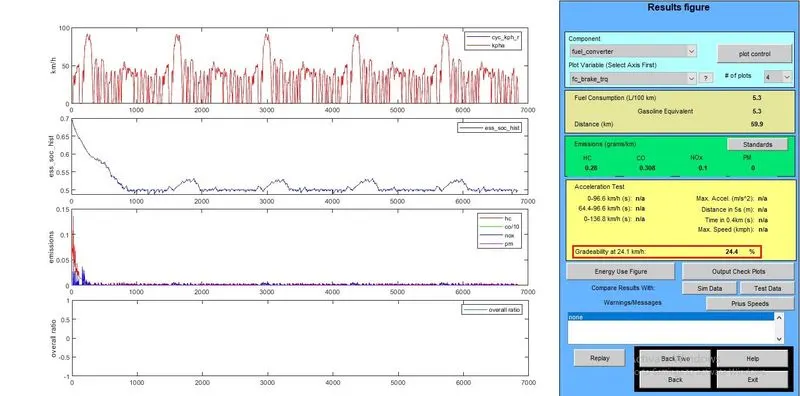
- Enter speed as 15 mph and run the simulation.
- As observed from the result bellow the gradeability at speed 15 mph is 24.2%
Case 4-
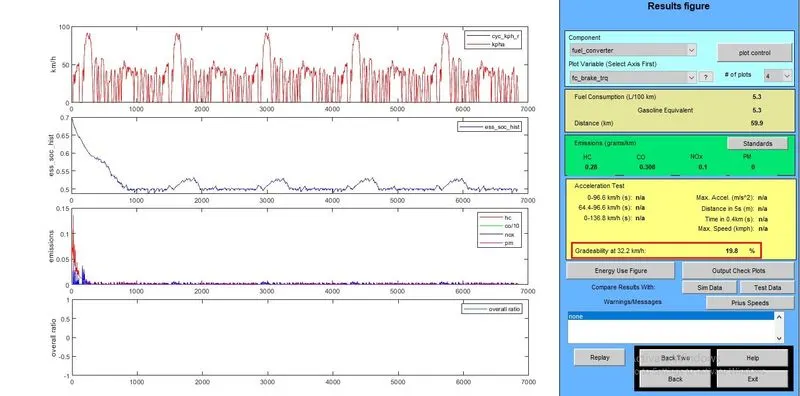
- Enter speed as 20 mph and run the simulation.
- As observed from the result bellow the gradeability at speed 20 mph is 19.8%
Case 5-
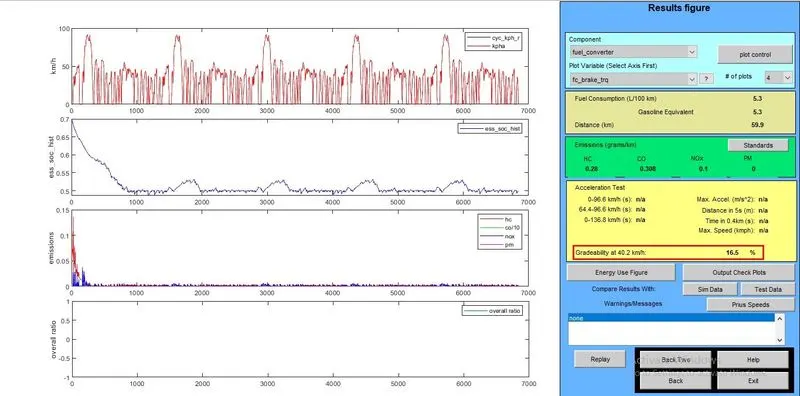
- Enter speed as 25 mph and run the simulation.
- As observed from the result bellow the gradeability at speed 25 mph is 16.5%
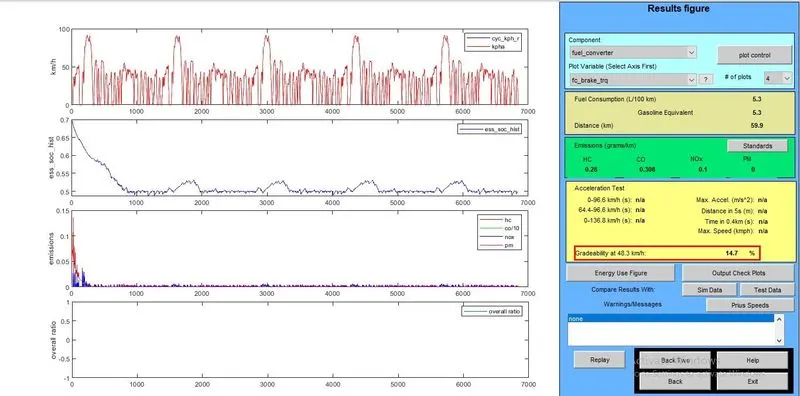
Case 6-
- Enter speed as 30 mph and run the simulation.
- As observed from the result bellow the gradeability at speed 30 mph is 14.7%
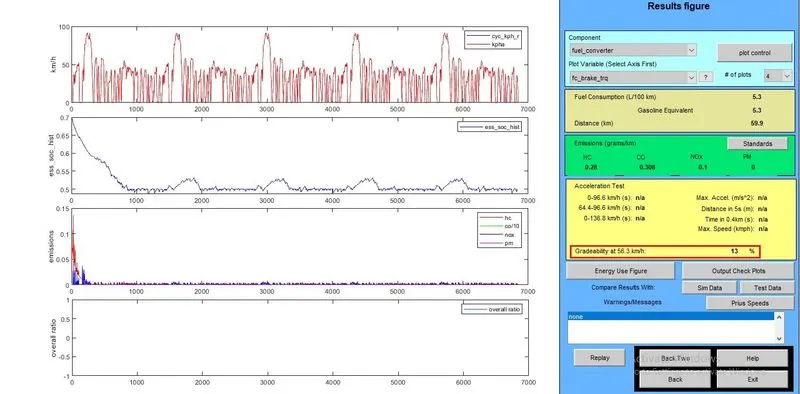
Case 7-
- Enter speed as 35 mph and run the simulation.
- As observed from the result bellow the gradeability at speed 35 mph is 13%
Result Table-
| Speed | Gradeability |
| 5 | 32.8 |
| 10 | 30.3 |
| 15 | 24.4 |
| 20 | 19.8 |
| 25 | 16.5 |
| 30 | 14.7 |
| 35 | 13 |
Observation-
As observed from the result table gradeability decreases as speed increases.