Week-6 Challenge: EV Drivetrain
Q1) Which types of power converter circuits are employed in electric and hybrid electric vehicle?
Following are the power converters used in EV and HEVs-
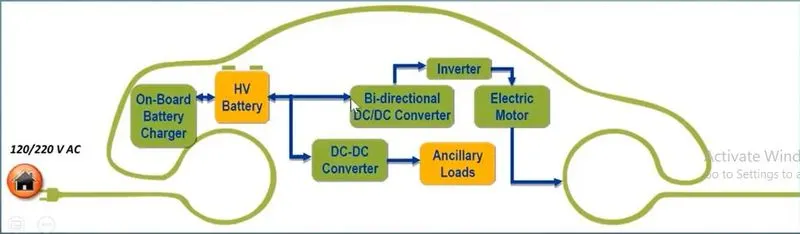
- On board battery charger (AC-DC)-
- On board battery charger are used to charged the vehicle battery.
- This are typically AC-DC power converters.
- AC power from the grid is converted into DC power and this power is stored in the battery.
- This are unidirectional type of power converters.
- Bidirectional DC-DC converter-
- The inverter draws DC power from the battery.
- But sometimes battery voltage and inverter input voltage can be different. Thus, a DC-DC converter is used between battery and the inverter to match the inverter voltage requirement.
- During regenerative braking motor acts as generator and generates AC power. This AC power is converted into DC and DC-DC bidirectional converter converts to match the battery voltage requirement.
- As this DC-DC converter is used for both charging and discharging of the battery, it is necessary to have a bidirectional converter.
- Inverter (DC-AC)-
- Inverter is nothing but a DC-AC converter.
- The motor requires AC power for its operation, but power stored in the battery is DC.
- Thus, an inverter is used to match the motor voltage requirements.
- DC-DC converter-
- There are various auxiliary equipment in the car which require DC power.
- The voltage requirement of these equipment are much less than the battery terminal voltage.
- Thus, DC-DC converter is used to meet the voltage requirement of these auxiliary equipments.
Q2) An Electric Vehicle's powertrain with 72V battery pack in shown in the diagram below. The duty ratio for acceleration operation is 'd1' and for the braking operation the duty ratio is 'd2'.
The other parameters of the electric vehicle is given below,
Motor and Controller Parameters:
Rated Armature voltage= 72 V
Rated armature current= 400 A
Ra= 0.5Ω, KΦ= 0.7 Volt second
Chopper Switching frequency= 400 Hz
The vehicle speed-torque characteristics are given by the below equation
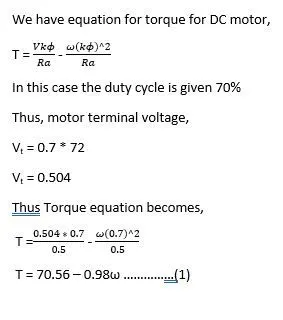
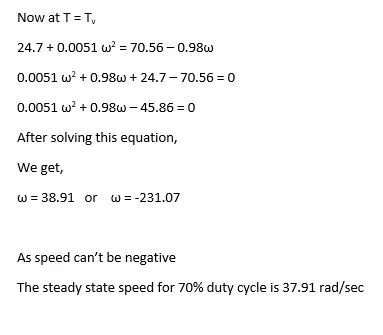
What is EV steady state speed if duty cycle is 70%?
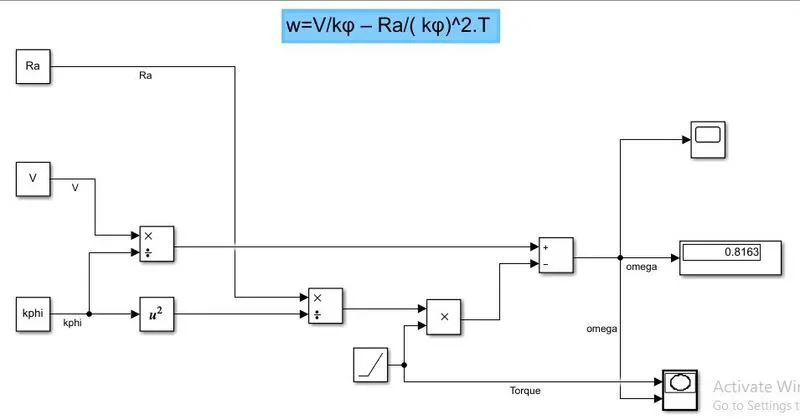
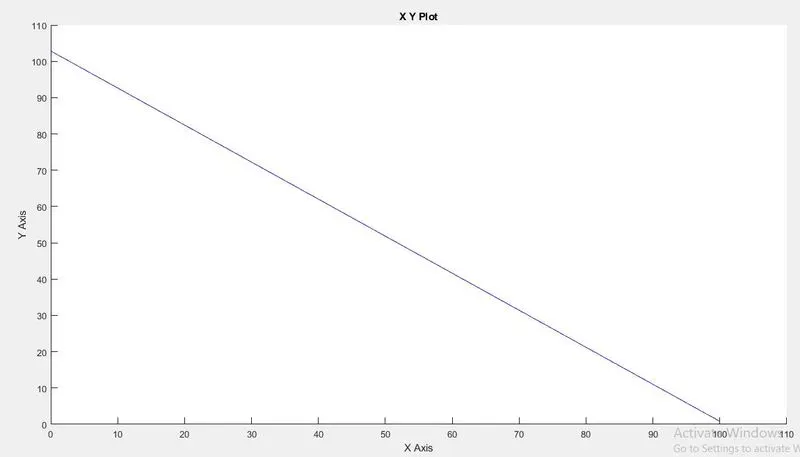
Q3)Develop a mathematical model of a DC Motor for the below equation using Simulink.
ω">ωω= V/Kϕ">ϕϕ -Ra/Kϕ">ϕϕ^2 .T
Q4) Refer to the blog on below topic:
Induction Versus DC brushless motors by Wally Rippel, Tesla
Explain in brief about author’s perspective.
- There are many different configurations of IC engines. There is no specific best configuration. Different configuration suits different applications. This is the same case for electric vehicle drives.
- In earlier times there were lead acid batteries, DC brushed motors and contactor controllers. But with development in technology these were replaced by lithium batteries, DC brushless and modulating inverters respectively. There is a chance that these will also become obsolete and will be replaced by more advanced technology.
- In brushless motors there are two or more permanent magnets on rotor and stator has windings. These two interact to produced rotational motion. Inverter provides necessary current control which is required for rotational motion.
- The stator of the 3 phase induction motor and brushless motor are both same. The difference is in stator. The stator of the induction motor is made of stacked steel laminations with buried peripheral conductors that form shorted structure.
- 3 phase induction motor is directly connected to the 3 phase utility supply. This is the reason behind its success. But for a brushless DC motor a inverter in required to give the supply.
- Induction motor has ability start under load condition. In contrast, a brushless DC motor produces no starting torque when directly connected to fixed frequency utility power.
- There are some limitations of 3 phase induction motor. Shaft speed is proportional to line frequency. Hence when used with utility supply I is a constant speed Also it has limitations on starting torque and peak torque compared to DC motor.
- It is possible to power an induction motor with a DC source by using inverter. If frequency of the inverter is varied then speed of the motor also can be control.
- Today, all the hybrids are powered by DC brushless drives, with no exceptions.
- One of the main differences is that much less rotor heat is generated with the DC brushless drive. Rotor cooling is easier and peak point efficiency is generally higher for this drive. The DC brushless drive can also operate at unity power factor, whereas the best power factor for the induction drive is about 85 percent. This means that the peak point energy efficiency for a DC brushless drive will typically be a few percentage points higher than for an induction drive.
- In brushless motors, when maximum torque is required, especially at low speeds, the magnetic field strength (B) should be maximum – so that inverter and motor currents are maintained at their lowest possible values. This minimizes the I²R When torque levels are low, the B field should be reduced such that eddy and hysteresis losses due to B are also reduced. Ideally, B should be adjusted such that the sum of the eddy, hysteresis, and I² losses is minimized.
- For induction motors magnetic flux density depends on V/f. For light loads inverter can reduced the voltage to minimised the magnetic losses and improved the efficiency. During high performance also B can be maintained low to minimised the losses. For DC brushless motor magnetic losses increases with increase in the size of the motor. But with induction motors magnetic losses does not increases with size. This is the advantage of induction motor over brushless DC motor. The peak efficiency of the induction motors is less than the DC brushless motor, But the overall average efficiency is much better than the brushless DC motor.
- Permanent magnets are costly and these rotors are difficult to control. Thus induction motors have cost advantage over DC brushless motors. Also due to field weakening capabilities of induction motor the rating and cost of inverter is less.
- The control of induction motors is difficult. The control strategies are more complex and difficult to understand. Achieving stability over speed torque curve is more difficult. This means that added cost in development.
- It can be concluded that DC brushless drives will continue to dominate the Hybrid electric vehicles and induction drives will dominate the pure electric vehicles.