Week 11 - Louver/Grille characterization
Aim: To do a parametric study for the given Hexa Grille for various Reynolds numbers and determine the loss coefficient for the grille.
Introduction to grille
A grille is a vent cover through which air is blown into or out of a room for circulation back to the central heating or cooling unit.
Difference between Louver and grille
Louvres, or dampers, are often attached to the back of a heat register. These adjustable louvers/dampers can open or close the register to open and close the flow of air as shown in Fig. (a)
A grille has no damper to control air flow, so air is left to flow freely. Grilles do not have the damper normally found on registers as shown in Fig. (b).
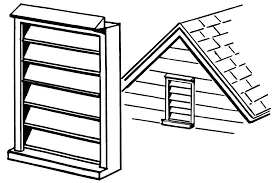 Fig. (a) Louver used in a house
Fig (b) Grille used in Car
Procedure:
Step 1: Create a cabinet of length cabinet that is 160 mm in length with inlet and outlet openings at the two ends (with cross sectional area of 7.363 mm x 12.7 mm)
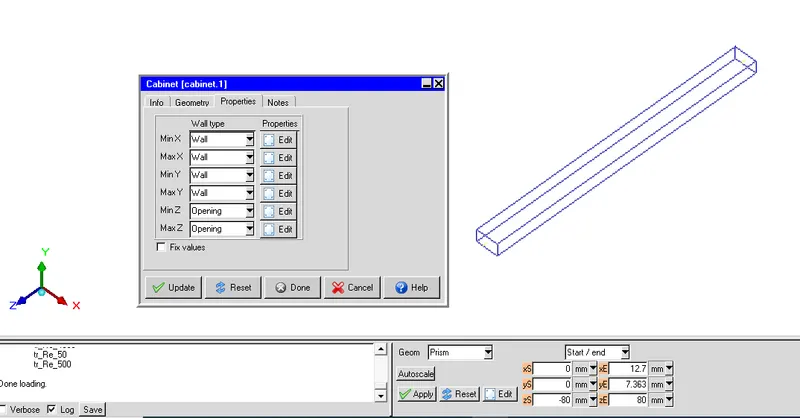
The min X, max X, min Y and max Y are given symmetry boundary conditions.
For the velocity in min Z direction, an equation is given with $ symbol to show that its a variable and the equation for velocity in terms of Reynolds number is specified.
i.e., Z velocity = $Re*ν/L
where ν – kinematic viscosity, = 1.84e-5 m2/s for air
L is the characteristic dimension and is calculated by the hydraulic diameter.

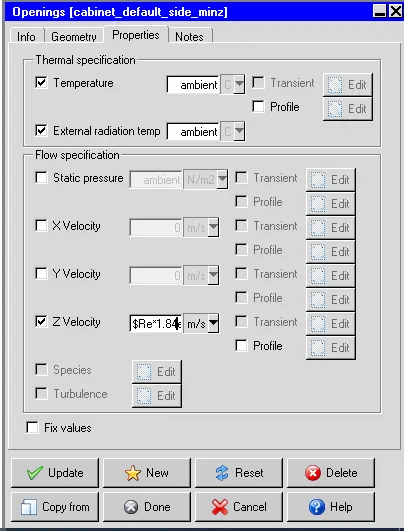
Specify the initial value of 10 for Re.
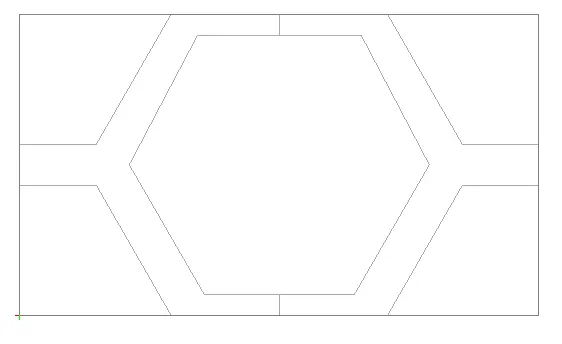
Step 2: Create a Hexa grille with the polygon option using the folowing coordinates
|
Vertex |
X |
Y |
Z |
|
1 |
6.35 |
0.5065 |
0 |
|
2 |
6.35 |
0 |
0 |
|
3 |
3.7 |
0 |
0 |
|
4 |
1.875 |
3.1735 |
0 |
|
5 |
0 |
3.1735 |
0 |
|
6 |
0 |
4.1895 |
0 |
|
7 |
1.875 |
1.4895 |
0 |
|
8 |
3.7 |
7.363 |
0 |
|
9 |
6.35 |
7.363 |
0 |
|
10 |
6.35 |
6.8565 |
0 |
|
11 |
4.35 |
6.8565 |
0 |
|
12 |
2.6778 |
3.6815 |
0 |
|
13 |
4.5138 |
0.5065 |
0 |
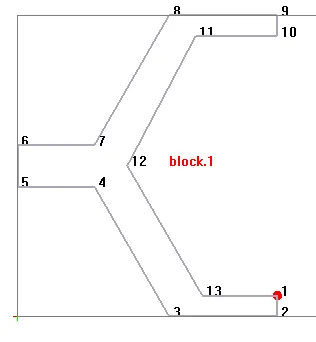
Create a mirror of the block about high end to complete the hexa grille as shown below
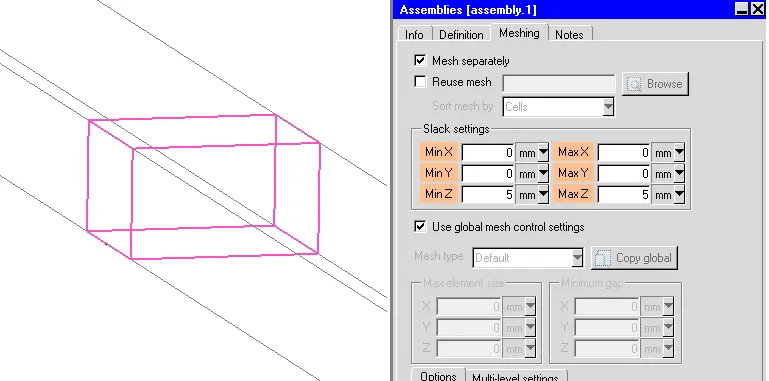
Create an assembly containing grille and specify 5 mm slack in Z - direction
Step 3: Mesh Generation
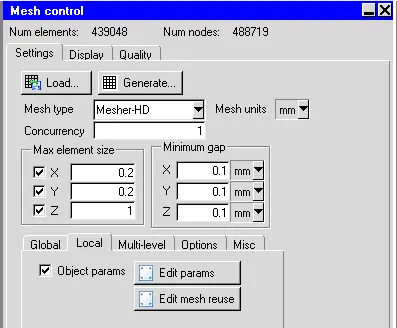
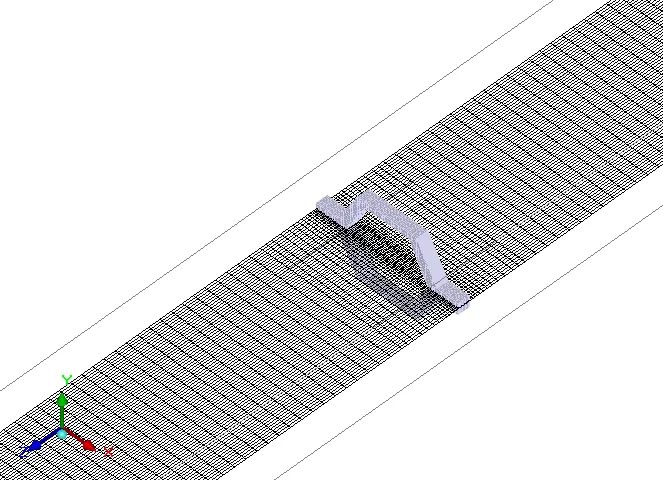
By setting up the object parameters for the grille, and max elements size in X, Y and Z directions, a mesh is generated consisting of approximately 0.4 million elements in the domain.
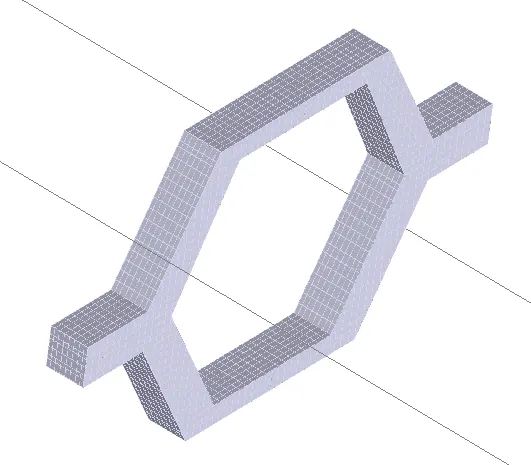
The volume filled mesh in the block is shown below.
Also, cut plane mesh in Y direction is shown below.
Step 4: Define reports
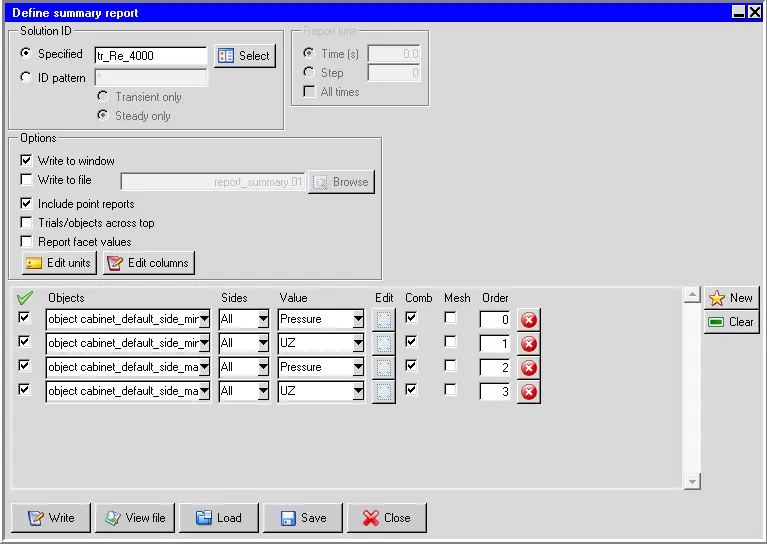
Under Reports menu, open summary report to define summary report.
Now, the reports for the pressure and velocities (UZ) at the min Z and max Z is created.
Step 4: Defining the trial in Parameters and Optimization
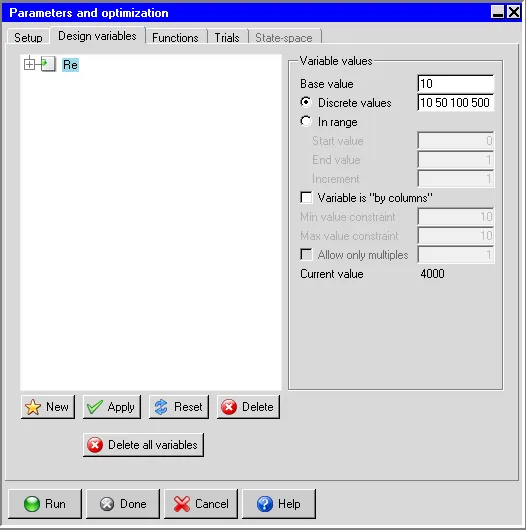
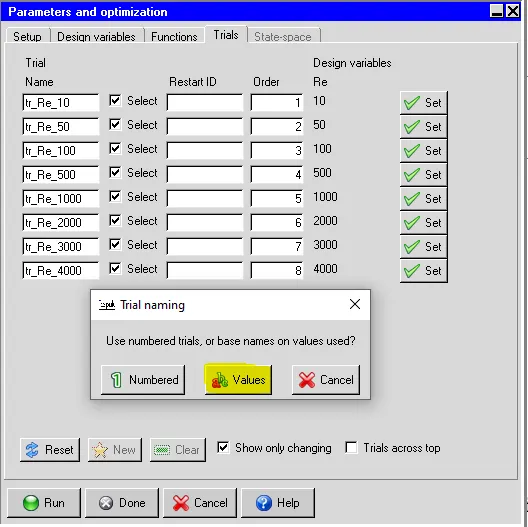
Under setup option, defining the parametric trials by all combinations and discrete values of 10,50,100,500,1000,2000,3000 and 4000 is specified with the base value of 10
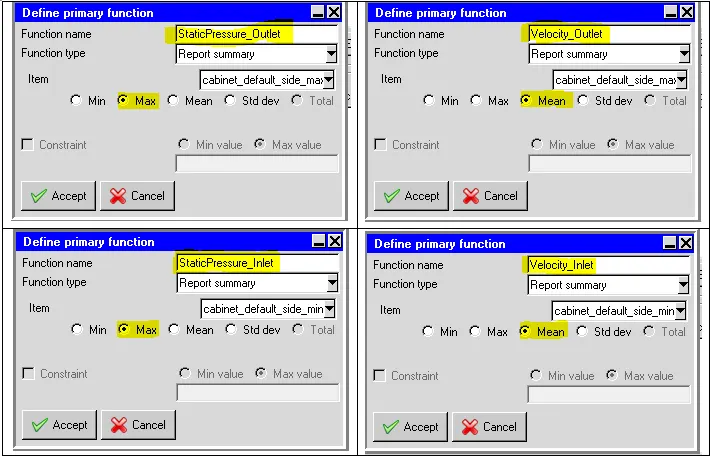
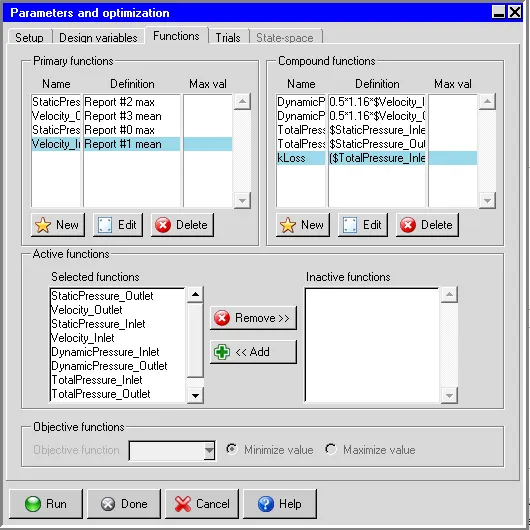
Under functions tab, the primary functions and compound functions are defined.
For primary functions, the static pressure and velocity at the min Z and max Z locations are defined with the help of report summary as shown below
Similarly, compound functions such as Dynamic pressure and total pressure at inlet and outlet and the loss coefficient are defined interms of primary functions as shown below
Dynamic pressure is calculated as 0.5*ρ*$Uz*$Uz
where ρ is the density of air = 1.16 kg/m3
The values of Uz are chosen for inlet and outlet to calculate the corresponding values of dynamic pressures at inlet and outlet respectively.
similarly, total pressure is calculated as the sum of staticpressure and dynamic pressure at inlet and outlet.
Finally, the loss coefficient (Kloss) is calculated as 
The trials are chosen based on the values and is run for the simulation.
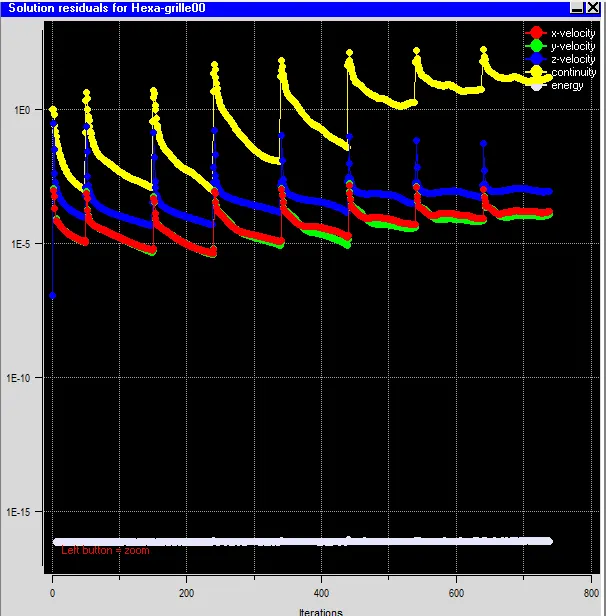
The solution is run for the trials and the problem is solved. The covergence plot is shown below.
The summary report is shown below
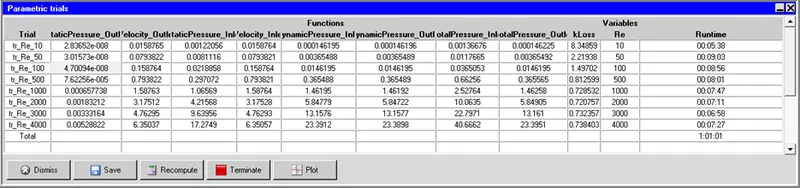
Based on the results obtained, a result is plotted for Kloss vs Re as shown below.
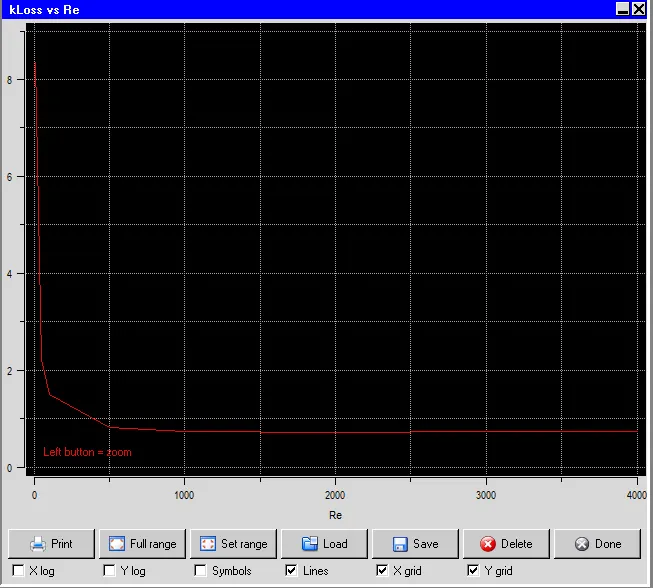
It is seen from the plot that the value of loss coefficient is high for Low Re and decreases with increasing Re. For the given hexa grille, the value remains nearly constant when Re >= 500.
Conclusion:
In this challenge, we have seen how to use parameterization feature to calculate the loss coefficient of a grille for various values of Reynolds number. Also, we learnt about the defining the primary and compound functions to calculate the loss coefficient.