Underbody Coating
Underbody Coating:
- In Indian road conditions, a cars underbody is affected by corrosion and also wear and tear caused by muddy water, bad roads, stones and other obstacles on the road
- To prevent this underbody coating provides long term protection from corrosion to car’s underbody.
- It also helps to protect parts like internal body panels, frame rails and other inner cavities that are not accessible but are prone to corrosion.
Benefits:
- Heat insulation: It insulates the interior area of the car from extreme temperatures from beneath the vehicle providing a comfortable cabin experience.
- Minimizes Sound: It minimizes the sound from underneath the car resulting a noiseless, smooth driving experience.
- Anti-chipping property: If any stone hits the coating it does not get chipped away hence protects the underbody coating from exposure to water.
- Increased Vehicle’s life: Good underbody coating not only protects the underbody from corrosion but also protects the engine and transmission as well
Types of undercoating:
Rubberized Underbody Coating: This type of undercoating is considered as the best underbody coating for the car.
Wax based Underbody Coating: This type of ephemeral undercoating will wear away in a few months’ time. The benefit of this coating is it provides protection against moisture, and it is affordable too.
Asphalt based Automotive Underbody Coating: It is best suited for trucks and large vehicles and this provides a greater degree of protection as compared to rubber-based coating. This type of coating contains little amount of rubber for sound-insulation purposes. The process of this undercoating is more time consuming.
Process of Underbody Coating:
1) Pretreatment:
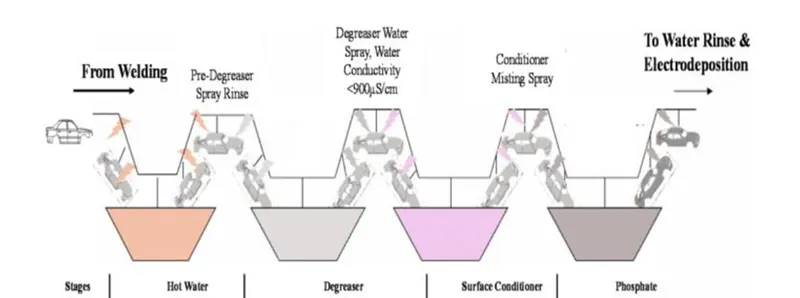
Fig.1 Precoating process
- The first sequence in preparing the BIW for coating is pretreatment.
- Pretreatment removes and clean excess metal and forms an appropriate surface structure enabling bonding of a corrosion protection layer.
- It consists of cleaning the body surface to remove remaining oils from the staming and welding residues through three primary liquid dip processes of degreasing, conditioning and phosphating.
- Benefits: Pretreatment helps the primer to bond onto the metal
2) Electrodeposition:
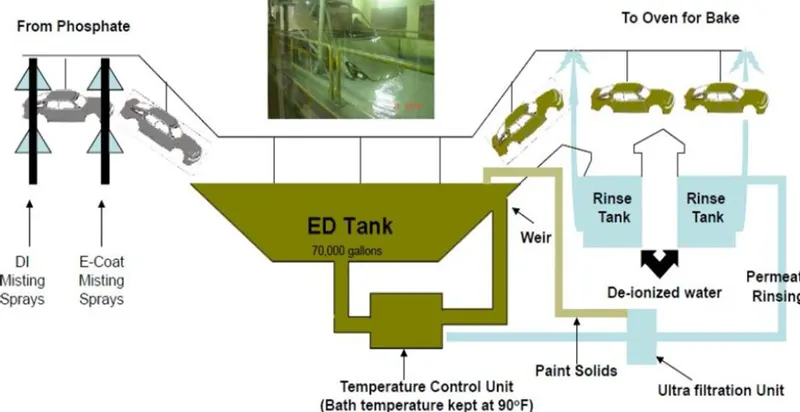
Fig.2 Electrodeposition process
- Electrodeposition process involves dipping the vehicle bodies into the coating solution and passing an electric current through the body and the liquid ED paint solution.
- Because of the charged nature of this coating process, the ED paint penetrates into places where a spray method cannot reach.
3) Rust-Proof Materials: Sealer/PVC
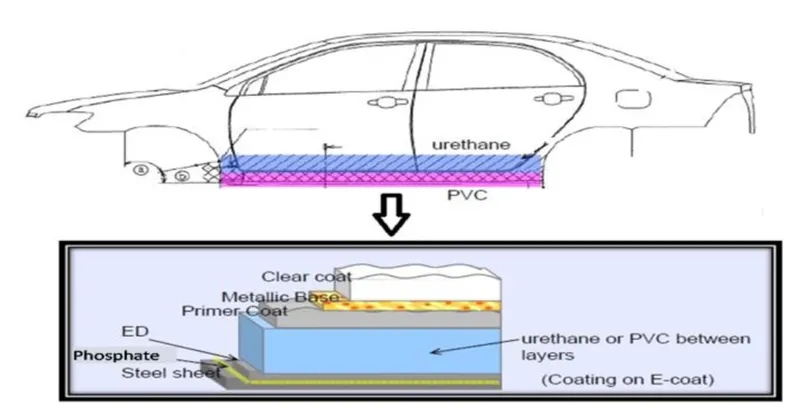
Fig. 3 The underbody coating
- The third step is underbody coating and seam sealing using PVC.
- The above fig. indicates the lower door sections and rocker panel locations where PVC or urethanes are applied as an anti-chipping protection.
4) Primer:
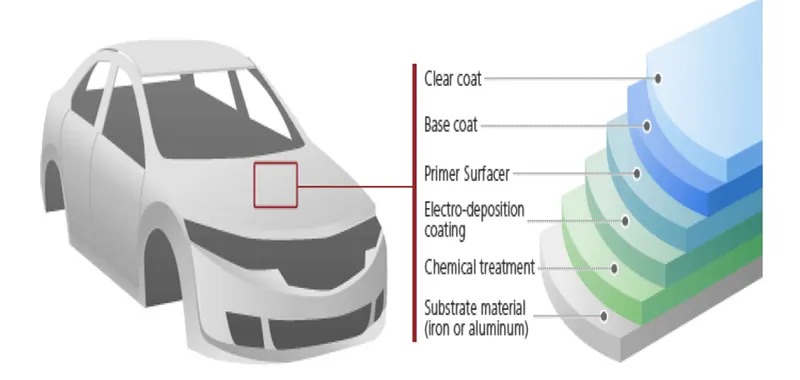
Fig. 4 Primer coating
The fourth coating step is the primer. It can be water-borne, solvent-borne, or a powder.
The primer smoothes minor imperfections and scratches that may be created during the previous steps.
5) Topcoat:
This process involves two steps:
Basecoat: It contains the primary coloring pigments. The basecoat is third layer added to the car after the primer.
Clearcoat: The final coating on vehicle’s surface is the clearcoat. It provides durability, environmental protection, and resistance to scratch to the overall coating. It also protects from UV damage from the sun.