Section Modulus calculation and optimization
AIM:
To find the section modulus of the previously designed hood and to optimize it to increase the hood strength.
SECTION MODULUS:
It is a geometric property used to calculate the bending stress in a structural member. It has great use in structural analysis and design.
Mathematically, it is defined as the ratio of moment of inertia of a section about its centroidal axis and the distance of the extreme layer from the neutral axis.
It is denoted by Z,
S=I/ymax
There are two types of section modulus:
(1) Elastic Section Modulus-
For general design, the elastic section modulus is used, applicable up to the yield point for most metals and other common materials.
Generally, elastic section modulus is denoted by S.
S=I/ymax
(2) Plastic Section Modulus-
The plastic section modulus is used for materials where elastic yielding is acceptable and plastic behaviour is assumed to be an acceptable limit. Designs generally strive to ultimately remain below the plastic limit to avoid permanent deformations, often comparing the plastic capacity against amplified forces or stresses.
Significance of Section Modulus:
(1) Section modulus is an important factor for designing beams and flexural members.
(2) Easier to calculate strength and stresses in beams.
(3) Higher the section modulus, higher will be the resistance to bending.
From Bending Equation,
σ/y=M/I=E/R
where,
σ is bending stress produced in a beam at a distance y from the neutral axis.
M is the bending moment
I is the moment of inertia
E is the modulus of Elasticity
R is the radius of Curvature.
From section modulus,
σ=M/I/ymax=M/Z
From the above equation, it can be inferred that the higher the section modulus lesser will be the bending stress produced in the beam, greater will be its load-bearing capacity.
CALCULATION:
Case 1 – Before optimization
The Hood created already was imported and section inertia analysis was done.
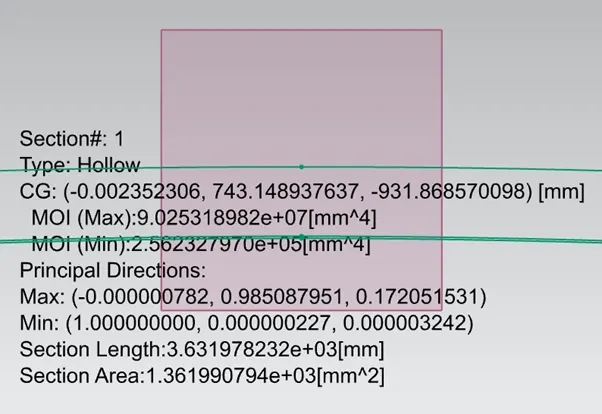
I (MAX) =9.025318982 e+07 (mm^4), I (MIN) = 2.562327970 e+05 (mm^4)
As per the section modulus equation,
S = I/Y
I = MOI (min) Value is considered
Y = Total distance / 2, Total distance =876.3181 mm
Y =876.3181/ 2
= 438.1595 mm
Therefore, Z = 2.562327970 e+07 (mm^4) / 438.1595 (mm)
Z = 584.7934 mm^3
Case 2- After optimization
The hood inner panel’s curve is offsetted by 0.5mm and section inertia analysis is done same as case 1.
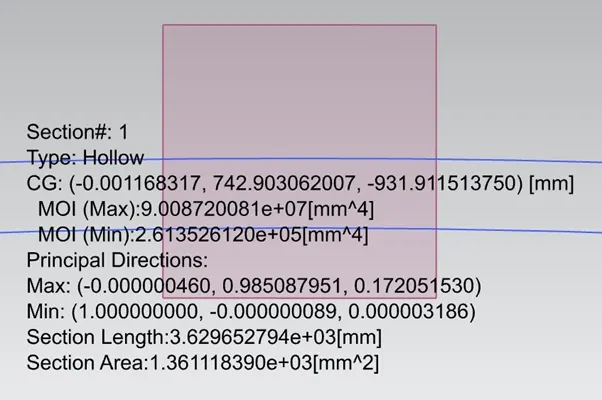
I (MAX) =9.00872008 e+07 (mm^4), I (MIN) = 2.613526120 e+05 (mm^4)
As per the section modulus equation,
S = I/Y
I = MOI (min) Value is considered
Y = Total distance / 2, Total distance =876.3181 mm
Y =876.3181/ 2
= 438.1595 mm
Therefore, Z = 2.613526120 e+05 (mm^4) / 438.1595 (mm)
Z = 596.4782 mm^3
CONCLUSION:
From the calculation, it can be concluded that with the increase in the sectional area i.e., 0.5 mm, the section modulus increases hence the resistance to bending stress increases which results in a stronger hood design.