Section Modulus calculation and optimization
QUESTION :
Use the Section from your Hood design and calculate the Section Modulus using the formula
S = I/y
Objective :
Detail report about the Section Modulus , Moment of inertia, relation between the Modulus of inertia and section modulus and explain that with the profile of section with the Hood design.
Section Modulus:
The section modulus is a measure of a beam's ability to resist bending stress. A beam with a higher section modulus will be able to withstand greater bending stress without failing. The section modulus is also used in the design of structural members, such as beams and columns.
- The section modulus is defined as the ratio of the moment of inertia to the distance from the neutral axis to the outermost edge of the section.
- Section modulus is a geometric property of structural member.
- Section modulus is used to calculate the bending stresses in a structural member.
- Section modulus is a direct measure of a strength of any cross sectional area of an object about a neutral axis.
- Section modulus depends only on the cross-section shape or cross-section area of the structure.
- Section modulus can be said that the greater the dimensions of a cross-section under a given load, the greater the Section modulus and the smaller the bending stress.
The section modulus is denoted by the symbol 'Z' and has units of length cubed (e.g., mm^3, in^3).
Mathematically, the section modulus can be expressed as: Z = I / y
I - The moment of inertia of the cross-section about the neutral axis
y - The distance from the neutral axis to the outermost fiber of the cross-section.
The neutral axis is the axis that passes through the centroid of the cross-section, which is the point where the area of the cross-section is evenly distributed.
Moment of Inertia:
The moment of inertia is a measure of a beam's resistance to bending and twisting. It is defined as the sum of the products of the area of each element in the section and the square of its distance from the neutral axis.
- The moment of inertia is a fundamental property of a beam and is used to calculate the section modulus.
- It is also used to measure as well as other properties such as the radius of gyration and the torsional constant.
- A beam with a higher moment of inertia will be more resistant to bending and twisting stresses.
The formula for calculating the moment of inertia is I = ∫y²dA,
where y is the distance from the neutral axis and dA is the area of the element.
Relation between Section Modulus and Moment of Inertia:
Example :
A person need to cross the canal there is rectangular Wooden Plank is arranged between the ends of canal. As the wooden plank is in the rectangular cross-section it can used in eaither Horizantal position or Vertical Position.
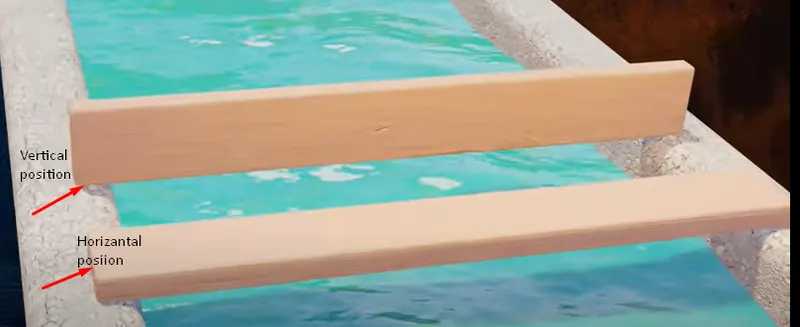
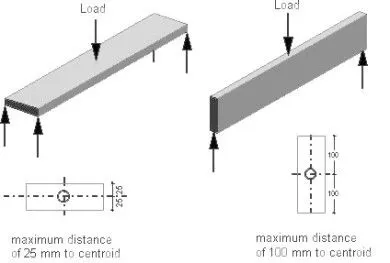
Which is the best way to cross the canal without falling into it?
Let us find the moment of inertia in the both cross-section areas
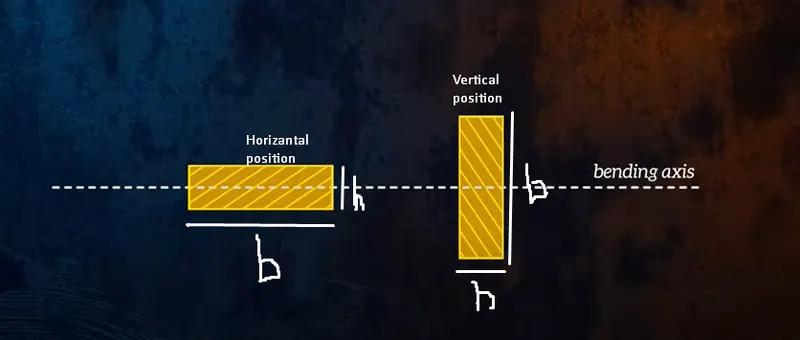
Finding Section modulus in both positions.
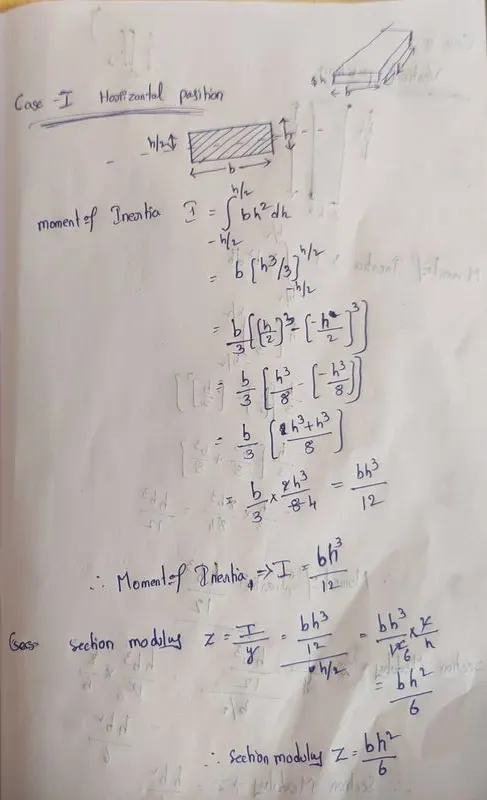
in Horizantal position I = bh3/12
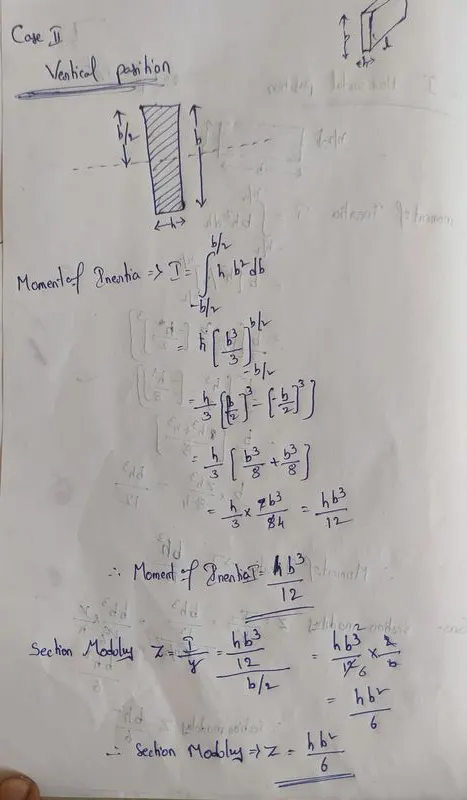
in Vertical position I = hb3/12
we know that b>h ( Breadth is greater than the Height of the wooden plank)
so the Moment of Inertia of Wooden plank in the Vertical position is high than the Moment of Inertia of Horizantal Position.
So the Vertical position Wooden plank has more stiffness than the Horizantally placed wooden plank.

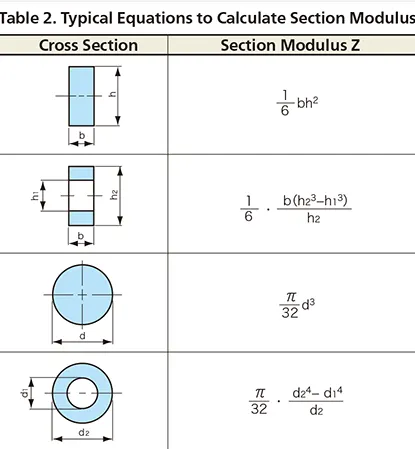
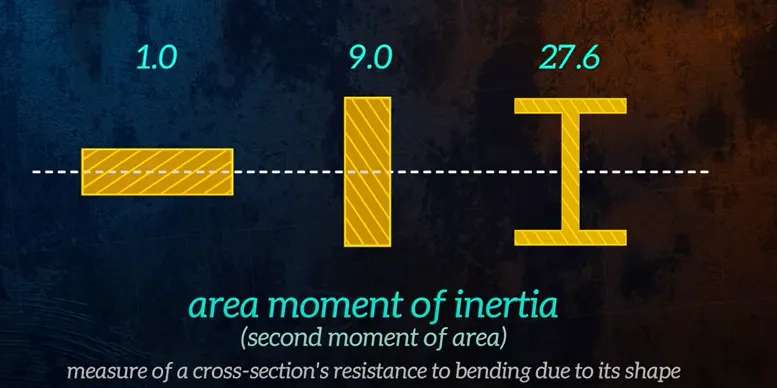
The cross-section area that is passing through the neutral axis is less then the Moment of Inertia will be the more . So that I section beams are used commonly in the structures and beams to have the Maximum Moment of Inertia. Here is a small comparison of different cross section of beams with values of it
The relation between Moment of Inertia and Section Modulus is find by Bending Equation
Bending Theory:
Bending theory is also known as flexure theory is defined as the axial deformation of the beam due to external load that is applied perpendicularly to a longitudinal axis.
The Bending Equation is M / I = σ b/y = E / R ,
where M - Moment
I - Moment of Inertia at the neutral axis
σ b - Bending Stress
y - Distance from neutral axis to the outermost cross-section.
E - Young's Modulus
R - Radius of curvature
By simplifying the equation M/σ b = I/y
Section Modulus is writen as Z = M/σ b
so Z = I/y , Section Modulus is directly proportional to Moment of Inertia Z ∝ I.
Momentt of Inertia is dependent on the Cross-sectional area
If the cross-sectional area increases then the Moment of Inertia increases, as the Section Modulus is directly propertional to moment of Inertia then it is also increases . The higher the value of Section modulus is the more rigid the component or design that is created.
Project:
How the cross-sectional area varies the Moment of Inertia and Section Modulus of the Hood Design in NX-Cad.
Aim:
To prove that increase in Area of Cross-section with the same neutral axis will increase the Moment of Inertia that also increases Section Modulus.
Procedure:
- Open the Hood Assembly design in the NX-Cad .
- Work in the Assembly Workbench and make a 2D sketch in the selected axis.
- Take a Intersection curve along the Hood in appropriate axis, let us consider the section in X-Axis at the center of it.
- Edit the sketch that connect the all the curves of the Intersection Curves to get the closed profile , so that we can have the Cross-sectional area of it
- Perform the Section Inertia Analysis on the the closed curve sketch done already.
- Note the all the values in the Analysis report mainly Imax and Imin in mm^4.
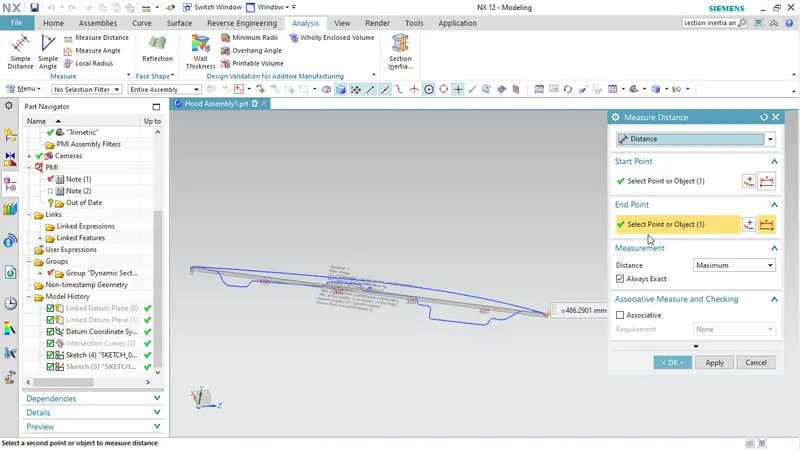
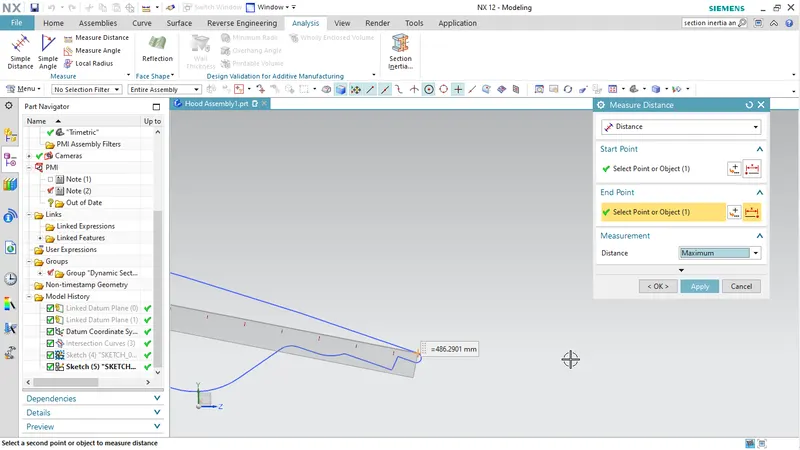
- Caliculate the maximum length from end to end of the Sketch and devide it by 2 to get the neutral axis and the distance is noted as 'y' in mm.
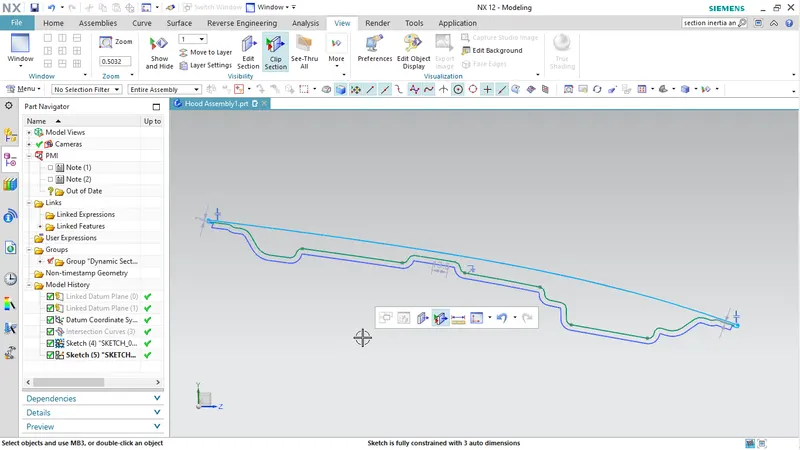
- Now create anothe sketch with same intersection curve , but offset the bottom curve by the 5 mm down direction to increase the Cross-sectional area of it.
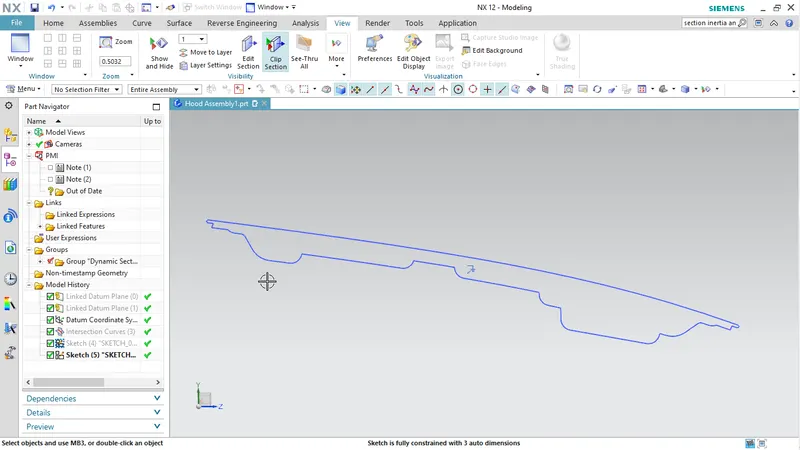
- Now connect the all the curves to get the closed profile on the offseted curves.
- Perform the Section Inertia Analysis on the Offsetted curve and note down the all the values of it.
- Perform the Necessary caliculation that is to find the Section Modulus with help of Moment of Inertia and Neautral Axis distance and the formula is Z=I/y.
- We need to consider mainly the minimum value of Moment of Inertia so that it the least case of scenario and beyod that is the failure is occured.
- Write down the Analysis report based on the caliculations done
- Conclude the observations and prove the Aim of project.
Caliculation:
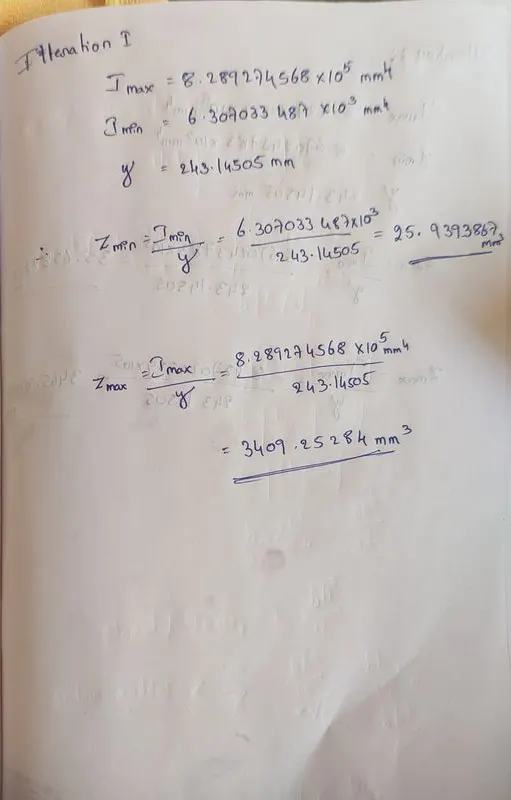
Itteratation-1
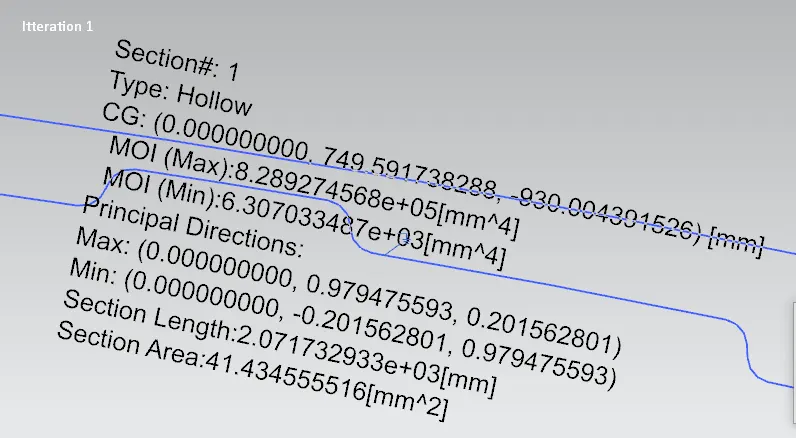
Cross-sectional area A= 41.434555516 mm^2
Moment of Inertia maximum MOI(max) : I(max) = 8.289274568 e+05 mm^4
Moment of Inertia maximum MOI(min) : I(min) = 6.307033487 e+03 mm^4
Distance from the neautral axis is y = 486.2901/2 = 243.14505 mm
Section Modulus is
Minimum Section Modulus Z(min) = I(min)/y = 25.9393867mm^3
Maximum section Modulus Z(max) = I(max)/y =3409.25284mm^3
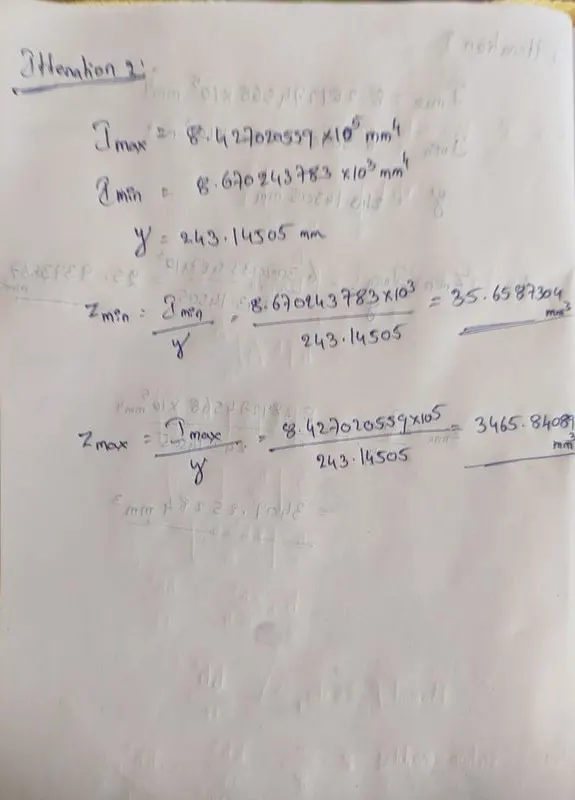
Itteration 2
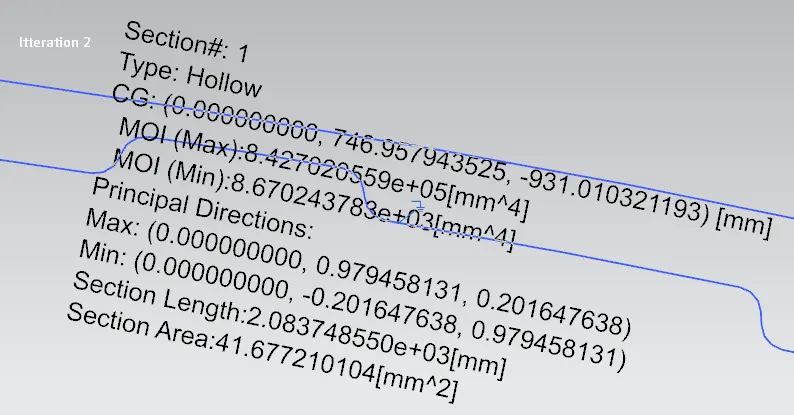
Cross-sectional area A= 41.677210104 mm^2
Moment of Inertia maximum MOI(max) : I(max) = 8.427020559 e+05 mm^4
Moment of Inertia maximum MOI(min) : I(min) = 8.670243783 e+03 mm^4
Distance from the neautral axis is y = 486.2901/2 = 243.14505 mm
Section Modulus is
Minimum Section Modulus Z(min) = I(min)/y = 35.6587304mm^3
Maximum section Modulus Z(max) = I(max)/y =3465.84089mm^3
Conclusion:
As the area of cross-section is increased by the offseting the curve 5mm towords the down side then the moment of inertia is increased and the Section Modulus is increased . so the modified design with the higher cross sectional areawill have the higher Section Modulus . It it has the higher section modulus then the strength is high and the component or part or design will be more rigid.
Hood Outer and Inner design
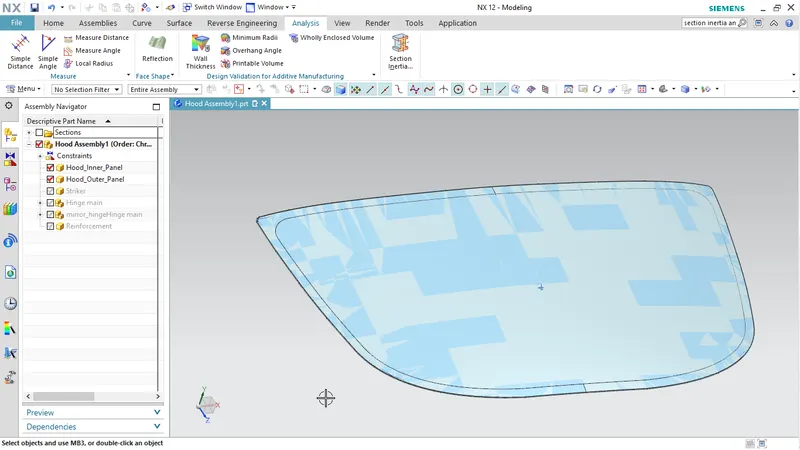
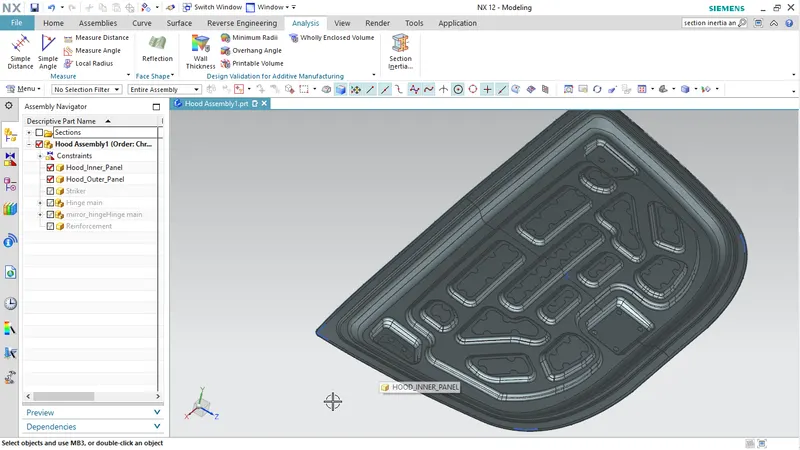
Intersection of curves of Outer and Inner Pannels
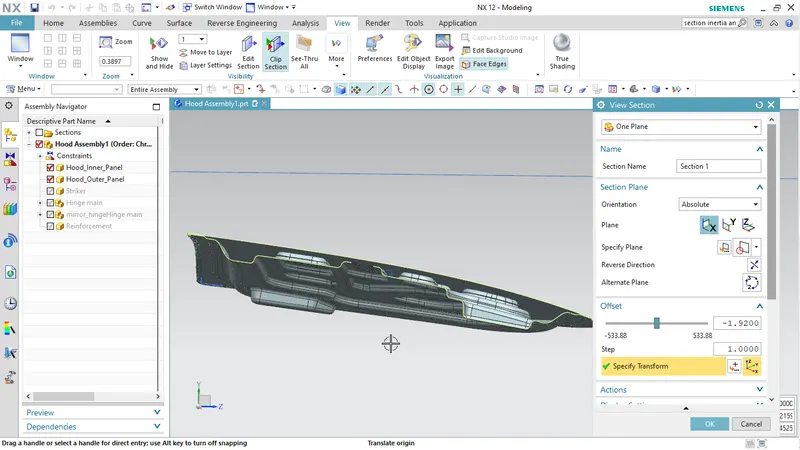
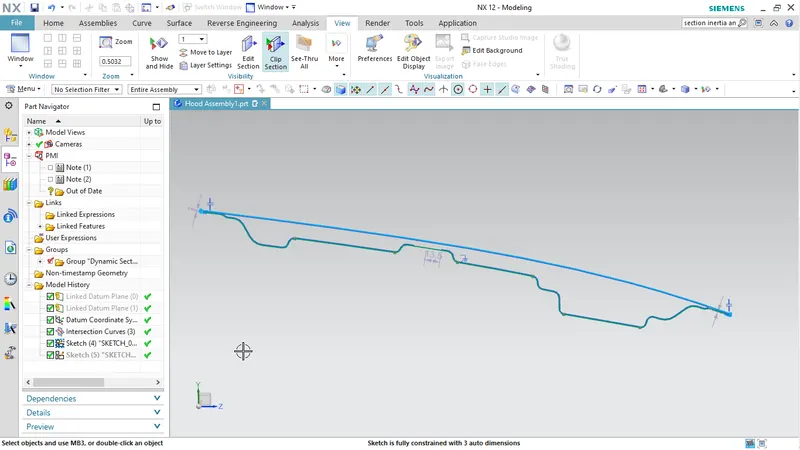
Curve 1 closed profile
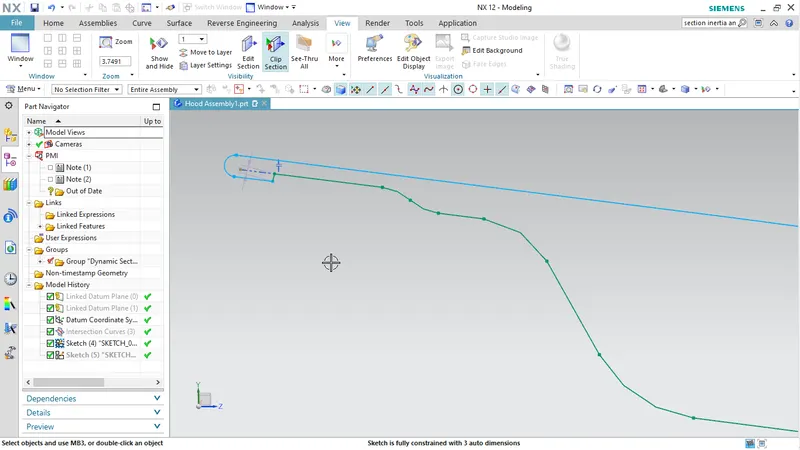
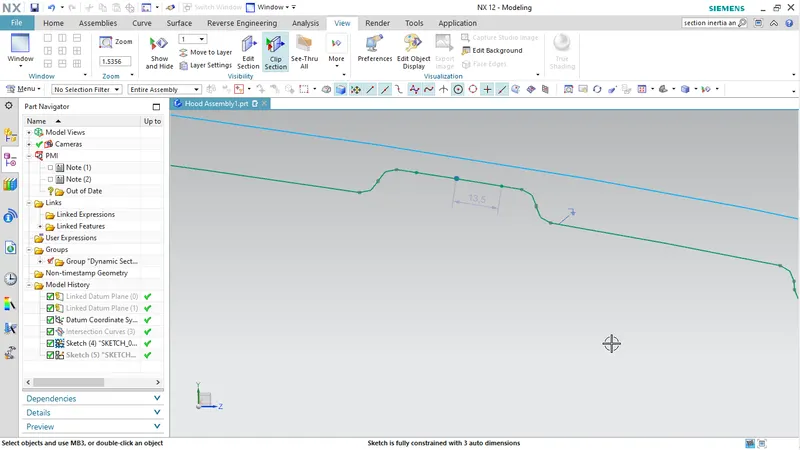
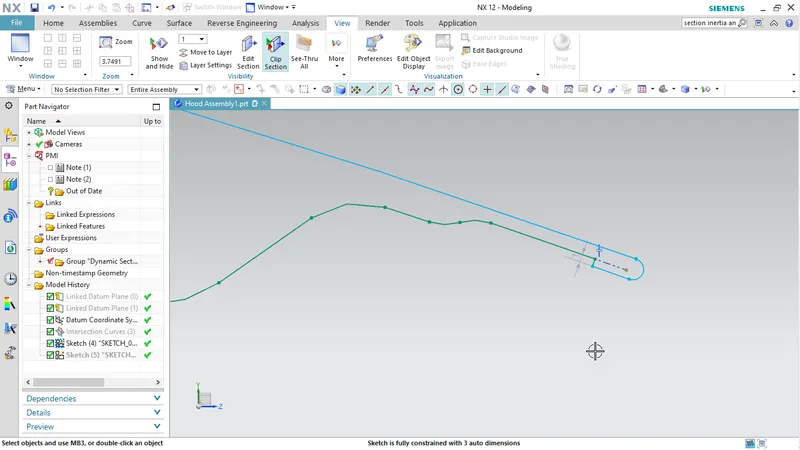
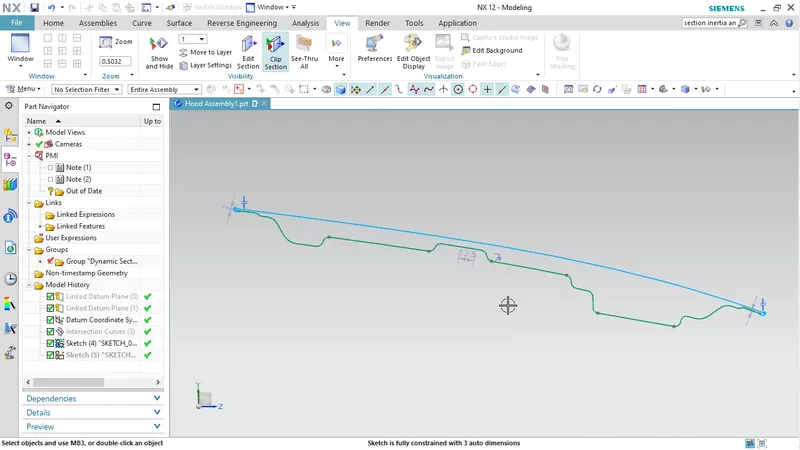
Itteretion 1 at curve 1
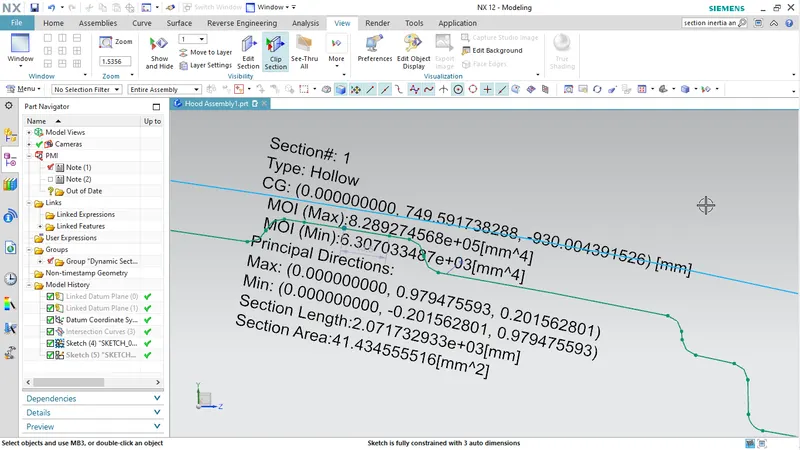
End to End maximum distance
Offset the bottom curve by the 5mm down wards
Sketch 2 offset curve closed profile sketch
Ittration 2 for offset curve increased cross-sectional area
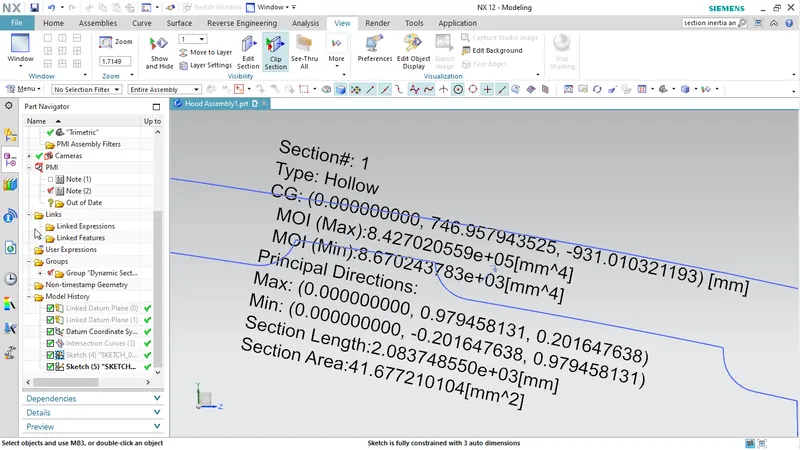
Comparrision between actual curve and modified or offset curve.