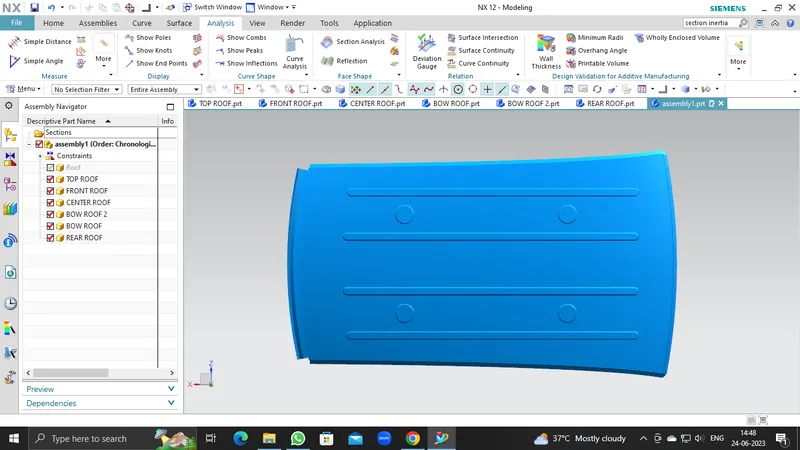
Roof Design
OBJECTIVE:
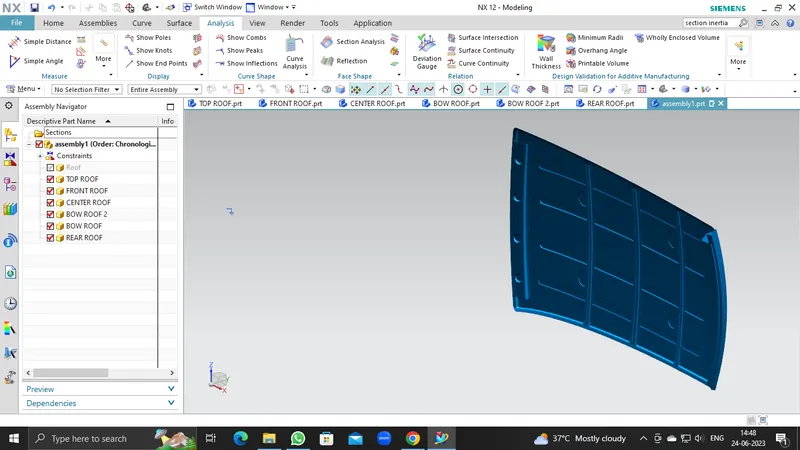
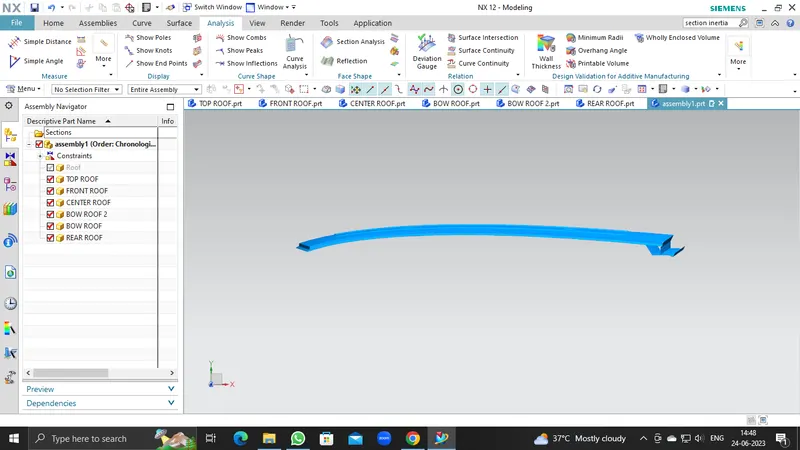
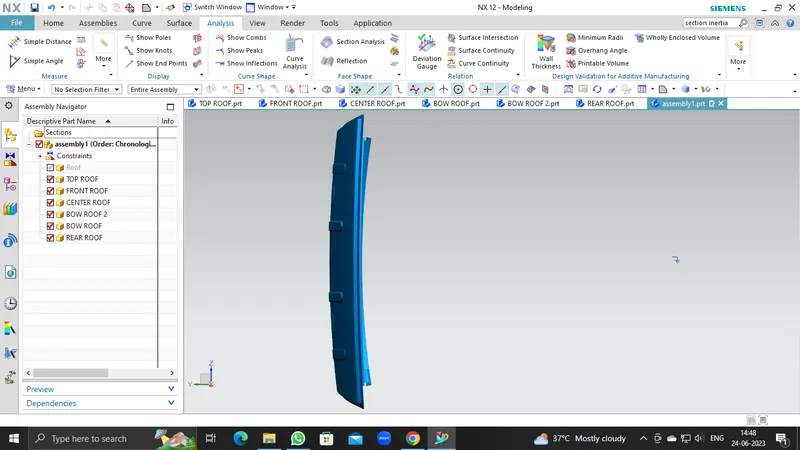
Design and develop the essential flanges and reinforcement such as Front Roof Rail, Rear Roof Rail and Bow roof from given aesthetic surface. And do the curvature study and calculate Heat Distortion and snow load creation to determine and justify the position of Bow roof.
INTRODUCTION:
ROOF:
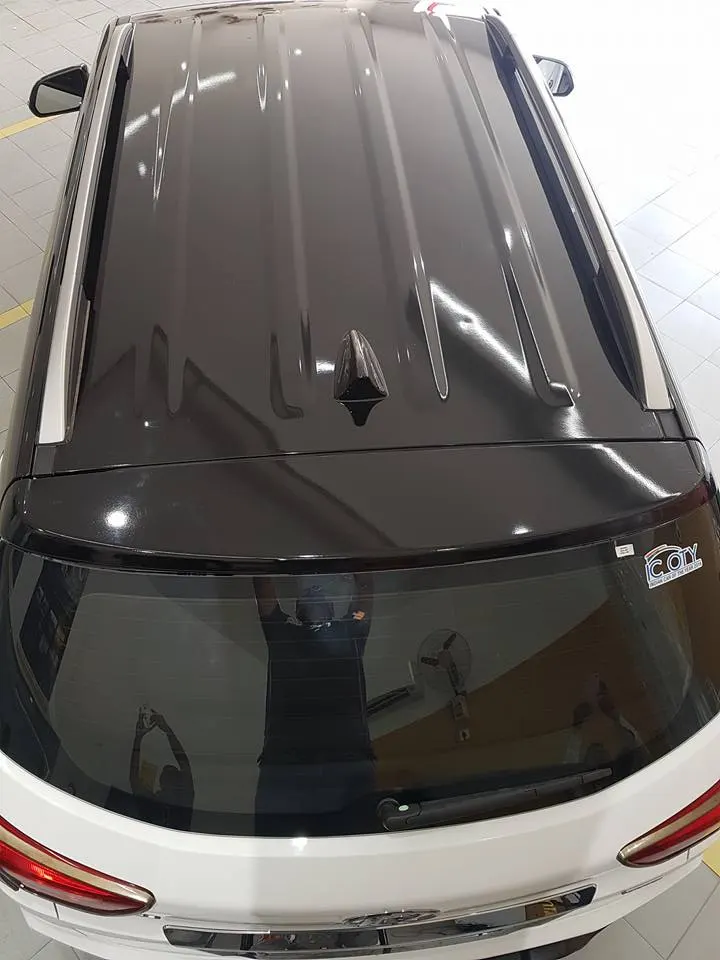
Roof is the part of automobile which is fixed top of the compartment which product the vehicle occupants from sunlight, rain, wind and other external factors. While roll-over accidents it product the passengers. So, strength of the roof is very important.
Roof Materials:
There are wide range of materials are using such as steel, Aluminium, Thermosetting plastic sheet. In case of steel usual thickness is range of 065 – 0.85mm.
Roof Parts:
To increase the strength of the roof, add reinforcement such as front rail, rear roof rail and bow roof. It is mainly used for avoid deflections.
Reinforcement Fixing:
Spot welding and flexible adhesives such as mastic are used to fix reinforcement with roof.
Manufacturing Process of Roof:
Deep drawing method is widely used to sheet metal forming.
Deep Drawing:
It is one of the forming processes in which process combination of tensile and compressive pressure is given to change flat sheet to hollow sheet bodies.
It is basically classified into three types depend on load application.
1.Deep drawing using tools
2.Deep drawing using active media
3.Deep drawing by means of active energy
Deep drawing using tools method is mostly used in sheet metal forming.
Process of Deep Drawing:
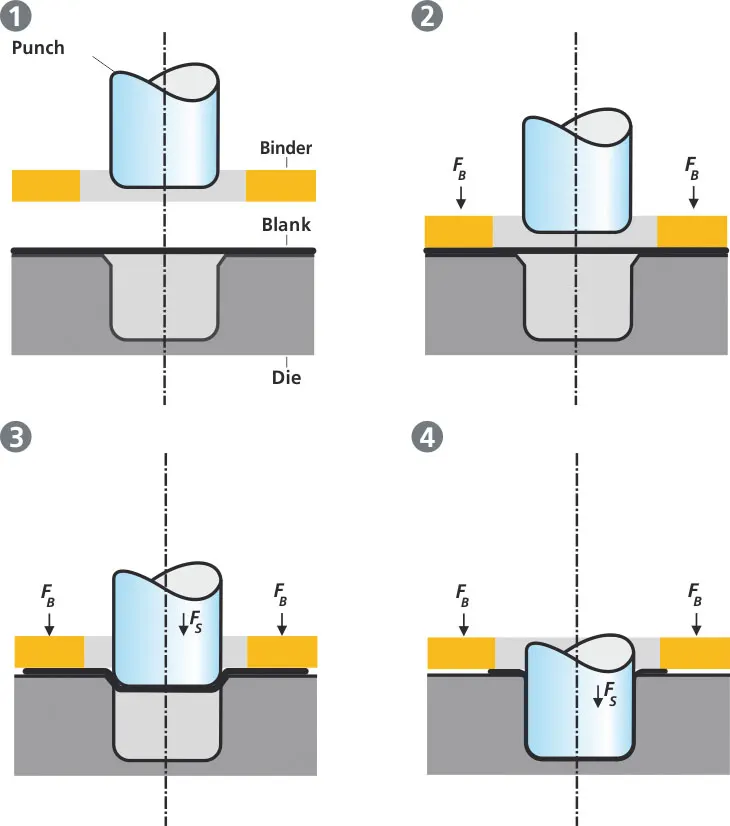
- The rigid tools consist of a punch, die and binder. This punch and die will be the product replica.
- In this process the holder closes after the sheet has been inserted.
- Then sheet is clamped on the die and binder hold the sheet
- The process will do slowly to prevent wrinkles forming under the binder.
- The punch pushes the sheet slowly get and the sheet gets die shape.
- The amount of punching force continually increased to lower dead centre of punch.
- In this process achieved in stretch purely decreased the thickness of the sheet metal.
- This is forming process in which only forming slightly curved and lo depth product.
- This process is combination of stretch and deep drawing involved. So, in which process should stretched the sheet metal as well as possible without reaching material limits. If give low stretching in complex parts sometime it will give defects such as wrinkles and splits.
EMBOSSING:
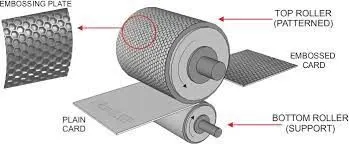
It is one of the forming processes which is used to form raised, sunken and relief design. In this process male and female rollers are passed on both sides and give desired patten. This design is fully depended on the dies of the male and female rollers. There is no thickness reducing in this process.
Characteristics:
- Ductile sheet metal also formed in this process
- Production rate is medium to high
- Same thickness is got after processing
- Varity of Parten is available in this processing
- Reproduces also done without variations.
BLANKING AND PIERCING:
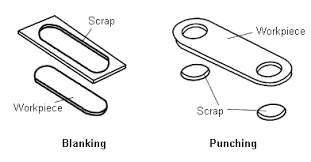
- These two processes are used to cut the sheet metal to get desired hole features.
- In the blanking process push the punch and get required part. This final part is called blank which is separate from work piece and tool fixture. Remaining part in tool fixer which is called scarps.
- In the piercing process push the punch and unwanted part. It is called scarps. Final part is kept in the fixing tool. It is called washer.
MASTIC SELANTS:
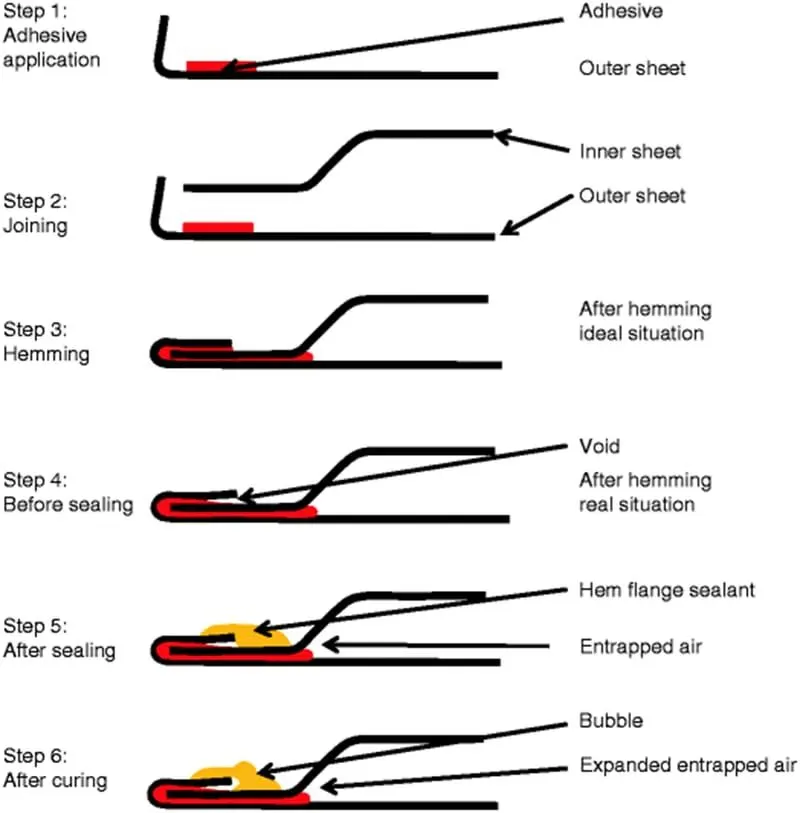
Mastic sealant is a type of liquid sealant that cures an in elastic state. It gives bonding between two surfaces. It is one type of adhesives. In the roof model outer panel is aesthetic look. So, we can’t use fasteners. So, we use hemming and mastic sealant. Hemming only joined with outside part. But this sealant is used in the rest of part. It is one type of elastic component. Initially it is in semi solid form after curing it will come solid form additionally, which increases strength of the panel. It is used to fix the roof rail and top part of roof.
Spot Welding:
Spot welding is one of the joining processes which is used to join the two sheet metal parts. Heat the sheet then join the sheets. In the roof model directly not visible parts are welded by this technique.
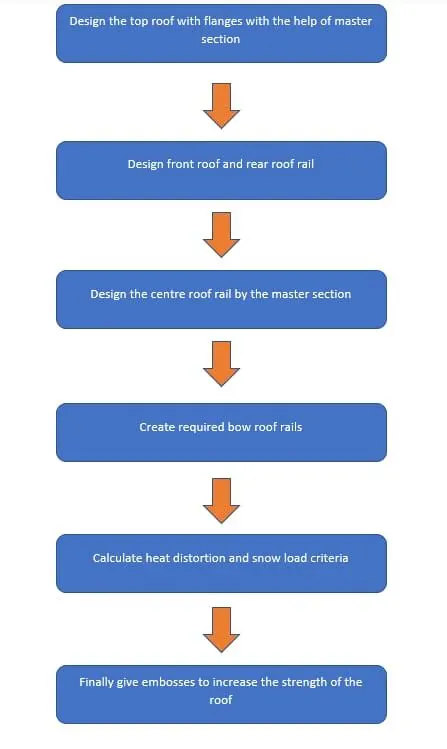
DESIGN METHODOLOGY:
DESIGNING OF ROOF:
Astatic Surface:
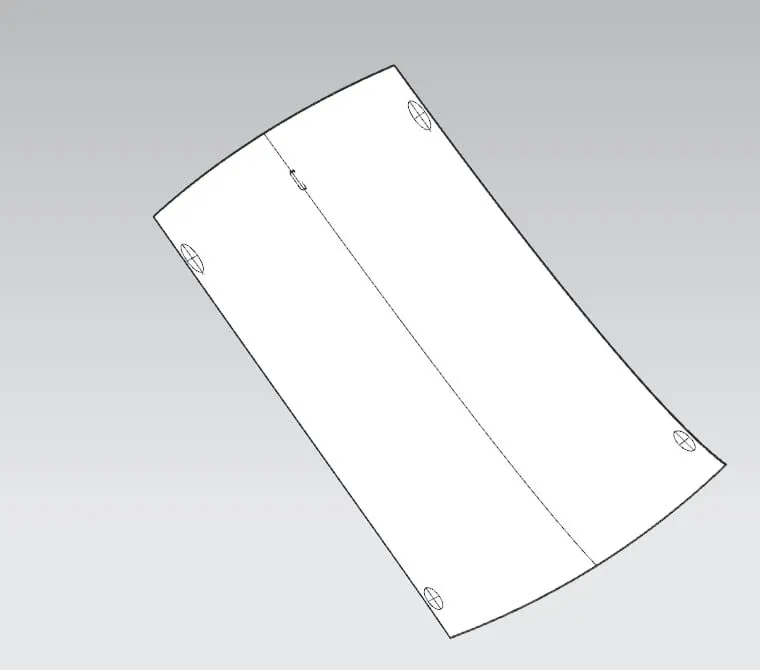
They have given astatic surface of roof which is used to create the roof, front rail, centre rail and bow roof.
Master Section:
They have given master section which guides to design the component after complete class A surface. It is used to design the roof with help of measurements.
Given Master Sections:
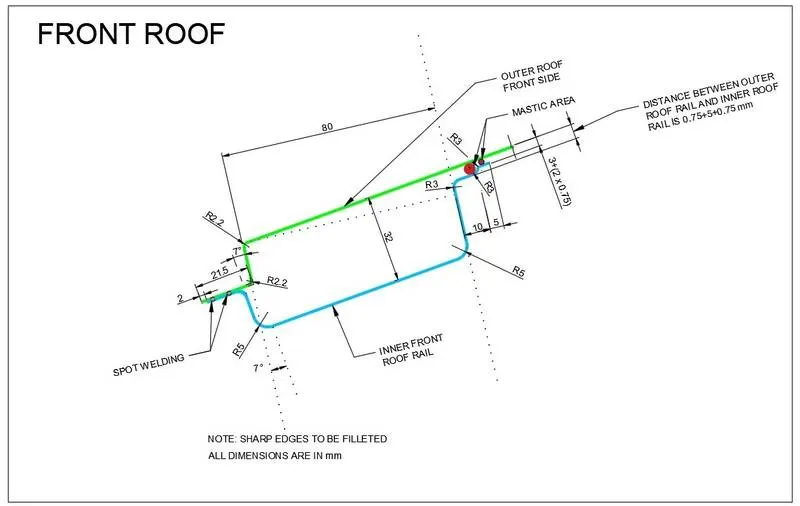
Front Roof Rail Master section
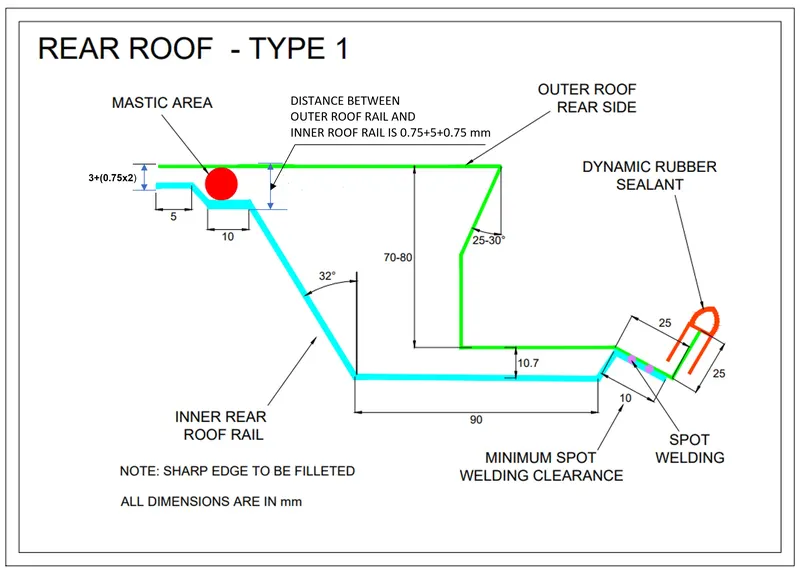
Master section of the Rear Roof Rail
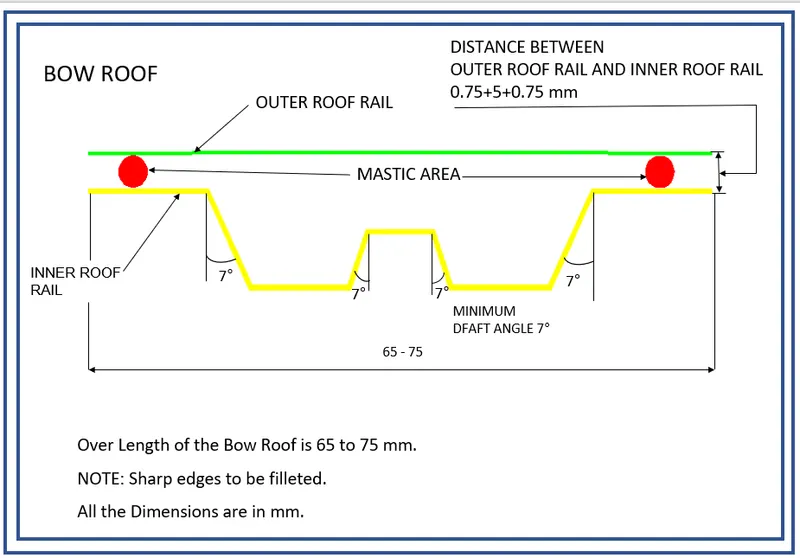
Master section of Bow Roof
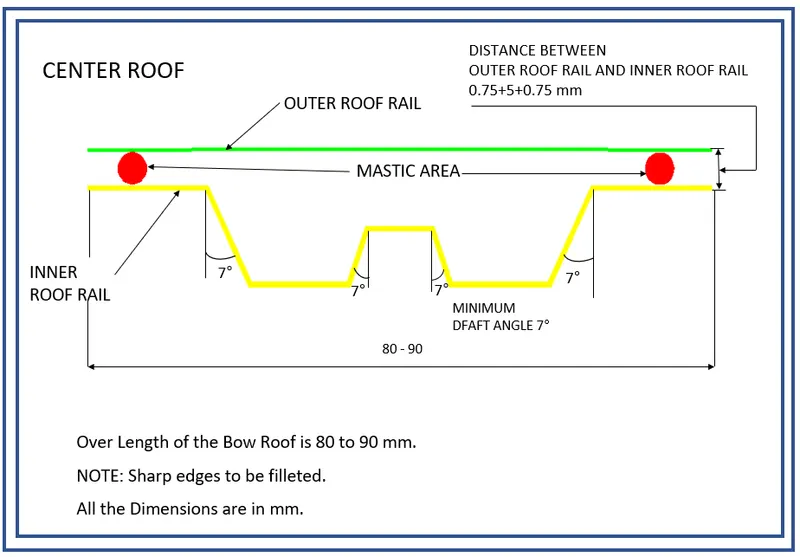
Master section of Center Reinforcement Rail
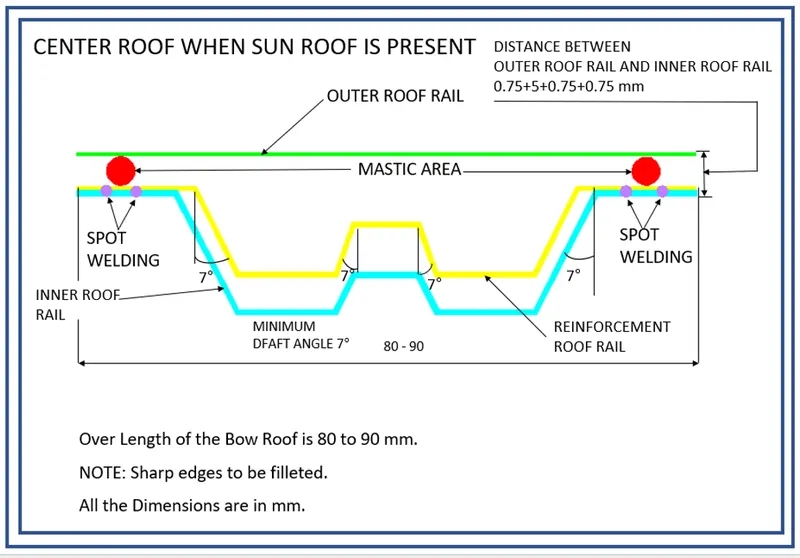
Top Roof:
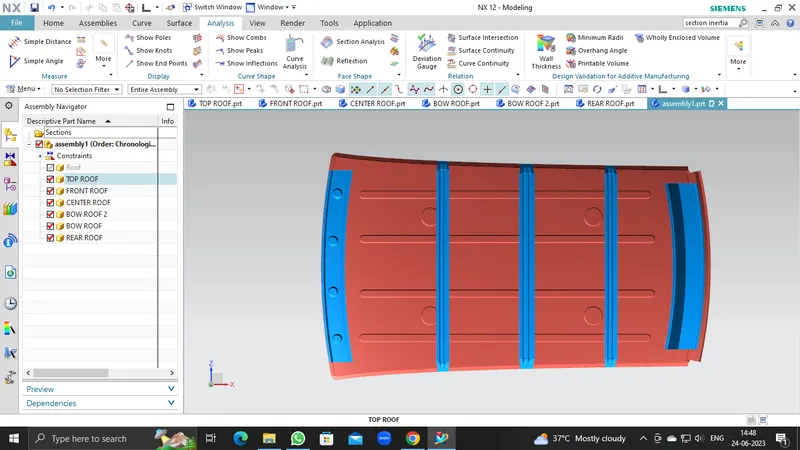
It is top part of the roof. This is used to create the all-roof rails. It has flanges. This part is covered the car. All roof rails are attached with this part.
This part is created with help of given surface and master section. Some flanges are created with the help of master section
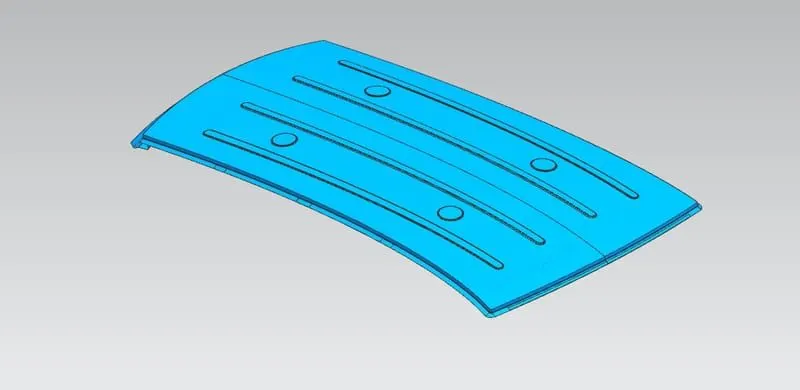
Front Roof:
Front roof is in front side of the roof which act as reinforcement and it will give strength to the roof. In this part attaching the bracket map and lamp. While we design this roof, we should consider road visibility criteria.
They have given separate master section for this part. So, it is used to design with the help of law extension, trim etc and give required fillets Then give thickness to this surface. If we want, we can create embosses. In this model I have created embosses. Cut some portion on side to fix A pillars.
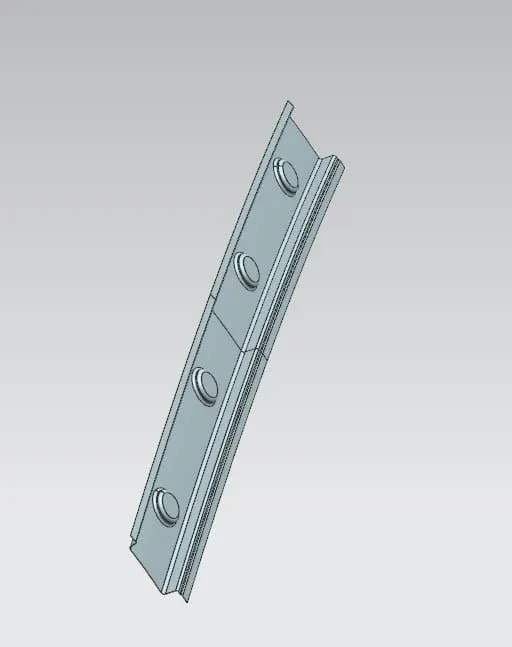
Rear Roof Rail:
When we designing the rear roof rail, we should consider the head clearance of the passenger and rear visibility criteria.
They have given master section which is used to design the rear roof with help of surface workbench and give fillets. Finally, we give thickness to this surface. Cut some portion for fixing pillars.
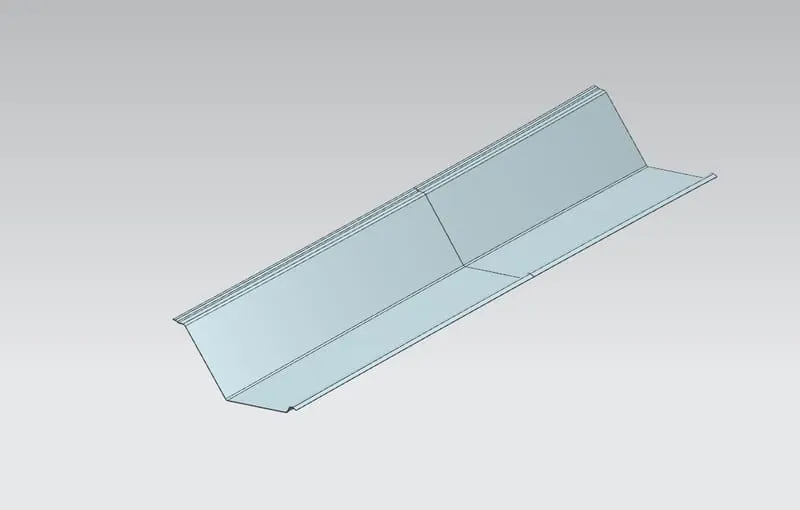
Centre Roof Rail:
This reinforcement is fixed centre of the roof. Which is avoid the deformation of roof while give weight in the top.
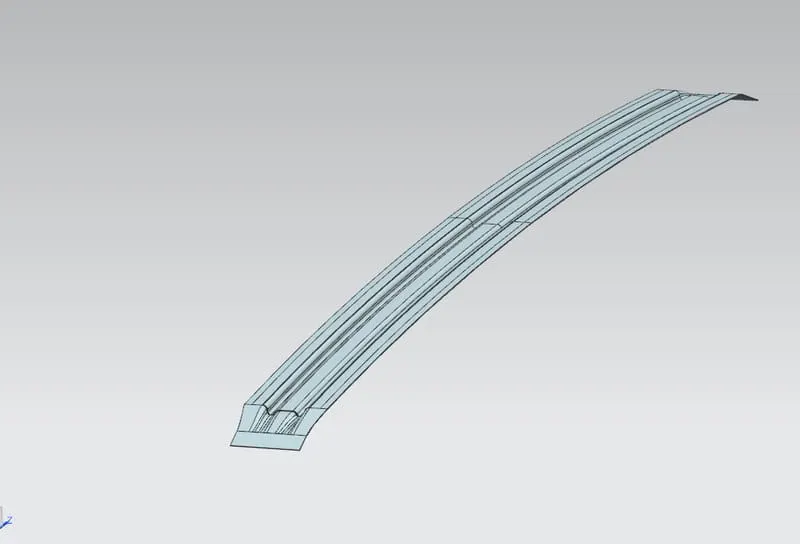
Design the centre roof with help of master section. We should take width of the centre roof 80-110mm. If the snow load calculation value is not pass, we can give reinforcement to this roof. In this model I have given reinforcement to this roof. This reinforcement is designed by given the master section.
Bow Roof's:
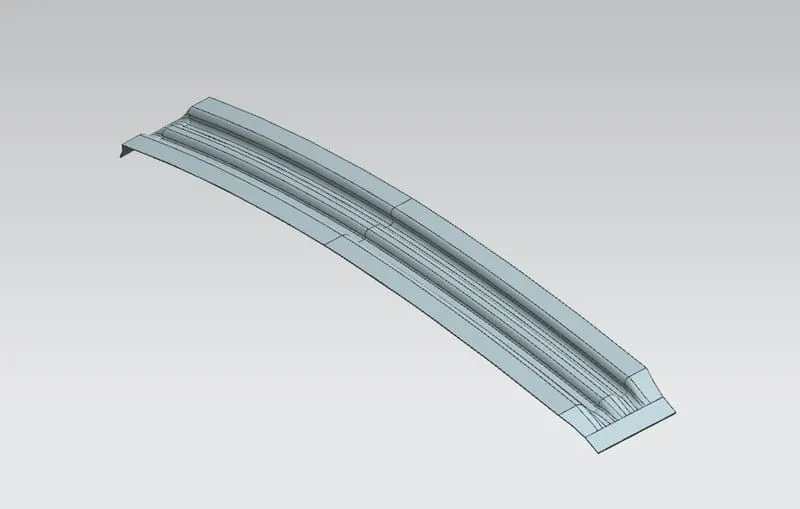
Bow roofs are generally given to increase the strength of the roof and avoid the deformation. No of roofs are depend on the length of the roof.
Master section is used to create this bow roofs. In this model I have given two bow roofs. If the roof is not passed the snow load calculation, we can increase the no of bow roofs.
CALCULATION:
Heat Distortion Criteria:
Heat distortion temperature in which metal softens and deform under load. In crease the no of bow roof and reinforcement increase the strength of the roof. So, it will increase the heat distortion criteria.
Bow–Roof Prediction Formula
W = [1.73 x 10^(-3) x L] + [1.85 x 10^(-8) x (R^2)/t] + [ 1.10x10^(-3) x l] - 2.68
Where,
L = Roof Length in X-Direction[mm](Roof dimension in 0-Y)
R = Roof curvature
R = 2(Rx*Ry)/(Rx+Ry)
Rx = X curvature
Ry = Y curvature
t = Roof plate thickness [mm]
l = Bow Roof Span [mm]
Judgment Condition
OK< 2.7
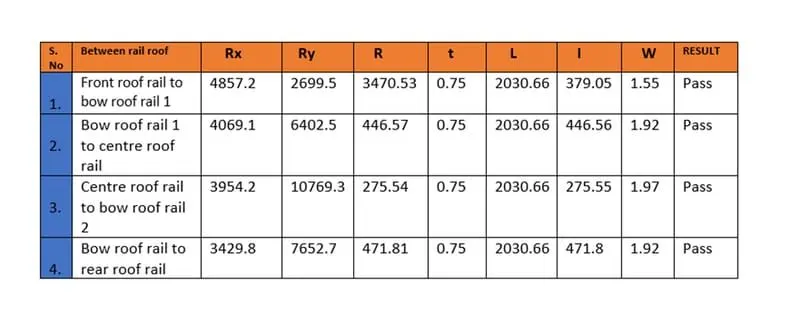 By this calculation fully satisfying the condition of the heat distortion.
Snow Load Prediction:
Snow load is downward force of roof. When we apply load on the roof or in accident condition how to stable roof which is give this calculation. When we give embosses and reinforcement strength of the roof will increase. So, if the roof not pass this calculation, we can give reinforcements and embosses.
Snow Load Prediction Formula
Qr = [Iy x t2] / [α x s x [(Rx + Ry)/2]2 x 10-8]
Note: The Qr value given over here is correct. There was a typo error in the formula given in the video.
Where,
α = My x Lx2 x 10-12 , My = Y(Ly-Y)
t = Roof plate thickness [mm]
Ly = Distance between the front and rear roof Rails on the Vehicle along with 0Y[mm]
Length of Roof panel with the center point between Roof rail Front /Rear as the front and rear reference point.
Lx = Distance between the Left and Right end of the roof on the Roof BOW [mm]
The width of the roof panel is exposed on the surface.
Y = Distance front Front Roof Rail to Roof BOW[mm]
s = Distance for which Roof BOW bears divided load [mm]
s = L1/2 + L2/2
Iy = Geometrical moment of inertia of Roof BOW (Y cross-section )[mm4]
Rx = Lateral direction curvature radius of roof panel Y cross-section on Roof BOW [mm]
Roof panel curvature Radius of the Length Lx in Front view
Ry = Longitudinal Direction curvature radius of the Roof panel X cross-section on Roof BOW [mm]
Roof panel X curvature radius of length s in Side view
Judgment condition
Qr ≥ 3.1
250 ≤ s ≤ 380
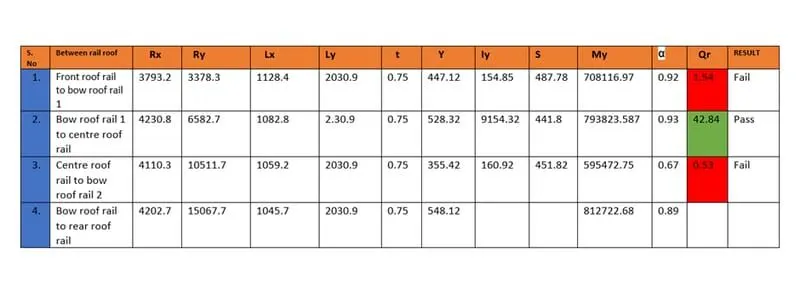
By this calculation two values are not satisfied the value. So, I have given embosses. This embosses will increases the strength of the roof.
CONCLUSION:
Given master section are used to roof are created with reinforcements. Then heat distortion and snow load calculation are successfully done. By this project via how to calculate and how to increase the strength of the roof which are detailly explained.
Here Attached Some Images For References.