Project 2 - Supply and Demand Gap Analysis
Aim:
The aim of this analysis is to identify the supply and demand gap in the Uber network and provide recommendations to improve the efficiency of their service.
Introduction:
Uber is a ride-hailing platform that connects passengers with drivers through a mobile app. The company has revolutionized the transportation industry by providing a convenient and affordable alternative to traditional taxis. However, as the demand for their service continues to grow, it becomes increasingly important for Uber to ensure that their supply of drivers is able to keep up with the demand.
Problem statement:
The main problem that Uber faces is the supply and demand gap. This occurs when there are more passengers requesting rides than there are drivers available to fulfill those requests. This can lead to longer wait times for passengers and missed opportunities for drivers. In order to address this problem, Uber needs to analyze their data and identify areas where it can improve its service.
Methodology:
In order to conduct this analysis, we will use a dataset that contains the following columns: Request id, Time of request, Drop-off time, Pick-up point, Driver id, and Status of the request. We will use PowerBI to create visualizations that will help us identify patterns and trends in the data.
Analysis:
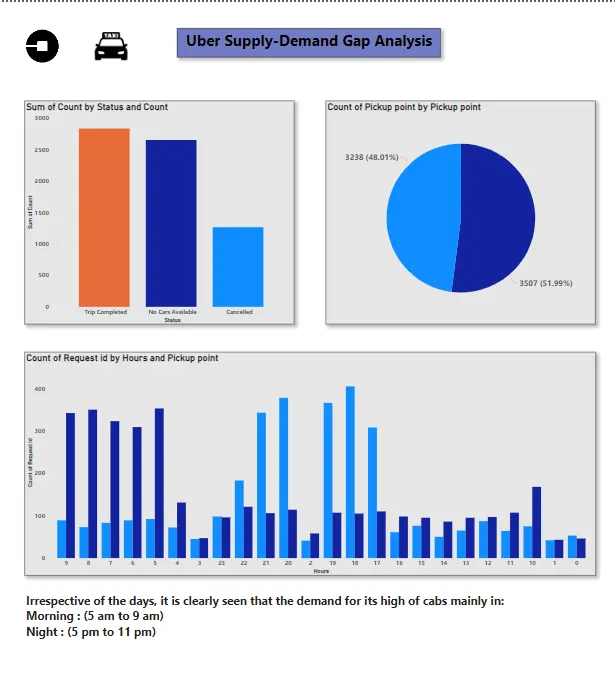
We will begin our analysis by creating a visual that shows the number of requests made over time. This will help us identify when the demand for rides is highest. We will then create a second visual that shows the number of completed trips over time. This will help us identify when the supply of drivers is highest. We will also create a visual that shows the pick-up points of passengers, which will help us identify areas where the demand for rides is highest.
Insights:
Based on our analysis, we may discover that there are certain times of day or locations where the demand for rides is highest. We may also discover that there are certain times of day or locations where there is a shortage of drivers. This information can be used to make strategic decisions about where and when to deploy drivers in order to optimize the efficiency of the Uber network.
Recommendations:
Based on our insights, we may recommend that Uber increase their marketing efforts in areas where the demand for rides is highest. We may also recommend that Uber offer incentives to drivers to work during times when there is a shortage of drivers. Additionally, we may recommend that Uber invests in new technologies, such as autonomous vehicles, to further optimize the efficiency of their service.
Conclusions:
By conducting this analysis, we have gained valuable insights into the supply and demand gap in the Uber network. By implementing our recommendations, Uber can improve the efficiency of their service and provide a better experience for both passengers and drivers.