Project 1 - COVID-19 Vaccinations Trend Analysis
Aim
The aim of this report is to analyze the vaccination data for various countries and vaccine types and provide insights and recommendations for improving vaccination efforts.
Introduction
Vaccination is an important tool in preventing the spread of infectious diseases and protecting public health. With the ongoing COVID-19 pandemic, vaccination has become even more critical to controlling the spread of the virus. This report analyzes vaccination data from multiple countries and vaccine types to identify patterns and trends that can inform vaccination efforts.
Problem Statement
The COVID-19 pandemic has highlighted the importance of widespread vaccination efforts, but many countries have struggled to secure enough vaccines and distribute them equitably. By analyzing vaccination data, we can identify areas where vaccination efforts are lagging and make recommendations for improving distribution and increasing vaccination rates.
Methodology
The data for this analysis was collected from public sources and compiled into a single dataset. The dataset contains information on the total number of vaccinations, the number of people vaccinated and fully vaccinated, the daily vaccination rate, and the percentage of the population that has been vaccinated, broken down by country and vaccine type. The analysis was conducted using Power BI, a data visualization and analytics tool. I have replaced the null values with 0 other than that everything was well with the data set.
Analysis
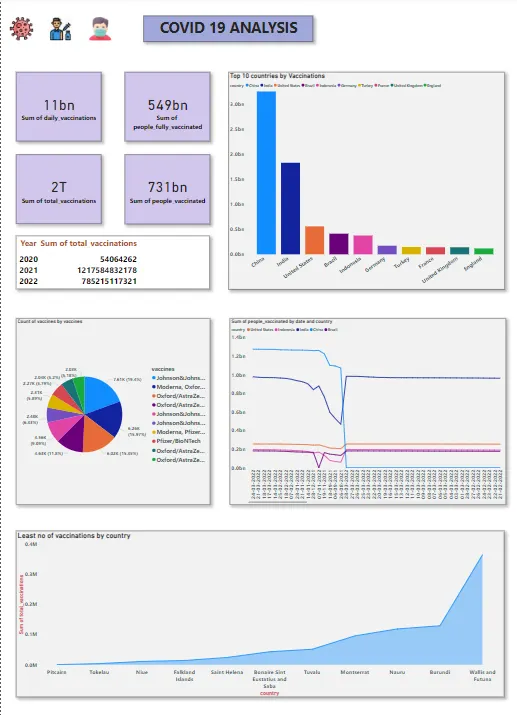
The dataset contains information on vaccinations for several different countries and vaccine types. We created several visualizations to analyze the data and identify patterns and trends. Some of the key insights we found include:
- China has administered the most total vaccinations of any country in the dataset, followed by India and the United States.
- The Johnson and Johnson vaccine is the most commonly used vaccine in the dataset, followed by the Moderna and Oxford/AstraZeneca vaccines.
- Many countries in the dataset have a relatively low percentage of their population vaccinated, with some countries still below 500 vaccinations.
Insights
Based on our analysis, we have several insights and recommendations for improving vaccination efforts:
- Countries with low vaccination rates should prioritize increasing the number of vaccines available and improving distribution to reach more people.
- Governments and health organizations should work to address vaccine hesitancy and misinformation to increase public confidence in vaccines.
- Efforts should be made to ensure that vaccine distribution is equitable and accessible to all populations, regardless of socioeconomic status or geographic location.
Recommendations
Based on our insights, we recommend that governments and health organizations take the following actions to improve vaccination efforts:
- Increase funding and resources for vaccine distribution, particularly in low-income and rural areas.
- Launch public awareness campaigns to promote the benefits and safety of vaccines and dispel myths and misinformation.
- Work with community organizations and healthcare providers to ensure that vaccines are accessible and available to all populations.
Conclusions
Vaccination is a critical tool in preventing the spread of infectious diseases and protecting public health. By analyzing vaccination data and identifying areas for improvement, we can make recommendations to improve distribution and increase vaccination rates. Governments and health organizations must work together to ensure that vaccines are accessible, equitable, and effective in protecting public health.