Project 1 _Creating an Architectural plan for the provided plot size and develop relevant basic structural drawings
Commands Used in this challenge
- Line
- Xline
- Polyline
- Rectangle
- Circle
- Arc
- Trim
- Move
- Offset
- Hatch
- Layer
- MatchProp
- Multileader
- Fillet
- Copy
- Explode
- Dimlinear
- Dimcontinue
- Dim break
- Dim update
- Hide pallets (POFF)
- Show pallets (PON)
Aim: To draw residential building of dimensions 55’X60’ with following drawings
- Plot drawing
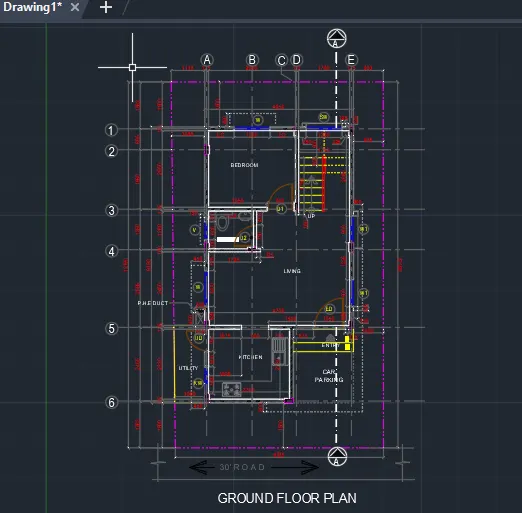
- Ground Floor Plan
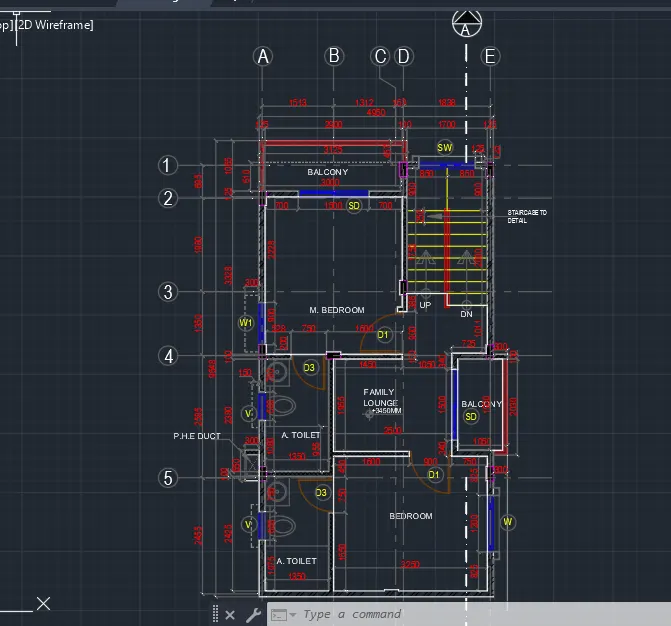
- First Floor Plan
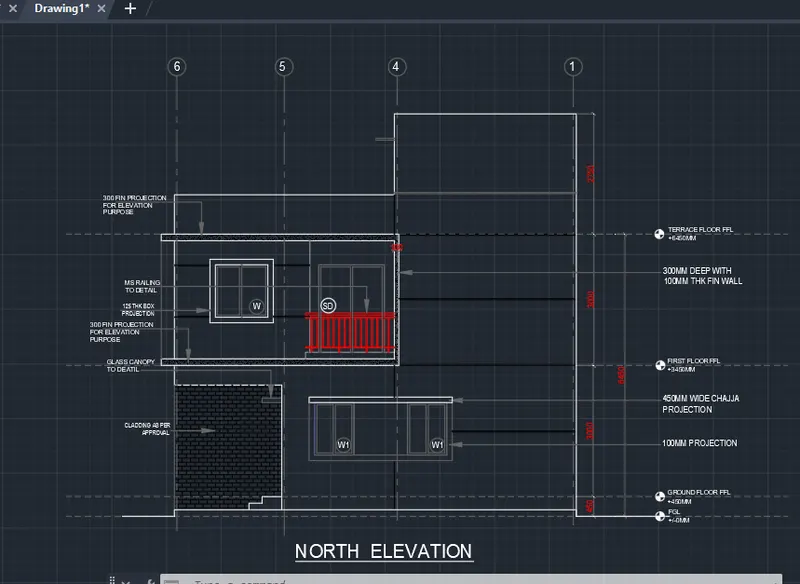
- Elevation
- Center line drawing
- Footing Layout
- Beam Layout
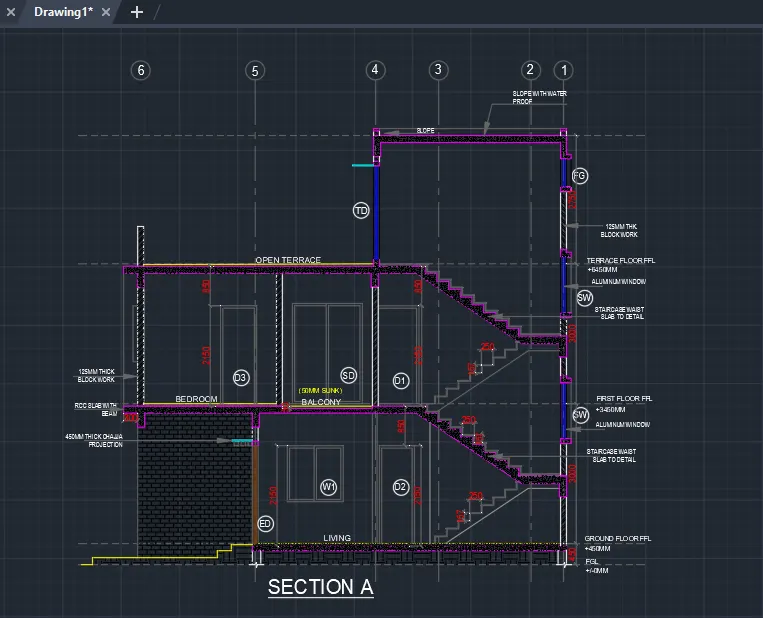
- Section View
Introduction:
The residential building to be drawn with plot dimensions 55’X60’. The plinth dimensions are chosen as 35’X40’. The G+1 floor is designed as duplex house with stairs inside the house. The plot is north facing. The building is designed with following rooms
- Ground Floor Living Room
- Kitchen (Open)
- Main Bedroom
- Puja Room
- Staircase to first floor
- First Floor Living room
- Bedroom-2
- Guest Bedroom
- Balcony
- Staircase to roof
Building is designed with main door at the North-East (Ishan) facing north and main gate at north west position. Initially layers are created for all the components of the house.
The dimensions of the components of house are as follows
Walls
- Thickness of main walls is taken as 9”
- Internal wall thickness is taken as 4.5”
Columns and Beams
- All the columns are of size 9”X12” or 12”X9” respectively
- All the beams are of size 9”X9”
- Rebar specifications are explained in procedure
Doors
There are three door types
- Dimension of Main door and entrance 4’X8’ and at the balcony access
- Dimension of doors of all bedrooms are 3’6”X7’
- Dimension of doors of all toilets and Puja room are 2’8”X7’
Windows
- Windows to the side of main door are taken as 2’7.5”X4’5”
- Windows in main bedrooms and in both halls 3’X5’6”
- Windows over the bed lights as 1’6”X4’6” in all bedrooms
- Ventilators as 1’6”XN depending on its preferred height
Staircase
- Inner Staircase consist of 21 steps with curved steps at the change in flight direction making it single flight straircase
- Thread and Raiser are taken as 10” and 6” respectively
- Curve radius is also taken as 10”
- Outer staircase is connected to the roof with 21 steps
- Thread and Raiser are taken as 10” and 6” respectively
- Hand rails are 2” in diameter and height of 2’9”
Procedure:
Open AutoCAD
In Start-up settings start from scratch select Imperial (Feet and Inches)
Open grid and snap settings
- Change snap and grid spacing to 1’
- Change major line every grid line to 10
- Turnoff adaptive grid
Type ‘un’ in command box and press enter
Change units’ type to decimal and precision to 1’1/16” and insertion scale to inches
Step 1: Creating Layers
Open Layer properties and create new layers by clicking on new layer or right click on any layer and select new layer to create new layer
Step 2: Creating Plot Drawing
Initially direction mark is made drawing perpendicular lines and adding text and respective layer is assigned
Change the current layer to wall layer
- Draw a rectangle of dimensions 60’X54’9.625” at any point on the screen
- Draw a line vertically up from top left corner of distance 21’
- Offset the left and bottom line of rectangle drawn to distance of 2’ right and up respectively
- Offset the top line of rectangle drawn to distance of 18’ to downwards
- Offset the right edge line of rectangle drawn to distance of 18’ to downwards
- Trim off the extra portions of inner rectangle
- Draw the roadway of width 15’ along with center alignment line
- Add relative text to the plot drawing
- Hatch the plinth area using hatch type ANS137 and hatch scale 100
Step 3: Creating Ground Floor Plan View
A. Creating Walls
Change the current layer to walls layer
- Draw a rectangle of dimensions 60’X54’9.625” at any point on the screen
- Offset the left and bottom line of rectangle drawn to distance of 2’ right and up respectively
- Offset the top line of rectangle drawn to distance of 18’ to downwards
- Offset the right edge line of rectangle drawn to distance of 18’ to downwards
- Trim off the extra portions of inner rectangle
- Offset both rectangle to a distance of 9” to inside to give the wall thickness
- Draw the inner walls of thickness 4.5”
- Offset the bottom inner wall edge to a distance of 12’
- Offset the last offset line to a distance of 4.5”
- Offset the last offset line to a distance of 4’7.5”
- Offset the last offset line to a distance of 4.5”
- Offset the left inner wall edge to a distance of 14’
- Offset the last offset line to a distance of 4.5”
- Offset the last offset line to a distance of 4.5”
- Offset the last offset line to a distance of 4’3”
- Offset the last offset line to a distance of 4.5”
- Trim off the extra lines to obtain the figure as shown below
Create the front door inside the top right corner as shown in below figure
Create the main door opening of the dimension 4’
Create the door openings of the puja room, main bedroom and toilet in main bedroom as
Trim off the extra portions at the main door
B. Creating Stairway
Change the current layer to stairs
- Draw a thread of stair line of width 3’6”
- Offset the line to distance of 10” to upwards
- Change the direction of stairs after 5 threads of stairs
- Draw another 16 threads lines of width 10” as shown in figure
C. Creating Doors and windows
Doors and windows are created as blocks and then added to the drawing
Doors
Create all door 1 using rectangles and arc of required width as shown in following figures
Convert the drawing into block using block command with name “Main_Door_4’ ”
Windows and Ventilators
Windows are created by using rectangles and offset lines from center
Top and bottom lines are draw using wall layer and rest in window layer
Step 4: Creating First Floor Plan View
A. Creating Walls
Change the current layer to walls layer
- Draw a rectangle of dimensions 60’X54’9.625” at any point on the screen
- Offset the left and bottom line of rectangle drawn to distance of 2’ right and up respectively
- Offset the top line of rectangle drawn to distance of 18’ to downwards
- Offset the right edge line of rectangle drawn to distance of 18’ to downwards
- Trim off the extra portions of inner rectangle
- Offset both rectangle to a distance of 9” to inside to give the wall thickness
-
As most of the plan is same for the first floor as well, such as
- Dimensions of the main bedroom and bedroom 2 are same
- Dimensions of stairway
- Doorway to the balcony is similar to it draw in ground floor plan
So all the necessary things are select and copy pasted into the first floo
Step 5: Creating Front and Side Elevations
A. Front Elevation
For obtaining the proper front elevation view from the north, vertical mirror view copy of the ground floor is created
- Change the current layer to extension lines
- Create vertical extension line at all the wall edge points
- Draw all the wall with their thick
- Each floor height is taken as 10’6”
- Trim the extra portions
a. Doors and Windows
- Doors and windows for elevation are similar to those added in section 2-2 view
- Door of first is half visible because of the parapet wall as shown in figure
- Curved Window along the inner staircase is added at a height of 7’ from the roof bottom
-
b. First Floor Staircase
- Staircase to the roof of the house is through the balcony in the first floor
- Front Elevation of the staircase is side view of the stairs
- Each step is 6” in height and 10” in length
- First six steps are invisible because of parapet balcony wall.
- After 11 steps flight changes direction
- Landing is of 3’ width
- Hand rails of height 2’9” is added to each step
- 3 Steps are drawn at the main door
-
c.Architectural Components
- Plants are added at the entrance on both side of main door
- Car and Bike components are added
- Trees are added as other components
- Elevation Features are added on balcony walls
d. Elevation Result
After adding all the architectural features the result of elevation
- Column Layout
-
Change the current layer to wall layer
- Draw all the walls of the plan view excluding doors and windows
Change the current layer to column layer
- At the bottom left corner draw a rectangle using column layer
- All the columns are of size 9”X12” or 12”X9”
- Columns are placed along the direction of wall in some cases
- Draw the columns at all necessary points
- Reinforcement in column consists of 6 bars of 0.472” diameter(12mm) bars
- Stirrups of side 0.315” i.e.8mm dia bars with 150mm center to center spacing
-
II. Center Line Drawing
Change the current layer to center line
- Draw the lines connecting centres of all columns in line
- Both horizontal and vertical center lines are drawn
- Give codes with alphabets for vertical center lines
- Give code with number for horizontal center lines
- The distance from one center line to another is to be shown
III. Footing Layout
- Draw the column layout again
- Change the current layer to ‘Footing_Foundation’
- Draw a rectangular footing circumscribed in a circle of radius 1’8”
- Dimension of all footings drawn is 3’4”X3’4” (1mX1m)
IV. Beam layouts
i. Ground floor Beams layout
Change the current layer to beam
- Draw the column and wall layout of the ground floor plan
- Beams are drawn with dimension 9”X12” (12” is the depth of the beam)
- Beam is not used above the bathroom and puja room walls
Hatching
The hatching is done for all components of plan and elevation
Elevation patterns are chosen and applied with their respective attributes
Hatch patterns used for respective props are
- All the walls in top view and side view are hatched with ANS132
- All walls in front view are hatched with BRICK pattern
- All beams and slabs are hatched with AR-CONC
- All floors are hatched with ANS137
- All Doors are hatched with solid colour patterns
- All windows are hatched with gradient blue patterns
Result:
Residential G+1 floor design consists of plot drawing, plan view, center line drawing, column and beam layouts, elevation view and section views are drawn. The house consists of 3 bedrooms, 2 living rooms, puja room, kitchen and balcony. Layers are created in the first step and assigned accordingly. After drawing plan view one horizontal section and vertical section lines are drawn named as section 1-1 and section 2-2. Required components and furniture to the house are added using design center command and some other files are added from the cad blocks from browsing. Step by step procedure for all components is shown in respective steps.
Vastu Shastra Followed
- Entrance of the house is provided at the North-East position.
- Living room is provide at the North-West position of the house.
- Master bedroom and Guest bedroom is provided in the South-West position of the house.
- Kitchen is provided at the South-East position and hob is placed such that cooling is done with facing east
- Pooja room is provided at the East.
- Bathroom placed in the west.
- Staircase provided in the North- west.
- Balcony is provided at North and East positions.
In the first 7 steps, all the drawings are drawn. At the end of each step, result of that step is shown. Using step 8 hatching is done for all the drawings. The final result consists of all the drawings of the residential house with hatching.
- All dimensions are in feet and inches
- Dimensions are assigned accordingly
- Text is assigned for all the required components