Introduction to National Building Code and Steps in a Construction project
1.ans.) Building codes or standards essential for the modeling/ efficiency of drawings in Revit as:-
A building code is a set of rules that specify the standards for constructed objects such as Buildings. The main purpose of building codes is to protect public health, safety and general welfare as they relate to the construction and occupancy of buildings and structures.
- Building codes address many of a society’s most important concerns, including public health and safety, and environmental protection.
- The building codes also address cost efficiency and investment value. In large part, building codes establish a building’s quality, safety and energy performance for years to come, because initial design and construction decisions determine operational and maintenance costs for the life of the building.
- Building equipment and other components may be replaceable and upgradeable, but many aspects of building performance are "designed in" at the beginning, and are too expensive and difficult to change.
- Foundations and other parts of the building envelope are typically in place for 50 years or more. Building codes and design and construction decisions affect us every day.
- Some requirements such as fire safety codes and structural and seismic standards affect us in obvious ways. Others, such as lighting quality, acoustics and the air we breathe also have major effects on our health and productivity. We spend nearly 90 percent of our lives inside buildings, according to the U.S. Environmental Protection Agency, which is why the EPA is concerned about the impact of indoor air quality on public health.
- Model codes, a set of minimum requirements for building design, construction and operation to protect public health, safety and the natural resources that sustain us, help us "build it right" at the beginning when it matters most.
Thus Building codes offer enhanced protection against the threats of natural disasters and terrorism to make our communities more resilient, sustainable and livable for generations to come, which lowers the price of mitigation for building owners. Model codes provide guidance on how to design, build and operate buildings to achieve these goals.
2.ans.) From the National Building Code, groups essential when we begin modelling in Autodesk Revit are:
Group A: Residential buildings
Group B: Educational buildings
Group C: Institutional buildings
Group D: Assembly buildings
Group E: Business buildings
Group F: Mercantile buildings
Group G: Industrial buildings
Group H: Storage buildings
Group I: Hazardous buildings
3.ans.) The five major steps that occur in project cycle are:-
- Phase 1: Project Initiation
The first phase of the project management life cycle is project initiation. This is where the project’s value and feasibility are measured. This phase is an evaluation of the project’s goals, timeline and costs to determine if the project should be executed. It balances the requirements of the project with available resources to see if pursuing the project makes sense.
- Phase 2: Project Planning
Once the project receives the green light, project managers need a solid project plan to guide their team, execute the project on time and stay within the budget.The project plan prepares teams for the obstacles that might come over the course of the project and helps to understand the cost, scope and timeframe of the project. The project plan gives the team direction for producing quality outputs, handling risk, creating acceptance, communicating benefits to stakeholders and managing suppliers.
- Phase 3: Project Execution
This is the phase that is most commonly associated with project management. Execution is all about building deliverables that satisfy the customer. Team leaders make this happen by allocating resources and keeping team members focused on their assigned tasks.Execution relies heavily on the planning phase. The work and efforts of the team during the execution phase are derived from the project plan.
- Phase 4: Project Monitoring and Control
Monitoring and control are sometimes combined with execution because they often occur at the same time. As teams execute their project plan, they must constantly monitor their own progress.To guarantee delivery of what was promised, teams must monitor tasks to prevent damage, calculate key performance indicators and track variations from allotted cost and time. This constant vigilance helps keep the project moving ahead smoothly.
- Phase 5: Project Closure
Teams close a project when they deliver the finished project to the customer, communicating completion to stakeholders and releasing resources to other projects. This vital step in the project management life cycle allows the team to evaluate and document the project and move on to the next one, using previous project mistakes and successes to build stronger processes and more successful projects.
4.ans.) Examples of different disciplines involved in construction of a project are:-
- Architect
- Civil Engineer
- Electrical Engineer
- Geotechnical engineer
- Structural Engineer
- Plumbing Engineer
- Fire Protection Engineer
- Lift , Escalator and moving walk specialist
- Safety Engineer
- Acoustics Specialist
- Environment/Sustainability specialist
- Town planner
- Urban designer
- Interior Designer
- Security system specialist
- Surveyor
- Project/Construction Manager
- Heating, Ventilation and AC engineer
- Asset/Faculty Manager and other specialists
5.ans.) There are various types of buildings that are classified based on several criteria such as size, function, construction, style, design, etc. However, the International Building Code (IBC 2018) and the Uniform Building Code (UBC) classify buildings based on use & occupancy. Classification is as follows:-
Residential buildings
Educational buildings
Institutional buildings
Assembly buildings
Business buildings
Mercantile buildings
Industrial buildings
Storage buildings
Hazardous buildings
(ii) a. Four unit apartments --------------- Residential building (Subdivision A-4)
b. School with capacity of 1000 students--------- Educational building (Subdivision B-2)
c. A single unit shop ------------- Merchantile building (Subdivision F-1)
d. Multi story Shopping complex --------- Assembly building (Subdivision D-4)
e. Steel machine factory ---------- Industrial building (Subdivision G-1)
6.ans.) The design team for construction projects consists of an architect and engineers. Often, the team itself may consist of an architectural firm and an engineering firm which themselves employ several architects or engineers. The design team is primarily responsible for taking your idea and bringing it to life using their professional skills. The end result is a design that aligns with the client’s desires, is feasible, and is within the budgetary restrictions for the project.
while
A management team is a collection of top managers who set the strategy and run the operations of an organization together with its top leader. The management team can meet anywhere from weekly to monthly or quarterly depending on the type of business and the team setup. It is normally structured around the direct reports of the top leader. The purpose of the management team is to successfully operate the organization it is heading with all that that entails as well as develop and execute a proper strategy for the future of the organization. The output of the team should also be more than the sum of the output of each of the individuals
7.ans.) a.Height Limitations
b. Area Limitations
c. Room sizing
d. Wall height
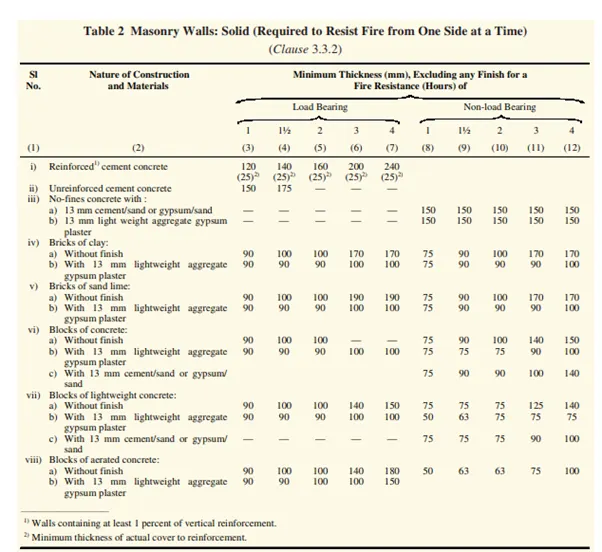
e. Thickness based on fire life and safety :- It is given by Table 2 of Fire and life safety system section of NBC.
f. Passageway requirements :- The width of means of access shall be 6 m for residential occupancy and not less than 12 m for other occupancies depending on the length of the means of access. In addition, the road shall not terminate in a dead-end and shall join another street of 12 m width. The compulsory open spaces shall not be used for parking.. Adequate passage way for fire-fighting vehicles shall be provided at the main entrance with a minimum width of 4.5 m and a head room of 5 m.
An exit may be a doorway, corridor, internal or external staircase. It can be a verandah with access to the street or the roof. It can be a horizontal exit leading to refuge area or adjoining building.
All exits shall be free of obstruction
Exits shall be clearly visible and the path to the same shall be clearly marked and sign posted. Exits shall be illuminated and wired to an independent electrical circuit.
The floors of the areas for exits shall be illuminated.
Exits shall be so arranged that that they may be reached without passing through an occupied unit.
8.ans.) Models created by me in week 2-4 challenges are satisfying the guidelines of NBC.
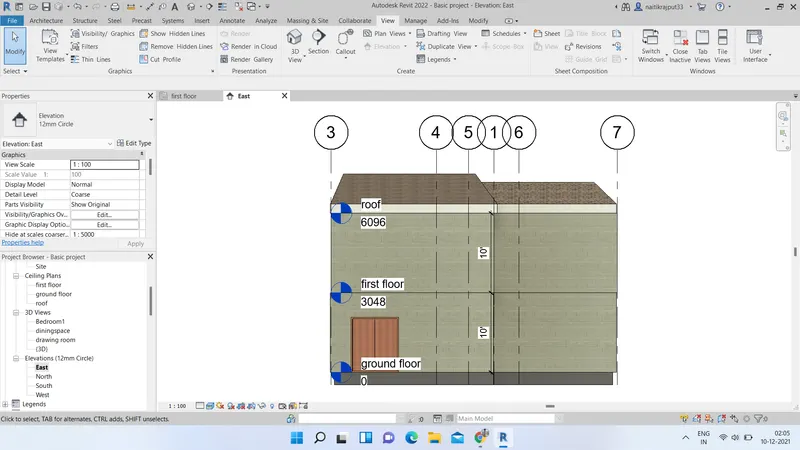
- Height of my model is 6.096 m < 15 m, thus Ok.
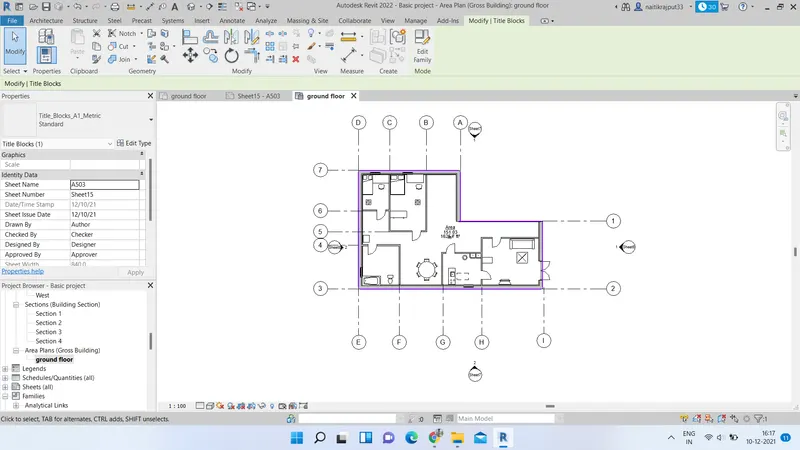
- Area of my model is 151.03 m2 , 75% of which 113.27 > 40 m2 . Thus OK.
- Master Bedroom is 3.35m * 5.48 m= 18.358 m2> 12.5 m2
- Living room is 5.79m * 4.26m= 24.67 m2> 15.5 m2
- Walls in my model are of 3m height > 2.75 m. Thus satisfied.
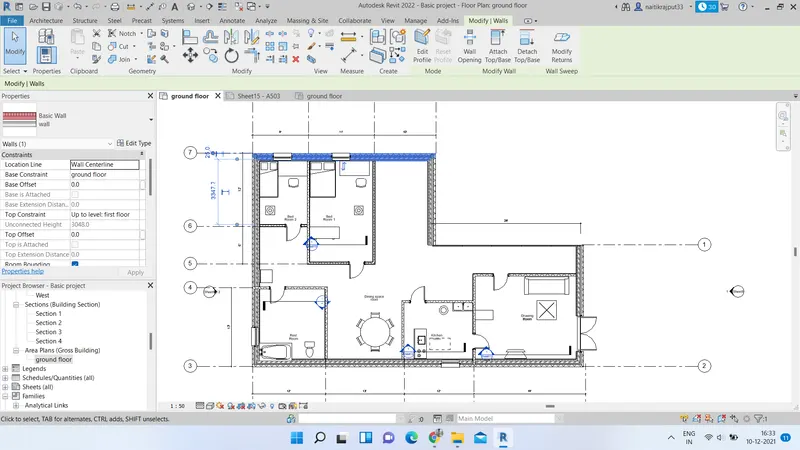
- Thickness of main wall is 11" (290 mm) and of inner wall is 5" (125mm). Thus OK.
- In my model approach road is 6' approx 2 m > 1.5m.
Thus all conditions are satisfied here.