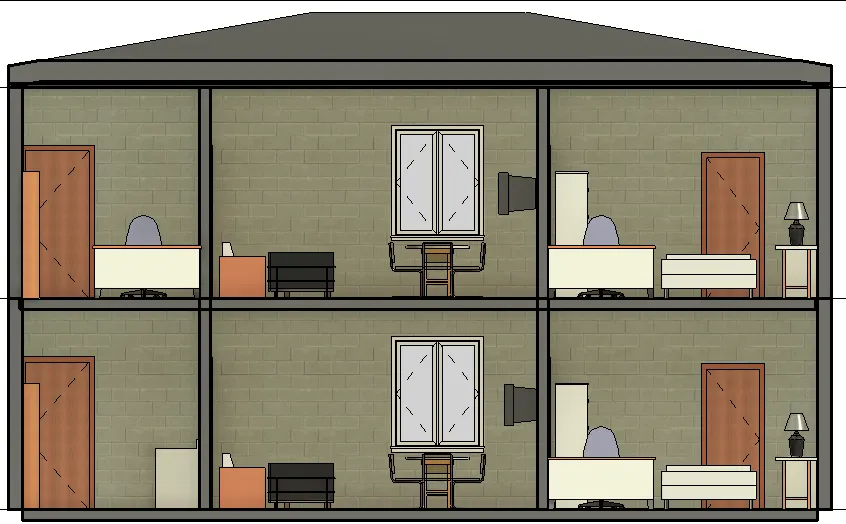
Introduction to National Building Code and Steps in a Construction project
1) Why are building codes or standards essential for the modeling/ efficiency of drawings in Revit ?
Ans. The reasons are as follows:
- A model building code organization is a set of building codes that are developed and maintained by a standard organization.This standard organization operates independently of the jurisdiction or area in which the building code standards are being developed.
- Local governments or councils can choose to adopt these building codes as they see fit,in order to better review construction within their area.
- Building code organizations establish minimum safety,constrcution and material requirements for builders to adhere to.
- To achieve the minimum standards of safety and welfare of residents of a building,the governing body defines a set of guidelines to regulate the construction activities termed as buidling codes.
- A building code is a set of rules to regulate the construction activities acroos the country.
- The National Building Code of India(NBC),a comprehensive building code,is a national instrument providing guidelines for regulating the building construction activities across the country.
- It serves as a model code for adoption by all agencies invloved in building construction works like Public Works Departments and other government construction departments.
- The code mainly containes administrative regulations,development control rules and general building requirements,fire safety requirements,stipulations regarding materials,structural design,building and plumbing services and assest and facility management.
2) From the National Building Code list the groups that will be essential to you when you begin modeling in Autodesk Revit.
Ans. According to NBC buildings are classified according to use or the character of occupancy in one of the following groups:
- Group A Residential
- Group B Educational
- Group C Institutional
- Group D Assembly
- Group E Business
- Group F Mercantile(relating to trade or commerce)
- Group G Industrial
- Group H Storage
- Group J Hazardous
3) List the five major steps that occur in project cycle . The steps should include from conceptualization of project to maintenance and final stage.
Ans. The steps are:
1. Intiation: in this stage,management or other authority figures have determined a business need that will require the work of a project manager.The project itself could improve business processes,create revenue or otherwise fill a need in the organization.
2. Planning: the planning phase is when the project plans are documented,the project deliverables and requirements are defined and the project schedule is created.It involves creating a set of plans to help your team through the implementation and closure phases of the project.
3. Execution: after the planning stage is complete,its time to begin the work.Hence the execution stage or the stage where a project is carried out.
4. Control: it is the process of consistently monitoring progress during execution to ensure your team is performing as they should.
5. Closure: it is the final stage of the project life cycle, and it begins after a project has been completed.
A building project comprises the following major stages:
- Location
- Conceptualization and planning
- Designing and detailing
- Construction/execution
- Maintenance and repair.
4) Give examples of different disciplines involved in construction of a project.
Ans. The example are as follows:
a) Cost Estimation: managing the building of civil engineering systems from cradle to grave to include coordination between the owner,contractor and desinger.
b) Contractors: Effective contract administration is integral to acquiring the next job or project as a construction manager.
c) Geotechinal: designing foundations and earthwork systems to support soil itself and transfer loads from structures into the eart while limiting settlements.
d) Managements: managing equipment,personnel and supplies to build more effectively,efficiently and economically.
e) Structural: designing systems of structural members used to support loads for a specified public function such as bridges,building,dams and bell towers.
f) Surveying: measuring physical features to include horizontal distances and elevation differences to determine property lines,layout of bildings and produce maps.
Appropriate multi-disciplinaru temas need to be constituted to sucessfully meets the requirements of different stages.Each team may comprise need based professionals out of the following depending upon the nature,magnitude and complexity of the project.
- Architect
- Civil Engineer
- Electrical Engineer
- Plumbing Engineer
- Fire Protection Engineer
- HVAC Engineer
- Environment Specialist
- Town Planner
- Urban Designer
- Landscape Architect
- Security System Specialist
- Interior Designer
- Quantity Surveyor
- Project/Construction Manager
- Other Subject Specialist.
5) How are buildings classified ? Place the following buildings under each category
a. Four unit apartments
b. School with capacity of 1000 students
c. A single unit shop.
d. Multi story Shopping complex
e. Steel machine factory
Ans.
The National Building Code of India(NBC),a comprehensive building code,is a national instrument providing guidelines for regulating the building construction activities across the country.It serves as a model code for adoption by all agencies invloved in building construction works like Public Works Departments and other government construction departments.The code mainly containes administrative regulations,development control rules and general building requirements,fire safety requirements,stipulations regarding materials,structural design,building and plumbing services and assest and facility management.
- Group A Residential
- Group B Educational
- Group C Institutinal
- Group D Assembly
- Group E Business
- Group F Mercantile(relating o trade or commerce)
- Group G Industrial
- Group H Storage
- Group J Hazardous
a) Four unit apartment comes under group A Residential.
b) School with capacity of 1000 students comes under Group B education.
c) A single unit shop comes under Group E business.
d) Multi story shopping complex comes under Group F mercantile or group G Industrial.
e) Steel machine factory comes under Group G Industrial,Group H Storage,Group J Hazardous.
6) Distinguish the roles of Design team and Management team
Ans.
Design Team:
A design team can be a singular individual working on design projects across an organization,up to a team of 50+ designers who have their own department.There is lot that goes into effectively leading a design team.
In buidling projects various aspects like form,spaceplanning,aesthetics,fire and safety,structural adequacy,plumbing services,lightning and natural ventilation,electrical and allied installations,air conditioning,heating and mechanical ventilation,acoustics,sound insulation noise control,installation of lifts and escalators,building automation,data and voice communication,other utility installations,landscape planning and design,urban planning etc. need to be kept in right at the concept stage.The project requiring such multidisciplinary inputs need a co-ordinated approach among the professionals for prope rintegration of various design inputs.For this,and to take care of the complexities of multi-disciplinary requirements,a design team of professionals from required discipline shall be constituted at the appropriate stage.Here,it is desirable that the multi-disciplinary integration is intiated right from the concept stage.The team shall finalize the plan.The composition of the team shall depend on the nature and magnitude of the project.
Design is an evolutionary and participatory process,where paerticipation of owner constitutes a very important input at all stages,and the same shall be ensured by the design team.(SP 7 GROUP 1(2005)NCB-4.1 DESIGN TEAM)
Management team:
The management team is the group of individuals that operate at the higher levels of an organisation and have day to day responsibility for managing other individuals and maintaining responsibility for key business functions.
The objective of project management or construction management is primarily to acheive accomplishment of project in accordance with the designs and specifications in a stipulated time and cost framework,with a degree of assurance prior to commencement and satisfaction on accomplishment(SP 7 GROUP 1(2005) NCB-4.2 PROJECT MANAGEMENT AND CONSTRUCTION MANAGEMENT TEAM).
7) Refer to NBC, Identify the modeling requirements for the project ( from week 4).
a. Height Limitations
b. Area Limitations
c. Room sizing
d. Wall height
e. Thickness based on fire life and safety
f. Passageway requirements
Ans.
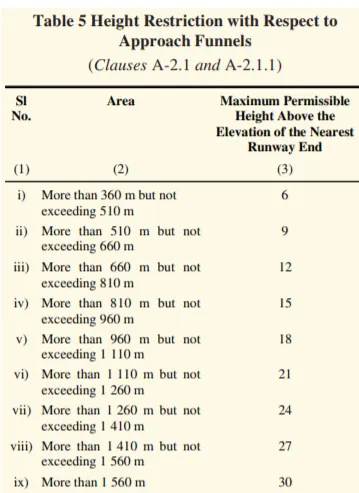
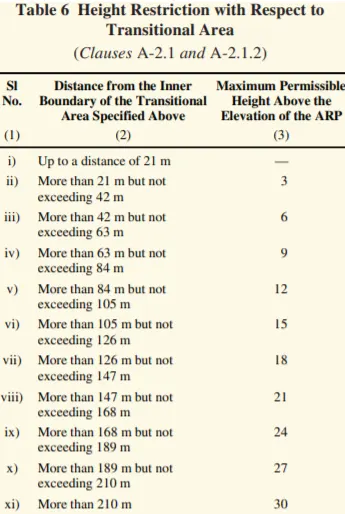
a) Height Limitations: A-2 Height Restriction- No building or structure higher than the height specified in Tables 5 and 6 shall be constructed or erected or no tree which is likely to grow higher than the height specified in the tables 5 and 6,shall be planted,on any land within a radius of 20km from ARP of the aerodromes listed.
C-2.5 Height of building(Form NBC)
The height of building shall not exceed 15m.
Important Guidelines:
- For buildings up to height of 15m,there is no need to provide lifts.
- Housing for the low-income group shall preferably be up to a maximum of two storeys.
- Buildings for housing beyond 15m in height should be resorted to in exceptional circumstances and it should be governed by provisions laid down in this Code.
According to my model the height is 7m.Therefore it does not extend 15m,so my project is according to NBC standards in height limitations.
b) Area Limitations: (FORM NCB)
The minimum plot size with ground coverage not exceeding 75 percent,shall not be less than 40m^2 in small and medium town and not less than 30m^2 in metropolitan cities.Plot sizes below 30m^2 but not less than 15m^2 may be permitted in case of cluster planning.
According to my model the are is not less than 40m^2,my plot size is 39 feet x 29 feet.
c) Room Sizing:
Every dwelling unit to be provided should have at least two habitable rooms.Even of one room is provided intially it should be provided where additions are not possible,the carpet are of multipurpose single room should be atleast 12.5m^2.Such one room dwelling units with 12.5 m^2 carpet area of habitable space is permitted only in case on site rehabilitation of slum dwellers.In a house of two rooms,first room shall not be less than 9 m^2 with minimum width of 2.5m and second room shall not be less than 6.5m^2 with a minimum width of 2.1m provided the total area of both the rooms is not less than 15.5m^2.In incremental housing the bigger room shall always be the first room.
According to my model the room sizing are according to NCB.
d) Wall Height:
F-3.4 Minimum Height
The minimum height of rooms/spaces shall be as follows:
PART 3 DEVELOPMENT CONTROL RULES AND GENERAL BUILDING REQUIREMENTS 59
a) Habitable room 2.75m
b) Kitchen 2.6m
c) Bath/water-closet 2.2m
d) Corridor 2.1m
F-3.4.1 in the case of sloping roofs,the average height of roof for habitable rooms shall be 2.75m and the minimum height at eaves shall be 2.10m.
According to my model the walls are accroding to NCB.
e) Thickness(NCB GROUP 1 TO 5)
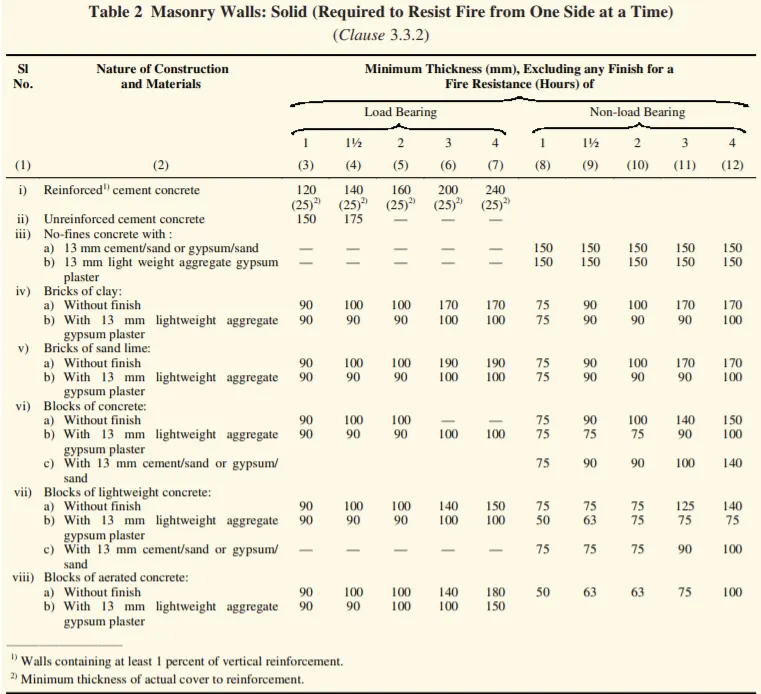
According to my model the walls thickness are accroding to NCB.
f) Passageway requirements:
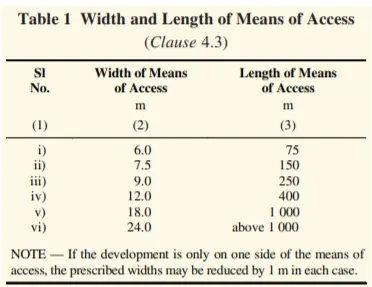
The residential plots shall abut on a a public means of access like street/road.Plots which do not abut on a street/road shall abut/front on a means of access,the width and other requirements of which shall be given in Table 1.
8) We have identified requirements for modeling from question 7, Use these numbers from code book and verify the numbers used in modeling the unit from week 2 to week 4. If the numbers are not reasonable, use the numbers obtained from the code book to create a revision of the mode.
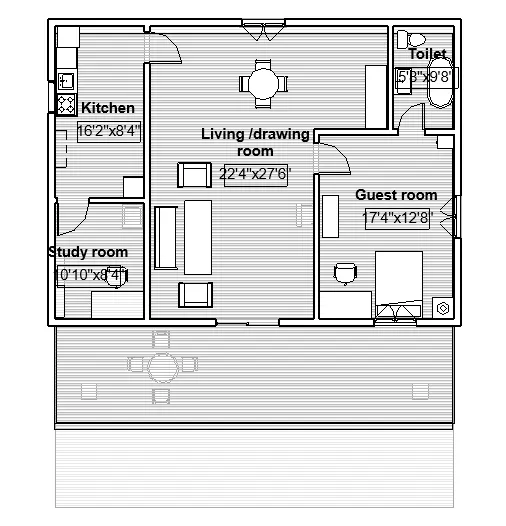
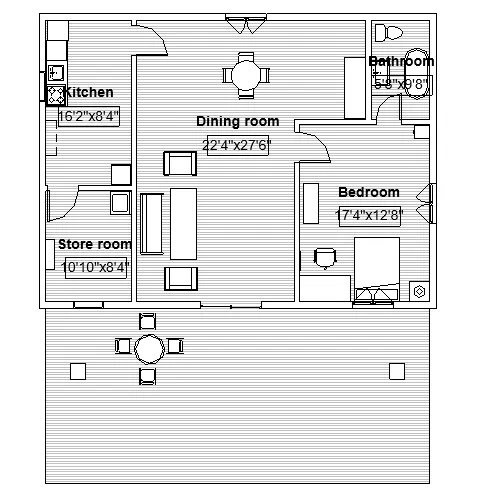
Ans. My project is according to the NCB guidelines.Staircase or shaft needs to be added in my project.
First floor plan:
Ground Floor Plan:
Section View: