Hood design-Week 2
HOOD DESIGN
AIM:
To Design Hood outer panel, inner panel and the necessary reinforcements by following the Master section mentioned with the design parameter explained in the videos. Submit an assembly of Hood inner panel, outer panel, latch, hinge, and the reinforcements.
Theory:
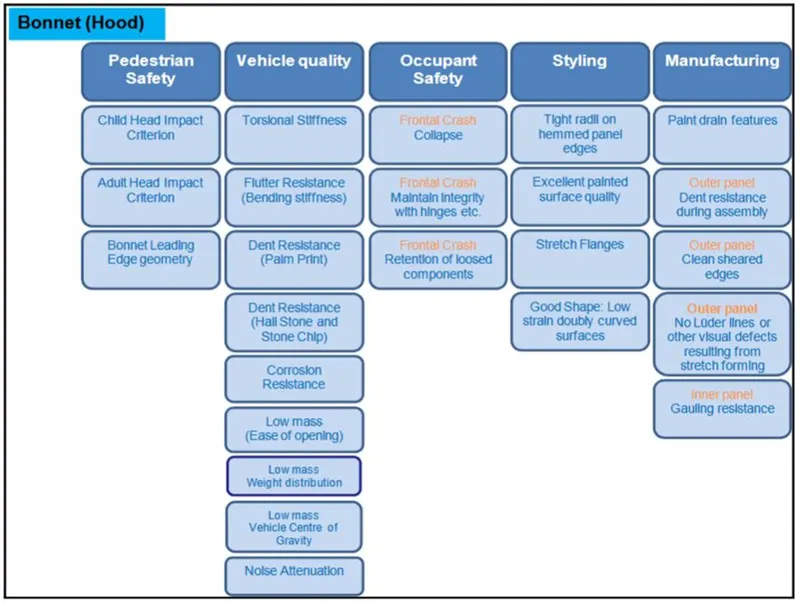
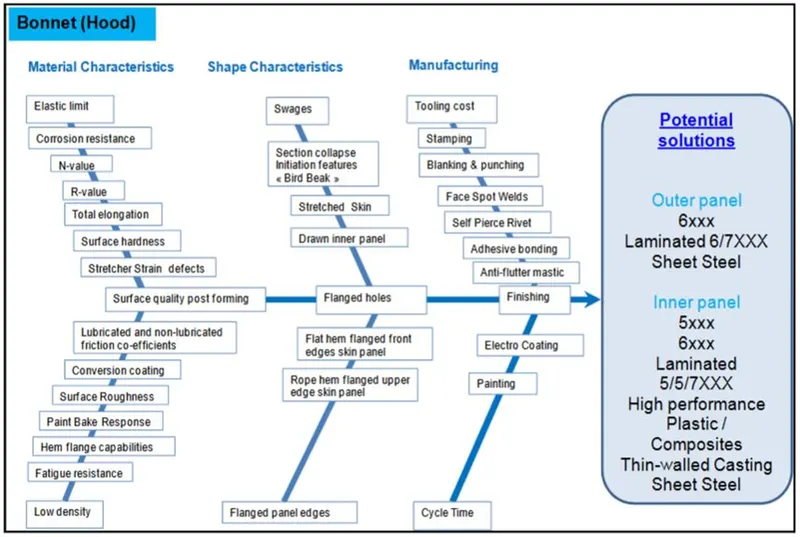
Hood is a main component of front portion of a car. It is an opening body panel that covers the engine in front engine vehicle. It consist of an outer panel and inner panel. The inner panel provides the strength while the outer panel functions as the metal cover. It is an access panel to the engine compartment to enable maintenance of power train, drive belts, battery, fluid levels and lamp units.
Design considerations :
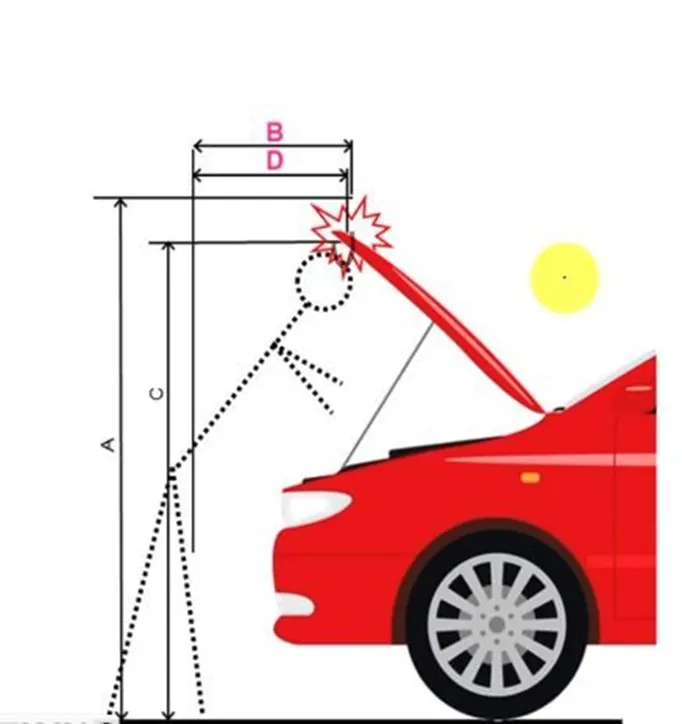
The human comfort factor for automobile design is first consideration. It is a method to safeguard and protect space for the human user and necessary components that make up the vehicle being designed. All safety regulations are ensured during this process. Ergonomical consideration consist of Hood clearance, Hood Opening angle and location of support rod or gas stay.
Hood opening angle is different for different regions or countries. It is decided by the average height of the human in that particular country.
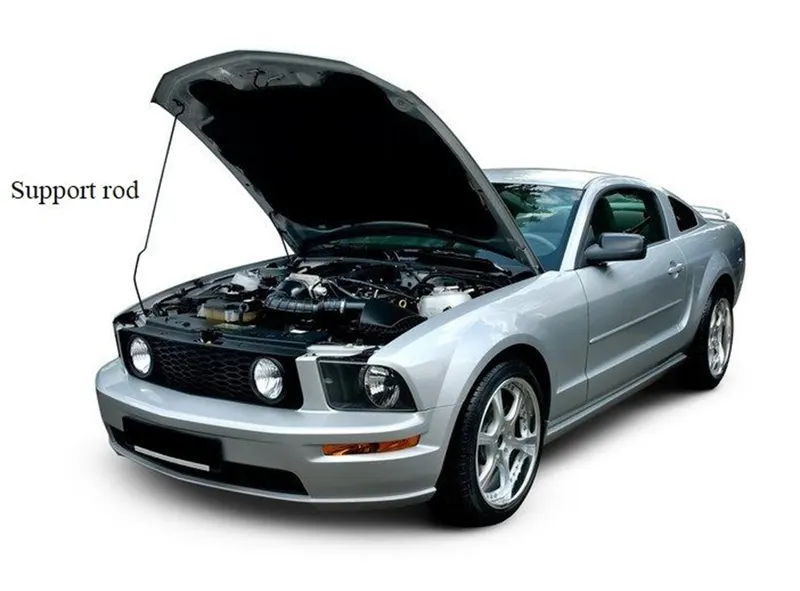
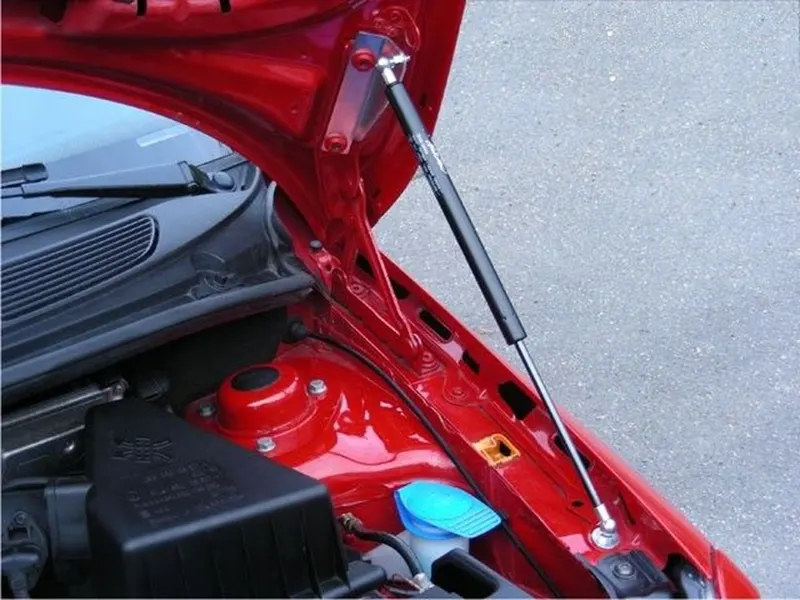
There are two types of hood stay, support rod and Gas stay which holds the position of hood at desired angle.
1) Support rod :
It is a simple metallic rod. It is not usually made linear to increase rigidity of rod but the length from line connecting support rod retaining point with retaining point on body side to maximum bending point should be less than 35mm to ensure the strength of support rod.
It should have sufficient clearance with other engine components to avoid rattling noise.
Gourmets are provided to keep the support rod in rest condition.
Advantages of support rod are as follows
- They are economical
- Light in weight.
Disadvantages of support rod are as follows
- When striking with the automotive body panel to leave scars which are very likely to cause rust.
- The metal rod is often too hot to be gripped by hands immediately after the vehicle has been stopped.
2) Gas stay :
It is a device used for supporting the engine hood of a vehicle in its open position by means of an actuator which is activated by gas.
In case of gas stay only initial force is required to open the hood then it automatically opens at desired angle with the extension of pneumatic piston in cylinder of gas stay assembly.
Advantages of Gas stay are as follows
- No human effort is required
- Easy to operate
Disadvantages of Gas stay are as follows
- They are heavy in weight compared to support rod.
- Cost is more.
Safety requirements :
The most important safety requirement is regarding the frontal collision.
It should withstand in high collision forces as well as it should divert the forces in outward direction so intensity of collision forces would be reduced to cabin side of car.

Pedestrian safety :
Design should be such way that it should reduce the injuries to the pedestrians in the event of a pedestrian vehicle collision. The objective of these measures is to reduce the number of road accident fatalities and the severity of injuries sustained by pedestrians involved in a collision with a vehicle in urban traffic.
The height, weight and age of the pedestrian all play a role in the kinematics of the event and in his ability to survive. Most fatalities for the younger population are related to brain damage caused by head impact on the bonnet. For older people additional risks include rupture of arteries in the lower limbs and pelvis from bumper and bonnet leading edges. Impact frequency and seriousness of injury has been studied for many years, resulting in rating systems and improved design.
Evaluation of pedestrian safety for a bonnet must be carried out in the context of its surrounding elements like Vehicle styling, size (wrap around distance “WAD”) and under bonnet clearance to other elements (considered as hard points). Local bonnet stiffness is influenced by mounting point stiffness such as hinges, bump stops and latches. This is better understood by superimposing the kinematics of a dummy onto the test conditions.
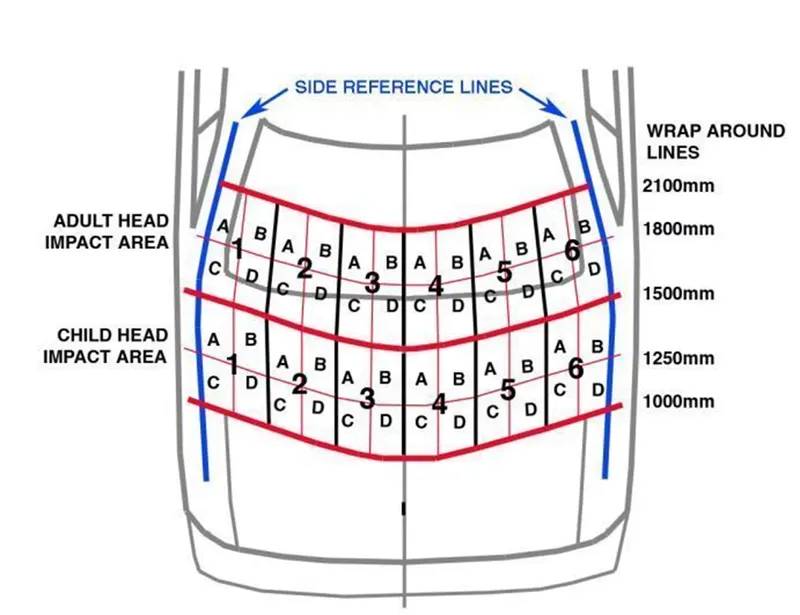
Wrap Around Distance (WAD) :- It is the geometrically traced distance from the contact point with the Ground Reference Plane, vertically below the front face of the bumper, to any point on the vehicle front structure.
Side Reference line :- The geometric trace of the highest points of contact between a straight edge, held parallel to the lateral vertical plane of the vehicle and inclined 45 deg. is traversed down the side of the front structure, and the side of the front structure.
Child Head Impact Zone :- 1000 WAD to 1500 WAD
Adult Head Impact Zone :- 1500 WAD to 2100 WAD
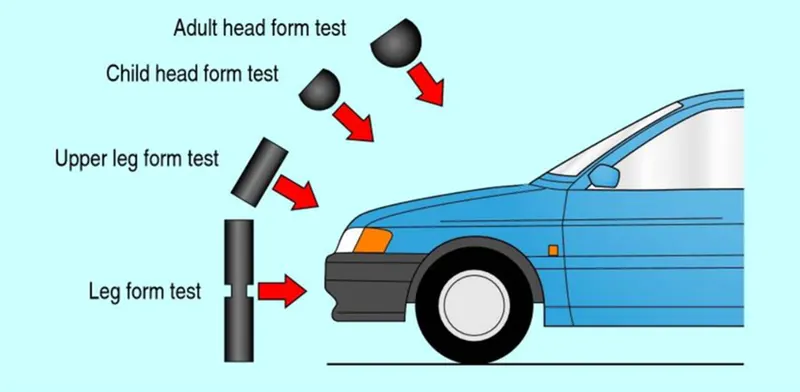
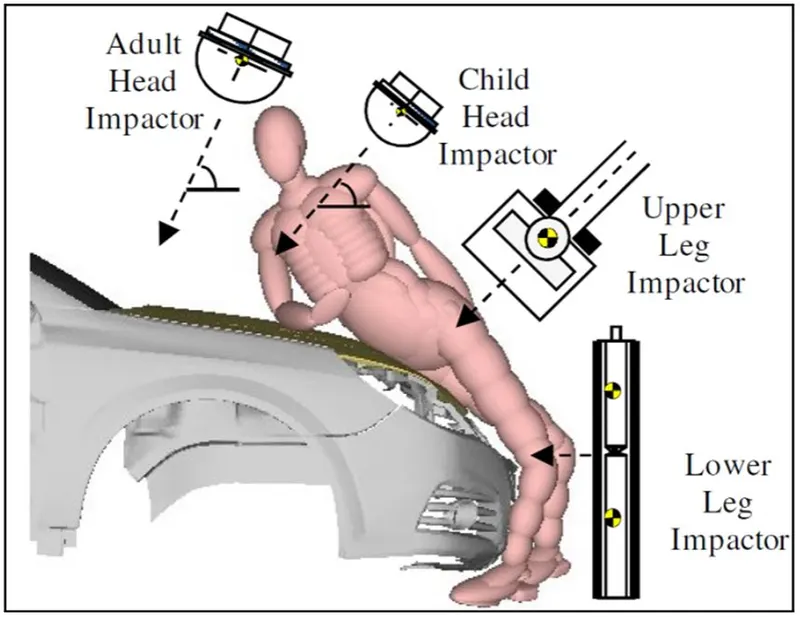
Besides functioning as an engine compartment cover, the hood of modern vehicles can also help manage the impact energy of a pedestrian’s head in a vehicle-pedestrian impact. However, a hood’s ability to absorb impact energy may be impeded by the proximity of the hood to components packaged inside the engine compartment, i.e., by its under hood clearance.
For example, for a given hood design, the hood’s ability to absorb impact energy through deformation can be significantly reduced when the hood and engine block are in close proximity.
Therefore, a large under hood clearance would be preferred for pedestrian protection.
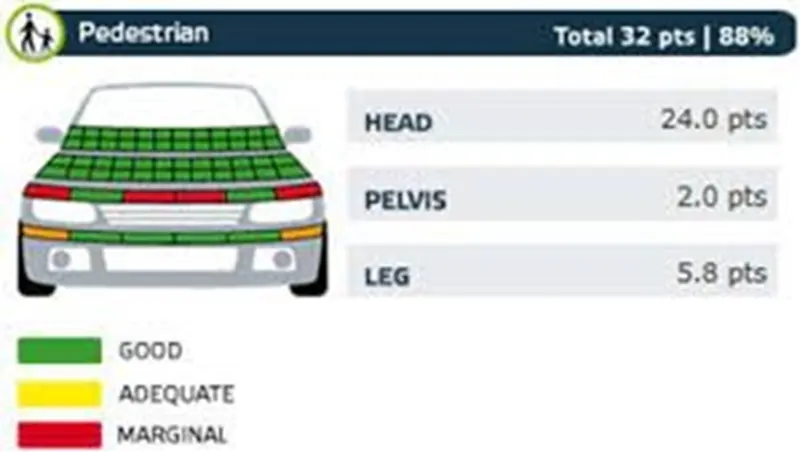
The predicted level of protection offered by the vehicle is verified by EURO-NCAP.
Hood Thickness Information
- Outer Panel Thickness = 0.75mm
- Inner Panel Thickness = 0.75mm
- Reinforcement Thickness = 1.5mm
Hemming:
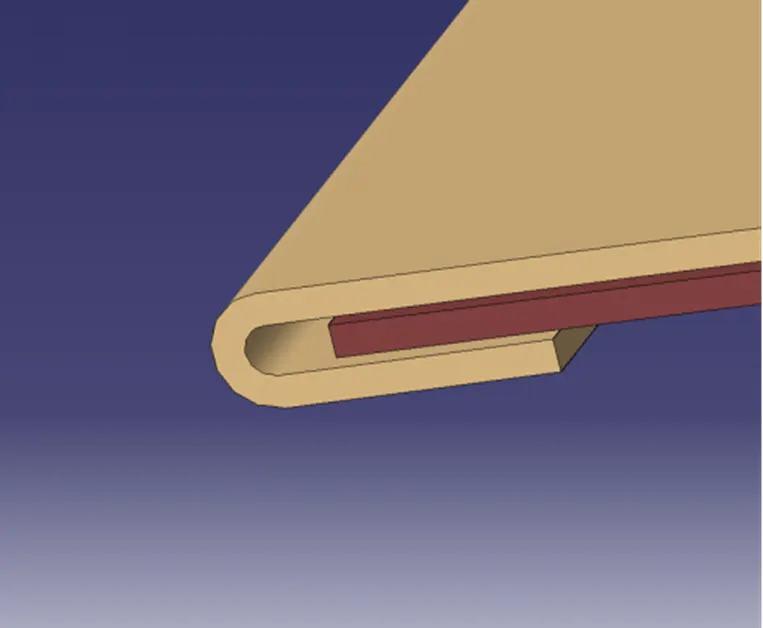
Hemming is a forming operation in which the edges of the sheet are folded or folded over another part to achieve a tight fit. Normally hemming operations are used to connect parts, 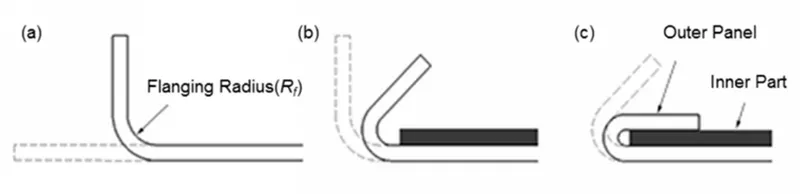 the appearance of a part, and reinforce part edges.
In car part production, hemming is used in assembly as a secondary operation after deep drawing, trimming, and flanging operations to join two sheet metal parts (outer and inner) together. Typical parts for this type of assembly are hoods, doors, trunk
lids, and fenders.
The accuracy of the hemming operation is very important since it affects the appearance of the surface and surface quality. Material deformations, which occur during the hemming process, can lead to dimensional variations and other defects in parts. Typical hemming defects are splits or wrinkles in the flange, material overlaps in the corner areas, or material roll-in. This is why it is important to use simulation tools to, on the one hand, better understand the hemming process and, on the other hand, significantly reduce the number of “trial and error” loops during try out and production.
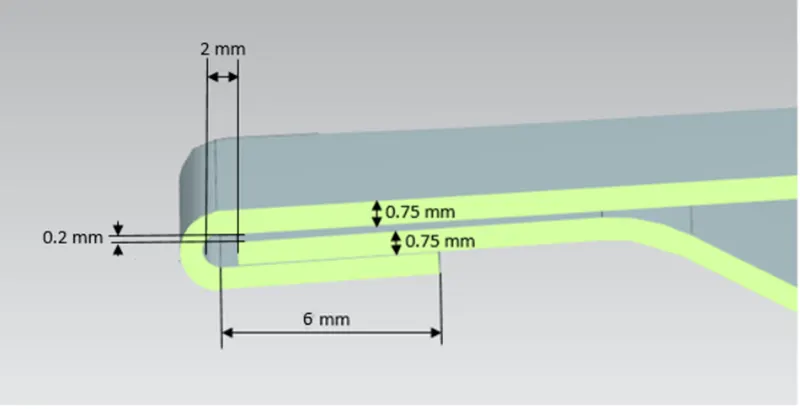
Relief data:
Relief is provided onto the part or component in order to remove any stresses developed in a particular area i.e sharp corners that take place during the hemming process is carried out. Thus corners are rounded or chamfered.
Tools:
- Offset surface- The offset surface gadget copies the picked surface at a provided distance and guidance.
- Emboss- The embossing contraption makes a punched surface of the picked shut contour. The punch is produced using a chosen surface containing the contour surface. Sketch. a draft can be obliged the punch from either the end cap or the base surface.
- Trim sheet- The trim sheet gadget parts the target surface along the intersection curve of the target surface and the gadget surface. The piece of the cover on either side of the intersection can be either discarded or retained according to need.
- Through curves- This contraption creates a surface between two various surface sections where the shape can change in section.
- Law Extensions- Creates an extended surface subject to an open-chain contour or a shut contour on the picked target surface. A draft can be obliged by the extension.
- Face blend- Creates a curved blend or fillet along two picked surfaces in gave direction vector. The blend curve can be changed regarding reach, width, and continuity.
- Extend sheet- Creates an extension of the picked sheet up to a given distance.
- Offset in the face- Creates an offset in the front or edge on the target face up to a provided distance.
- Bridge curve- Create a roundabout portion between two intersecting and non-intersecting curves. The beginning and endpoint of the roundabout changed by providing distance.
- Projected curve- Creates a projection of a curved profile onto a goal surface. The surface can be linear and curved. The direction can be changed by a reasonable vector.
- Sew- combines sheet bodies by sewing common edges together or combines solid bodies using sewing faces. Any opening between the surfaces can be closed.
- Mirror Geometry- Mirror a geometry along a face.
- The curve on the surface- Creates a surface spline feature directly on the face.
- Thicken- creates a strong body using thicken.
- Extracted body- Creates a body of picked geometry that can be changed by editing the parent feature and rebuilding the extracted feature.
Front Relief:
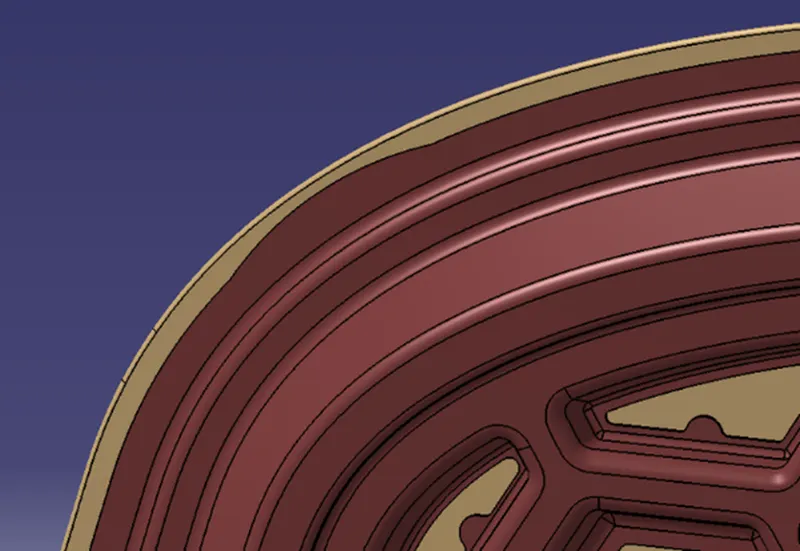
Rear Relief:
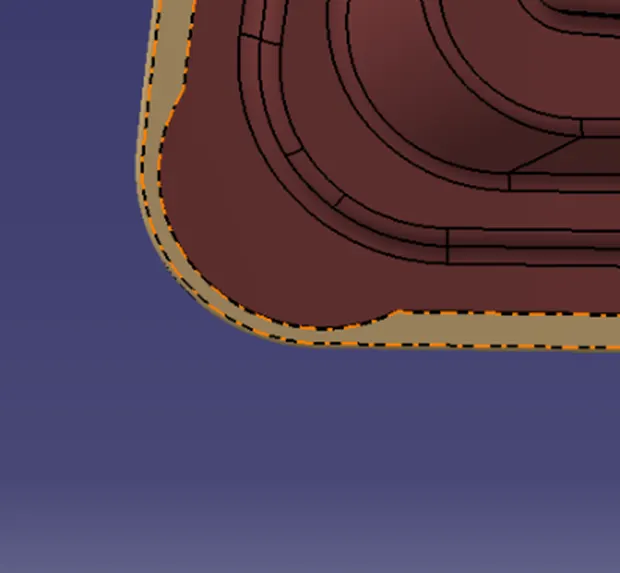
Outer panel hemming:
Latch trajectory motion:
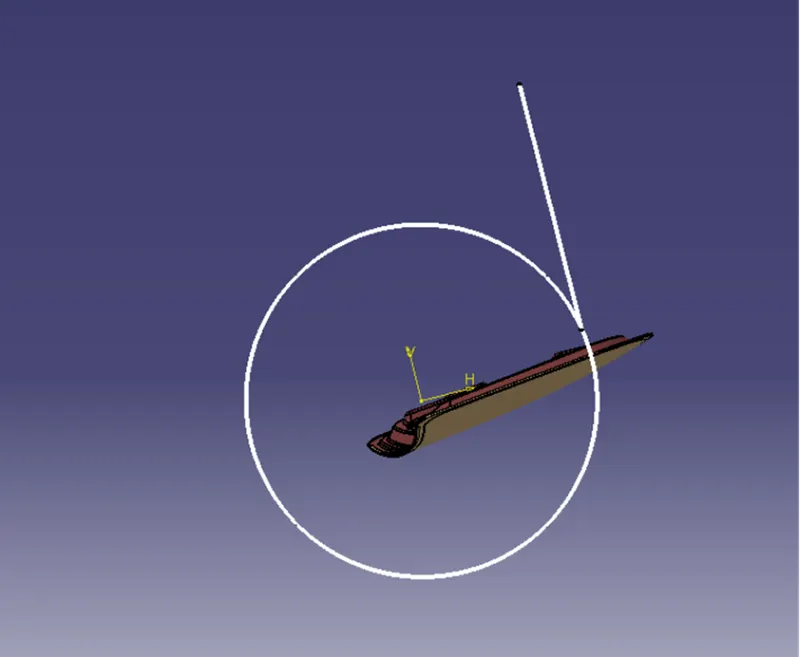
while opening or closing hood, the latch should be perfectly aligned with fixing or striker point. For that, latch trajectory must be perpendicular to the hinge axis.
OUTER PANEL:
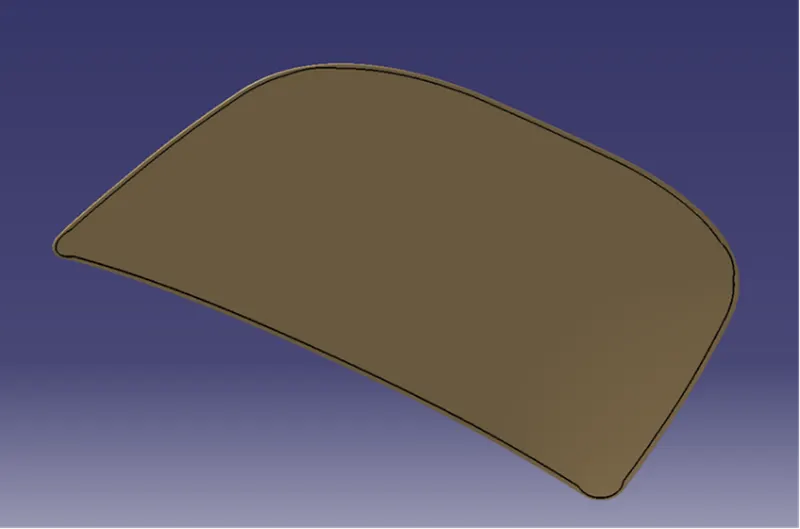
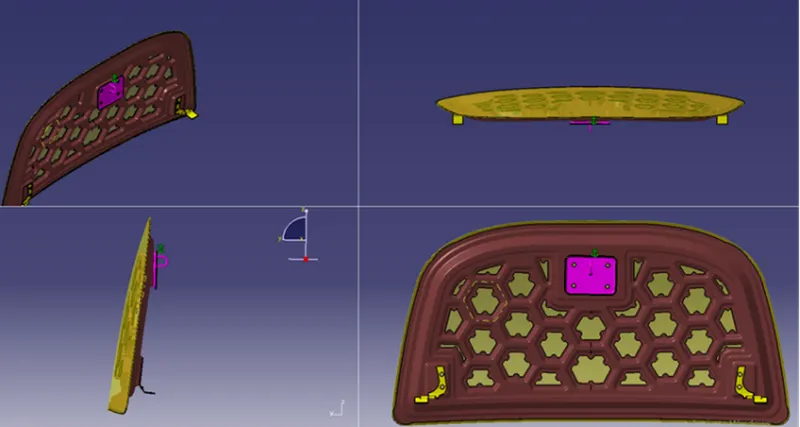
ISOMETRIC VIEWS:
Deep drawing:
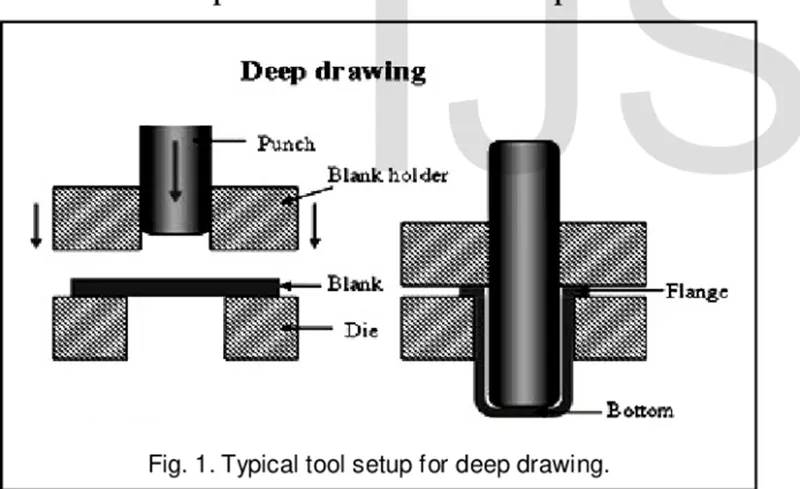
Deep drawing is a sheet metal forming process in which a sheet metal blank is radially drawn into a forming die by the mechanical action of a punch. It is thus a shape transformation process with material retention. The process is considered "deep" drawing when the depth of the drawn part exceeds its diameter.
PROCEDURES OF DESIGN HOOD:
Hood is one of the major components of the Vehicle body. It mainly covers 2 major power transmitting components i.e. Engine and Radiator assembly. Along with covering them through its inner panel, the hood outer panel also serves a major role in the aesthetics and ergonomics of the vehicle.
It has 3 supportive components Viz.
- A) Hinges- for easy opening and closing of the hood
- B) Latch- to keep hood in correct closed position &
- C) Support Rod- helps in keeping the hood in the open position.
We will be mainly discussing
- Hood outer panel
- Hood inner panel
- Hinge Assembly
- Latch assembly
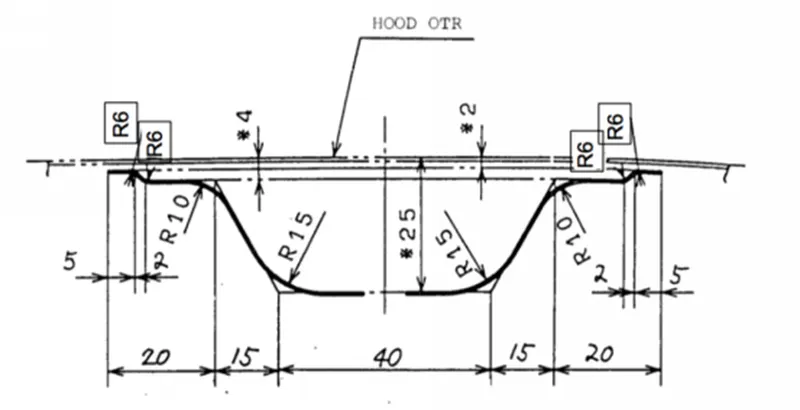
Hood inner panel is designed as per the given Master Section sketch concerning the Hood outer skin provided.
HOOD INNER PANEL:
- In the inner panel only we can research & implement the safety of pedestrians & as well as the driver. In this panel only we can attach the reinforcement, embossed, mastic points, etc.
- It is an object of the present invention to provide a hood inner panel capable of reduction of a reaction force of the hood inner panel even if a level of deformation of a hood of a vehicle increases, & ensuring a sufficient energy absorption capacity.
First, we have to create a hood inner panel with the given master section and create embosses for forces impact in the hood.
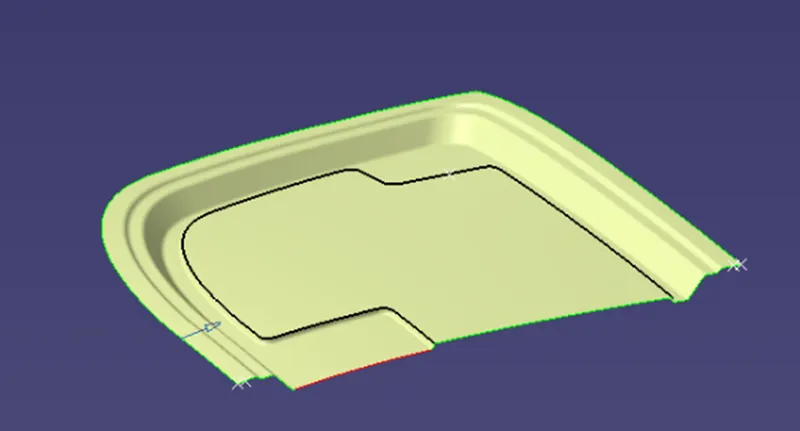
Offsets the given outer panel which given master section 1.7mm, 4.7mm, 26.5mm and 21.5 mm. split the offsets surfaces by using a parallel curve, in first offset surface 15mm form edge, the second surface between 17mm and 30 mm from the edge, third surface 50mm from the outer edge. Use multi section tool from the split edges and join three surfaces with the surface fillet option. The fillet value is min 3mm and max 5mm in the sheet metal.
Then for the embossing surface draw a sketch excluding are for hinge and latch emboss position. extrude the sketch and split joined surface offset surface. Create sweep in split edges and trim with a 21.5mm offset surface.
The necessity of Emboss and its Designing:
After the basic master layout is done we have to provide emboss sections to dissipate the collision force to outer corners toward hinge portions. Thus impact force passing to passenger cabin be reduced majorly.
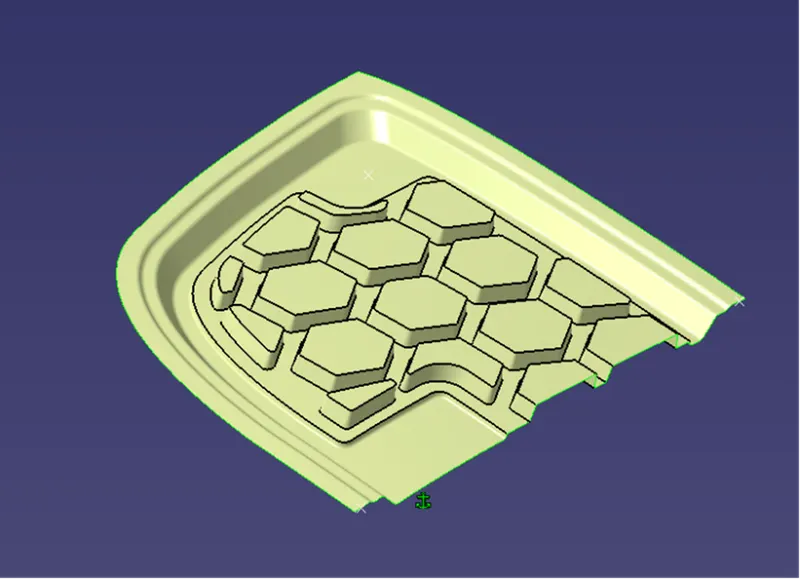
While creating these emboss we have to keep in mind the draft direction and draft angle so that the stamping tool will create proper embossed structures on the panel. Consider the following image for reference of embossed sections on the inner panel.
Create a sketch for embossing on the above-trimmed surface. As same extrude the sketch and split with surfaces, sweep emboss split edges with the angle of 7 degrees concerning the surface. Trim with 5.7 mm offset surface.
Mastic creation:
Mastic Data
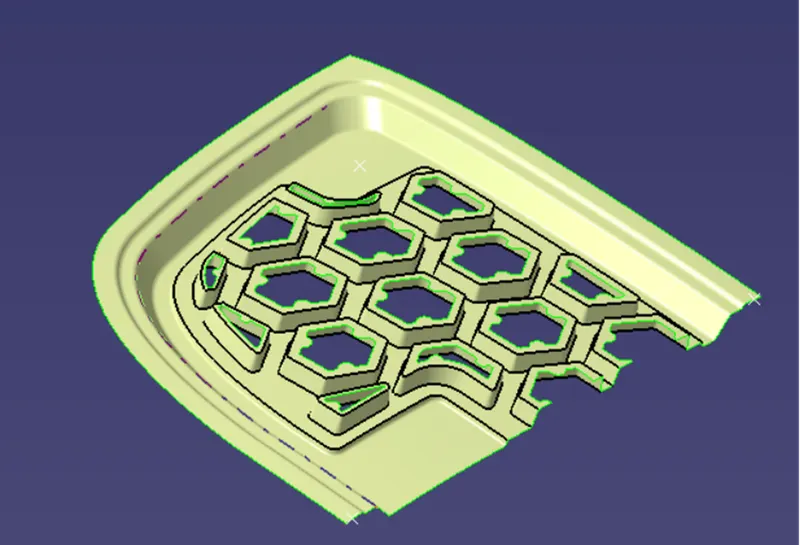
To reduce NVH i.e. noise vibration and hardness between the hood inner panel and an outer one, mastic sealants are needed to be applied. Every mastic sealant improves the strength locally by around 80mm. It joins the inner panel with the outer panel also reducing the vibrating noise.
Thus while designing embosses on the inner panels we have to design mastic portions where sealant can be applied as shown in the image: Mastic Data.
Mastic regions are designed such that they will be closer to the outer panel. Rubber sealant is applied on the mastic regions of the Hood's inner panel which will glue both panels together.
Hinge Positioning:
Hinge positioning is needed to be properly designed so that the opening and closing of the hood will occur correctly. Also, it will decide if the latch and striker get closed correctly or not.
To have proper hinge location, align hinges on the inner panel such that the midpoint of an axis passing through both hinges with striker centre point be radius which will create a trajectory.
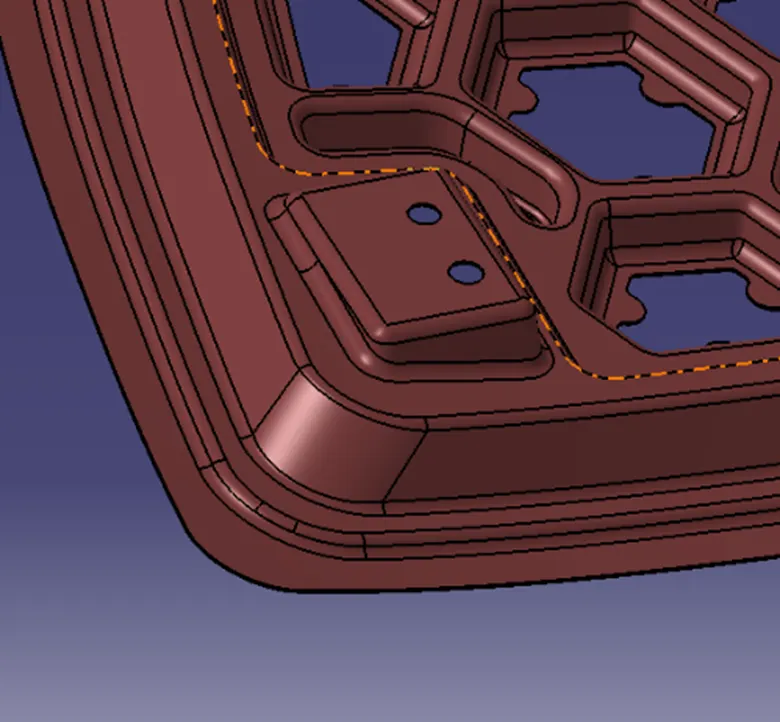
Latch Emboss: Similar to hinge emboss we have to design latch emboss to improve the local strength of the inner panel providing a support structure for latch mounting.
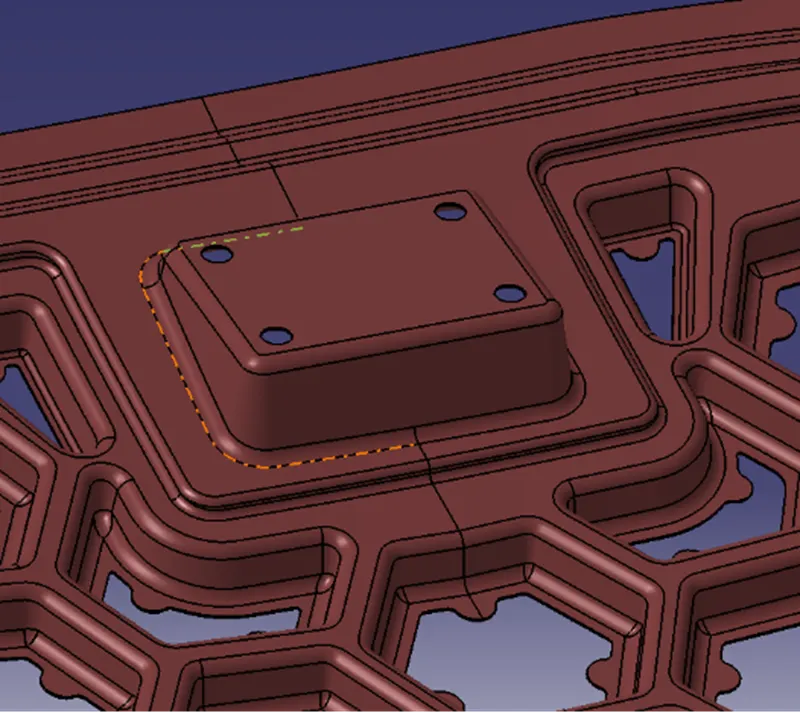
Inner Panel of Hood:
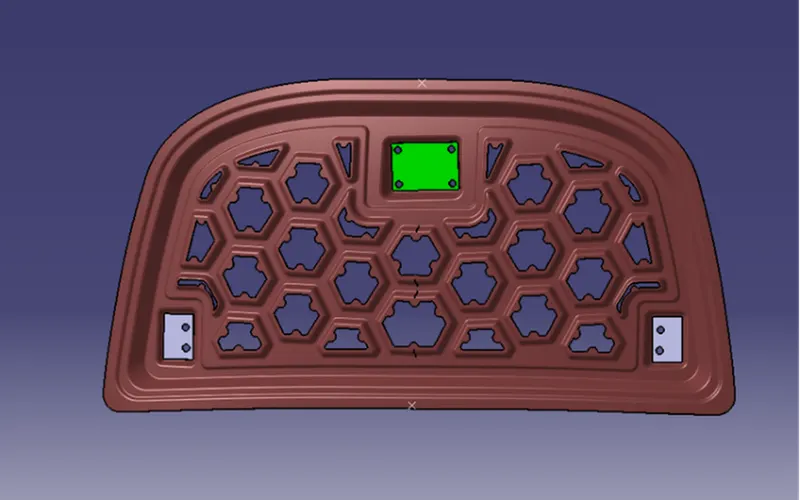
This is the final inner panel of the hood with emboss, cut-out and hinge emboss and latch emboss.
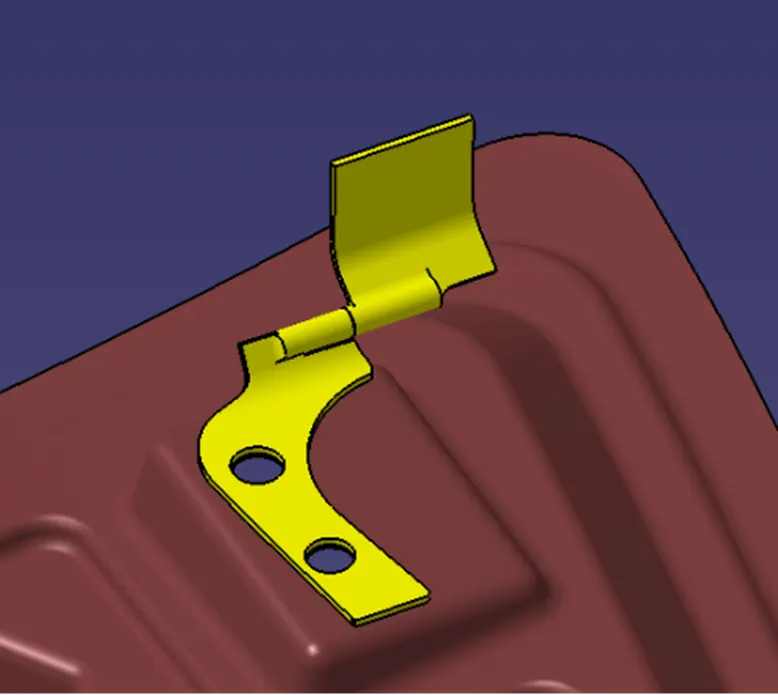
Latch Assembly:
Latch & striker is used for locking the hood with the car. It is usually placed on the space provided on the inner panel.
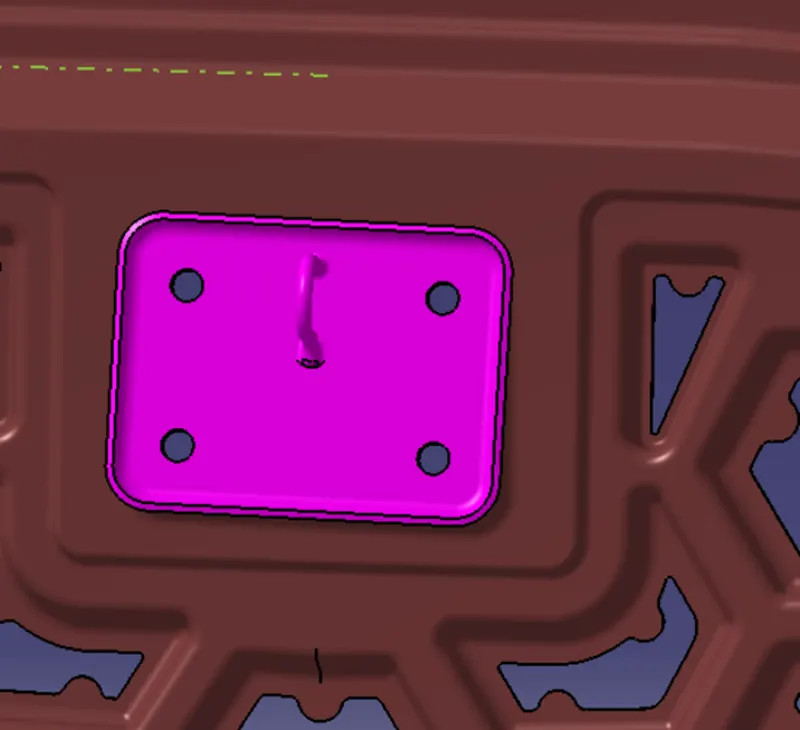
REINFORCEMENT:
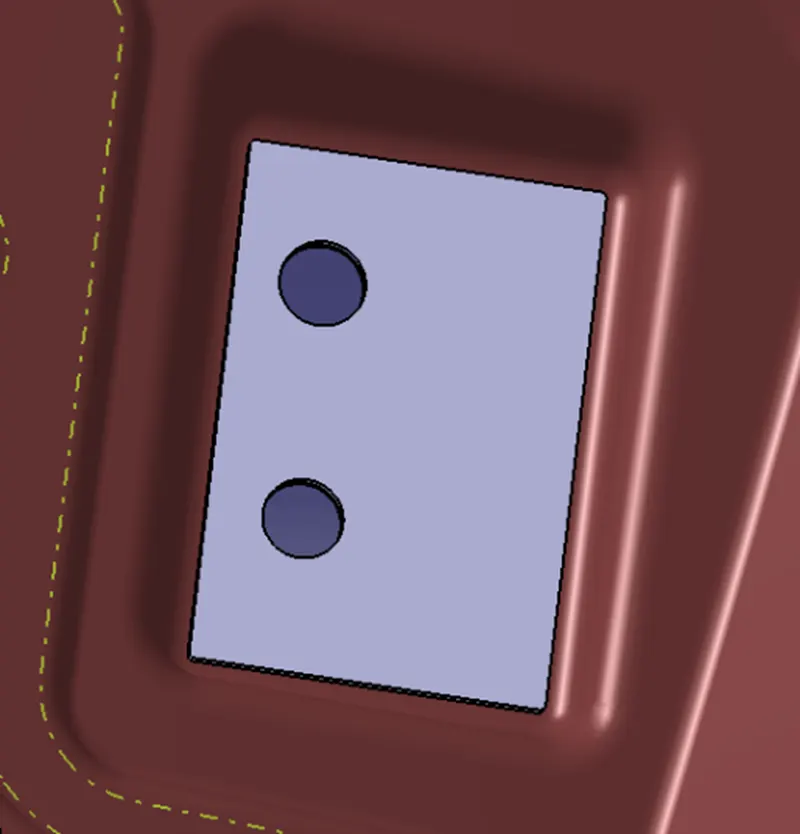
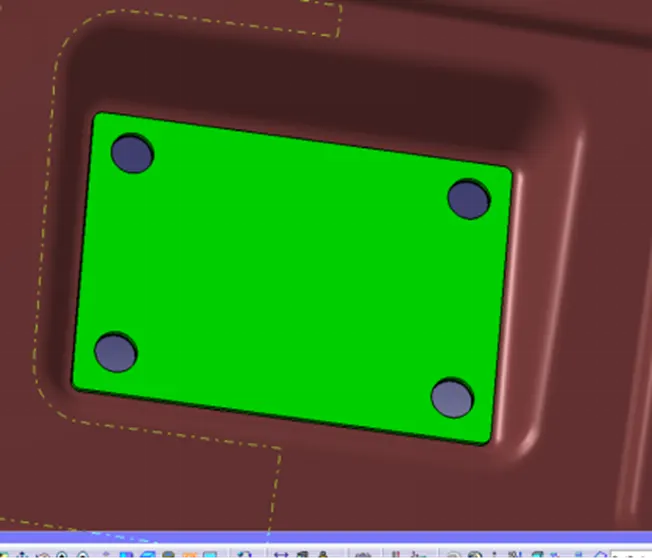
To furthermore reduce the impact on the occupants inside the car, additional latch and hinge reinforcement to the hood. When latch and striker are placed, there is a drop in strength at that position thus reinforcement is required. Also, stiffness pads are placed to reduce NVH. Hinge and latch reinforcement thickness is kept at 1.5 mm but it may vary.
Hinge Reinforcement:
Latch reinforcement:
Inner panel with hinge and Latch assemble:
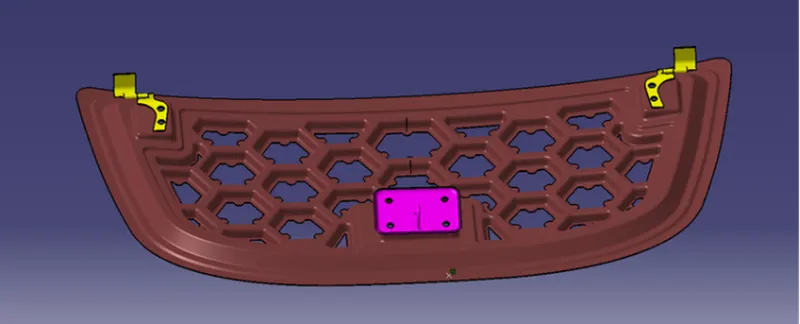
Inner panel with hinge and Latch Reinforcement:
Conclusion:
Therefore, we designed the Hood outer panel, inner panel, and the necessary reinforcements by following the Master section mentioned with the design parameter. Submitted an assembly of Hood inner panel, outer panel, latch, hinge, and reinforcements.