Fender Design - Wheel Arch Challenge
Aim:- Calculate the Wheel Arch gap at required points and check whether the car passes the European standard.
Fender
Fender is the American English term for the part of an automobile, motorcycle or other vehicle body that frames a wheel well (the fender underside). Its primary purpose is to prevent sand, mud, rocks, liquids, and other road spray from being thrown into the air by the rotating tire. Fenders are typically rigid and can be damaged by contact with the road surface.
Sticky materials, such as mud, may adhere to the smooth outer tire surface, while smooth loose objects, such as stones, can become temporarily embedded in the tread grooves as the tire rolls over the ground. These materials can be ejected from the surface of the tire at high velocity as the tire imparts kinetic energy to the attached objects. For a vehicle moving forward, the top of the tire is rotating upward and forward, and can throw objects into the air at other vehicles or pedestrians in front of the vehicle.
The purpose of a fender is pretty simple. Its purpose is to keep mud, rocks, and other road debris from being thrown around by the tires. In other words, the fender is a housing for the wheels that keeps road debris contained. If there was nothing covering the wheels, all kinds of debris would be kicked up by the rotating tires.
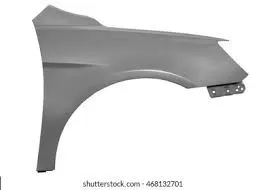
What Is The Purpose Of A Fender On A Car?
The purpose of a fender is pretty simple. Its purpose is to keep mud, rocks, and other road debris from being thrown around by the tires. In other words, the fender is a housing for the wheels that keeps road debris contained. If there was nothing covering the wheels, all kinds of debris would be kicked up by the rotating tires. The fender not only protects your car from sustaining damage from road debris but it prevents this debris from being thrown up at other vehicles on the road. This is why vehicles with large, oversized tires are often required by law to install fender flares.
Types of fenders
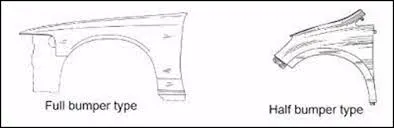
1. FULL BUMPER TYPE:
The full bumper type fender was used in old cars, it covers the full area until the front lighting. But it has a lot of sheet metal material which is unnecessary and increases the weight of the fender. This type of fenders are no longer used in automobiles
2. HALF BUMPER TYPE:
Mainly half bumper type is used in automobiles. It is basically related to scrap management. Half bumper type leads to less wastage of the blank.
We are changed from full bumper type to half bumper type to reduce the scrap rate per blank. In the full bumper, we can only produce one Fender per blank, whereas as a half bumper type we can produce 2 fenders per blank.
There are three wheel arch fender regulations:-
- JAPAN REGULATION REQIREMENTS:--
As per Japanese regulation, the clearance between tyre and fender must be greater than 5mm The projected points to be measured are at an angle 30° forward & 50° rearward respectively.
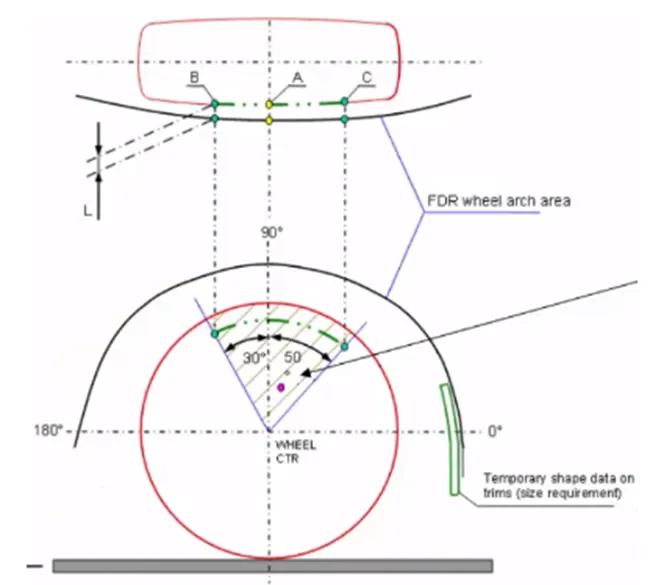
As per Japanese regulation, the clearance between tyre and fender must be greater than 5mm The projected points to be measured are at an angle 30° forward & 50° rearward respectively. Thus at point c, the clearance value is in negative value which denoted interference and hence the modifications are to be carried out.
- USA REGULATIONS REQUIREMENTS:--
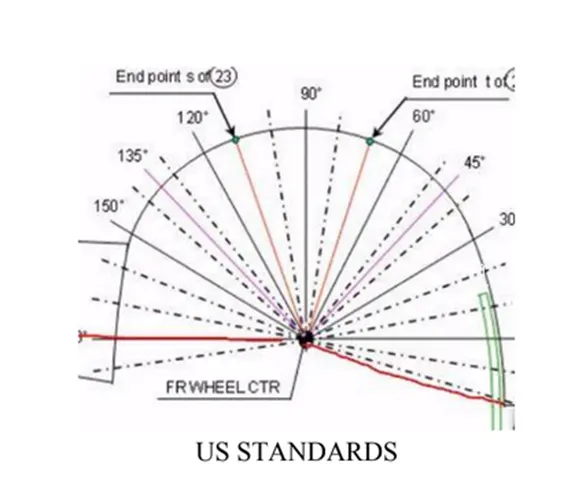
As per US regulation, the clearance between tyre and fender must be greater than 5mm. The projected points to be measured are at an angle 0° forward to 100° respectively. Thus each position is divided into 10°. Thus the projected distances are measured at around 21 different points.
- EUROPEAN REGULATION REQUIREMENTS:--
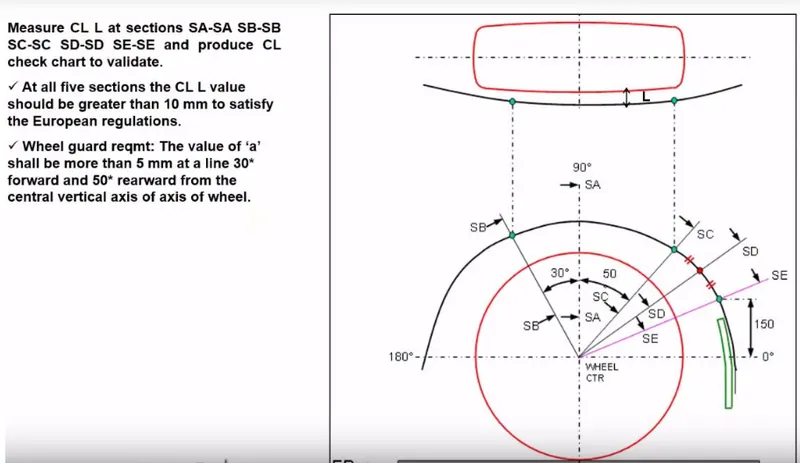
As per European regulation, the clearance value between fender and tyre profile must be greater than 10mm. The value is measured in projected point at an angle 30° forward and 50° rearward respectively. The measurement took in five different positions of the tyre at point a & b the clearance is acceptable. But at point c, d & e there is a negative sign which denoted the interference of wheel arch with a tyre.
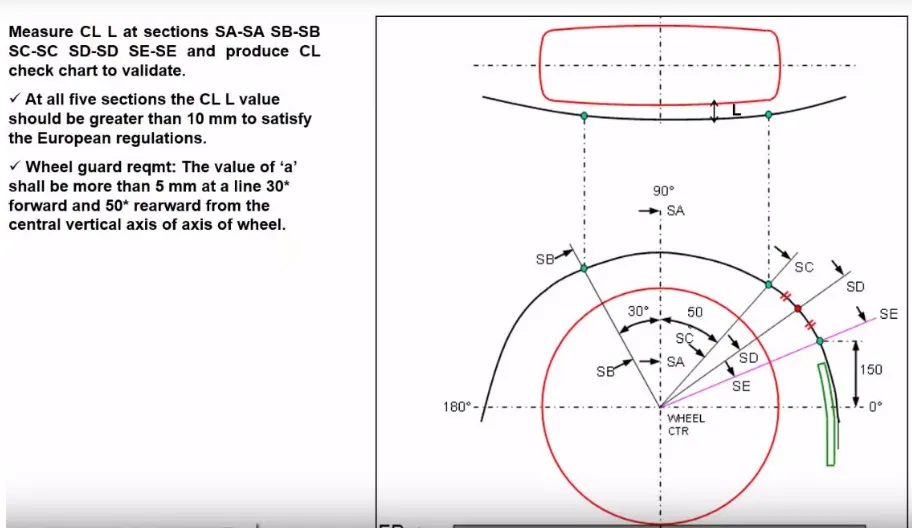
|
SR .NO |
POINTS |
ANGLE |
|
1. |
SB |
30 Degree from center. |
|
2. |
SA |
90 Degree reference line. |
|
3. |
SC |
50 Degree to right from center. |
|
4. |
SE |
150mm above from the center line . |
|
5. |
SD |
This is the midpoint of point SC and SE. |
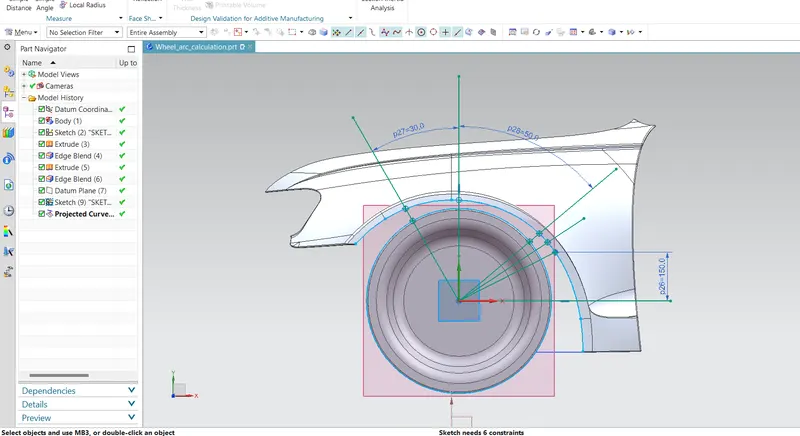
So as shown in the above figure and table we need to sketch and locate this points on to the wheel.
Now as we have just located the points as per the given standards we need to project the points on to the fender and then calculate the distance and give the proof that the above given fender is following the European standards or not.
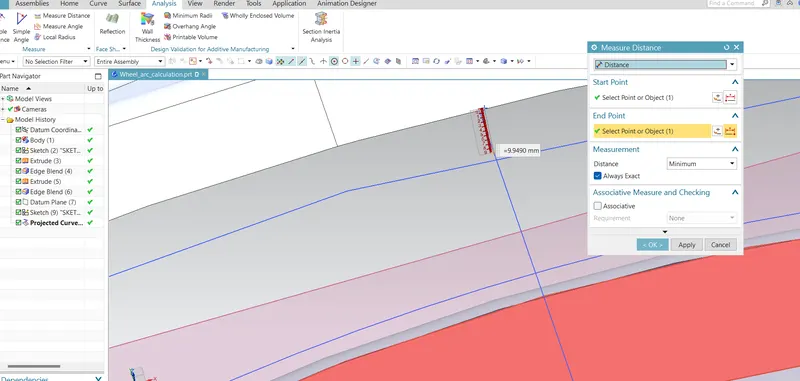
Now as we have projected the points let’s calculate the L i.e the length between these two points.
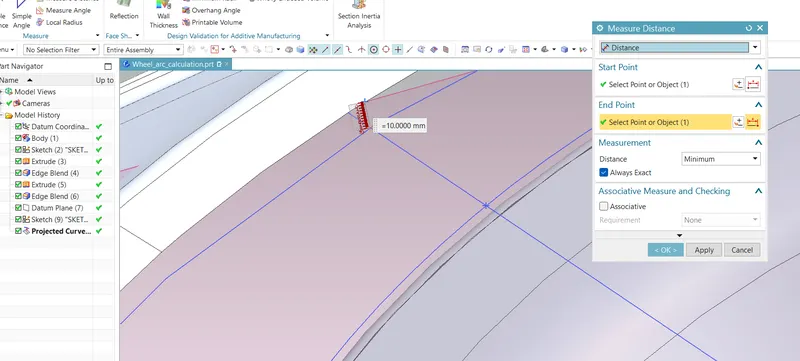
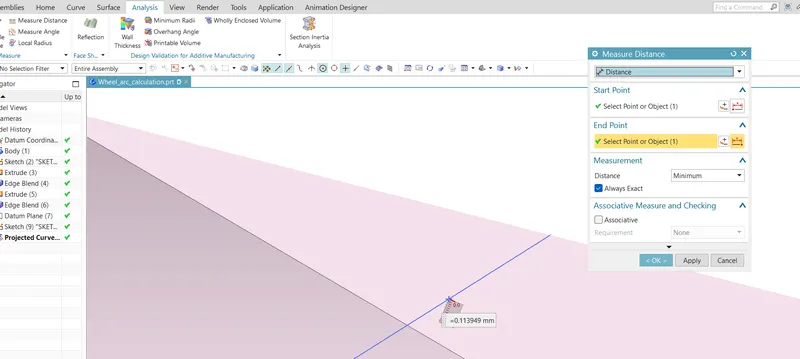
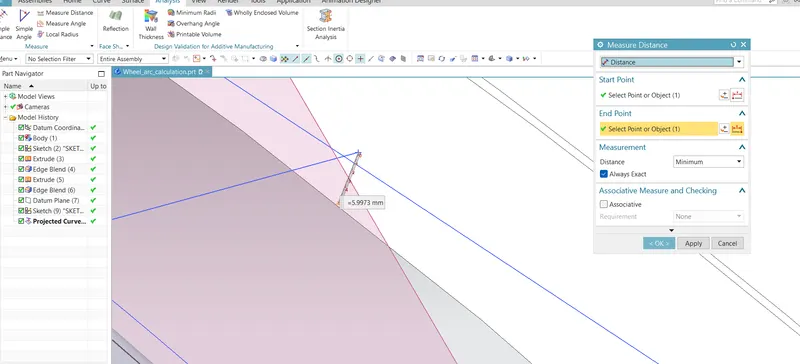
The calculated data is given in the form of the table.
Here in total the four points is located.
The distance should be greater 10mm.(LENGTH)
|
Sr no. |
Points |
Distance (L) |
Image |
|
1. |
SB |
10mm |
|
|
2. |
SA |
9.9490mm |
 |
|
3. |
SC |
0.1139mm |
|
|
4. |
SE |
5.9973mm |
|
|
5. |
SD |
2.8875mm |
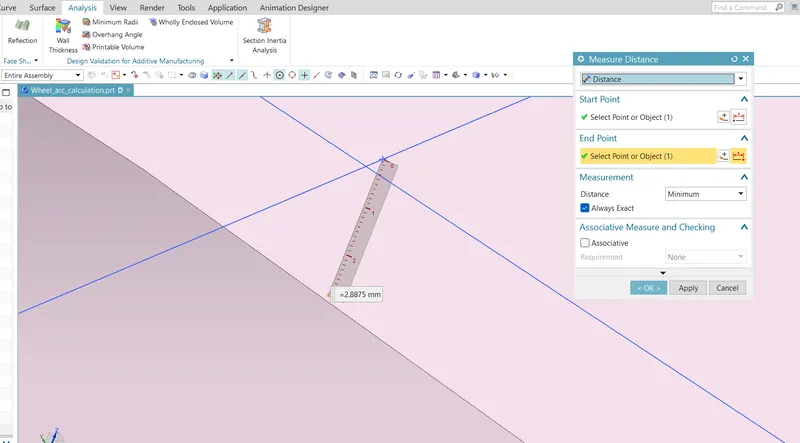 |
Wheel guard clearance (a)
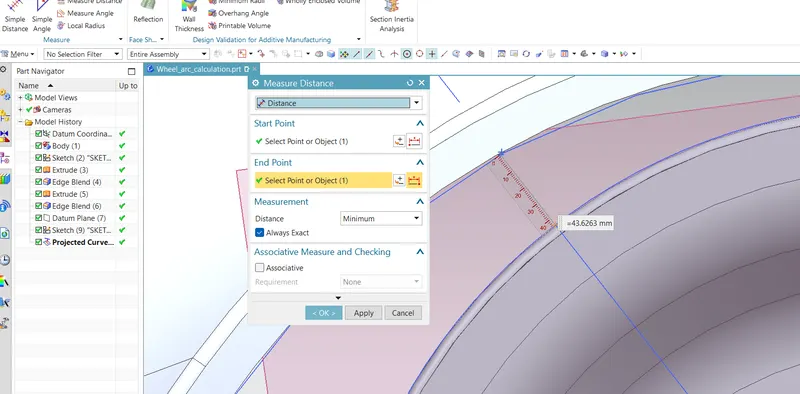
Distance at BB clearance (a)= 43.6263
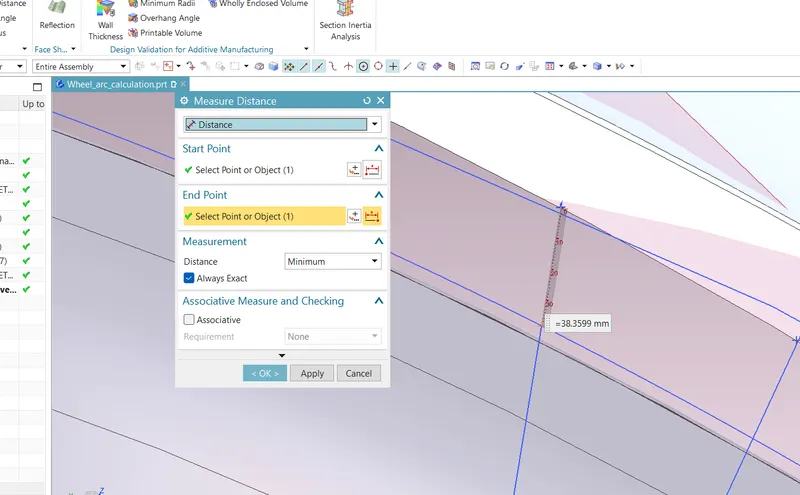
Distance at CC clearance (a)= 38.3599
Result:-
At all section that is SB,SA,SC,SD,SE clearance value should be more than 10mm
SB has the tolerance length of 10mm and rest all the points SC, SE, SD,SA are below 10mm i.e less than 10mm. to satisfy it should be more than 10mm .so it does not satisfies this condition
Wheel guard clearance a ( a should be more than 5mm)
So the values of a are more than 5 mm so it satisfies this requiremnet
Conclusion:- This fender cannot pass the European standards.Because both the conditions that is all section claerance as well as wheel guard clearance (a) has to be satisfies . The design should be sent back to the class A designer to modify the design and increase the gap.