BIRD-STRIKE ANALYSIS ON AN AIRCRAFT WINDSHIELD USING LS-DYNA
BIRD-STRIKE ANALYSIS ON AN AIRCRAFT WINDSHIELD USING LS-DYNA
Introduction:
A bird strike refers to collision between an aircraft and a bird. It mostly occurs at the low altitude or on the ground i.e. runways during take-offs and landings. With the increase in number of annual flights, birdstrike incidents have also increased.
Bird strikes on aircraft mostly occurs during take-off or landing stages as the large open fields surrounding the airports provides perfect feeding, nesting and resting areas for large species of birds. Most common part of aircraft where bird strike can occur is the engine followed by leading edge (wing and empennage), windshield, nose and fuselage.
Various methods are implemented by airport authorities to keep these birds away from the runways like remote bird sensors and hand-held laser devices for detection of birds during flight operations.
Objective:
Experimental testing of aircraft engines is associated with high costs and long development times. The usage of new composite and hybrid metal reinforced composite structures in aircraft components requires extensive testing.
In order to reduce the reliance on physical testing that slows the development, new computational approaches for assessing the bird strike crashworthiness are needed.
The aim of this project is to develop a numerical and scientific methodology to study the bird-strike phenomenon against the windshield of a commercial aircraft.
A series of numerical simulations have been performed using the explicit finite element solver code LS-Dyna, in order to estimate the windshield structure capability to absorb the bird impact energy, safely and efficiently, according to EASA Certification Specifications.
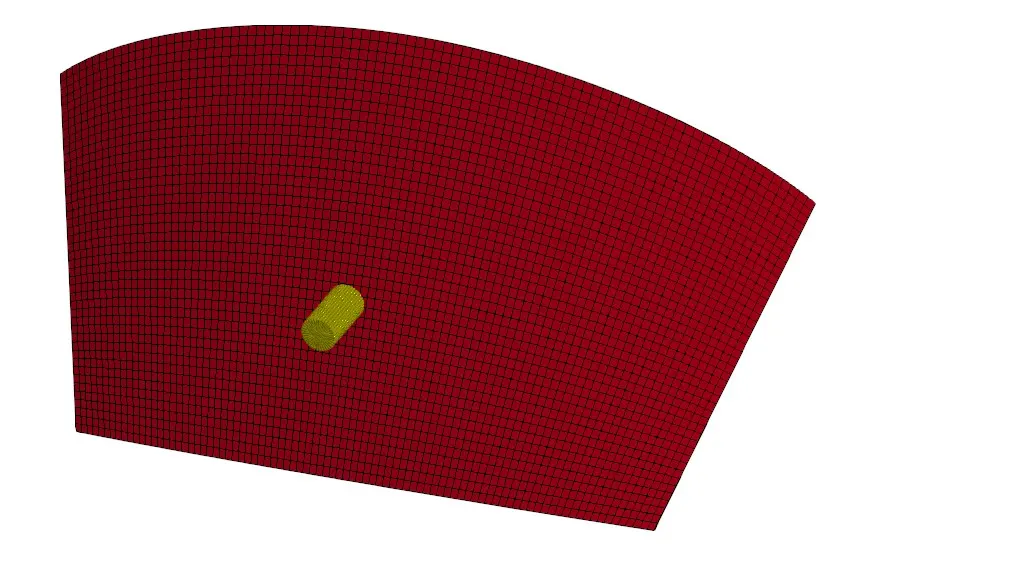
The project is focussed on developing a numerical approach of a simplified, but realistic, square flat windshield model where it is subjected to the impact of a 1.4 kg bird model at 100 m/s to estimate the sensitivity and impact response of the windshield structure.
Significance of Bird strike analysis:
Birdstrike is a major threat to commercial aviation with about 90% of all foreign object damage cases are related to birds. Majority of bird strikes cause little damage to the aircraft; however, the collision is fatal to the birds involved.
Most accidents occur when there is a collision involving a bird (or birds) and the windscreen or a bird (or birds) is sucked into the engines of the aircraft. In addition to property damage, collisions between manmade structures and conveyances and birds is a contributing factor among many others, to the worldwide decline of many avian species.
In order to reduce the number of experimental tests, design engineers perform an intensive numerical analysis addressed to verify the ability of a specific structural component in absorbing such localized impact energy, and to identify the most probable critical location.
Most part of these analyses are carried out with explicit nonlinear finite element (FE) code which allows a good correlation with the real test, at least in its global behaviour, which, indeed, is the objective of this project.
Smooth Particle Hydrodynamics (SPH) Formulation:
The SPH formulation is mostly applied to fluids. In this formulation the fluid is divided into a set of discrete elements known as particles. There is no contact between the individual particles and it is a mesh free method.
The distance between the particles is known as smoothing length. This method of formulation can handle very large deformations. Each particle is assigned with a mass in SPH technique.
Bird impact can be considered as a hydrodynamic impact because at very high impact speeds, bird act as fluid.
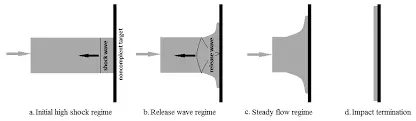
Bird impact process is divided into 5 stages namely:
- 1.Solid Structure impact
- 2.Solid Fluid transition
- 3.Fluid Structure Impact
- 4.Non-Linear growth of impact region
- 5.Structural response and damage
At the initial impact phase, the shockwave is generated upon the contact between bird and the structure and this shock wave propagates through the bird material.Bird impact process lasts for few milliseconds.
The first four stages occur simultaneously. The pressure gradient occurs on the edge of the projectile which causes the particles to flow steadily in the outward direction. Steady flow is attained after several replications of release waves. As the impact proceeds, decay occurs where the pressure reduces to zero and it is called the termination phase.
Development of 1.4kg Bird Model:
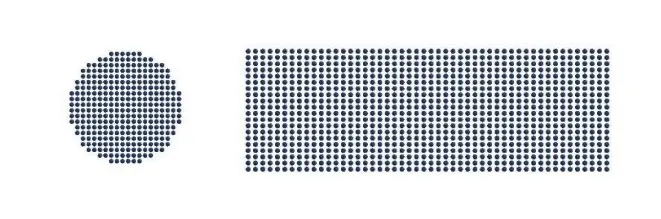
Geometries such as regular cylindrical, spherical, ellipsoidal and cylinder with hemispherical ends are typically used to model the bird. Mostly cylindrical or hemispherical ended cylinder is used as it is believed to give adequate results and are relatively simple to define in finite element pre-processor.
The SPH bird model is developed using LS-Prepost. In this study, cylindrical bird model has been used.
According to the certification requirements, the mass of the bird is `m = 1.4 kg`, the density is `ρ = 950 (kg)/m^3` . The geometric model is approximated by a right circular cylinder, and using the formula,
`D=((2m)/(pirho))^(1/3)=0.098m`
having assumed `L=2D` and therefore `L=0.196m`.
Material properties of Bird model:
The SPH approach is used to model the bird model instead of traditional Lagrangian approach because SPH method is more accurate where a considerable loss of accuracy due to element distortion is neglected. The resulting numerical model employs 15,907 SPH nodes with an average distance between them of 5 mm.
It impacts the windshield at a speed of `100 ms^-1`, as required by the International Certification Standards.The SPH bird model was considered as node, and the velocity is given to this node set using the INITIAL VELOCITY card in LS-Prepost.
An idealization of fluid dynamic material has been used for the bird. Hence the bird model is defined by using *MAT NULL card and an Equation of State (EOS) is specified. *MAT NULL card is generally used for soft behavior type of the material.
An EOS is required in order to accurately simulate material behaviour. An EOS determines the hydrostatic behaviour material by calculating pressure as a function of density or temperature. EOS comes into picture where we have very high strain rates, material pressures more than yield stress and propagation of shock waves.
*EOS_GRUNEISEN is the most commonly used EOS forms for non-gaseous materials.
Material models that require an accompanying EOS, calculate only the deviatoric component of stress ,i.e. the strength behaviour, whereas the EOS calculates pressure component of total stress.
The Gruneisen EOS used in modeling bird material, has parametres of `c=1647` and `S1=2.48`, where c= speed of sound in the material and S=coefficient of the slope of shock speed versus particle speed curve Vs-Vp.
Development of Windshield structure:
As result of the impact, following the International Certification Standards, the windshield must, not only, withstand to the event without bird penetration, but also avoid a complete fragmentation of all transparencies, to ensure acceptable visibility to allow safe flight and landing.
This specification could be critical in the case of the windshield made up by only two panels because an impact on a side could cause the failure of the other panel too, or an impact on the canter beam, which divides the two panels, could create a fragmentation of both transparencies at the same time with consequent loss of visibility.
Ensuring for safety standards, the windshield geometry in this project is modelled with three layers of transparent composite materials.
The first(impact prone) layer and the third layer are modeled Acylic glass material properties and the second layer is modeled with PVB (Polyvinyl Butyral) which bonds the two acrylic glasses together.
Material properties of Windshield layers:
| Configuration | Surface area `(m^2)` | First layer thickness(mm) | Second layer thickness(mm) | Third layer thickness(mm) |
| Single curvature | 2.75 | 4 | 4 | 4 |
A typical windshield is made up by laminated glass. The basic layup of a laminated glass involves two glass panels bonded by polyvinyl-butyral (PVB) interlayer. In the case of an impact, such as the birdstrike, the splinters, caused by the glass failure, remain connected to the PVB-interlayer.
The FE model of the windshield panel, where each layer of the laminate is modeled with solid elements, pure hexahedral, to take into account the curvature of the windshield and efficient simulation results.
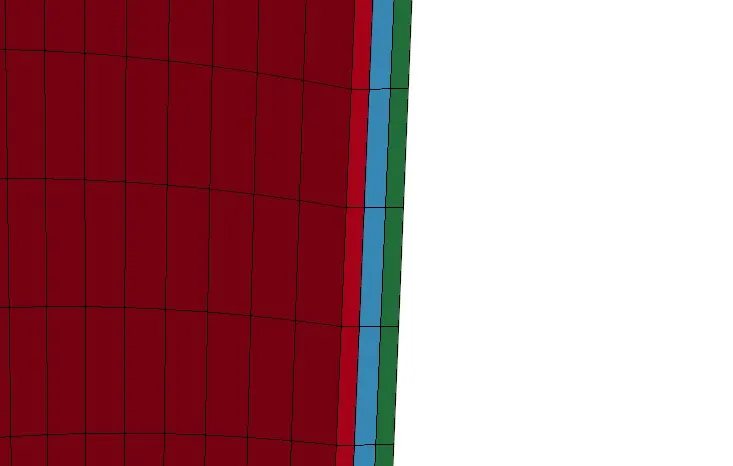
The glass is considered as an elasto-plastic material with the Power law plasticity material model and the plastic material of the PVB (Polyvinyl-butyral), which is interposed between the layers of glass, behaves like a viscoelastic interlayer. This type of material shows good characteristics of strength and transparency, allowing a high deformation before the failure and a good tearing strength.
1. Acrylic glass for layer 1 and 3
| Density`((kg)/m^3)` | Young's Modulus `(Pa)` | Poisson's ratio | Hardening exponent | Yield stress `(Pa)` |
| 2500 | 6.895e+10 | 0.22 | 0.5 | 7.500e+07 |
2. PVB (Polyvinyl Butyral) for layer 2
| Density`((kg)/m^3)` | Bulk Modulus `(Pa)` | Short time shear modulus `(Pa)` | Long time shear modulus `(Pa)` | Decay constant |
| 2500 | 2e+9 | 1e+9 | 9e+6 | 12.6 |
Boundary Constraint, Section, Contact and Control setup:
In order to fix the windshield structure boundary in space, all the edge nodes of the windshield layers are arrested from all six DOFs using Boundary_SPC card node set selection.
Since the windshield layers are modeled with solid elements,they are modeled with *SECTION_SOLID card with hexa-hedron element formulation and the bird is modeled with default SPH section parameters.
During the impact event, the bird and windshield models should be interacting with each other and to avoid penetration of elements interacting, *AUTOMATIC_NODES_TO_SURFACE card is defined to ensure contact setup between the bird and windshield.
In the *CONTROL_TERMINATION card, a simulation runtime of 8ms is defined in the ENDTIM option. Houglass energy is allowed to compute as there is a dissipation of energy during the impact event.
The results and output files are requested from the *DATABASE card.
Model checking and solving the setup:
One of the most important pre-processing tasks is to ensure the validity of a CAE model before submitting it to the solver for analysis.
A good and rich suite of checks reduces engineering errors, increases the confidence in the simulation results, and minimizes the duration of a simulation cycle by eliminating multiple back and forths from the solver to the pre-processor.
After getting cleared up with the errors if any, the bird-strike simulation setup is saved.
The saved keyword file is set to run in LS-DYNA manager.
A normal termination of the setup is achieved and the results are analyzed for post-processing.
Post-processing results:
The numerical results of the birdstrike analysis against the windshield structure are presented in this section.
Animation
The following animations show that the impact of bird against an aircraft windshield at a velocity of 100m/s. The bird after impact against the windshield is splashed and breaks down into pieces of debris.

1. Effective Stress
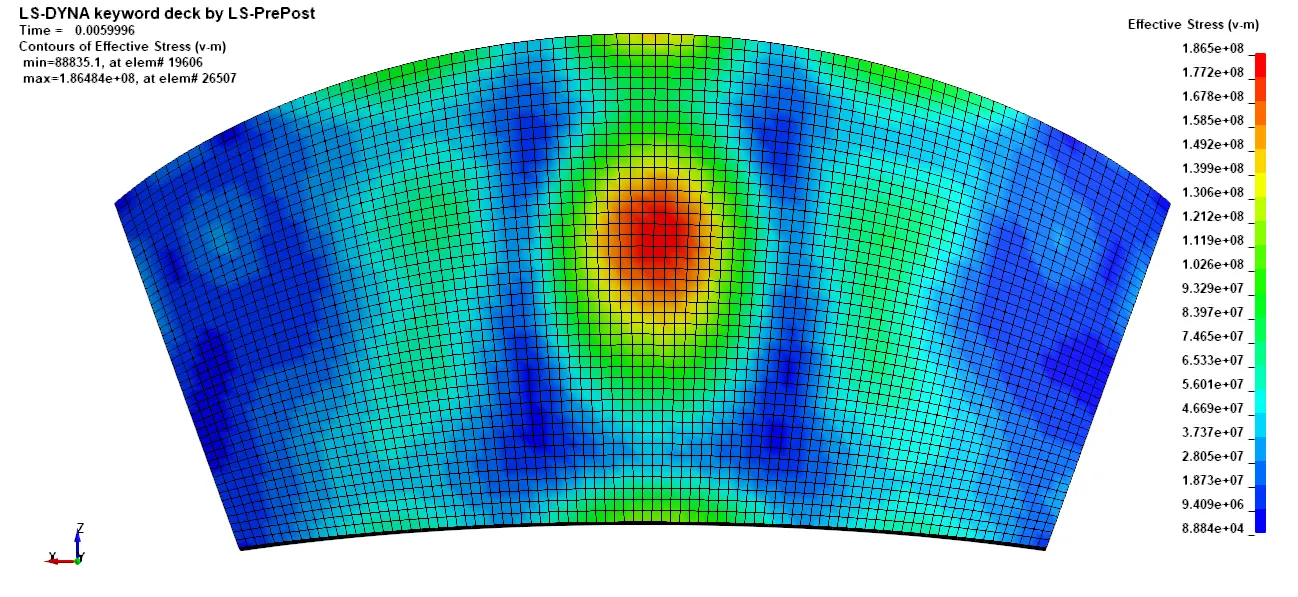
The above figure displays the contour plots of Von Mises stress distribution in the windshield structure. It can be seen that the impacted zone of the windshield is subjected to a greater stress limit.
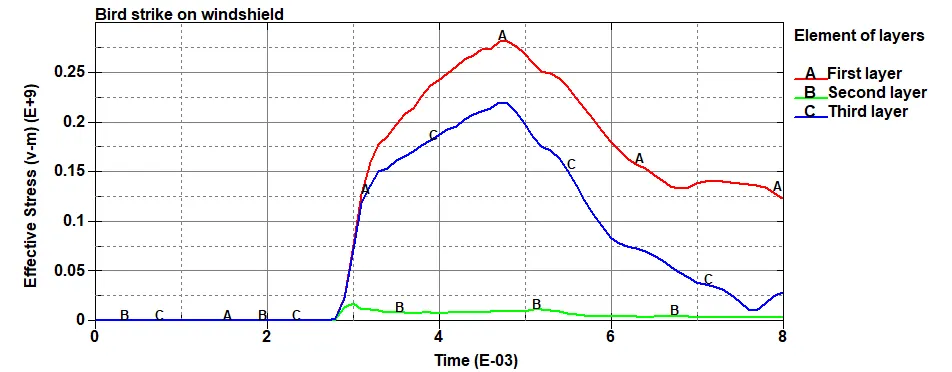
The stress plots depict that the first layer of the windshield results in greater stress distribution, followed by the third acrylic glass layer. The PVB second layer produces less stress.
It can be seen from the simulation results that that the windshield layers 1 and 3, given a yield stress of `75MPa`,the peak values of stresses for layers 1 and 3 are `280 MPa` and `220 MPa` respectively which crosses the limiting yield stress value. Thus, accounting for failure in the windshield structure during the bird-impact event.
1. Energy plots
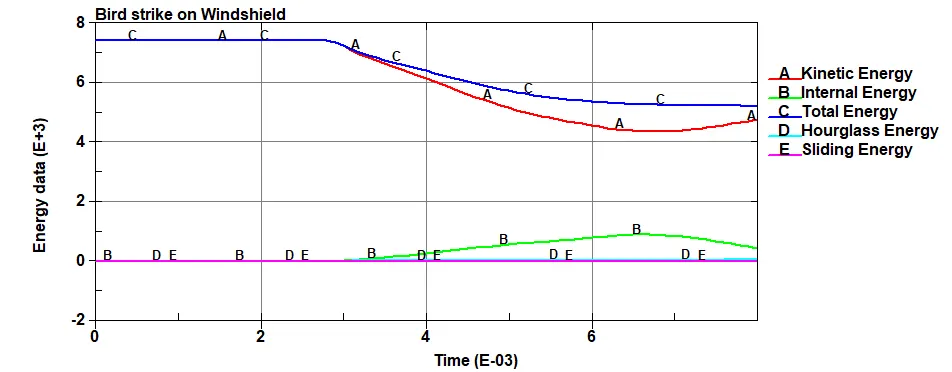
The above plot shows the global energy distribution during the bird-impact event.
The total energy remains conserved while transformation of energy occurs from Kinetic to Internal energy.
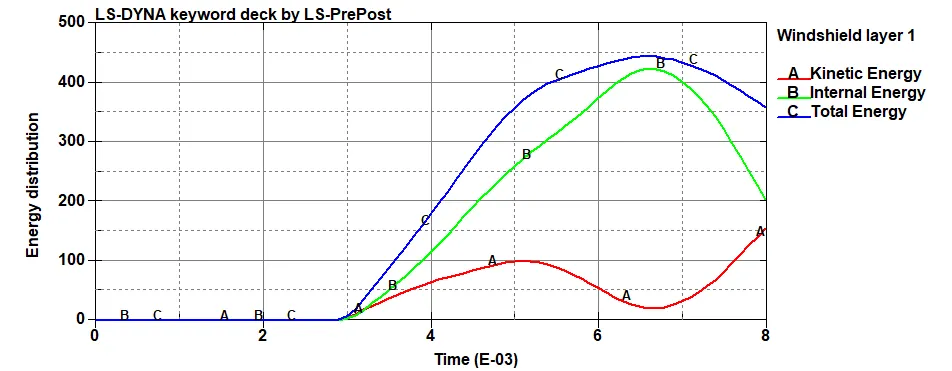
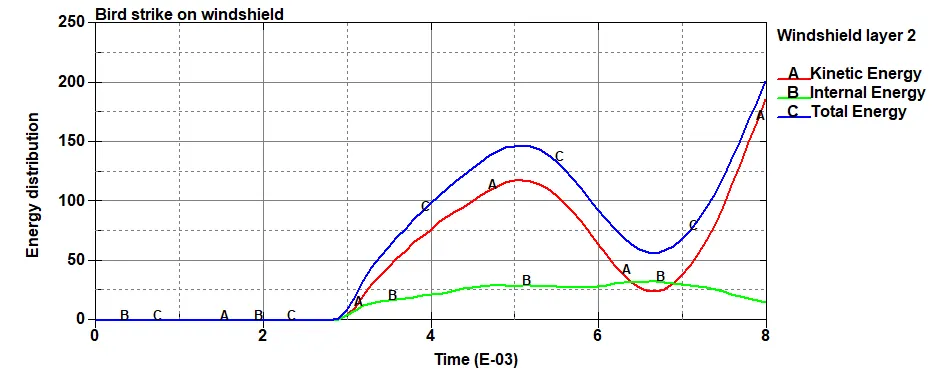
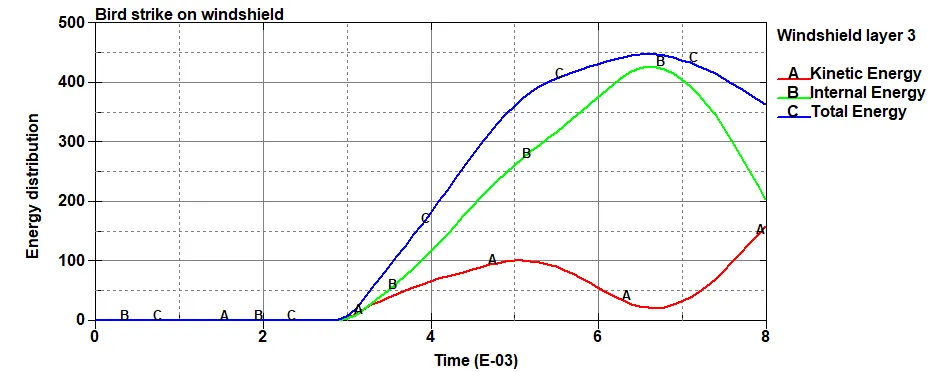
The above three plots depict the energy distribution of each windshield layer.
The energy peak is reached at a delayed time in the unimpacted panel, justifying the conclusion of a “spreading out” of the energy from a very localized area toward larger surface, moreover reducing any incipient failure.
3. Impact zone displacement
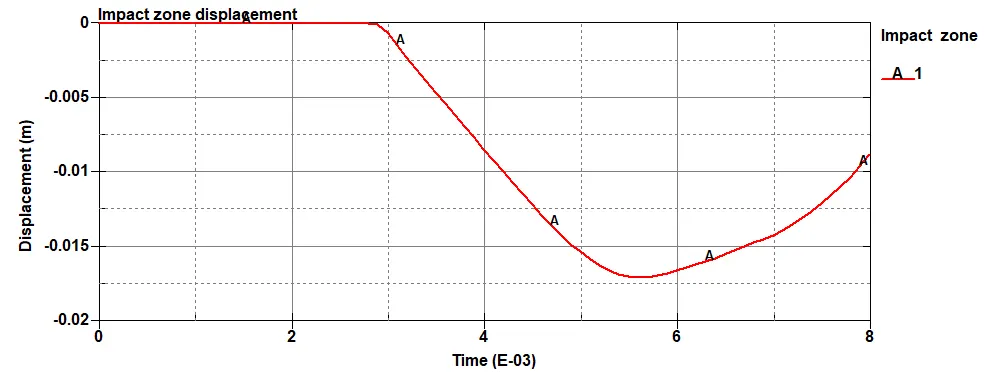
The above plot presents the displacement time-history of the impacted area of the windshield panel. It reaches a maximum value of `17mm` after 2.9 milliseconds starting to the instant of the impact. Then the panel tends to return to its initial configuration, reaching a final value of `8.75mm` at the end of the simulation, (8 msec).
Conclusion:
The goal of this work has been the development of a methodological numerical approach to the study of birdstrike against the windshield phenomenon of an airplane. The SPH approach has been confirmed to be the most suitable and feasible methodology to simulate the dynamics of a high-speed bird impact.
Both bird SPH and target FE model have been prepared by the LS-PrePost pre-processor software, while each numerical simulation has been performed by using LSDyna explicit solver.
The results obtained by the numerical simulation , have verified its capability to withstand the impact force transferred by the bird during the impact, by the virtue of its material properties and geometrical characteristic allowing the bird to slide along the windshield and to continue its path reducing the transfer of its kinetic energy to the structure.
It can also be concluded that the computational methodology can be used for certification as it is less time consuming and less expensive when compared to physical testing.