Week - 8 Mass Scaling
Mass Scaling❄
OBJECTIVE:
To use mass scaling to reduce the runtime of a model and ensure the stability of mass scaling by altering the values of TSSFAC and DT2MS.
PROCEDURE and RESULT:
Trial No.1
- The .key file provided is opened in Notepad++ and the Timestep Card is ignored and saved and the model is ran in the dyna manager.
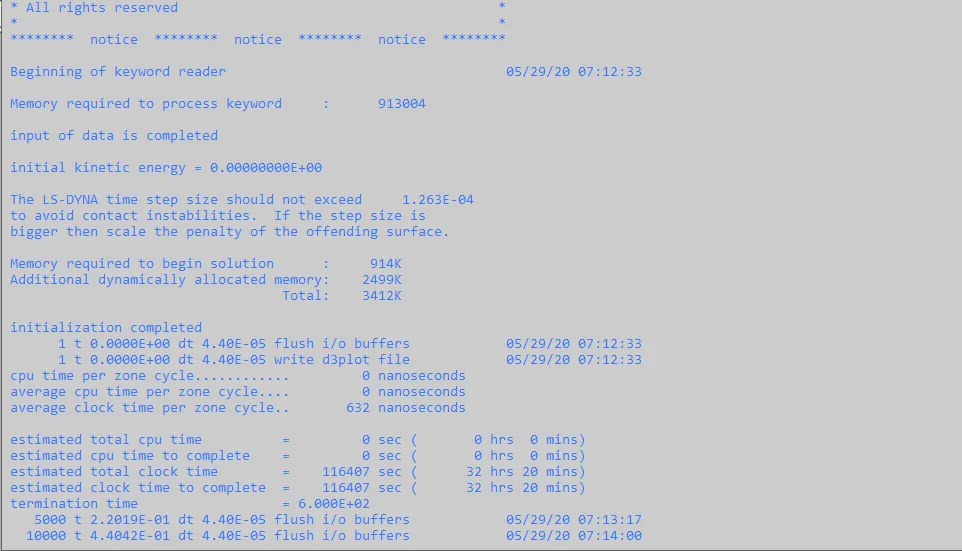
- It is found that without Mass Scaling the est. clock time is 32 hrs 20 mins.
Dt=4.4e-05
Termination time:600ms
No. of Timesteps req= (termination time)/Dt
= 600/4.4e-05
=13636363.63 no. of timesteps.
Trial No.2
- The Time step card is taken into account and the model is ran as it is and the changes are noted.
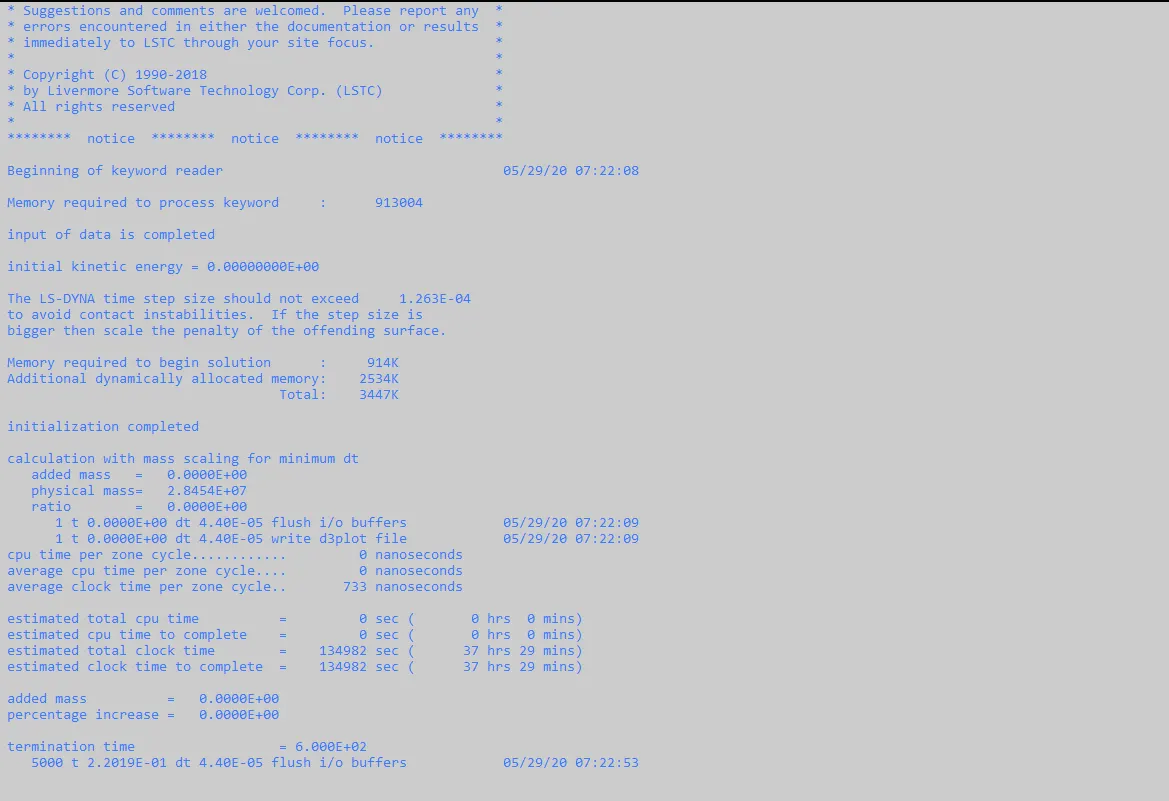
- It is found that with Mass Scaling the est. clock time is 37 hrs 29 mins.
Our goal is to reduce this time as much as possible without affecting the Stability of the model.
Since the Dt value here is a smaller value than the previous run, the clock time increased.
No mass is added here since Dt value(3.5e-05) is reduced
Trial No.3
- TSSFAC is now changed to 0.8 from 0.9. TSSFAC is the timestep scale factor and it doesnt affect the mass scaling.
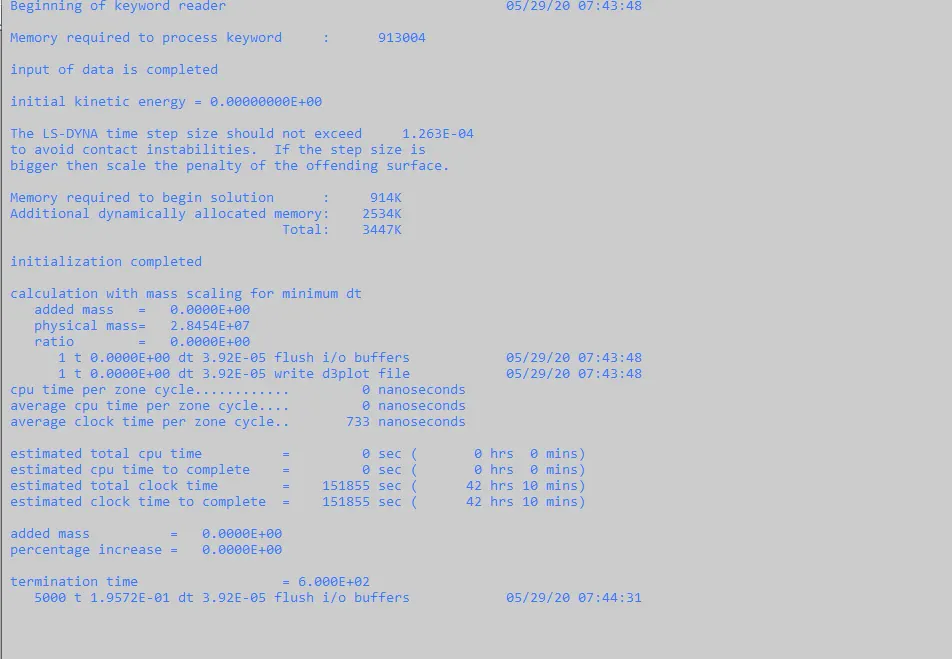
- It is found that the est. clock time is 42 hrs 10 mins. Zero mass is added since there is no change in the DT2MS value
Here it is seen that the timestep reduced and clock time increased.
New Dt is 3.92e-05
Trial No.4
- DT2MS is being adjusted again without altering TSSFAC and the changes are noted.
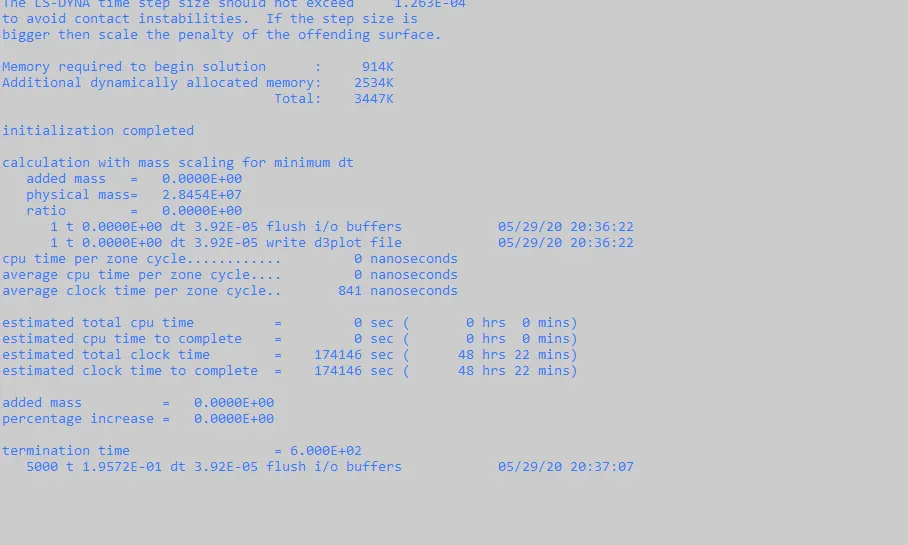
New DT2MS=3.6e-05. Now the clock time is almost similar to the previos run as we got the same Dt that means, we didin't get much difference.
Trial No.5
- So now we change the DT2MS to a bigger value and the simulation is being run.
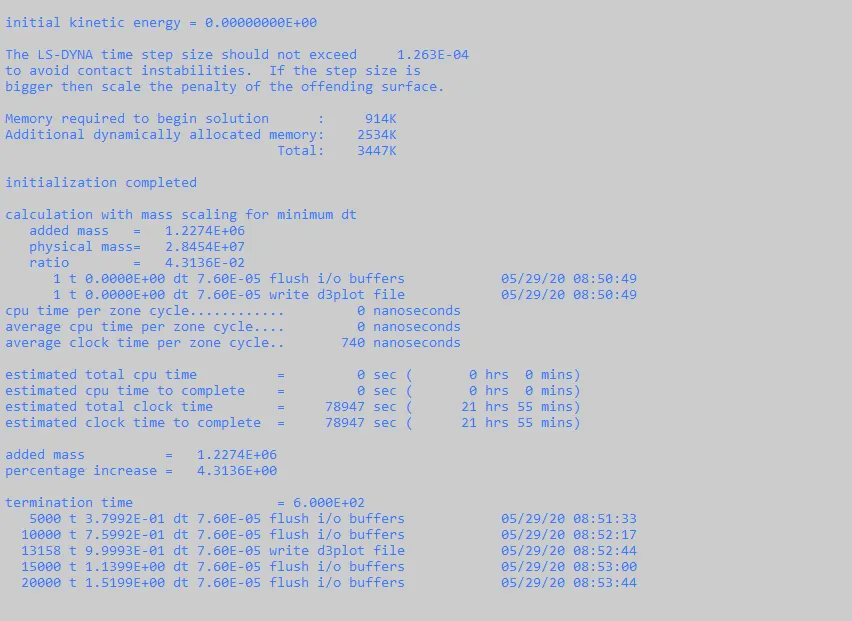
The new DT2MS is 9.5E-05 and we the Clock time reduced drastically to 21Hrs 55Mins.
The mass percent added also remain in the limts. that is 4.3% which is safe.
Trial No.6
- Now the TSSFAC is being adusted again by keeping DT2MS constant.
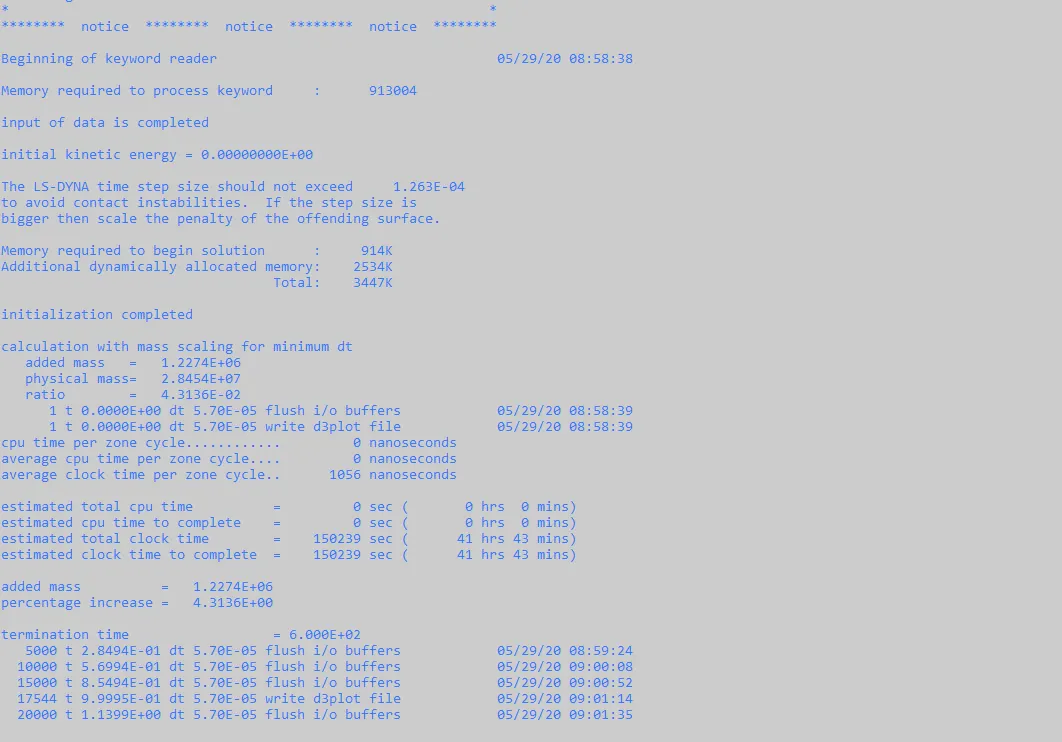
The added mass percent remains intact but the clock time increased to 41 hrs and 43 mins.
Trial No.7
- Now the TSSFAC is adjust again back to 0.9 as 0.9 is the default and suggested value in mass scaling.
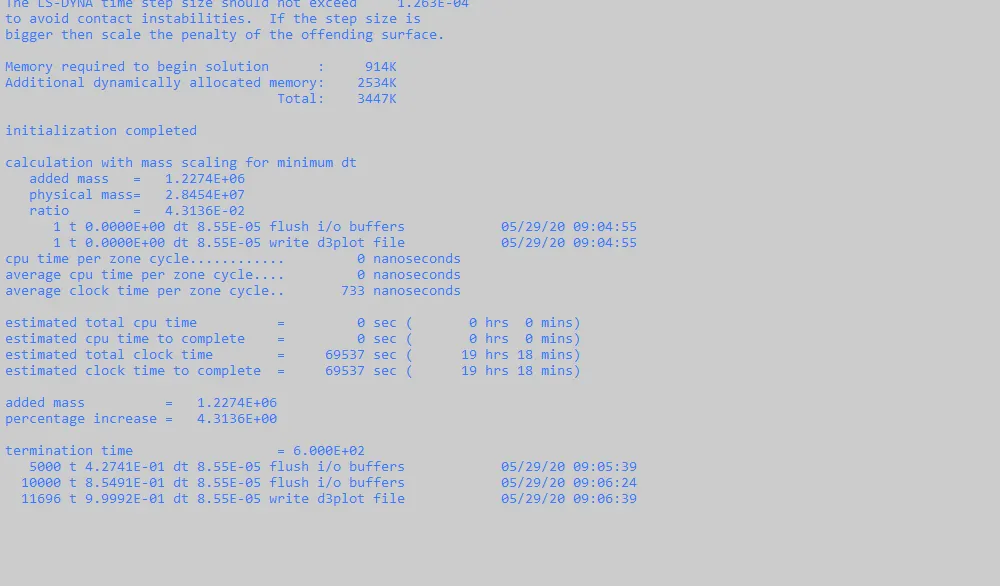
Now the time has been reduced back to 19hrs 18 mins and still the mass percent increase remains in the limits.
New Dt=8.55e-05, %increase=4.3
Trial No.8
- Now DT2MS is adjusted to 1e-04
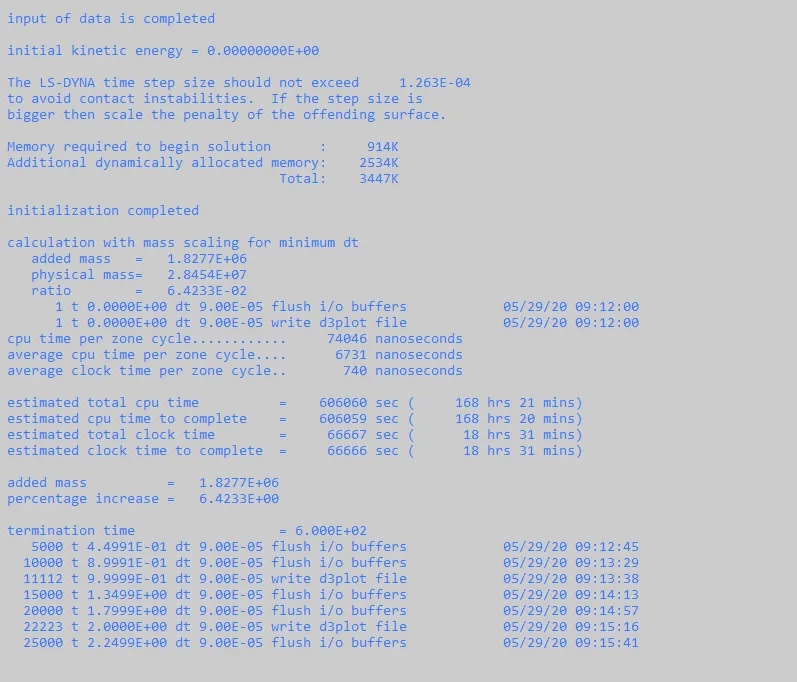
The mass percent increased to 6.4 but as per the challenge, it's still lies in the safe limits.
Trial No.9
- As we run the simulation faster, there is a chance of instability. So, to avoid that, the DT2MS is slightly adjust to a bigger value.
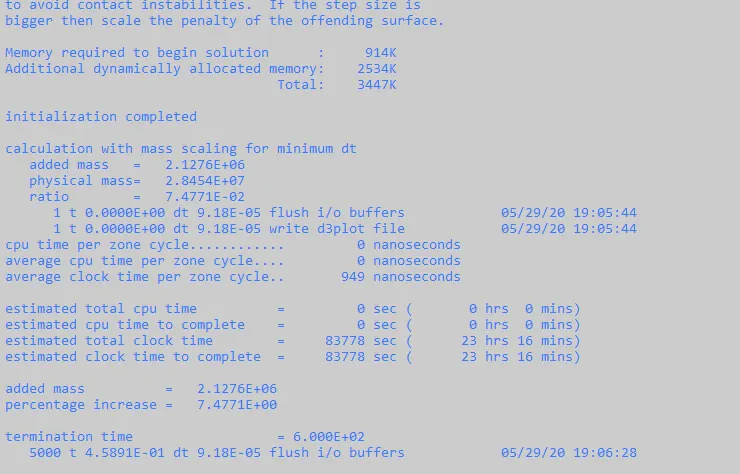
The DT value slightly increased to 9.18-05 which is not a big deal. The simulation will be able to run within 20hrs of time.
The mass percent increase is now at 7.47% which is less than 8% and is the maximum value we can attain by varying DT2MS and keeping TSSFAC at 0.9.
As the results looks good, the mass scaling is stopped here and the final values are:
DT2MS=1.02e-04
TSSFAC=0.9
Added Mass=2.12e6
Mass percent increase=7.47%
Dt=9.18e-05
Clock Time (approx)=23 hrs.
IMPLICIT RUN
The same final file after the mass scaling is run in IMPLICIT solver by adding the following cards
Control Implicit General
Control Implicit Solution
Control Implicit Solver
The IMFLAG is set to 1iin Implicit General to activate the implicit solver. and the DT0 is defined as 5ms since the termnination time of the model is 600ms.
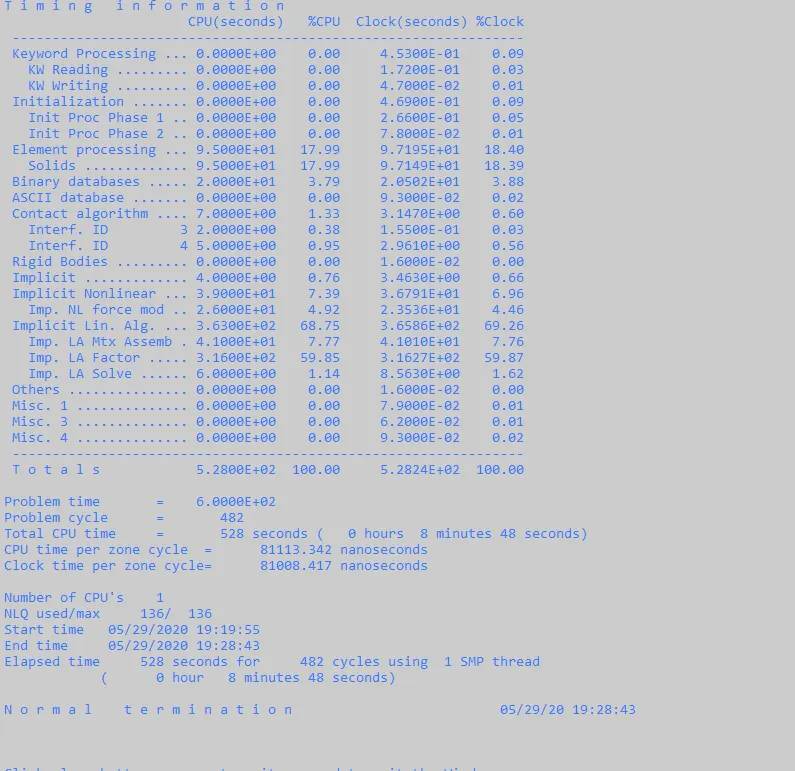
As almost every timestep got solved within 3 iterations, the entire model is solved succesfully in 9 mins of time.
CONCLUSION ✔
This chellenge is mainly focused on getting an idea on mass scaling but from the result, it's been proven that by mass scaling the clock time can be reduced drastilaclly without afftecting the stability of the model. The maximum allowed added mass percent is 10 to 12 because as more mass add, the inertia of the model changes to a big value and it may cause the model to run in an instable manner and the result may go wrong. When the same model is run in implicit way we were able to solve the model way faster. This shows by mass scaling and running the model in implicit solver, the model can be run much faster but this is not applicabe fot dynamic or robust appllications like car crash.Therefore it is concluded that by mass scaling we can run big models in a short period of time by keeping the stability of the model.
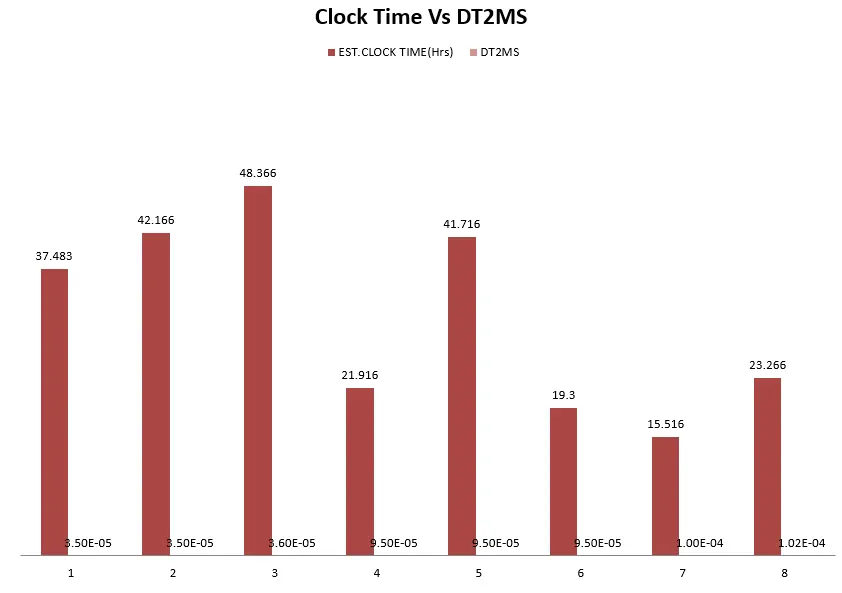
The Histogram for the mass scaling is below.
Note: All the necessary files are attached with this report.
Thanks,