Week 8 - Challenge 6 - Core & Cavity Design
AIM:
To create the Core and cavity blocks for the switch bezel designed in the earlier challenge.
INTRODUCTION:
The plastic parts were usually manufactured with the forming process, particularly the Injection molding process. In the forming processes, the part is formed between two or more dies based on the geometry of the part. In forming processes vacant space is left between the dies which are the same as the geometry of the part then the space is filled with the molten material on which the part is intended to manufacture. In the injection molding process basic die consists of a core and cavity.The core and the cavity will move in the tooling direction. Generally, the core will be the moving part and the cavity will be the fixed half through which the molten plastic is injected into the mold. The core and the cavity will be separated by the parting surface.
CORE AND CAVITY BLOCKS DESIGN:
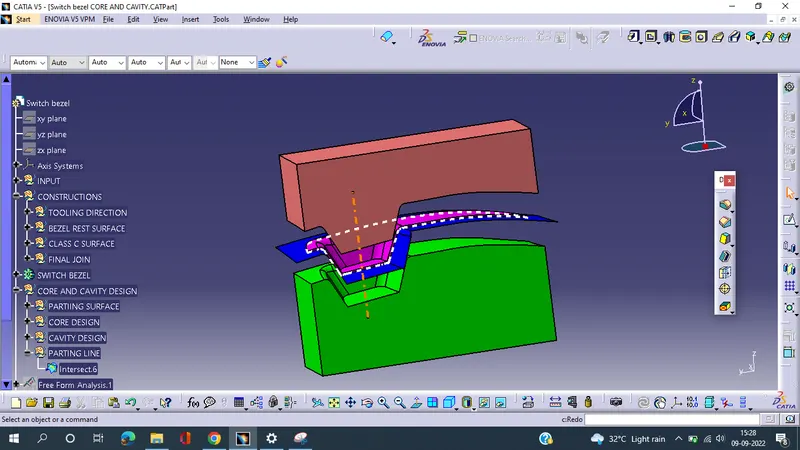
In this model as the Class C surface is visible from the A side surface along the tooling direction and the Parting surface must be kept on the B side surface as the Plastic defect ‘Flash’ might appear on the parting surface which will deteriorate the aesthetics of the product if it is kept on the Class A surface.
CORE BLOCK DESIGN:
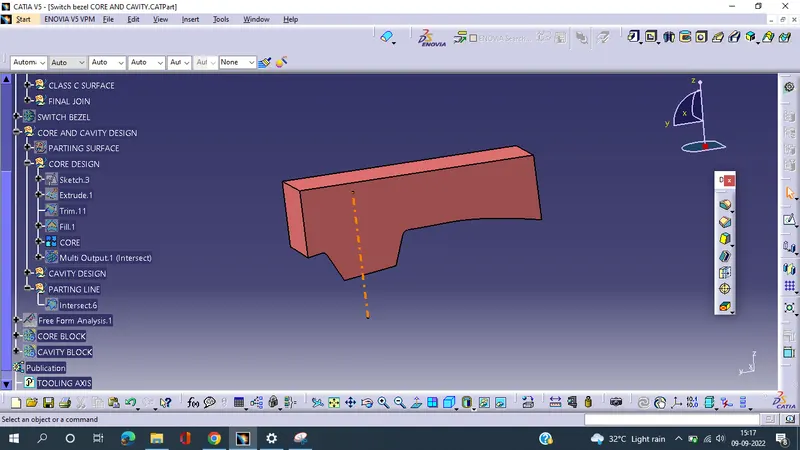
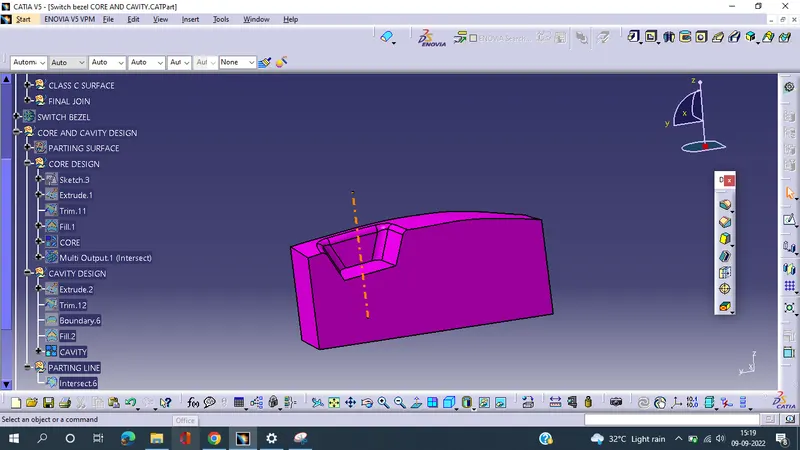
CAVITY BLOCK DESIGN:
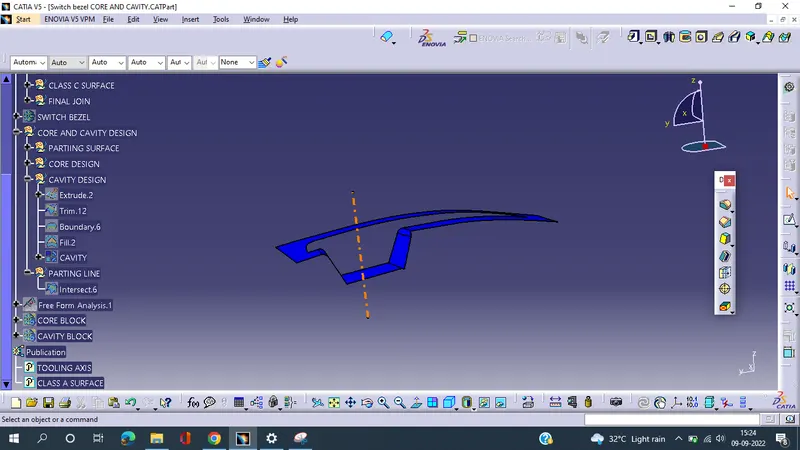
PARTING SURFACE:
Generally in Injection Molding has 2 major components: the Movable Half and the Fixed Half.During Injection Molding process, these 2 halves are pressed together tightly to form a sealed hollow to avoid the melt flow leakage and maintain certain holding pressure.The pressed surface is called the Parting Surface.
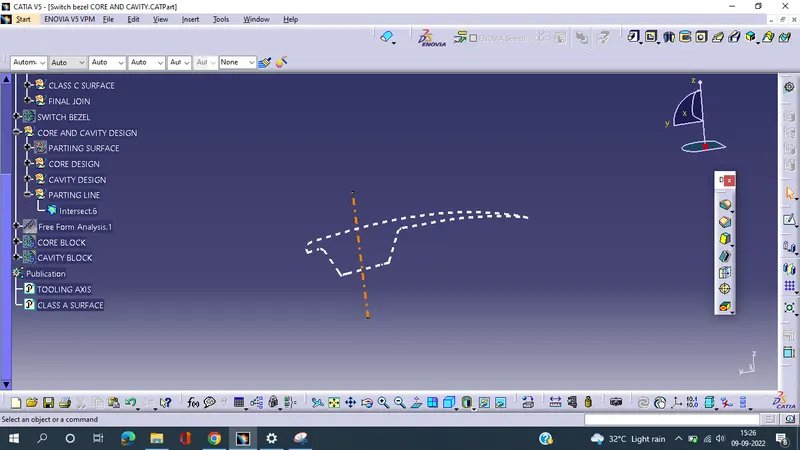
PARTING LINE:
Intersection of the Plastic Component with the Parting Surface is called the Parting Line.
CORE AND CAVITY ASSEMBLE:
The core and the cavity were translated 50mm along the tooling axis for the better visualization.
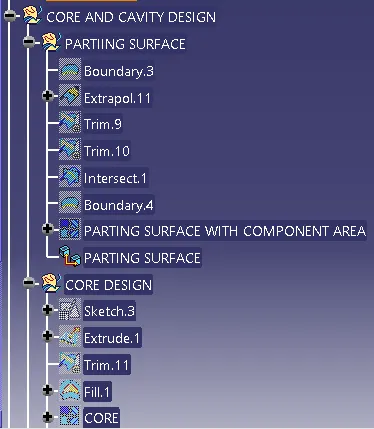
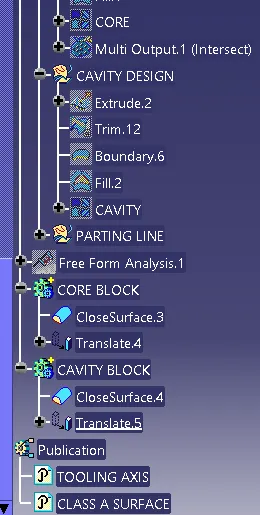
COMPLETE TREE STRUCTURE OF THE CORE AND CAVITY DESIGN:
CONCLUSION:
The Design of Core and Cavity for the Mold of Automotive Plastic Component – Door Switch Bezel is completed using concepts of Parting Surface, Parting Line.