Week 7 State of charge estimation
- Aim: To understand the coulomb counting method and way for counting SoC estimation using the coulomb counting.
- Method:
- Different applications impose different battery-pack performance management priorities. To function reliably, EVs need to have continuous updates for the estimates of two fundamental battery quantities: How much energy is available in the battery pack and how much power is available in the immediate future. An estimate of energy is most important for EV. Energy is an ability to do work and is a total quantity measured in Wh or kWh. Energy is a fundamental input to vehicle range calculations—it tells you how far you can drive.
- Ideally, we would like to be able to measure available energy and power directly and then report these values to the vehicle computer. Unfortunately, no such sensor exists. Instead, we must compute estimates of available energy and power using more basic quantities as inputs to the computation.
Coulomb counting:
- The Coulomb counting method is one of the most general and simple methods of estimating the SOC. We use it for a baseline comparison for more advanced methods. The Coulomb counting method measures the current of the battery and integrates the current overtime to estimate SOC. Limitations of the method, which lead to other projects along these lines, include the fact that inaccurate current measurements accumulate to large errors, whereas accurate current measurement is expensive. Other factors such as temperature, battery history, initial SOC and cycle life also influence the precision of the SOC estimate. Practically speaking, some phenomena, such as decreasing SOC when the battery is resting, and variations with temperature changes, cannot be captured by the Coulomb counting method.
- To determine available capacity, coulomb counting relies on the integration of the current drawn from and supplied to a battery over time.
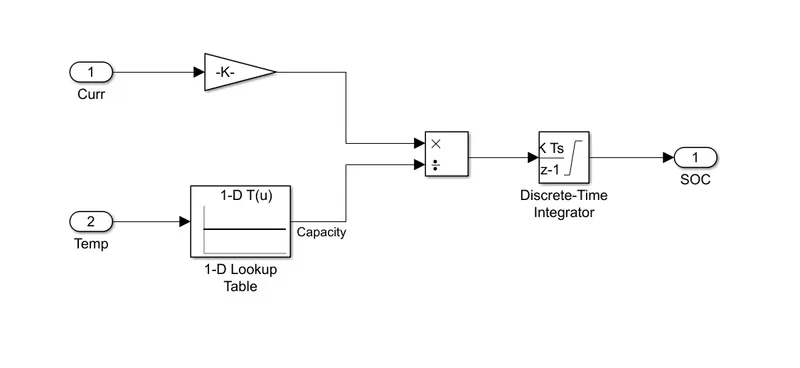
- The Coulomb counting method measures the discharging current of a battery and integrates the discharging
current over time in order to estimate SOC. Coulomb counting method is done to estimate the SOC(𝑡𝑡), which is
estimated from the discharging current and previously estimated SOC values, SOC(𝑡𝑡 −1). SOC is calculated by the following equation:
SOC (𝑡𝑡) = SOC (𝑡𝑡 − 1) +𝐼𝐼 (𝑡𝑡)𝑛𝑛Δ𝑡𝑡.
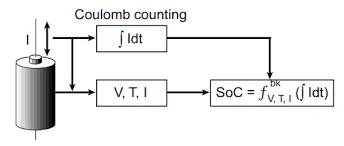
- Coulomb counting is advantageous in terms of a simple structure and its ease of implementation. However, some problems make it difficult to accurately estimate battery SOC by coulomb counting. Because battery capacity and efficiency are significantly influenced by operating temperature and current direction, these factors should be considered to correct for battery SOC. Sensor accuracy is also important because accumulated errors can lead to a drift in the estimated battery SOC. Furthermore, one of the main problems in coulomb counting is that it is necessary to calibrate the initial battery SOC.
- In order to improve SoC estimation, coulomb counting and voltage-based methods can be combined. In this method, a cumulative error of the counting integrator can be removed by a counter calibration based on the OCV characteristics. The calibration can only be done if the battery is not in use. Otherwise, the current is integrated to get the relative charge in and out of the battery.