Week 7 - Simulation of a 1D Supersonic nozzle flow simulation using Macormack Method
Aim:
To simulate the isentropic flow through a quasi 1D subsonic-supersonic nozzle and to derive both the conservation and non-conservation forms of the governing equations and solve them using MacCormack's technique. Also, to determine the steady-state temperature distribution for the flow-field variables and investigate the difference between the two forms of governing equations by comparing their solutions and plot the following,
1. Steady-state distribution of primitive variables inside the nozzle
2. Time-wise variation of the primitive variables
3. Variation of Mass flow rate distribution inside the nozzle at different time steps during the time-marching process
4. Comparison of Normalized mass flow rate distributions of both forms
THEORY:
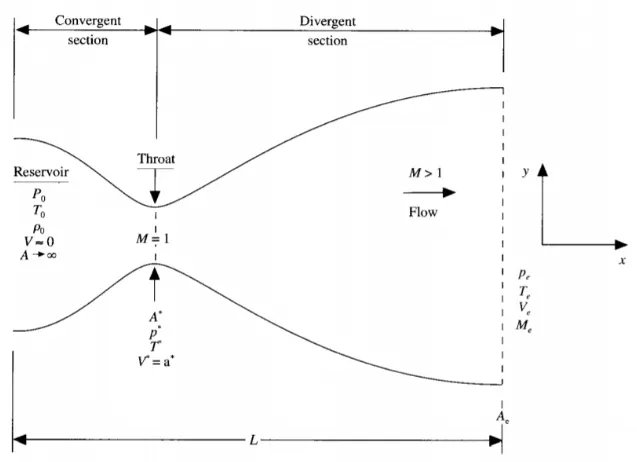
Consider Isentropic flow through a convergent-divergent nozzle. The flow at the inlet of the nozzle comes from the reservoir. The cross-section area of the reservoir is very large and hence velocity is very small(i.e v = 0 m/s at the inlet). The flow is locally subsonic in the convergent section of the nozzle, Sonic at the throat, and Supersonic at the divergent section. The 1D convergent-divergent nozzle is shown below,
Let us consider a small control volume near the throat of the nozzle as shown below,
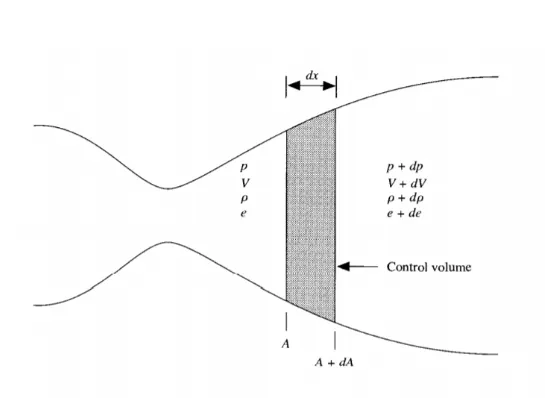
Assume that at a given section, the cross-section area is A, and the flow properties are uniform across the section. Hence, although the area of the nozzle changes as a function of distance along the nozzle, X, and therefore in reality the flow field is two-dimensional (the flow varies in the two-dimensional x-y space), We make the assumption that the flow properties vary only with X; this is tantamount to assuming uniform flow properties across any given cross-section. Such flow is defined as a Quasi-one-dimensional flow.
Governing Equations are represented in terms of PDE for both forms in order to use the Time Marching solution for the problem. The continuity, momentum, and energy governing equations (in terms of non-dimensional variables) for this quasi-one-dimensional steady isentropic flow can be expressed respectively as:
Non- Conservative Form:
1) Continuity equation,

2) Momentum equation,

3) Energy equation,

Conservative Form:
1) Continuity equation,
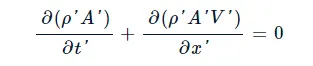
2) Momentum equation,

3) Energy equation,

Maccormack method:
In this method, we split Time Marching into Predictor and corrector phases.
i) Initial Conditions -The initial conditions of the profile for all the flow field variables which are velocity, density, and temperature have to be determined. These are guess values but should be specified with more awareness of the problem.
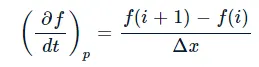
ii) Predictor Step - In this step, perform forward differencing for the space terms,
iii) Solution Update - with the predictor values, the initial solutions are updated,
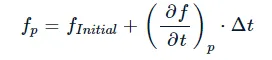
iv) Corrector Step - In this step, perform backward differencing for the space terms,
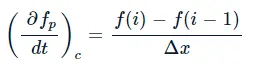
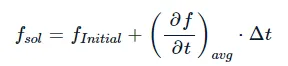
v) Average Derivative - find the average for predictor and corrector steps,

vi) Final solution update - Final solution of the flow field variables for the first time step,
Matlab Code:
Function Code:
- Non-Conservative form code:
%Function code for Non-Conservative form function [Mass_flow_rate_NC, Pressure_NC, Mach_number_NC, rho_NC, v_NC, T_NC, rho_throat_NC, v_throat_NC, T_throat_NC, Mass_flow_rate_throat_NC, Pressure_throat_NC, Mach_number_throat_NC] = non_conservative(x, dx, n, gamma, nt, C) %Intial boundary conditions rho_NC = 1 - 0.3146*x; T_NC = 1 - 0.2341*x; v_NC = (0.1 + 1.09*x).*T_NC.^0.5; a = 1 + 2.2*(x - 1.5).^2; %Area profile throat = find(a==1); %Throat profile %Outer Time Loop for k = 1:nt %Time-step control dt = min(C.*dx./(sqrt(T_NC) + v_NC)); %Saving a copy of Old Values rho_old = rho_NC; T_old = T_NC; v_old = v_NC; %Step 1 - Predictor method (forward difference for space terms) for j = 2:n-1 %Simplifying the Equation's spatial terms dv_dx = (v_NC(j + 1) - v_NC(j))/dx; drho_dx = (rho_NC(j + 1) - rho_NC(j))/dx; dT_dx = (T_NC(j + 1) - T_NC(j))/dx; dlog_a_dx = (log(a(j + 1)) - log(a(j)))/dx; %Continuity Equation drho_dt_P(j) = -rho_NC(j)*dv_dx - rho_NC(j)*v_NC(j)*dlog_a_dx - v_NC(j)*drho_dx; %Momentum Equation dv_dt_P(j) = -v_NC(j)*dv_dx - (1/gamma)*(dT_dx + (T_NC(j)*drho_dx/rho_NC(j))); %Energy Equation dT_dt_P(j) = -v_NC(j)*dT_dx - (gamma - 1)*T_NC(j)*(dv_dx + v_NC(j)*dlog_a_dx); %Step 2 - Solution update rho_NC(j) = rho_NC(j) + drho_dt_P(j)*dt; v_NC(j) = v_NC(j) + dv_dt_P(j)*dt; T_NC(j) = T_NC(j) + dT_dt_P(j)*dt; end %Step 3 - Corrector method (backward difference for space terms) for j = 2:n-1 %Simplifying the Equation's spatial terms dv_dx = (v_NC(j) - v_NC(j - 1))/dx; drho_dx = (rho_NC(j) - rho_NC(j - 1))/dx; dT_dx = (T_NC(j) - T_NC(j - 1))/dx; dlog_a_dx = (log(a(j)) - log(a(j - 1)))/dx; %Continuity Equation drho_dt_C(j) = - rho_NC(j)*dv_dx - rho_NC(j)*v_NC(j)*dlog_a_dx - v_NC(j)*drho_dx; %Momentum Equation dv_dt_C(j) = - v_NC(j)*dv_dx - (1/gamma)*(dT_dx + (T_NC(j)*drho_dx/rho_NC(j))); %Energy Equation dT_dt_C(j) = - v_NC(j)*dT_dx - (gamma - 1)*T_NC(j)*(dv_dx + v_NC(j)*dlog_a_dx); end %Step 4 - finding Average derivatives drho_dt = 0.5.*(drho_dt_P + drho_dt_C); dv_dt = 0.5.*(dv_dt_P + dv_dt_C); dT_dt = 0.5.*(dT_dt_P + dT_dt_C); %Step 5 - Final solution update for i = 2:n-1 rho_NC(i) = rho_old(i) + drho_dt(i)*dt; v_NC(i) = v_old(i) + dv_dt(i)*dt; T_NC(i) = T_old(i) + dT_dt(i)*dt; end %Applying Boundary Conditions %At Inlet rho_NC(1) = 1; v_NC(1) = 2*v_NC(2) - v_NC(3); T_NC(1) = 1; %At Outlet rho_NC(n) = 2*rho_NC(n-1) - rho_NC(n - 2); v_NC(n) = 2*v_NC(n - 1) - v_NC(n - 2); T_NC(n) = 2*T_NC(n - 1) - T_NC(n - 2); %Defining Mass flow rate, Pressure and Mach number Mass_flow_rate_NC = rho_NC.*a.*v_NC; Pressure_NC = rho_NC.*T_NC; Mach_number_NC = (v_NC./sqrt(T_NC)); %Calculating Variables at throat section rho_throat_NC(k) = rho_NC(throat); T_throat_NC(k) = T_NC(throat); v_throat_NC(k) = v_NC(throat); Mass_flow_rate_throat_NC(k) = Mass_flow_rate_NC(throat); Pressure_throat_NC(k) = Pressure_NC(throat); Mach_number_throat_NC(k) = Mach_number_NC(throat); %PLOTTING %Comparison of non-dimensional Mass flow rates at different time steps figure(1); if k == 50 plot(x, Mass_flow_rate_NC, 'm', 'linewidth', 1.25); hold on elseif k == 100 plot(x, Mass_flow_rate_NC, 'c', 'linewidth', 1.25); hold on elseif k == 200 plot(x, Mass_flow_rate_NC, 'g', 'linewidth', 1.25); hold on elseif k == 400 plot(x, Mass_flow_rate_NC, 'y', 'linewidth', 1.25); hold on elseif k == 800 plot(x, Mass_flow_rate_NC, 'k', 'linewidth', 1.25); hold on end %Labelling title('Mass flow rates at different Timesteps - NON CONSERVATIVE FORM)') xlabel('Distance') ylabel('Mass flow rate') legend({'50^t^h Timestep','100^t^h Timestep','200^t^h Timestep','400^t^h Timestep','800^t^h Timestep'}) axis([0 3 0 2]) grid on end end- This function is to calculate the values of Mass flow rate, Pressure, Mach number, Density, velocity, Temperature, Density at the throat, velocity at the throat, Temperature at the throat, Mass flow rate at the throat, Pressure at the throat, Mach number at the throat by the known equations for all the grid points.
- The initial boundary conditions for Density, Temperature, Velocity, Area of the profile, and throat area are provided.
- The Outer Time Loop is for computing the profile at different time steps.
- The MacCormack technique is applied to solve the Continuity, Momentum, and Energy Governing Equations of Non-Conservative Form.
- The equations are solved in six different stages using this technique. Namely, i) Initial Conditions, ii) Predictor Step, iii) Solution Update, iv) Corrector Step, v) Average Derivative, vi) Final solution update.
- Predictor & Corrector methods are assigned within separate for loops and iterated for each of the inner nodes.
- The calculated values are averaged in the next step and updating the solution with old values.
- Boundary Conditions are applied within the for loop for calculating the Mass Flow Rate, Mach Number, and Pressure, and also calculating the values at the throat area.
- The Distance(x) Vs Mass Flow Rate at different Timestep graph is plotted.
- Conservative form code:
%Function code for Conservative form function [Mass_flow_rate_C, Pressure_C, Mach_number_C, rho_C, v_C, T_C, rho_throat_C, v_throat_C, T_throat_C, Mass_flow_rate_throat_C, Pressure_throat_C, Mach_number_throat_C] = conservative(x, dx, n, gamma, nt, C) %Determining Initial profile of Density and Temperature for i = 1:n if (x(i) >= 0 && x(i) <= 0.5) rho_C(i) = 1; T_C(i) = 1; elseif (x(i) >= 0.5 && x(i) <= 1.5) rho_C(i) = 1 - 0.366*(x(i) - 0.5); T_C(i) = 1 - 0.167*(x(i) - 0.5); elseif (x(i) >= 1.5 && x(i) <= 3) rho_C(i) = 0.634 - 0.3879*(x(i) - 1.5); T_C(i) = 0.833 - 0.3507*(x(i) - 1.5); end end a = 1 + 2.2*(x - 1.5).^2; %Area profile throat = find(a==1); %Throat profile %Initial profile fot Velocity and Pressure v_C = 0.59./(rho_C.*a); Pressure_C = rho_C.*T_C; %Calculate the Initial Solution Vectors(U) U1 = rho_C.*a; U2 = rho_C.*a.*v_C; U3 = rho_C.*a.*(T_C./(gamma - 1)) + ((gamma/2).*v_C.^2); %Outer Time Loop for k =1:nt %Time-step control dt = min(C.*dx./(sqrt(T_C) + v_C)); %Saving a copy of Old Values U1_old = U1; U2_old = U2; U3_old = U3; %Calculating the Flux vector(F) F1 = U2; F2 = ((U2.^2)./U1) + ((gamma - 1)/gamma)*(U3 - (gamma/2)*((U2.^2)./U1)); F3 = ((gamma*U2.*U3)./U1) - (gamma*(gamma - 1)*((U2.^3)./(2*U1.^2))); %Step 1 - Predictor method (forward difference for space terms) for j = 2:n-1 %Calculating the Source term(J) J2(j) = (1/gamma)*rho_C(j)*T_C(j)*((a(j + 1) - a(j))/dx); %Continuity Equation dU1_dt_P(j) = -((F1(j + 1) - F1(j))/dx); %Momentum Equation dU2_dt_P(j) = -((F2(j + 1) - F2(j))/dx) + J2(j); %Energy Equation dU3_dt_P(j) = -((F3(j + 1) - F3(j))/dx); %Step 2 - Solution update U1(j) = U1(j) + dU1_dt_P(j)*dt; U2(j) = U2(j) + dU2_dt_P(j)*dt; U3(j) = U3(j) + dU3_dt_P(j)*dt; end %Updating Flux vectors F1 = U2; F2 = ((U2.^2)./U1) + ((gamma - 1)/gamma)*(U3 - ((gamma*0.5*(U2.^2))./(U1))); F3 = ((gamma*U2.*U3)./U1) - ((gamma*0.5*(gamma - 1)*(U2.^3))./(U1.^2)); %Step 3 - Corrector method (backward difference for space terms) for j = 2:n-1 %Updating the Source term(J) J2(j) = (1/gamma)*rho_C(j)*T_C(j)*((a(j) - a(j - 1))/dx); %Simplifying the Equation's spatial terms dU1_dt_C(j) = -((F1(j) - F1(j - 1))/dx); dU2_dt_C(j) = -((F2(j) - F2(j - 1))/dx) + J2(j); dU3_dt_C(j) = -((F3(j) - F3(j - 1))/dx); end %Step 4 - finding Average derivatives dU1_dt = 0.5*(dU1_dt_P + dU1_dt_C); dU2_dt = 0.5*(dU2_dt_P + dU2_dt_C); dU3_dt = 0.5*(dU3_dt_P + dU3_dt_C); %Step 5 - Final solution update for i = 2:n-1 U1(i) = U1_old(i) + dU1_dt(i)*dt; U2(i) = U2_old(i) + dU2_dt(i)*dt; U3(i) = U3_old(i) + dU3_dt(i)*dt; end %Applying Boundary Conditions %At Inlet U1(1) = rho_C(1)*a(1); U2(1) = 2*U2(2) - U2(3); v_C(1) = U2(1)./U1(1); U3(1) = U1(1)*((T_C(1)/(gamma - 1)) + ((gamma/2)*(v_C(1)).^2)); %At Outlet U1(n) = 2*U1(n - 1) - U1(n - 2); U2(n) = 2*U2(n - 1) - U2(n - 2); U3(n) = 2*U3(n - 1) - U3(n - 2); %Final Primitive value update rho_C = U1./a; v_C = U2./U1; T_C = (gamma - 1)*((U3./U1 - (gamma/2)*(v_C).^2)); %Defining Mass flow rate, Pressure and Mach number Mass_flow_rate_C = rho_C.*a.*v_C; Pressure_C = rho_C.*T_C; Mach_number_C = (v_C./sqrt(T_C)); %Calculating Variables at throat section rho_throat_C(k) = rho_C(throat); T_throat_C(k) = T_C(throat); v_throat_C(k) = v_C(throat); Mass_flow_rate_throat_C(k) = Mass_flow_rate_C(throat); Pressure_throat_C(k) = Pressure_C(throat); Mach_number_throat_C(k) = Mach_number_C(throat); %PLOTTING %Comparison of non-dimensional Mass flow rates at different time steps figure(4) if k == 50 plot(x, Mass_flow_rate_C, 'm', 'linewidth', 1.25); hold on elseif k == 100 plot(x, Mass_flow_rate_C, 'c', 'linewidth', 1.25); hold on elseif k == 200 plot(x, Mass_flow_rate_C, 'g', 'linewidth', 1.25); hold on elseif k == 400 plot(x, Mass_flow_rate_C, 'y', 'linewidth', 1.25); hold on elseif k == 800 plot(x, Mass_flow_rate_C, 'k', 'linewidth', 1.25); hold on end %Labelling title('Mass flow rates at different Timesteps - CONSERVATIVE FORM') xlabel('Distance') ylabel('Mass flow rate') legend({'50^t^h Timestep','100^t^h Timestep','200^t^h Timestep','400^t^h Timestep','800^t^h Timestep'}) axis([0 3 0.4 1]) grid on end end- This function is to calculate the values of Mass flow rate, Pressure, Mach number, Density, velocity, Temperature, Density at the throat, velocity at the throat, Temperature at the throat, Mass flow rate at the throat, Pressure at the throat, Mach number at the throat by the known equations for all the grid points.
- The initial boundary conditions for Density and Temperature are determined using the if-else command.
- The initial boundary conditions for Velocity, Pressure, Area of the profile, and throat area are calculated.
- The equation is split into Solution Vector(U), Flux Vector(F), and Source Term(J) in order to simplify it.
- The Outer Time Loop is for computing the profile at different time steps.
- The MacCormack technique is applied to solve the Continuity, Momentum, and Energy Governing Equations of Non-Conservative Form.
- The equations are solved in six different stages using this technique. Namely, i) Initial Conditions, ii) Predictor Step, iii) Solution Update, iv) Corrector Step, v) Average Derivative, vi) Final solution update.
- Predictor & Corrector methods are assigned within separate for loops and iterated for each of the inner nodes.
- The calculated values are averaged in the next step and updating the solution with old values.
- Boundary Conditions are applied within the for loop for calculating the Mass Flow Rate, Mach Number, and Pressure, and also calculating the values at the throat area.
- The Distance(x) Vs Mass Flow Rate at different Timestep graph is plotted.
Main code of solving Quasi 1D subsonic-supersonic nozzle,
clear all
close all
clc


%Inputs

n = 31; %No. of grid points
gamma = 1.4;
x = linspace(0,3,n);
dx = x(2) - x(1);
nt = 1400; %No. of time step
C = 0.5; %Courant Number


%FUNCTION CALL FOR NON CONSERVATIVE EQUATIONS
tic;
[Mass_flow_rate_NC, Pressure_NC, Mach_number_NC, rho_NC, v_NC, T_NC, rho_throat_NC, v_throat_NC, T_throat_NC, Mass_flow_rate_throat_NC, Pressure_throat_NC, Mach_number_throat_NC] = non_conservative(x, dx, n, gamma, nt, C);
Time_elapsed_NC = toc;
fprintf('Time Elasped for Non Conservative form: %0.4f', Time_elapsed_NC);
hold on

%Plots

figure(2)
%Timestep variation of properties at throat area (Non-Conservative form)

%Density
subplot(4,1,1)
plot(linspace(1,nt,nt),rho_throat_NC,'color','m')
ylabel('Density')
legend({'Density at throat'});
axis([0 1400 0 1.3]);
grid minor;
title('Timestep variation at throat area - NON CONSERVATIVE FORM')

%Temperature
subplot(4,1,2)
plot(linspace(1,nt,nt),T_throat_NC,'color','c')
ylabel('Temperature')
legend({'Temperature at throat'});
axis([0 1400 0.6 1]);
grid minor;

%Pressure
subplot(4,1,3)
plot(linspace(1,nt,nt),Pressure_throat_NC,'color','g')
ylabel('Pressure')
legend({'Pressure at throat'});
axis([0 1400 0.4 1.1]);
grid minor

%Mach Number
subplot(4,1,4)
plot(linspace(1,nt,nt),Mach_number_throat_NC,'color','y')
xlabel('Timesteps')
ylabel('Mach Number')
legend({'Mach Number at throat'});
axis([0 1400 0.6 1.4]);
grid minor;


figure(3);
%Steady state simulation for primitve values (Non-Conservative form)

%Density
subplot(4,1,1);
plot(x,rho_NC,'color','m')
ylabel('Density')
legend({'Density'});
axis([0 3 0 1])
grid minor;
title('Variation of Flow Rate Distribution - NON CONSERVATIVE')

%Temperature
subplot(4,1,2);
plot(x,T_NC,'color','c')
ylabel('Temperature')
legend({'Temperature'});
axis([0 3 0 1])
grid minor;

%Pressure
subplot(4,1,3);
plot(x,Pressure_NC,'color','g')
ylabel('Pressure')
legend({'Pressure'});
axis([0 3 0 1])
grid minor;

%Mach number
subplot(4,1,4);
plot(x,Mach_number_NC,'color','y')
xlabel('Nozzle Length')
ylabel('Mach number')
legend({'Mach number'});
axis([0 3 0 4])
grid minor;


%FUNCTION CALL FOR CONSERVATIVE FORM
tic;
[Mass_flow_rate_C, Pressure_C, Mach_number_C, rho_C, v_C, T_C, rho_throat_C, v_throat_C, T_throat_C, Mass_flow_rate_throat_C, Pressure_throat_C, Mach_number_throat_C] = conservative(x, dx, n, gamma, nt, C);
Time_elasped_C = toc;
fprintf('Time Elasped for Conservative form: %0.4f', Time_elasped_C);

%Plots

figure(5)
%Timestep variation of properties at throat area (Conservative form)

%Density
subplot(4,1,1)
plot(rho_throat_C,'color','m')
ylabel('Density')
legend({'Density at throat'});
axis([0 1400 0 1]);
grid minor;
title('Timestep variation at throat area - CONSERVATIVE FORM')

%Temperature
subplot(4,1,2)
plot(T_throat_C,'color','c')
ylabel('Temperature')
legend({'Temperature at throat'});
axis([0 1400 0.6 1]);
grid minor;

%Pressure
subplot(4,1,3)
plot(Pressure_throat_C,'color','g')
ylabel('Pressure')
legend({'Pressure at throat'});
axis([0 1400 0.2 0.8]);
grid minor

%Mach Number
subplot(4,1,4)
plot(Mach_number_throat_C,'color','y')
xlabel('Timesteps')
ylabel('Mach Number')
legend({'Mach Number at throat'});
axis([0 1400 0.6 1.4]);
grid minor;


figure(6);
%Steady state simulation for primitve values (Conservative form)

%Density
subplot(4,1,1);
plot(x,rho_C,'color','m')
ylabel('Density')
legend({'Density'});
axis([0 3 0 1])
grid minor;
title('Variation of Flow Rate Distribution - CONSERVATIVE FORM')

%Temperature
subplot(4,1,2);
plot(x,T_C,'color','c')
ylabel('Temperature')
legend({'Temperature'});
axis([0 3 0 1])
grid minor;

%Pressure
subplot(4,1,3);
plot(x,Pressure_C,'color','g')
ylabel('Pressure')
legend({'Pressure'});
axis([0 3 0 1])
grid minor;

%Mach number
subplot(4,1,4);
plot(x,Mach_number_C,'color','y')
xlabel('Nozzle Length')
ylabel('Mach number')
legend({'Mach number'});
axis([0 3 0 4])
grid minor;


figure(7)
%Mass Flow Rate Comparison Plot

hold on
plot(x,Mass_flow_rate_NC,'r','linewidth',1.25)
hold on;
plot(x,Mass_flow_rate_C,'b','linewidth',1.25)
hold on;
grid on
legend('Non Conservative','Conservative');
xlabel('Length of the Domain')
ylabel('Mass Flow Rate')
title('Comparison of Mass Flow Rate of both forms')- Code starts with clear all, close all, and clc to clear previous memories.
- Input parameters are assigned for the variables x, dx, n, gamma, not, and C.
- Non-Conservative and Conservative forms are created as separate functions with the necessary inputs.
- tic tac command is used for calculating the time elapsed between the functions.
OUTPUTS:
Plots:
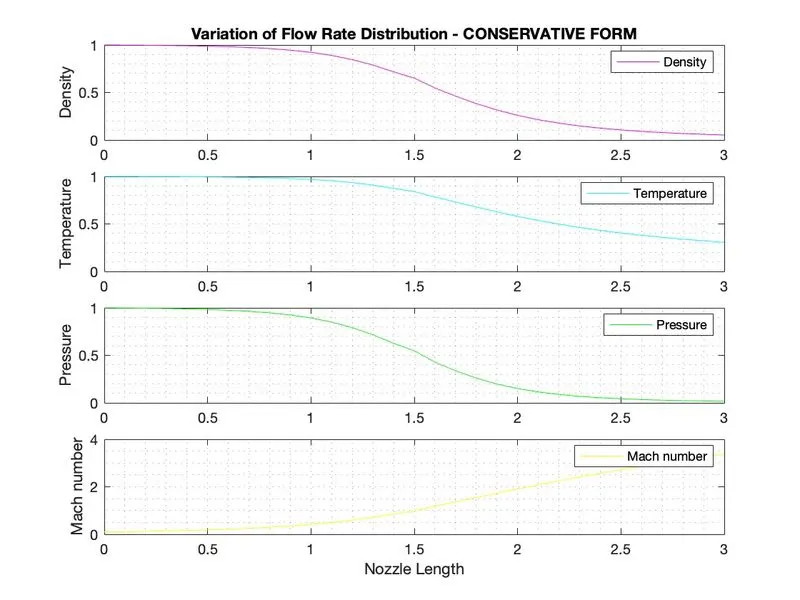
1) Comparison Of Variation In Flow Rate Distribution Throughout The Nozzle Length For Both The Forms:
NON-CONSERVATIVE FORM:
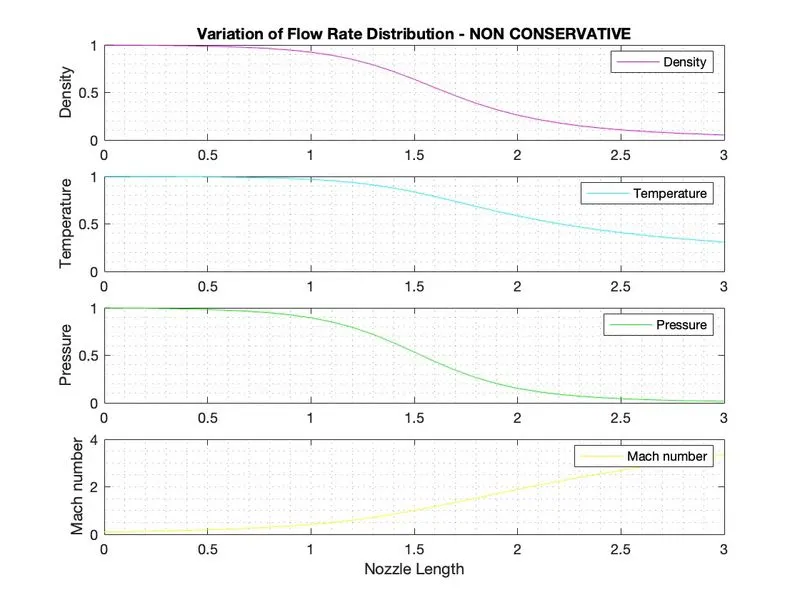
CONSERVATIVE FORM:
Observation:
Both form plots are the same. Thus the variation in flow distribution through the length of the nozzle is the same for both forms.
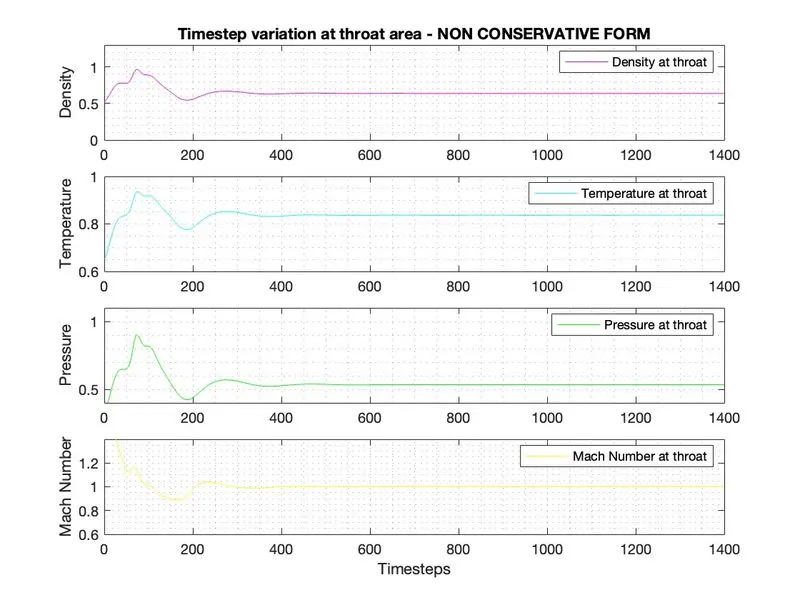
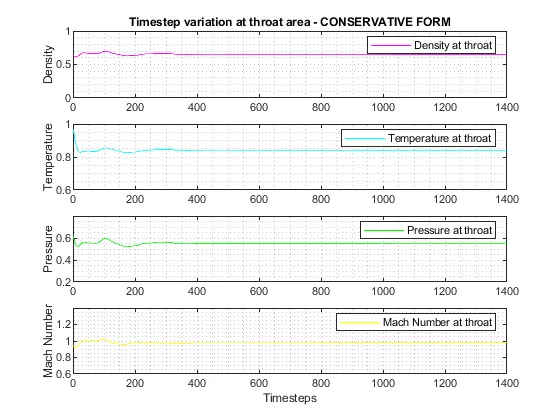
2) Comparison Of Variations At Throat Area At Different Timesteps For Both The Forms:
NON-CONSERVATIVE FORM:
CONSERVATIVE FORM:
Observation:
From the above plots, we can observe initial variations in the Non-Conservative form for a certain period of time which make it consume a higher amount of time to achieve a stable solution when compared to the Conservative form.
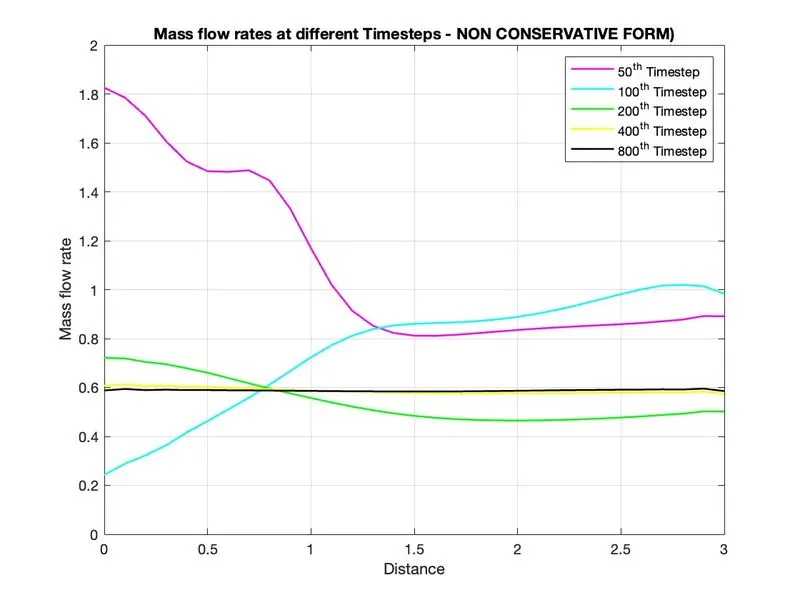
3) Comparison Of Mass Flow Rate At Different Timesteps For Both The Forms:
NON-CONSERVATIVE FORM:
CONSERVATIVE FORM:
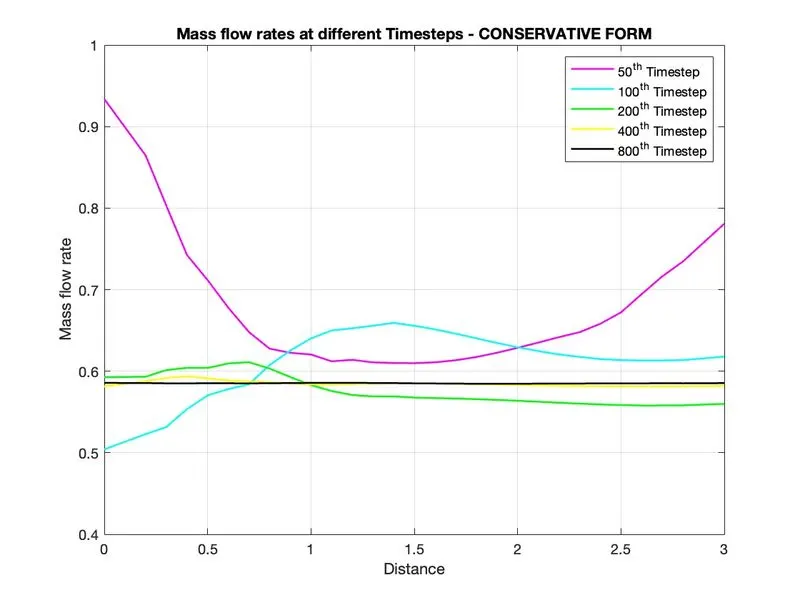
Observation:
The above plots show that the solution becomes stable after the 400th Timestep for both the forms attaining a constant value.
4) Comparison Of Normalized Mass Flow Rate Of Both Forms:
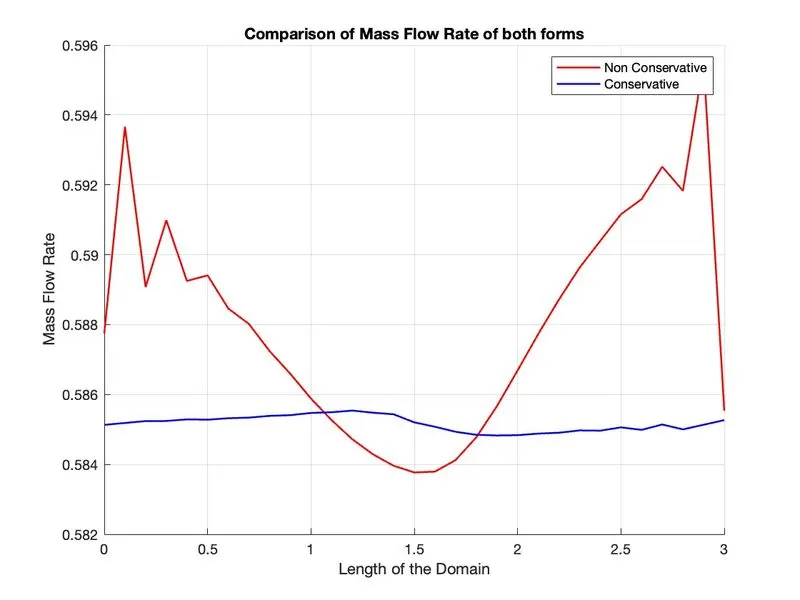
Observation:
Even though the final solution of both the forms was similar, the Non-Conservative form oscillates much when compared to the Conservative form. The Conservative form also gives an almost stable solution along the length.
TIME TAKEN:
The time taken by both the forms for simulation is as follows,
- Non-Conservative form = 123.212837 sec
- Conservative form = 103.017424 sec
GRID INDEPENDENCE TEST:
The aim of this test is to find the optimum mesh size for the solution, where it is neither too coarse to produce inaccurate results nor too fine, where it will consume a lot of computing effort and time. Generally, when we increase the number of grid points the solution will be more accurate but main problem is to what extent we have to increase this number of grid points so that the solution does not change with the further increase in no. of grid points. Here we have divided 3 unit long nozzle into 31 nodes, lets's try to double the number of divisions to 61 and check if the change affects the solution,
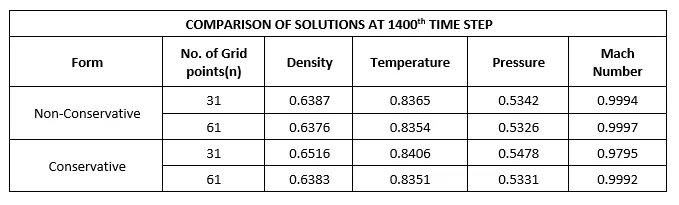
From the above table, the values are almost the same for both the forms even when the number of Grid points is changed from 31 to 61. The values don't get affected much by the increase of Grid points. Thus 31 is the optimum number of grid points for the solution and it is called the grid independence test.
CONCLUSION:
- From all the above results we can conclude that the Conservative form converges faster than the Non-Conservative form.
- The conservation form produced a stable solution along the simulation.
- Yet both forms are dependable in calculating the solutions.
Reference:
John Anderson CFD Book for initial and boundary condition