Week 6- Challenge
Aim:
Follow the below-mentioned quality criteria, mesh the component given below and assign thickness:
| S.N | Quality Criteria | Value |
| 1 | Aspect Ratio | 5 |
| 2 | Skewness | 45 |
| 3 | Warping | 15 |
| 4 | Taper | 0.5 |
| 5 | Min. Length | 2mm |
| 6 | Max. Length | 8mm |
| 7 | Min angle Quad | 45 |
| 8 | Max angle Quad | 135 |
| 9 | Min angle Tria | 20 |
| 10 | Max angle Tria | 120 |
| 10 | Tria % | 10 |
Target Element Length = 5mm
Solution:
After deleting the solids using the delete command we get the following:
Using the skin offset in the mid surface the following mid surface was created :
Surface Cleanup:
Washer Surface Creation
Washer surfaces have been created so that the curvatures are captued properly during meshing
Now we will be defining various meshing quality criterias:
1.Aspect Ratio :
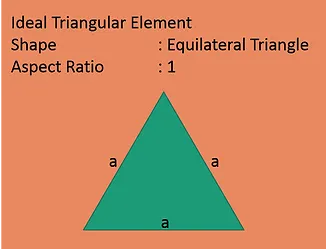
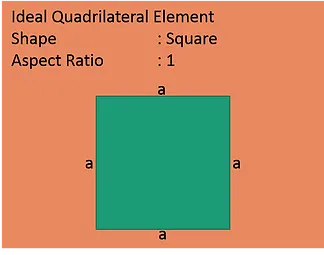
The ratio between largest and smallest characteristic dimension of an element is known as the Aspect Ratio.
Large aspect ratios increase the inaccuracy of the finite element representation and have a detrimental effect on convergence of Finite Element Solutions.
An aspect ratio of 1 is ideal but cannot always be maintained. In general the aspect ratios are maintained in between 1 to 5 at critical areas in a domain where derivatives of field variable are significant.
2.Skewness
-
Skewness is the Angular Measure of Element quality with respect to the Angles of Ideal Element Types.
-
It is one of the Primary Qualities Measures of FE Mesh. Skewness determines how close to ideal (i.e., equilateral or equi-angular) a face or cell is.
For Equilateral Triangle, Θ1, Θ2….. Θ6 = 90 degree
Hence, Skewness = 0 degree
Skewness of an Equilateral Triangle:
For Equilateral Triangle, Θ1, Θ2….. Θ6 = 90 degree
Hence, Skewness = 0 degree
Skewness= 90-min(Θ1, Θ2….. Θ6)
3.Jacobian
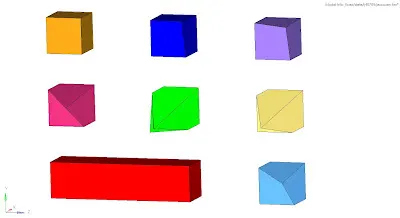
Jacobian, which is short for the Jacobian, is really the best measure of finite element mesh quality. It is one number which defines how good or bad an element is. The Jacobian is a measure of the normals of the element faces relative to each other.
4.Taper :
Taper occurs when the angular distortion of a quadrilateral shell element approaches 180 .
Meshing :
Now we will be doing meshing by creating mid surface of every part and creating the mesh for these parts :
As you can see the components have been remeshed in the areas to remove rotating quads and trias .
Meshed Component:
Part2:
Using the defeature command the surface is cleaned up so that a proper mesh can be obtained as shown above:
A cleanup has been done as shown below :
Meshing:
Part 3:
A surface cleanup is done using defeature command where edge fillets are removed so that more no of quad elements can be formed . Also washer surface is added so that the curvature is captured properly.
All edges are toggled so that more surfaces which are in square in shape are made so that more quads are created compared to trias .
The right hand surfaces are deleted so that the reflect command can be used as shown .
Creation of reflected surface
Final Meshed Component :
Quality Inspection:
Worse Elements :
As you can see the worse elements are only 0.1 % of total elements
Normals :
As you can see that the all elements have proper normals :
Dependency:
Penetrations:
As you can see 2 intersections were found
Using the automatic fix we can remove these intersections
Conclusion:
Meshing of the given component has been done and the quality check was done with it