Week - 2 - Explicit and Implicit Analysis
AIM:- To understand the function of implicit and explicit function by solving a polynomial equation.
THEORY:-
The finite element method (FEM) is a numerical problem-solving methodology commonly used across multiple engineering disciplines for numerous applications such as structural analysis, fluid flow, heat transfer, mass transport, and anything existing as a real-world force.
‘time-dependent’ when the effects of acceleration are pronounced and cannot be neglected. For example, in a drop test, the highest force occurs within the first few milliseconds as the item decelerates to a halt. In this case, the effect of such a deceleration must be accounted for.
In contrast, when loads are slowly applied onto a structure or surface the loading can be considered ‘quasi-static or ‘time-independent’. This is because the loading time is slow enough that the acceleration effects are negligible.
All of these implicit vs explicit problems are expressed through mathematical partial differential equations (PDE’s). While today’s computers can’t single-handedly solve PDEs, they are equipped to solve matrix equations. These matrix equations can be linear or nonlinear. In most structural problems, the nonlinear equations fall into 3 categories:
- Material Nonlinearity: Where deformations and strains are large (i.e., polymer materials)
- Geometric Nonlinearity: Where strains are small, but rotations are large (i.e., thin structures)
- Boundary Nonlinearity: Due to the non-linearity of boundary conditions, (i.e., contact problems)
In linear problems, the PDE’s reduce to a matrix equation as:
[K]{x} = {f}
and for non-linear static problems as:
[K(x)]{x} = {f}
For dynamic problems, the matrix equations come down to:
[M]{x´´} + [C]{x´} + [K]{x} = {f}
Implicit analysis
One method of solving for the unknowns {x} is through matrix inversion (or equivalent processes). This is known as an implicit analysis. When the problem is nonlinear, the solution is obtained in several steps and the solution for the current step is based on the solution from the previous step. For large models, inverting the matrix is highly expensive and will require advanced iterative solvers (over standard direct solvers). Sometimes, this is also known as the backward Euler. These solutions are unconditionally stable and facilitate larger time steps. Despite this advantage, the implicit methods can be extremely time-consuming when solving dynamic and nonlinear problems.
The implicit method should be used when the events are much slower and the effects of strain rates are minimal. Once the growth of stress as a function of strain can be established, these can be analyzed using implicit methods. In this case, one can consider a static equilibrium such that:
Sum of all forces = 0
Explicit analysis
Explicit analyses aim to solve for acceleration (or otherwise {x´´}). In most cases, the mass matrix is considered as “lumped” and thus a diagonal matrix. Inversion of a diagonal matrix is straightforward and includes inversion of the terms on the diagonal only. Once the accelerations are calculated at the nth step, the velocity at n+1/2 step and displacement at n+1 step are calculated accordingly. In these calculations, the scheme is not unconditionally stable and thus smaller time steps are required. To be more precise, the time step in an explicit finite element analysis must be less than the CFL time step.
https://enterfea.com/implicit-vs-explicit/
https://www.dynasupport.com/faq/general/what-are-the-differences-between-implicit-and-explicit
PROBLEM:-
USING EXPLICIT METHOD
`F(U)=U^3+9U^2+4U` (1)
`K(U)=(df) /(du)`
We know the generalized stiffness equation is `F=K*X`
F=Force
K=stiffness
X=Displacement
For the purpose of finding displacement in every step
`Delta F=K*DeltaU`
`K(U)=3*U^2+18*U+4` (2)
Step1:-
U=0 in step (2)
`DeltaF=1` initial condition.
`K(0)=3*(0)^2+18*(0)+4`
`K(0)=4`
`Delta U1=(DeltaF)/(K(U0)`
`DeltaU1=1/4=0.25`
`U1=Delta u1+U0`
`U1=0.25+0=0.25`
Where Keep U1=0.25 in eq(1)
`F(U1)=0.25^3+9*0.25^2+4*0.25=1.578`
`RESIDULA(R^0)=`Fint-Fext=1.578-1=0.578
`U exact=0.177`
Step 2:-
U1=0.25 in step (2)
`DeltaF=1` initial condition.
`Ku1(0.25)=3*(0.25)^2+18*(0.25)+4`
`Ku1(0.25)=8.6875`
`Delta U2=(DeltaF)/(K(U1)`
`DeltaU2=1/8.6875=0.115`
`U2=Delta u2+U1`
`U2=0.115+0.25=0.365`
Where Keep U2=0.365 in eq(1)
`F(U2)=0.365^3+9*0.365^2+4*0.365=2.707`
Fext=`DeltaF=1+1=2`
`RESIDULA(R^0)=`Fint-Fext=2.707-2=0.707`
`U exact=0.296`
Step 3:-
U2=0.365 in step (2)
`DeltaF=1` initial condition.
`Ku2(0.365)=3*(0.365)^2+18*(0.365)+4`
`Ku2(0.365)=10.969`
`Delta U3=(DeltaF)/(K(U2)`
`DeltaU3=1/10.969=0.0911`
`U3=Delta u3+U2`
`U3=0.0911+0.365=0.456`
Where Keep U2=0.365 in eq(1)
`F(U3)=0.456^3+9*0.456^2+4*0.456=3.792`
`Fext=DeltaF=1+1+1=3`
`RESIDULA(R^0)=`Fint-Fext=3.792-3=0.792`
`U exact=0.391`
| STEPS | ∆FI | ∆UI | UI | FextI | FintI | R^0 | Uexact |
| 1 | 1 | 0.25 | 0.25 | 1 | 1.578 | 0.578 | 0.177 |
| 2 | 1 | 0.115 | 0.365 | 2 | 2.707 | 0.707 | 0.296 |
| 3 | 1 | 0.091 | 0.446 | 3 | 3.792 | 0.792 | 0.391 |
IMPLICIT ANALYSIS: USING IMPLICIT
An implicit analysis is the same as an explicit analysis, except that at the end of each stepNewton-Raphson iterations are used to enforce equilibrium before moving to the next step.
Basically, an incremental force is applied to advance the solution forward at the beginning of a step. However, internal forces and external forces will not be in equilibrium unless the stiffness is linear for the given step.
Hence, to achieve equilibrium, corrections must be made to the displacement. This is accomplished by using Newton-Raphson iterations to minimize the residual,
`R(U)=` Fint-Fext`
By neglecting higher-order terms in the series, setting `Rj+1 = 0`, and solving for δuj+1 the following correction is obtained.
`deltau^(j+1)=-[k(u^j)]^-1.R^ j`
Iteration variable is j and it may take several iterations for the norm of the residual, ||R||to be reduced below the chosen tolerance criteria (for the example below a tolerance of `10^-2`is chosen)
Step 1:-
U=0 in step (2)
`DeltaF=1` initial condition.
`K(0)=3*(0)^2+18*(0)+4`
`K(0)=4`
`Delta U1=(DeltaF)/(K(U0)`
`DeltaU1=1/4=0.25`
`U1=Delta u1+U0`
`U1=0.25+0=0.25`
Where Keep U1=0.25 in eq(1)
`F(U1)=0.25^3+9*0.25^2+4*0.25=1.578`
`RESIDULA(R^0)=`Fint-Fext=1.578-1=0.578
Where`R^0=0.578`which greater than `10^-2`so, we need to do newton raphson method iteration
Let us consider `U1=U^0underset1`
`deltau^(1)=-[k(u^1)]^-1.R^0` -(3)
`U^0underset1``=3*U^2+18*U+4`
substitute `U^0underset1`=0.25
`k(u01)=3(0.25)2+18(0.25)+4`
`k(u01)=8.687`
From 3
`deltau^1=-1/8.687*0.578=-0.0665`
Where`U^1underset1``=deltau^1+U^0underset1`
`U^1underset1`=`-0.66+0.25=0.184`
Sub `U^1underset1`=0184 in `F(U11)`
`F(U11)`=`0.184^3+9*(0.184)^3+4=1.046`
`RESIDULA(R^1)=`Fint-Fext=1.046-1=0.046`
Which is greater than `10^-2` iteration is applied.
Iteration 2
`U1=U^1underset1`
`deltau^(2)=deltau^1-[k(u^1)]^-1.R^1`` 4
`U^1underset1``=3*U^2+18*U+4`
substitute `U^0underset1`=0.184
`k(u11)=3(0.184)2+18(0.184)+4`
`k(u11)=7.413`
From 4
`deltau^1=-0.066-1/7.413*0.046=-0.072`
Where`U^2underset1``=deltau^2+U^0underset1`
`U^2underset1`=`0.178`
Sub `U^1underset1`=0.178 in `F(U11)`
`F(U21)`=`0.178^3+9*(0.178)^3+4=1.002`
`RESIDULA(R^2)=`Fint-Fext=1.002-1=0.002`
Which is less than the `10^-2` iteration is stopped here.
`U exact=0.177`
Similarly, we need to do for U2=0.2966,u3=0.3911.
| STEPS | ∆FI | ∆UI | FextI | FintI | R^0 | Uexact |
| 1 | 1 | 0.178 | 1 | 1.002 | 0.002 | 0.177 |
| 2 | 1 | 0.297 | 2 | 2.007 | 0.007 | 0.296 |
| 3 | 1 | 0.391 | 3 | 2.993 | 0.002 | 0.391 |
Comparison between implicit and explicit
| explicit | implicit | exact | |||
| FextI | ∆UI | FextI | ∆UI | FextI | Uexact |
| 1 | 0.25 | 1 | 0.178 | 1 | 0.177 |
| 2 | 0.365 | 2 | 0.297 | 2 | 0.296 |
| 3 | 0.446 | 3 | 0.391 | 3 | 0.391 |
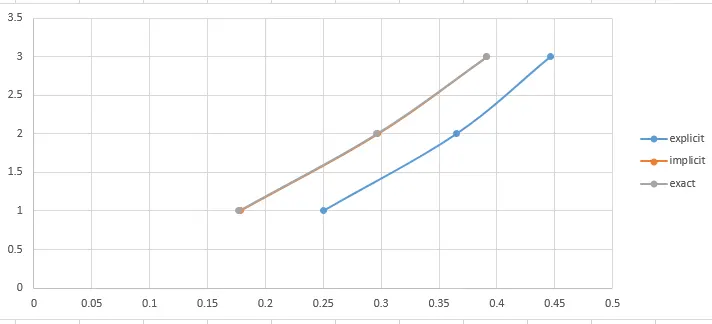
- Where the implicit and exact values are matching exacting due to equilibrium condition Fext=Fint
- The small change is due to the error percentage.
- Where the explicit it out the curve due to stability condition where it is used for shorter time steps.
Conclusion:-
- Understood how to calculate implicit and explicit manually
- Understood how solver will calculate the implicit and explicit values.
- Understood the difference between implicit and explicit.