Week 1 Understanding Different Battery Chemistry
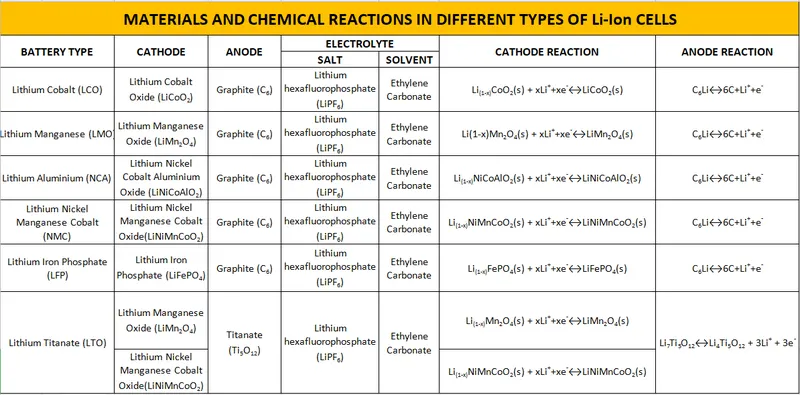
1.Prepare a table which includes materials & chemical reactions occurring at the anode and cathode of LCO, LMO, NCA, NMC, LFP and LTO type of lithium ion cells.Give your detailed explanation on it
A battery is made up of several individual cells that are connected to one another. Each cell contains three main parts: a positive electrode (a cathode), a negative electrode (an anode) and a liquid electrolyte.
Just like alkaline dry cell batteries, such as the ones used in clocks and TV remote controls, lithium-ion batteries provide power through the movement of ions. Lithium is extremely reactive in its elemental form. That’s why lithium-ion batteries don’t use elemental lithium. Instead, lithium-ion batteries typically contain a lithium-metal oxide, such as lithium-cobalt oxide (LiCoO2). This supplies the lithium-ions. Lithium-metal oxides are used in the cathode and lithium-carbon compounds are used in the anode. These materials are used because they allow for intercalation. Intercalation means that the molecules are able to insert something into them. In this case, the electrodes are able to have lithium-ions move easily in and out of their structures.
Reduction takes place at the cathode. There, cobalt oxide combines with lithium ions to form lithium-cobalt oxide (LiCoO2). The half-reaction is:
CoO2 + Li+ + e- → LiCoO2
Oxidation takes place at the anode. There, the graphite intercalation compound LiC6 forms graphite (C6) and lithium ions. The half-reaction is:
LiC6 → C6 + Li+ + e-
Here is the full reaction (left to right = discharging, right to left = charging):
LiC6 + CoO2 ⇄ C6 + LiCoO2
When the lithium-ion battery in your mobile phone is powering it, positively charged lithium ions (Li+) move from the negative anode to the positive cathode. They do this by moving through the electrolyte until they reach the positive electrode. There, they are deposited. The electrons, on the other hand, move from the anode to the cathode.
When you charge a lithium-ion battery, the exact opposite process happens. The lithium ions move back from the cathode to the anode. The electrons move from the anode to the cathode.
- NMC (NCM) – Lithium Nickel Cobalt Manganese Oxide (LiNiCoMnO2)
- LFP – Lithium Iron Phosphate (LiFePO4/C)
- LNMO – Lithium Nickel Manganese Spinel (LiNi0.5Mn1.5O4)
- NCA – Lithium Nickel Cobalt Aluminium Oxide (LiNiCoAlO2)
- LMO – Lithium Manganese Oxide (LiMn2O4)
- LCO – Lithium Cobalt Oxide (LiCoO2)
Lithium Nickel Manganese Cobalt Oxide Batteries
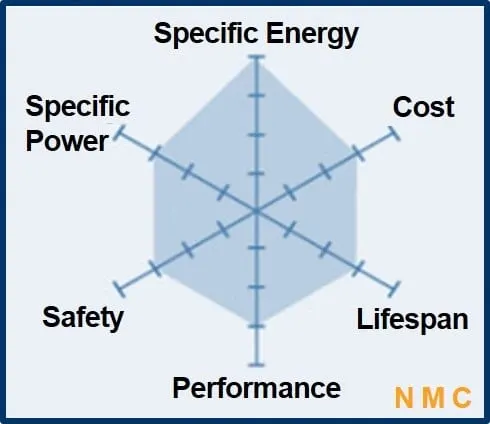
One of the most successful li-ion cathode formulas developed to date is obtained by combining nickel, manganese, and cobalt. Lithium-Nickel-Manganese-Cobalt-Oxide (LiNiMnCoO2), abbreviated as NMC, has become the go-to cathode powder to develop batteries for power tools, e-bikes and other electric powertrains. It delivers strong overall performance, excellent specific energy, and the lowest self-heating rate of all mainstream cathode powders, which makes it the preferred option for automotive batteries.
While NMC powder can refer to a variety of blends, the formula typically consists of 33% nickel, 33% manganese and 33% cobalt. This blend, sometimes referred to as 1-1-1, is a popular option for mass-produced cells in applications requiring frequent cycling (automotive, energy storage) due to the reduced material cost resulting from lower cobalt content.
| Product Code | SNMC
03001 |
|
| Material | NMC 333 | |
|
Physico-chemical properties |
D10/um | 4.2 |
| D50/um | 6.5 | |
| D90/um | 11 | |
| BET/m2/g | 0.48 | |
| TD/g/cm3 | 2.2 | |
| PH | 11.1 | |
| Li2CO3/% | 0.05 | |
| LiOH/% | 0.03 | |
|
Electro-chemical data 2.8-4.25V |
Capacity/ mAh.g-1 | 154.8 |
| Efficiency/% | 88.8 | |
| Rate capacity retention/% | 94.8 | |
| Cycle capacity retention @50 cycles/% | 98.3 | |
Lithium Iron Phosphate Batteries
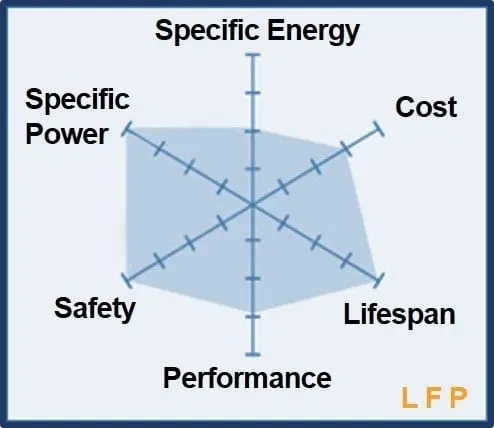
LFP Cathode PerfformanceLithium Iron phosphate (LFP) is a popular, cost-effective cathode material for lithium-ion cells that is known to deliver excellent safety and long life span, which makes it particularly well-suited for specialty battery applications requiring high load currents and endurance.
Discovered by University of Texas researchers in the mid-90s, LFP cathode offers several key advantages including a high current rating, long cycle life, and superior thermal stability, which makes it one of the safest and most abuse-tolerant cathode material options available to manufacturers. On the other hand, LFP delivers a lower nominal voltage, which results in lower specific energy when compared to other cathode materials on the market. Consequently, LFP batteries tend to have a higher self-discharge than other Li-ion battery types.
Lithium Nickel Manganese Spinel
Our LNMO battery material is a high-performance cathode powder for next-generation lithium-ion cell manufacturers and energy storage technology developers. Cost-effective, cobalt-free and low in nickel content, LNMO cathode material offers exceptional energy density and a high voltage plateau due to its three-dimensional spinel structure and electrochemistry.
To view a summary of our LNMO cathode powder’s performance characteristics, consult the table below. For an in-depth review of product specifications, or to inquire about purchasing LNMO battery material for your research lab or lithium-ion cell manufacturing facility, contact the battery division.
LNMO Battery Material Specifications
| Phase purity | Above 96 % | |
| Surface area | Less than 0.5 m²/g | |
| Tap density | Above 2.3 g/cm³ |
Below are the tabular format of chemical reaction of types of battery:-
===================================================================================================
2.Compare the differences between each type of Li+ion batteries based on their characteristics
Although all lithium ion batteries, or li-ion batteries have many aspects in common, there is a variety of different types of lithium ion battery that are available.Each lithium ion battery type has its own characteristics and this means that different types of Li-ion battery will be used in different areas.
Accordingly it is necessary to choose the right type of lithium ion battery for any application - understanding the different types and their characteristics enables the right type to be chosen for any particular application.
Typical lithium ion battery used for powering a power tool
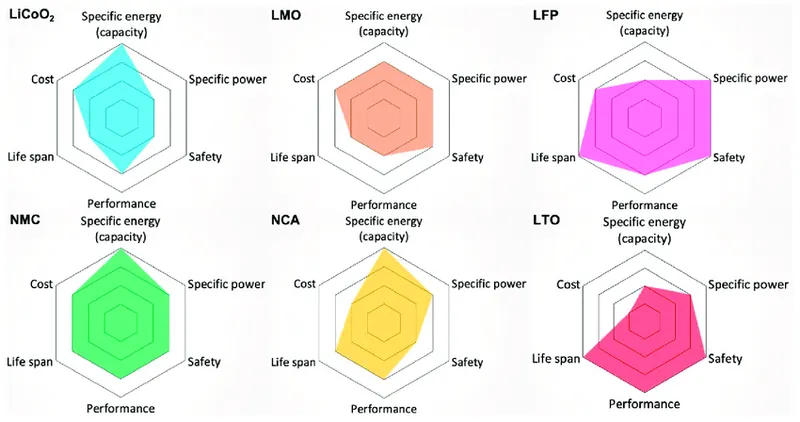
Lithium ion battery types overview
Parameters such as the chemistry, the cost, size, weight, capacity and many more attributes vary across the different types of lithium ion battery.Items such as handheld items of electronic equipment ranging from mobile phones, to tablet computers, games, e-readers and more require high energy density levels combined with high levels of safety. For these applications Lithium Cobalt Oxide types of battery are normally used.
In other applications a lower energy density can be tolerated, but a longer battery life may be needed. The type of li-ion battery used for these applications is often the lithium ion phosphate battery type or lithium nickel manganese cobalt oxide as these lithium ion battery types offer longer usable life times at the expense of the very high energy density.
For automotive applications where high current is a necessity, the lithium nickel manganese cobalt oxide battery type is often used.There are also other types of li-ion battery that are used for particular roles. With Lithium ion battery technology moving forward apace, new types of lithium ion battery are bound to appear on the market at frequent intervals.There is a good variety of different types of lithium ion battery. The main differences are the anode and cathode materials.
Each of the different types of lithium ion battery provide different characteristics and accordingly they tend to be used in different applications. The main types are summarised in the sections below.
Typical lithium ion battery used for powering a DSLR camera
Lithium Cobalt Oxide, LCO
The Lithium Cobalt Oxide, LiCoO2, battery is a type of lithium ion battery that find uses in many consumer items of electronic equipment. It provides a very high level of specific energy density along with a good level of safety.
The battery consists of a cobalt oxide cathode with a layered structure. The anode is graphite (carbon). During the discharge cycle, lithium ions move from the anode to the cathode, and in the reverse direction during charge.The graphite anode limits the battery life as the solid electrolyte interface changes and also as a result of anode thickening. Newer batteries may incorporate nickel or manganese to improve the lifetime as well as reducing manufacturing costs.
One of the drawbacks of the LCO battery is that its current capability in both charge and discharge is limited. As a guide, it should not be charged or discharged at a greater rate than its capacity, i.e. a 2400mAh battery should not be charged or discharged with a current greater than 2400mA. Often figures of 0.8 of the charge level are recommended.The LCO battery is now being supplanted in some applications by Lithium Manganese, as well as NMC and NCA types. This is occurring as a result of the improved performance of these other types as development improves the performance and as a result of cost.
| SUMMARY OF LITHIUM COBALT OXIDE BATTERY, LCO | |
|---|---|
| ATTRIBUTE | DETAILS |
| Key features | High energy density; high level of safety |
| Main disadvantages | Relatively short life-span; limited high load capability. |
| Main applications | Consumer electronics:- mobile phones, games, laptops, tablets, e-readers, etc. |
| Voltage | 3.60V nominal with typical operating rate between 3.0 - 4.2 V/cell |
| Specific energy (capacity) | 150 - 200Wh/kg typical |
| Battery life | 500 - 1000 cycle |
Lithium Iron Phosphate Battery, LFP
The Lithium Iron Phosphate, LFP type of lithium ion battery provides a low internal resistance and high current capability.In order to provide its high of current capability, this type of li-ion battery uses a nano-scale phosphate cathode material.
In terms of performance this type of lithium ion battery provides a slightly lower terminal voltage and it has a slightly higher self-discharge rate than other forms. However against this it provides a high current rating, and good thermal stability combined with a good level of, and good thermal stability.
| SUMMARY OF LITHIUM IRON PHOSPHATE, LFP BATTERY | |
|---|---|
| ATTRIBUTE | DETAILS |
| Key features | High current capability, longer calendar lifespan. |
| Main disadvantages | Slightly higher self-discharge rate; low cell voltage (3.3V) |
| Main applications | Power tools, some medical tools, hobbyist |
Lithium Manganese Oxide, LMO
This type of lithium ion battery uses Lithium Manganese Oxide, LiMn2O4 as its cathode material. This type of lithium ion battery is structured to allow high currents to flow and this enables it to provide very high current levels and also to be fast charged as well.
It generally uses a three-dimensional spinel structure, i.e. one in which the crystal structure in the cubic, isometric, system, with the oxide anions arranged in a cubic close-packed lattice. This structure improves the flow of ions on the electrode, thereby increasing he current capability and lowering the internal resistance of the cell. A typical 1500mAh battery may be able to deliver steady currents of up to 20 A, obviously for a relatively short time because of the overall battery capacity.
The structure of this type of lithium ion battery also has the advantage that it improves the thermal stability and improves the safety of the cell.However the disadvantage of the cell is the limited number of charge discharge / cycles as well as the limited calendar life, i.e. the degradation over time since manufacture.
| SUMMARY OF LITHIUM MANGANESE OXIDE, MNO BATTERY | |
|---|---|
| ATTRIBUTE | DETAILS |
| Key features | High current capability for charge and discharge. |
| Main disadvantages | Lower energy density than other types of lithium ion battery, low cycle life and calendar life. |
| Main applications | Power tools, some medical tools some vehicles. |
| Voltage | ~3.70V nominal |
| Specific energy | 100 - 150Wh/kg |
| Life expectancy | 400 - 750 cycles |
Lithium Nickel Cobalt Aluminium Oxide, NCA
The Lithium Nickel Cobalt Aluminium Oxide battery, or NCA, is a li-ion battery type that is rarely seen in consumer applications but is being investigated for the automotive industry. Its main advantage is that it has a good life span and high energy and power density figures.
However these features come at a cost and in view of the safety elements, it must be used with care. Further development is also required to bring it to a state where this type of li-ion battery can be more widely used.
| SUMMARY OF LITHIUM NICKEL COBALT ALUMINIUM OXIDE, NCA | |
|---|---|
| ATTRIBUTE | DETAILS |
| Key features | High energy density, high power density, good life span. |
| Main disadvantages | High cost; safety requires more care in the design and use. |
| Main applications | |
Lithium Nickel Manganese Cobalt Oxide, NMC
The lithium nickel manganese cobalt oxide lithium battery type uses a cathode comprising of a combination of nickel, manganese, and cobalt.The key to this lithium ion battery type is the combination of nickel and manganese. Nickel is known for its high specific energy, but poor stability whereas manganese provides low internal resistance but at the cost of low specific energy. Combining both in a cell in the correct manner is able to provide the required balance of the properties of both metals.
The cathode combination often consists of a combination of nickel, manganese and cobalt in equal proportions in a combination known as 1-1-1. This combination reduces cost by reducing the cobalt content, whilst still retaining some of the key performance parameters.
Another popular combination consists of 5 parts nickel, 3 parts cobalt & 2 parts manganese (5-3-2)
The NMC type of lithium ion battery can be optimised for either to high specific power or high specific energy. With the high cost of cobalt, manufacturers are trying to move away from its use, often increasing the use of nickel, so this is often a major fact in the choice of composition of the battery.
| SUMMARY OF LITHIUM NICKEL MANGANESE COBALT OXIDE, NMC | |
|---|---|
| ATTRIBUTE | DETAILS |
| Key features | High specific power or energy. |
| Main disadvantages | Power / energy density not as high as some other types. |
| Main applications | Power tools and electric vehicles. |
| Voltage | 3.60 - 3.70 V |
| Specific energy | 160 - 230Wh/kg |
| Life expectancy | 1000 - 2000 cycles. |
These types of lithium ion battery are some of the more popular ones available. However as the technology is continually seeing more development, new lithium ion technologies are always being developed and those which exist are being developed. This has arisen from the needs of the equipment manufacturers. Battery technology in general is forcing development forwards and significant amounts are being invested. As a result, this is a particularly fast moving area of technology where improvements are always being seen.
| Lithium-ion battery Types | SP | SE | SF | LS | CS | PF |
|---|---|---|---|---|---|---|
|
Lithium Cobalt Oxide |
L |
H |
L |
L |
L |
M |
|
Lithium Manganese Oxide |
M |
M |
M |
L |
L |
L |
|
Lithium Nickel Manganese Cobalt Oxide |
M |
H |
M |
M |
L |
M |
|
Lithium Iron Phosphate |
H |
L |
H |
H |
L |
M |
|
Lithium Nickel Cobalt Aluminum Oxide |
M |
H |
L |
M |
M |
M |
|
Lithium Titanate |
M |
L |
H |
H |
H |
H |
- SP stands for specific power
- SE stands for specific energy
- SF stands for safety
- LS stands for lifespan
- CS stands for cost
- PF stands for performance
- L stands for low
- M stands for moderate
- H stands for high