Week-11 Challenge: Braking
1.For a defined driving cycle, calculate the energy required for braking.
The braking is done by 2 method
a.Mechanical
b.Electrical
Braking is done to stop the vehicle at a desired position we directly cant apply brake to ev motor as it may create a jerk and the passenger may suffer injury hence the supply is cut of and mechanical brakes are used to slower down the speed at this instant regrenative braking is used to charge back the battery.
We have used WLTC CLASS1 driving cycle
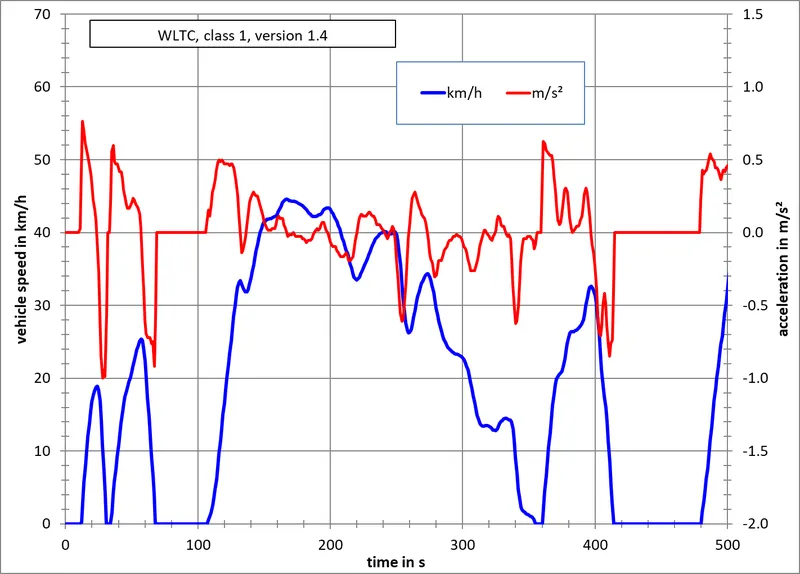
For calculating braking energy formula used is = 1/2 * mass * velocity^2
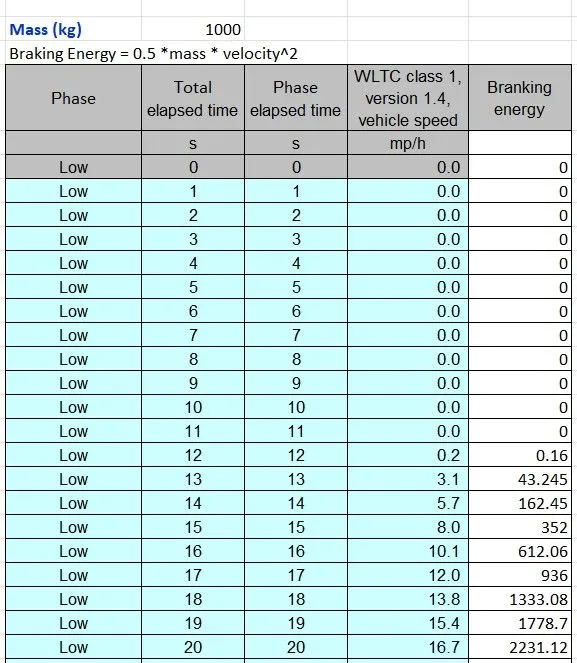
At each point the braking energy is calculated.
===================================================================================================================================
2.Why electric motor can’t develop braking torque at high speed similar to starting? How electric and mechanical brakes are coordinated?
Electric Braking
Regenerative braking is a way of taking the wasted energy from the process of slowing down a car and using it to recharge the car’s batteries. On a normal car, braking simply wastes energy - but with regenerative braking, some of the energy is able to be reused.Regenerative braking systems are common on many modern cars. On petrol and diesel models, it’s used to charge the battery that runs various ancillary systems in the car, meaning less work for the engine and less fuel burned. In these cars, the system is virtually imperceptible to the driver but in hybrid and pure electric cars regenerative braking takes a more active and obvious role. In these models, brake regeneration can help charge the larger batteries that directly drive the car.
The electric motor in your hybrid or electric car runs in two directions - one to drive the wheels and move the car, and the other to recharge the battery. When you lift your foot off the accelerator pedal and onto the brake, the motor swaps directions and starts to put energy back into the battery.When this process kicks in, you can feel the car start to slow down. It’s a different sensation in each car that has this function, because manufacturers can program-in how much regenerative braking occurs when you lift off the pedal.
All cars still have normal brakes, so if you push the pedal hard enough then the hydraulic system will kick in to get you stopped quickly (depending on your speed). Again, different cars will have different amounts of force on the pedal needed to get the brakes to kick in. There are many cars with regenerative braking, and they all feel a little bit different to use. In fact, in most electric cars you can even tailor the way it feels to your own preference. If you want to harvest as much lost energy as possible you can set it to the maximum setting, or if you hate the sensation of the car braking itself, you can turn it off. In most cases the car’s brake lights will come on if the car is slowing quickly, even if you’re not even touching the brake pedal.Some cars even have an automatic cruise control system that uses brake regeneration. The car in front is monitored by sensors and the brake regen is used to match that car’s speed on the road.
In many EVs, when you lift off the pedal completely it feels like you’ve got your foot firmly on the brake. This is often referred to as one-pedal driving, as you need to modulate your right foot to speed up and slow down, rather than swapping it between the brake and accelerator pedals.
Braking Torque
This situation does not occur at the beginning of an acceleration because most of the torque is used to increase the kinetical energy of the load (and motor). But when the speed is already high and no extra load is applied it is not possible to increase the torque.
EVs use regenerative braking. The instantaneous power from regen braking can be substantial. If the EV battery is 100% charged, or close to it, the regen braking cannot work as their is no battery capacity to absorb the energy. So the mechanical braking system is the only brakes the vehicle has when the HV battery is fully charged. The mechanical brakes are also the backup if the regen brakes were to fail for whatever reason. No complex system such a car or plane, etc., will ever have a single point failure that results in death and mayhem. Traditional cars have a dual reservoir braking system that provides in effect two independent brake systems, each serving two wheels. EVs will typically go the life of the vehicle without needing to service the mechanical brakes.
===================================================================================================================================
3. Make a MATLAB program which plots contour of given motor speed, torque and efficiency values. Attach the code as a .m file attach a screenshot of all the plots.
Matlab script for above question is as follows:-
%plotting contour plot of motor speed
close all
clc
%torque array
T = linspace (0,200);
%speed array
N = linspace (0,500);
%loss coefficients
kc=0.20; %copper losses
ki=0.008; %iron losses
kw=0.00013; %windage losses
%meshgrid
[X,Y]=meshgrid (N,T);
copper_loss = (Y.^2)*kc;
iron_losses = (X*ki);
windage_loss = (X.^3)*kw;
K=20;
output_power=X.*Y;
input_power = (copper_loss)+(iron_losses)+(windage_loss)+(output_power)+K;
Eff = (output_power)./(input_power);
n=linspace(0.7,0.95,10);
contourf(X,Y,Eff,n);
title('SPEED TORQUE CHS')
xlabel('SPEED rad/s')
ylabel('TORQUE N.m')
Results :-
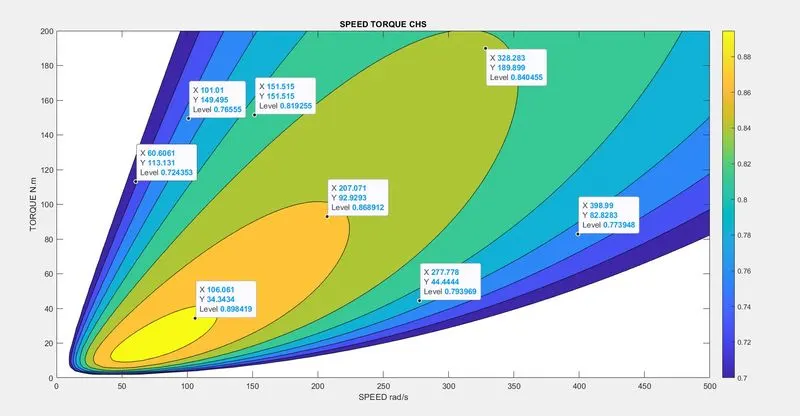
For low speed the efficiency obtain is max i.e approx 90% at around 90rad/s as the speed increases the efficiency decreases at max speed and max torque the efficiency observed is 80 % and in between its is 72 - 76%