Project 1 Mechanical design of battery pack
Battery pack capacity: 18 kWh
Cell: ANR26650M1-B
Details of Cell ANR26650M1-B are as belows:
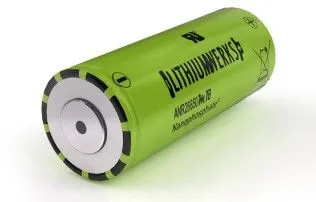
Lithium Werks’ 26650 cells are capable of delivering very high power due to its use of patented Nanophosphate ® battery technology. Based on lithium iron phosphate chemistry (LiFePO4), the cells are inherently safe over a wide range of temperatures and conditions.
Whether the application requires outstanding cycle life or stable float reliability, the Lithium Werks’ 26650 cells are suitable for a wide variety of power, pulse, or stand-by applications.
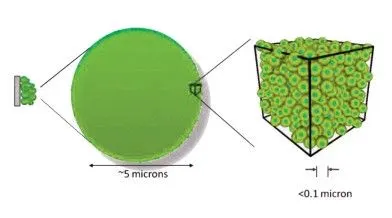
Nanophosphate® battery technology offers stable chemistry, faster charging, consistent output, excellent cycle life and superior cost performance. It provides the foundation for safe systems while meeting the most demanding customer requirements. Multiple layers of
protection are employed at the chemistry, cell and system level to achieve an energy storage solution with superior safety and abuse tolerance compared to metal oxide lithium-ion chemistries.
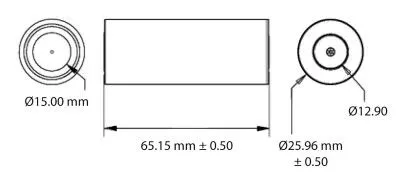
DIMENSION OF CELL:
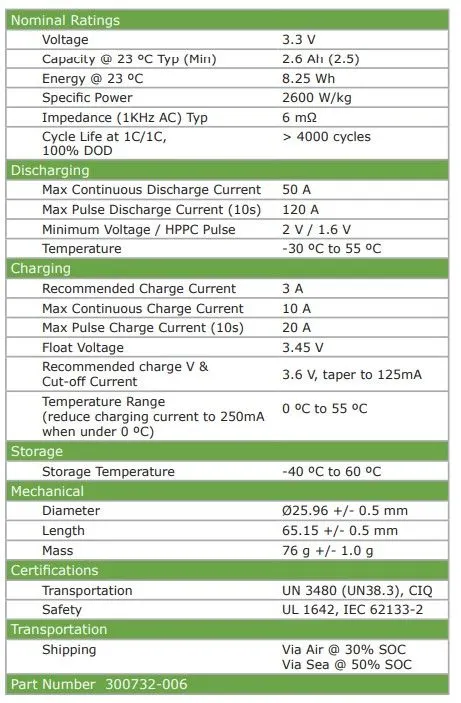
SPECIFICATION OF ANR26650M1-B:
Nominal Ratings
- Voltage: 3.3 Volts
- Capacity: 2.5 Ah
- Energy: 8.25 Wh
- Specific Power: 2600 W/kg
- Impedance (1KHz AC Typical) 6 mΩ
- Cycle Life at 1C/1C, 100% DOD: > 4000 cycles
- Cell Type: 26650 Lithium Ion Power Cylindrical Cell
Discharging
- Max Continuous Discharage: 50 A
- Max Pulse Discharge Current >50% SOC (10s): 120 A
- Minimum Voltage: 2 Volts
- Temperature: -30ºC to 55ºC
Charging
- Recommended Standard Charge: 2.5 Amps
- Max Charge Rate: 10 Amps
- Max Pulse Charge Current <50% SOC (10s): 25 A
- Float Voltage: 3.45 Volts
- Recommended charge V & Cut-off Current: 3.6 Volts, taper to 125mA
- Temperature (reduce charging current to 250mA when under 0ºC): 0ºC to 55ºC
Mechanical
- Diameter: Ø25.96 +/- 0.5 mm (1.0")
- Length: 65.15 +/- 0.5 mm (2.6")
- Mass: 76 g
Certifications
- Transportation: UN 3480 (UN38.3), CIQ
- Safety: UL 1642, IEC 62133
The LithiumWerks ANR26650M1-B is the next generation of A123 Systems’ pioneering 26650 cylindrical cell, now with greater power and energy density and lower impedance. This versatile lithium ion cell is suitable for a wide variety of applications and system designs. Proven performance in the toughest conditions, combining durability, reliability, and safety, the ANR26650 cell offers an excellent combination of price-performance.
Cylindrical Cell Primary Applications:
- Portable high power devices
- Stationary battery backup systems
- Grid stabilization energy storage systems
- Commercial truck and bus hybrid electric vehicles (HEVs)
- Lithium Ion Cell Benefits:
Power: Over 2,600 W/kg and 5,800 W/L
Safety: Excellent abuse tolerance and environmentally friendly
Life: Excellent calendar life, 10X cycle life vs. conventional lithium ion
CELL DATA:
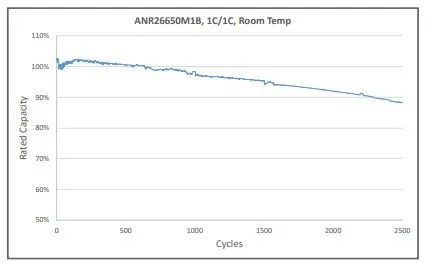
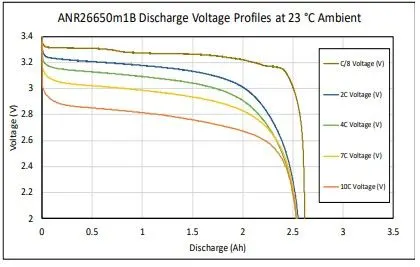
CONSTRUCTION OF BATTERY:
Total Energy is 18000 Wh
- Number of cells (N) = energy/(nominal voltage capacity)
N=`18000/(3.3+2.5)`
N=2182 cells.
We need a minimum of 2182 cells to get 18 kWh energy, now based on that we need to decide configuration-series and parallel
And we assumed 400 Volts are need to run the vehicle
In series configuration capacity remains the same and voltage will be the sum of individual in a parallel configuration, the voltage remains the same and capacity accumulates
The nominal voltage of one call is 3.3V
Number of series cells required to produce 400 V (Ne) voltage required/nominal voltage of one cell
Ns=`400/33`
Ns=122
122 cell are connected in series will generate 400 voltage and the capacity of the whole module will be 2.5 Ah
Now we need to find the number of calls which will be connected in a parallel configuration Np (cell in parallel)= total cell/Ns
Np=`2182/122`
Np=18
Cell architecture 122 cell are"
Enclosure volume we have to find the volume of single module volume consist of 122 cells in series connection and multiplied with 18 parallel connected module volume.
Single module,
Let as assume 122 cells (single module) are divided into 2 modules of 61+61 cells.
The length of the module=No.of cell in Low (Cell dia + Margin at both side of cells) + clearance at side(2(cell dia+ margin)).
=61 (26+4)+60
=1890mm.
The breath of the module=(cell dia +Margin of both side of cells + clearance)
=26+4+60
=90mm.
Height of the module-Height of cell + connecting strip thickness,wires say 35mm
=65+35
=100 mm.
Thus the volume required for single module is 1.8 *.09*0.1=0.0162 `m^3`.
Total number of modules assumed are 18*2=36 modules since single module is divided Into two modules
Therefore total volume required for battery pack of 122S18P configuration construction is
=0.0162*36
=0583 `m^3`.
Let's powertrain energy consumption=100 Wh/km at 70% powertrain efficiency
Range = Capacity/energy consumed per kilometre
Range
`18000/100`
Range = 180 km
So our vehicle will be able to cover around 180 km with current parameters.
ANR26650 cell has 26mm diameter and 65mm height. On the basis of that we need to decide battery size of battery casing.
Length of casing (L) = number of cells at series (cell diameter (26) + margin at both side of cell (4))+ clearance at side (diameter of edged cell + margin)
Weight of battery pack
Cell weight 76g
Number of the cells = 2182
Battery pack weight (w)= cell weight number of cells+ weight of accessories
W = 76 * 182 + 4.5
=165.8+ 4.5
=170.3 kg
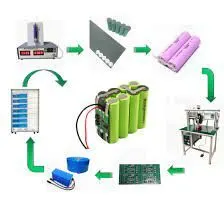
BATTERY PACK MAKING:
A well-designed battery pack needs to compete with petrol-based engines to appeal to customers. That’s a real challenge because electric batteries need to overcome complex issues that internal combustion engines (ICE) do not have.
Here are some common issues that can affect a battery pack’s performance:
Cold temperatures prevent batteries from delivering their full power. Batteries operate best within a specific temperature range, which is between 68°F and 77°F (20°C and 25°C). Maintaining the right operating temperature is essential.Batteries lose part of their available power over time due to natural wear. EV manufacturers need to make sure that this power loss does not affect the driving experience.Battery cells need to be balanced to offer optimal performance, meaning that they must all have the same voltage. Battery cells are rebalanced during charges, but they lose their ability to maintain that balance as they age. In addition, rapid charges which are gaining in popularity are challenging the balancing performance.
To better understand the complexity behind battery technology, let’s go over the following subjects:
BATTERY PACK:
A battery pack is a device that stores electrical energy to provide power to an electrical system, such as an electric vehicle (EV) or an energy storage system (ESS). The energy is stored in cells that are all connected to one another in the battery pack.
To provide sufficient power, battery packs require a minimum voltage level which a single cell cannot achieve. Multiple cells are therefore connected in series to boost voltage. Some designs use small-capacity cells. To achieve the desired battery energy, cells are connected in parallel to boost capacity. Cells connected in parallel provide power as if they were a single, larger cell.
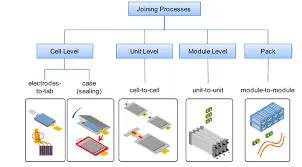
Battery packs are made of multiple, smaller sections called battery modules (or sub packs). These modules include a smaller number of cells connected in series and parallel. They are usually at a lower voltage, which is safe for handling. Modules facilitate servicing when only a few cells are defective and if they can be replaced without replacing the entire battery. EV batteries are typically made of 4 to 40 modules connected in series to one another.
COMPONENTS OF BATTERY PACK:
A battery pack is the most expensive part in an electric vehicle. It is a complex system made of a wide range of components. Here are some of the important components.
- Cells are the most important components of a battery pack. The mixture of materials comprising the cell is known as its chemistry. Different battery chemistries can achieve different performances and specifications. There are two common types of cells: energy cells and power cells. There are also many variants to provide the perfect trade-off depending on the application. In the EV industry, the lithium-ion cell (li-ion cell) is the most common chemistry. Alternative chemistries are sometimes used, such as Nickel-Metal Hydride (NiMH), which offers a slightly better lifecycle.
- Electrical connectors such as busbars, wires, or other distribution conductors are used to make series or parallel connections between cells and groups of cells. These connections are typically done using ultrasonic bonding or laser welding. Busbar connections between modules can also be done mechanically using fasteners.
- Thermal interface materials (TIMs) such as pastes, adhesives and gap fillers are inserted between battery components to join them mechanically while improving thermal properties between surfaces. With the rise of the structural battery pack, TIMs are becoming essential components.
- The Battery Management System (BMS) protects cells by monitoring key parameters such as voltages, currents, and temperatures. It is responsible for cell balancing (to maintain the optimal performance of the cells at the right voltage) and communicates with several systems such as engine management and temperature control. It also includes protection devices that can shut down the battery if needed.
- The Battery Thermal Management System (BTMS) controls the thermal energy in the electric vehicle’s powertrain and cabin, providing cooling or heating as needed to meet the battery’s thermal needs and protect the cells. The BTMS includes several components such as a heat exchanger, tubes, hoses, cold plates, pumps, valves, and temperature sensors.
- The Contactor System is a switch controlled by the battery management system. It can cut off the electrical connection between the main battery and the high voltage bus, which delivers current to the traction motor and other high-voltage components.
- The Housing is a rigid enclosure that protects the battery from environmental factors such as water, dust, and salt. It helps maintain a precise temperature and electrical insulation in the battery, and it prevents damages like rust and slow shorts.
- The Communications System ensures communication with other components in the electric vehicle. The most used protocol is CAN bus.
CONCLUSION:
We have calculated the required details for battery design.