Understanding the concepts on Degrees of Freedom
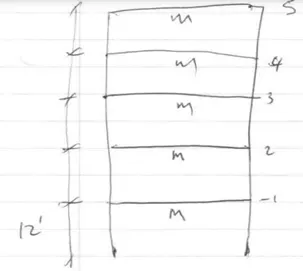
Question 1: A five storey structure with 5 translational DOF is shown here. Each storey has mass ‘m’. The eigenvalue problem has been solved and the 5 periods of vibration Tn and their corresponding mode shapes, φn has been derived.
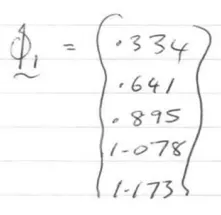
The fundamental period of vibration (T1 = 2 seconds) and its associated mode shape:
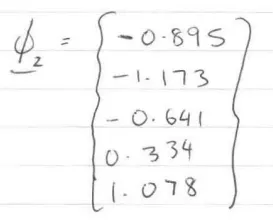
The second mode of vibration (T2 = 0.6852 seconds) and its associated mode shape:
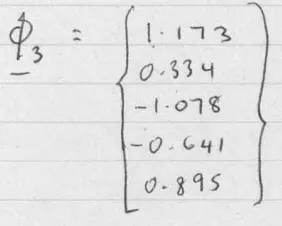
The third mode of vibration (T3 = 0.4346 seconds) and its associated mode shape:
The fourth mode of vibration (T4 = 0.3383 seconds) and its associated mode shape:
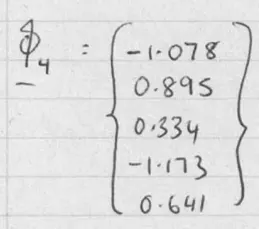
The fifth mode of vibration (T4 = 0.2966 seconds) and its associated mode shape:
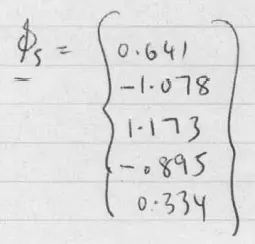
. Ln , Mn and Γn for each of the five modes are to be computed from Equations below.
. Also, calculate the effective modal mass Mn* and the modal mass participating ratio for the 5 modes. The mass matrix will be required to evaluate these parameters.

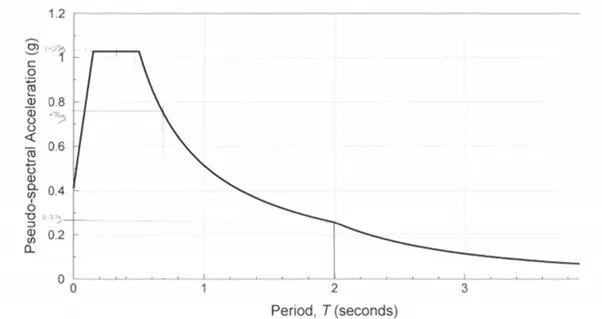
. Finally, obtain the base shear for each of the 5 modes of vibration and the combined base shear as per SRSS rule. The pseudo acceleration design spectrum to obtain the base shear for each mode is provided below.
. How many modes are to be considered such that a modal mass participating ratio of 90% is obtained?
AIM: To compute Ln, Mn, Tn for of the five modes from the given equations. To calculate the effective modal mass Mn* and the modal mass participating ratio for the 5 modes. To obtain the base shear for each of the 5 modes of vibration and the combined base shear as per SRSS rule.
PROCEDURE:
Step-1: Mn=nTmn
Mode-1: The first mode of vibration(T1)=2 seconds
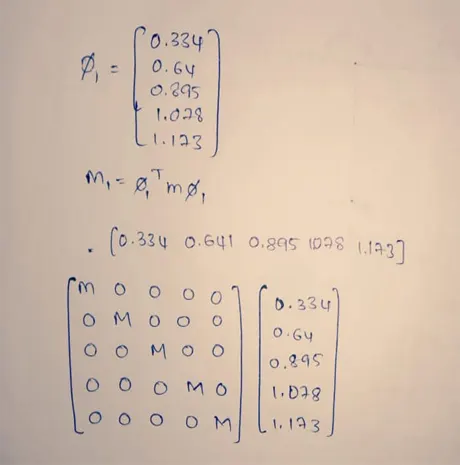
By scientific calculator, we got M1 as 3.861M M1=3.861M
Mode-2: The second mode of vibration, T2=0.6852 seconds
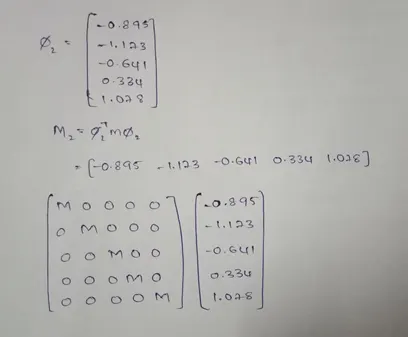
By scientific calculator, we got M2 as 3.86M
M2=3.861M
Mode-3: The third mode of vibration, T3=0.4346 seconds
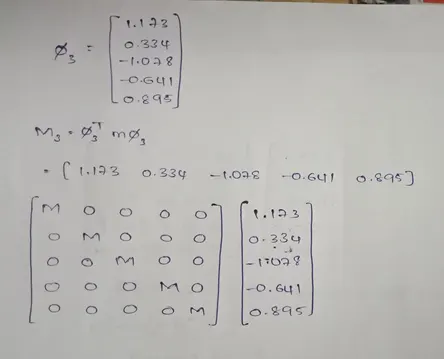
By scientific calculator, we got M3 as 3.85M
M3=3.85M
Mode-4: The fourth mode of vibration, T4=0.3383 seconds
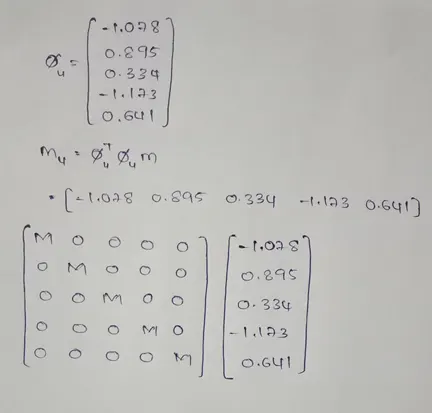
By scientific calculator, we got M4 as 3.861M
M4=3.861M
Mode-5: The fifth mode of vibration, T5=0.2966 seconds
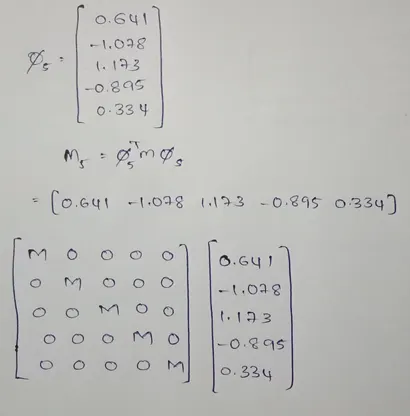
By scientific calculator, we got M5=3.861M
M5=3.861M
Step-2: Ln=nTm
Mode-1: The first mode of vibration, T1=2 seconds
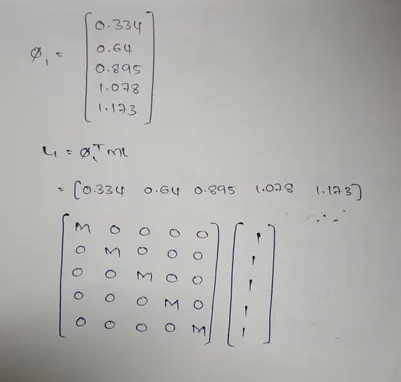
By scientific calculator, we got L1 as 4.121M
L1=4.121M
Mode-2: The second mode of vibration, T2=0.6852 seconds
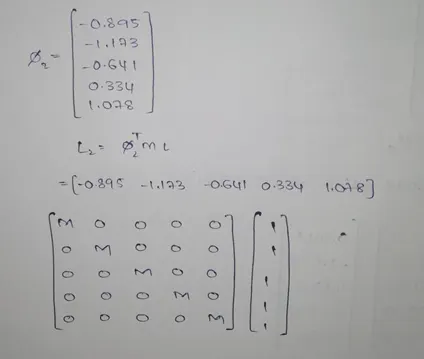
By scientific calculator, we got L2 as -1.298M
L2=-1.298M
Mode-3: The third mode of vibration, T3=0.4346 seconds
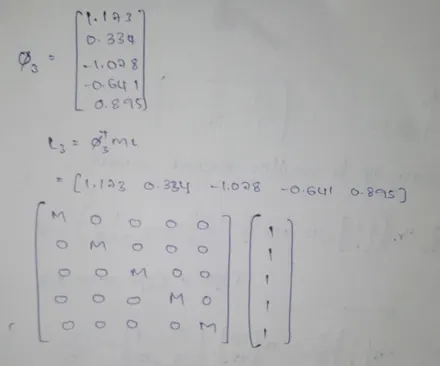
By scientific calculator, we got L3 as 0.687M
L3=0.687M
Mode-4: The fourth mode of vibration, T4=0.3383 seconds
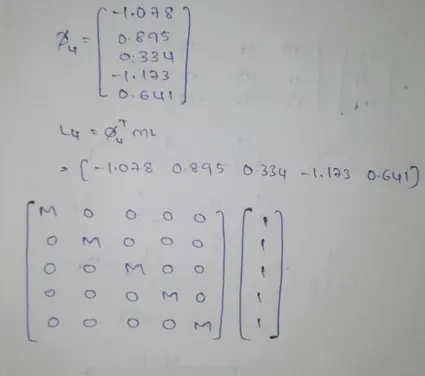
By scientific calculator, we got L4 as -0.38M
L4=-0.38M
Mode-5: The fifth mode of vibration, T5=0.2966 seconds
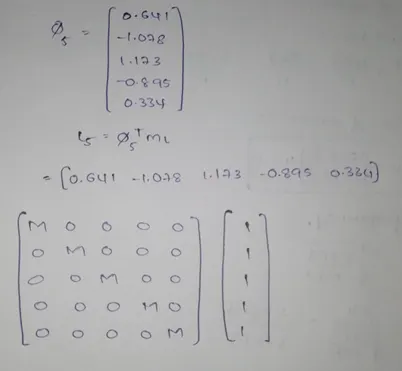
By scientific calculator, we got L5 as 0.175M
L5=0.175M
Step-3: Γn=Ln/Mn
Mode-1: Γ1=L1/M1 =4.121M/3.861M =1.067
Mode-2: Γ2=L2/M2 =-1.298M/3.861M =0.178
Mode-3: Γ3=L3/M3 =0.687M/3.85M =0.178
Mode-4: Γ4=L4/M4 =-0.381M/3.861M] =-0.09
Mode-5: Γ5=L5/M5 =0.175M/3.861M =0.04
Step-4: Mn=Ln2/Mn
Mode-1: M1*=L12/M1 =4.39M
Mode-2: M2*=L22/M1=0.43M
Mode-3: M2*=L22/M1 =0.12M
Mode-4: M3*=L32/M3 =0.03M
Mode-5: M5*=L52/M5 =0.007M
Step-5: Modal mass participating ratio=Mn*/Mj Mn*= Effective modal mass
Mj= Total mass= M+M+M+M+M=5M
Mode-1: M1*/Mj=0.88=88%
Mode-2: M2*/Mj=0.086=8.6%
Mode-3: M3*/Mj=0.024=2.4%
Mode-4: M4*/Mj=0.006=0.6%
Mode-5: M5*/Mj=0.001=0.1%
Step-6: To obtain shear force for each of the 5 modes os vibration.
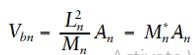
Vbn=AnxLn2/Mn =AnxMn*
From the graph,T1=2 sec, A1=0.27g
T2=0.6852 sec, A2=0.76g
T3=0.4346 sec, A3=1.03g
T4=0.3383 sec, A4=1.03g
T5=2.9666 sec, A5=0.76g
Mode-1: Vb1=A1xM1*=2.619 kips
Mode-2: Vb2=A2xM2*=0.719 kips
Mode-3: Vb3=A2xM2*=0.272 kips
Mode-4: Vb4=A4xM4*=0.067 kips
Mode-5: Vb5=A5xM5*=0.011 kips
Step-7: Combined base shear, Vb=root(Vb12+ Vb22+ Vb32+ Vb42+ Vb52) =root((2.613)2+(0.719)2+(0.272)2+(0.067)2+(0.011)2) =3.20 kips
Step-8: The two modes are to be considered such that a modal mass participating ratio of 90% is obtained,
(M1*/Mj)+(M2*/Mj)=88%+8.6%=96.6%
Result: Ln, Mn, Γn values are calculated for each of the 5 modes. The base shear force for each of the 5 modes are obtained. Effective modal mass and the modal mass participating ratio for 5 modes are obtained.