What is Section Modulus?
Section modulus is a geometric property for a given cross-section used in the design of beams or flexural members. Other geometric properties used in the design include an area for tension and shear, the radius of gyration for compression, and the Moment of inertia and polar moment of inertia for stiffness. Mathematically, Section modulus can be defined as the ratio of the moment of inertia of a section about its centroidal axis and to the distance of the extreme layer from the neutral axis.
It is denoted by S
S = I/y max
Where,
I = Moment of Inertia(m^4)
y = distance from NA to extreme end of the object(m)
The unit of section modulus is m^3 and its directly proportional to the Moment of Inertia
Types of section Modulus.
1. Elastic Section Modulus
Elastic section modulus is calculated when we are to use the material behavior till the yield point. For general design purposes, we use elastic section modulus.
Elastic section modulus is denoted by Se
Se = I/y max
Where,
I = Moment of Inertia
y = distance from NA to extreme end of the object
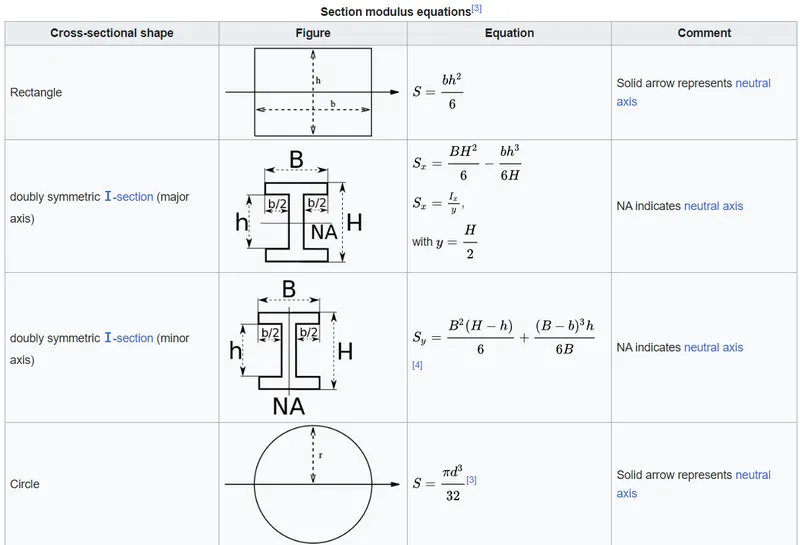
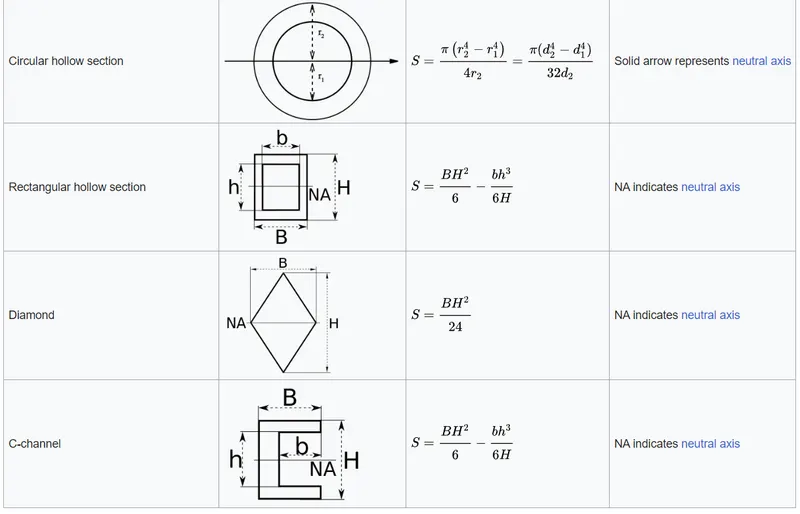
Elastic section modulus of different sections.
2. Plastic Section Modulus
The plastic section modulus is used for materials where the elastic yield is acceptable and the plastic behavior is considered to be in an acceptable range. It depends on the location of the plastic neutral axis. The PNA is the axis that bisects the cross-section such that the compressive force from the region in compression is equal to the tension force from the region under tension. So, for sections with a constant yield stress, the area above and below the PNA will be equal, but for mixed sections, this is not necessarily the case. Mathematically, The plastic section modulus is the sum of the areas of cross-sections on each side of the plastic neutral axis that may or may not be equal and multiplied by the distance from the local centroid of the two regions to the plastic neutral axis.
The plastic section modulus is denoted by Sp
Sp = (Ac × yc) + (At + yt)
where,
Ac = Area of cross-section under compression.
At = Area of cross-section under tension.
yc = Distance from the PNA to the CG of the areas under compression.
yt = Distance from the PNA to the CG of areas under tension.
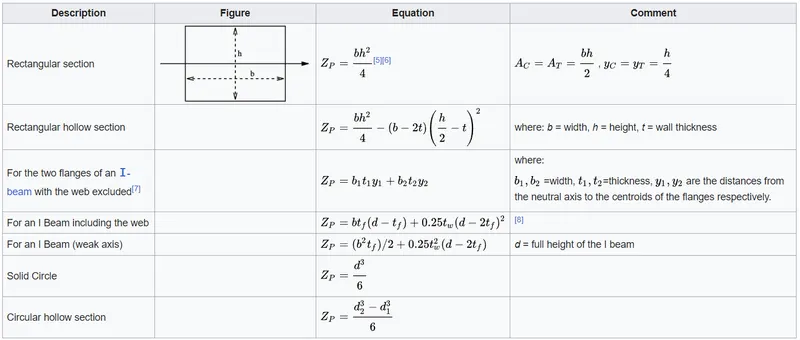
Plastic section modulus of different sections.
Calculating the section modulus of the designed hood and trying to optimize it.
So, for calculating the section modulus ie .S = I/y max (mm^3) we will require the following data from the design.
I = Moment of Inertia(mm^4)
y = distance from NA to extreme end of the object(mm)
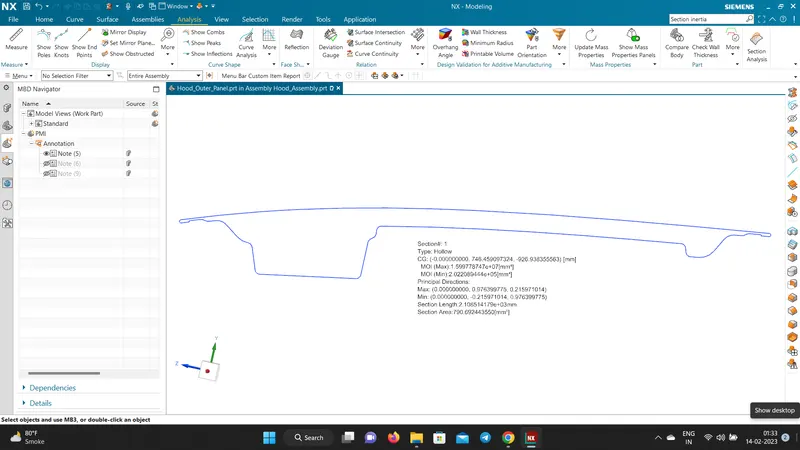
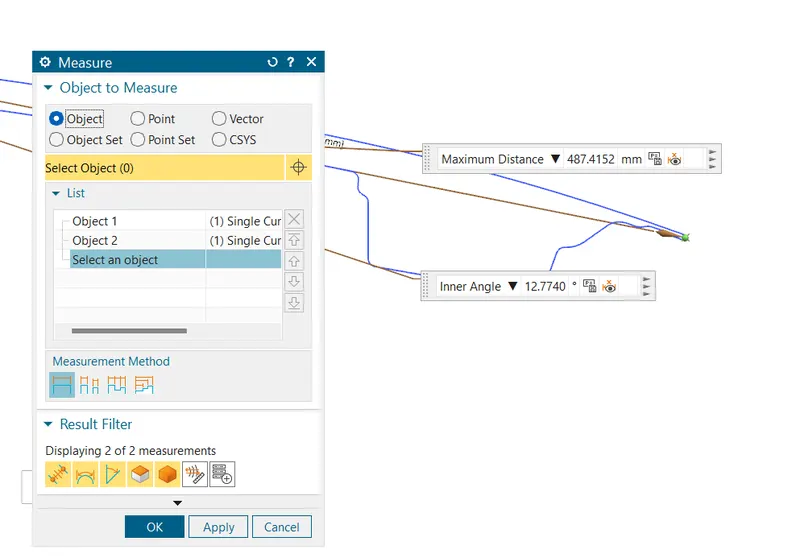
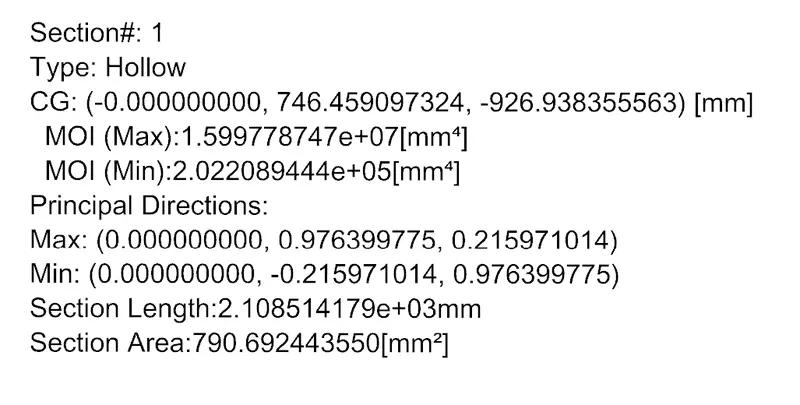
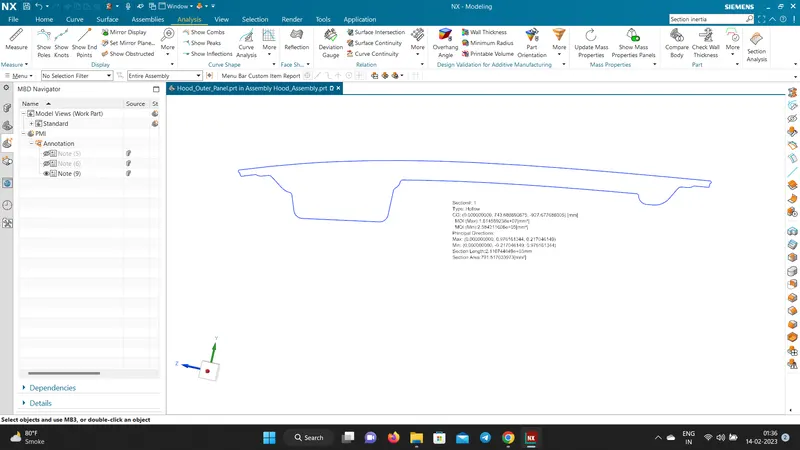
with the help of intersecting curve, we can get the cross-section to find y of the hood and by using section inertia analysis we can get the moment of inertia I
therefore, I = MOI(Max) =1.599x10^7 mm^4
y max = Maximum Distance/2 = 487.415/2 = 243.707 mm
Thus section modulus will be S = I / y max = 1.599x10^7/243.707 = 656.115x10^2 mm^3
- Design optimization -(Increasing Depth of inner panel by 2mm)
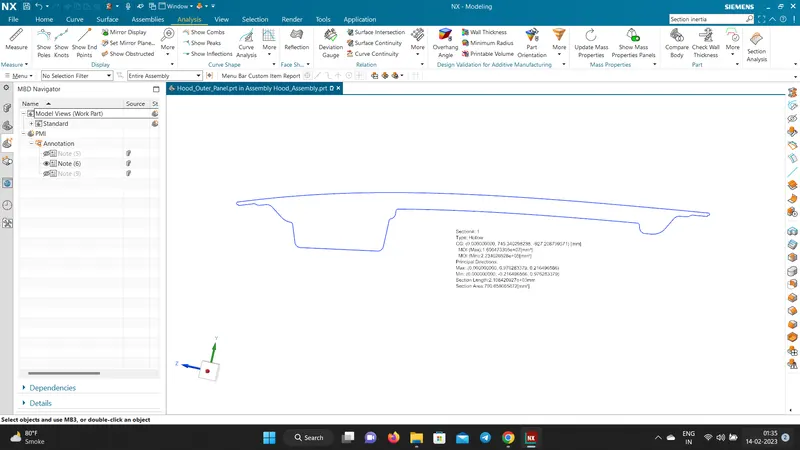
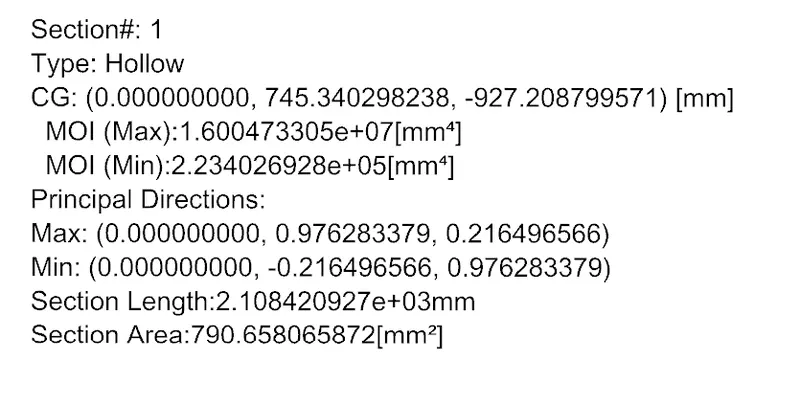
The distance will remain the same as only the depth is increased
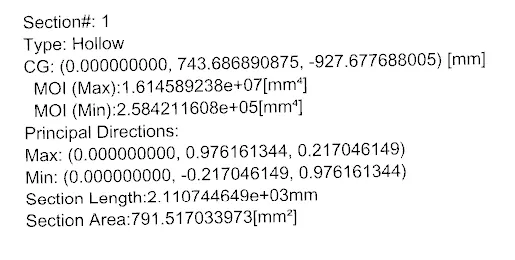
I = MOI(Max) =1.600x10^7 mm^4
y max = Maximum Distance/2 = 487.415/2 = 243.707 mm
Thus section modulus will be S = I / y max = 1.600x10^7/243.707 = 656.526x10^2 mm^3
The section modulus has been optimized by 0.411x10^2 mm^3
- Design optimization -(Increasing Depth of inner panel by 5mm)
The distance will remain the same as only the depth is increased
I = MOI(Max) =1.614x10^7 mm^4
y max = Maximum Distance/2 = 487.415/2 = 243.707 mm
Thus section modulus will be S = I / y max = 1.614x10^7/243.707 = 662.270x10^2 mm^3
The section modulus in comparison with the existing design has been optimized by 6.154x10^2 mm^3
Conclusion
As the section modulus is directly proportional to the moment of inertia, with the increase in the depth of the inner panel the moment of inertia increases resulting increase in the section modulus itself.