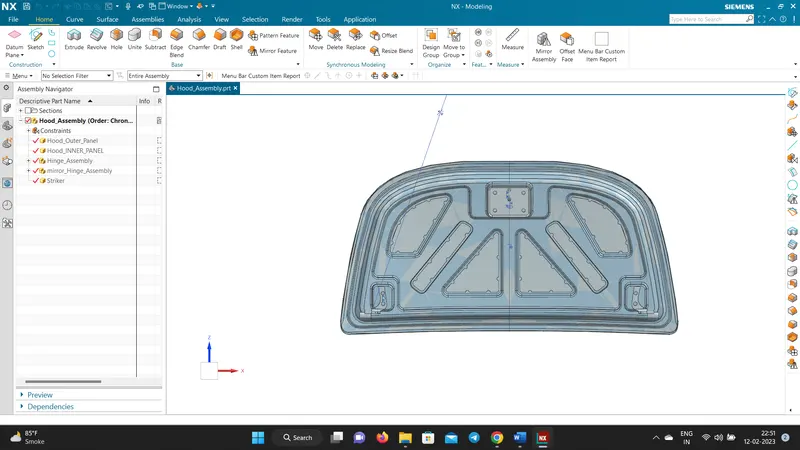
Hood design-Week 2
HOOD
The Hood also known as the bonnet is the top-hinged covering of the engine compartment, which can be opened for the maintenance/ repairability access of the engine and other constituent components.
While coming to designing the Hood, there are various factors that are to be taken into consideration such as pedestrian safety, manufacturability, Hood Head zone for lock striker, Force distribution on frontal collision, etc.
Pedestrian safety is analyzed by taking into consideration the Adult and Child head impact zone, the zones are been measured by a wrap-around distance and the side reference line (where wrap-around distance is a trace of points received on the front structure when one end of a flexible tape of the required length is held at the ground reference level and another end is in contact with the front structure, whereas the side reference line is the trace of the highest contact point between a straight edge inclined at a 45-degree angle with the side of the vehicle.) The child head impact zone ranges from 1000WAD to 1500WAD (mm) and that of the Adult head impact zone ranges from 1500WAD to 2100WAD. It comes under the Euro NCAP (European car assessment program), different assessments are made on the designs and are been graded for the rating of the vehicle.
A Hood assembly comprises the following parts.
1.Hood Outer panel
2.Hood Inner Panel
3.Latch and Striker
4.Hinge
5.Hood Stay/Support Rod
HOOD OUTER PANEL.
Hood outer panel is the aesthetic element of the hood. It is the uppermost layer of the hood which is been provided by the styling team after taking shape, position, and size into consideration with respect to the safety norm. The outer panel and inner panel are attached together by hemming. So required hemming flange and reliefs for the hemming operation are to be provided. We also provide mastic sealants between the outer panel and inner panel to reduce vibration
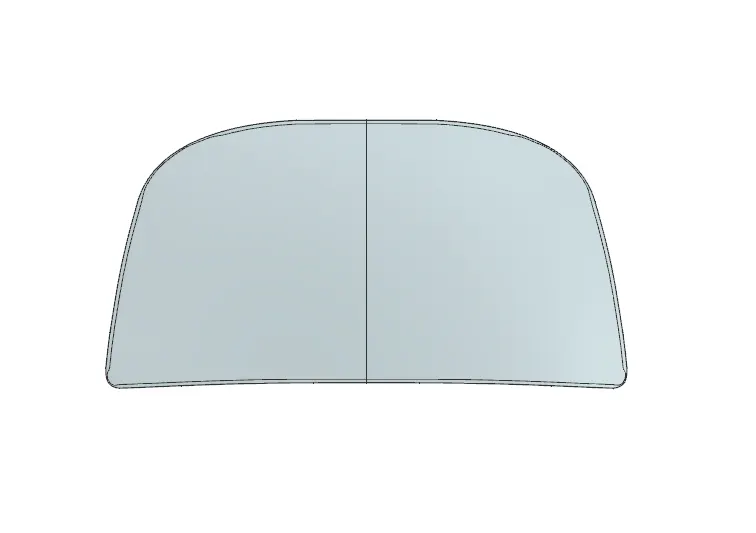
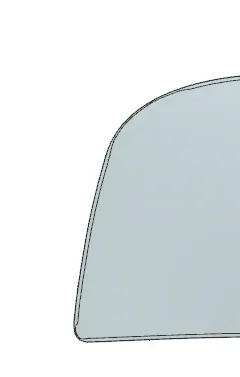
Hood Outer Panel Relief angles on Hood Outer Panel
HOOD INNER PANEL.
The inner panel is the underlying layer of the outer panel which provides strength and rigidity to the hood outer panel. The master section represents the initial embossed shape on which further shapes are embossed for force routing, the striker and hinge fixing location is also been embossed. Reinforcements are been provided according to the design requirement mostly to strengthen the weaker sections.ie.hinge and striker location.
Emboss
Sheet metal embossing is the stamping process to obtain raised or sunken edges for the desired design pattern on the sheet metal. This is done with help of male and female dies between which sheet metal is placed and the dies are pressed against the sheet metal to obtain the designed pattern. In some cases, roller dies are used to get the raised edges in the sheet metal.
Manufacturing considerations for the embossing creation
- The distance between the outer edges of the embossing should be a minimum of 5mm.
- The minimum Draft angle to be provided to the emboss is 7 degrees for the easy removal of the part from the die.
- No sharp corners are to be provided in the embossing because it would lead to inefficient manufacturing.
- The height of the emboss should not be more than 5mm.
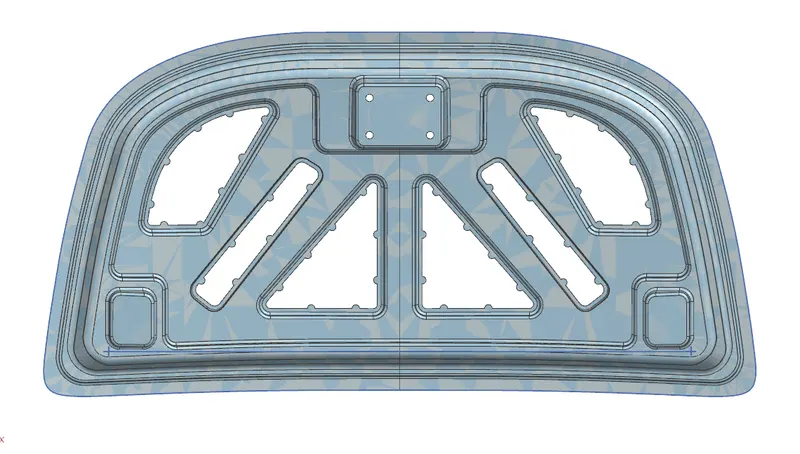
Hood Inner Panel
Mastic Sealant
The hood possesses a large surface area and only the boundary of the inner and outer panels is hemmed. The center region of the hood can't be joined through joining techniques like welding, riveting etc as they will leave marks on the surface which spoil the aesthetics of the vehicle. So mastic sealants are used to stick the inner surface of the outer and inner panel at specific locations they are also elastic components thus they also help in reducing the NVH. mastic sealants have an effect around a circular region of 80mm diameter thus they are arranged in such a way that it covers the areas away from the hemming which is more vulnerable to vibration.
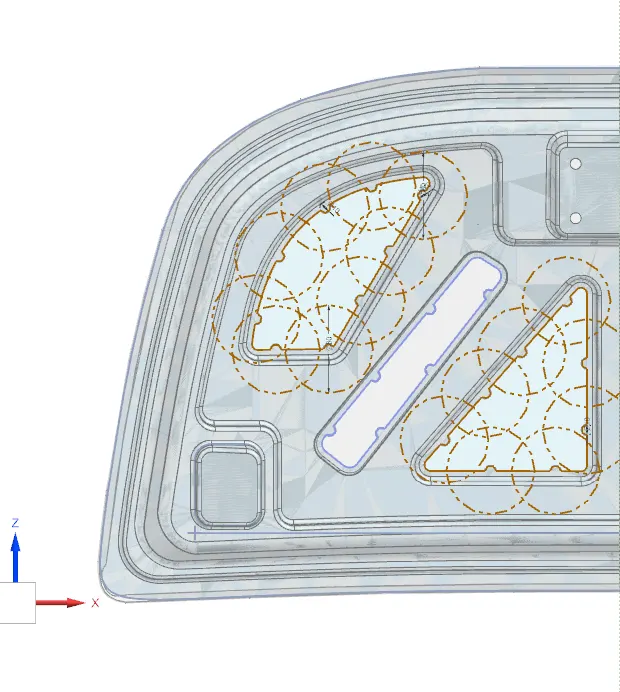
Mastic sealant Circle
HINGE, LATCH, AND STRIKER
The hinge helps in the smooth motion of the hood on an axis so that it can easily be lifted once it is freed from the latch. To hold the Hood over the engine compartment during movement of the vehicle. Latch and striker are been provided. The striker is mounted on the inner panel top end and the latch is fixed on the engine compartment. While fixing the striker, latch trajectory is to be taken into consideration. The latch trajectory is given by drawing a circle at the center of the hinge axis, First, the hinges are been fixed then the trajectory of the latch is been made for proper mating condition of the striker axis the tip of the striker should be tangent to the hinge axis circle.
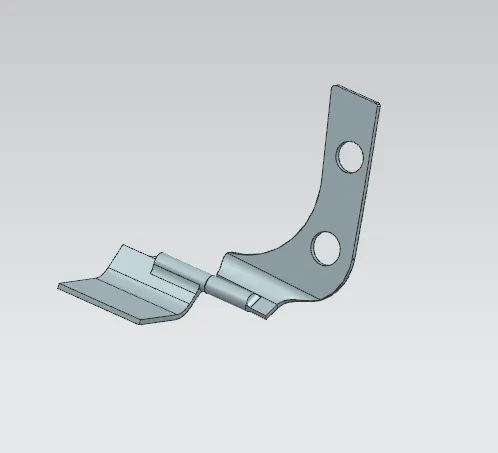
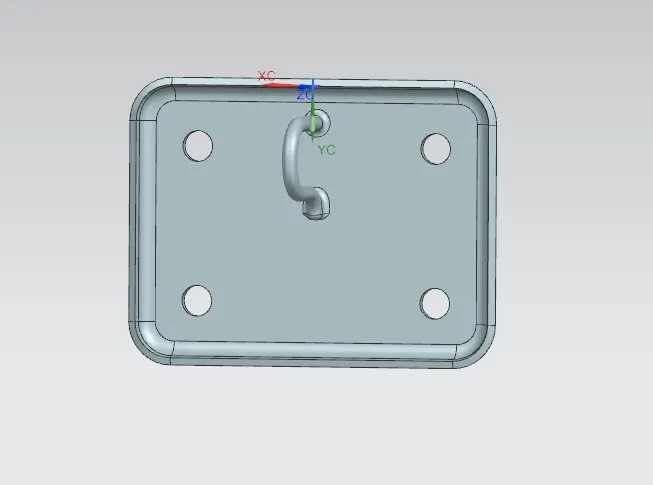
Hinge Striker
HOOD STAY/SUPPORT ROD/GAS STAY.
While maintenance/Repairing the engine the hood needs to be kept open and to hold the hood in an open position stay rod is provided which can be fixed at a point on the engine compartment and the rod takes the load of the hood. For less effort application gas rods are used in which the cylinder is actuated with the help of gas which acts as a spring that relies on elastic deformation it is expensive so they are mostly seen in high-end or top-model vehicles
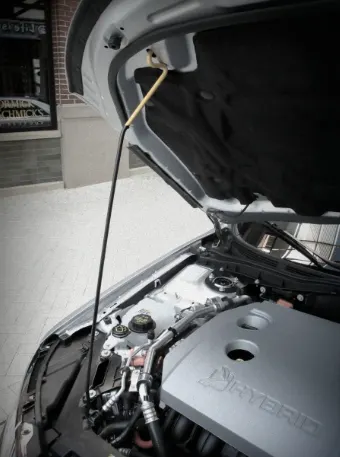
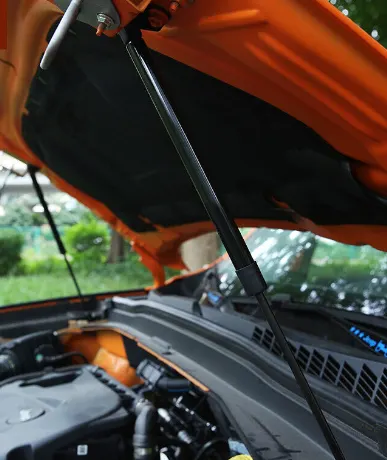
Support Rod Gas Rod
MANUFACTURING PROCESS
1. DEEP DRAWING
It is one of the most widely use processes in all manufacturing sectors.In the automobile sector, it is used for vehicle body parts. Deep drawing of sheet metal is performed with a punch and die. The punch is the desired shape of the base of the part, once drawn. The die cavity matches the punch and is a little wider to allow for its passage(clearance). The sheet metal workpiece, called a blank, is placed over the die opening. A blank holder, that surrounds the punch, applies pressure to the entire surface of the blank, (except the area under the punch), holding the sheet metal work flat against the die. The punch travels towards the blank. After contacting the work, the punch forces the sheet metal into the die cavity, forming its shape. Equipment for sheet metal deep drawing processes would involve a double action, one for the blank holder and one for the punch. Both mechanical and hydraulic presses are used in the manufacturing industry. Typically the hydraulic press can control the blank holder and punch actions separately, but the mechanical press is faster. Punch and die materials, for the deep drawing of sheet metal, are usually tool steel and iron. However, the range of materials for punch and die can span from plastics to carbides. Parts are usually drawn at speeds of 4 to 12 inches per second.
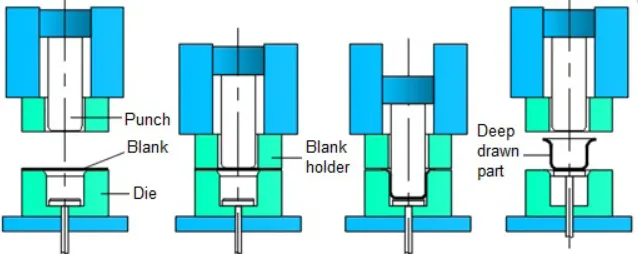
Deep Drawing Process
2. HEMMING
In sheet metal operations, hemming refers to the bending of a sheet metal edge upon itself. Clothing edge stitching is very similar to this. Like an edge stitch, a hem strengthens and improves the appearance of a metal edge. Joints can also be formed by folding the edge of one part onto the edge of another. Hemming is a secondary technique used in the automotive component assembly, following deep drawing, trimming, and flanging operations, to unite two sheet metal sections (the outer and inner). Hoods, doors, trunk lids, and fenders are typical components for this kind of installation. There are two types of hemming processes conventional die hemming and roll hemming. In conventional die hemming, the flange is folded over the entire length with a hemming tool. and in Roll hemming, A hemming roller is used to hem rolls progressively. The flange is formed and the hemming roller is guided by an industrial robot. Several pre-hemming and final hemming processes can also be separated into the roll hemming operation. When compared to traditional die hemming, roll hemming offers much greater tool flexibility and cheaper tool costs. The fact that the hemming is accomplished with a hemming roller that follows a predetermined path, however, results in substantially longer cycle times.
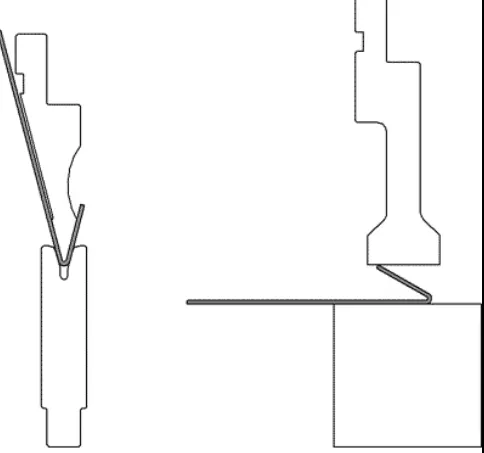
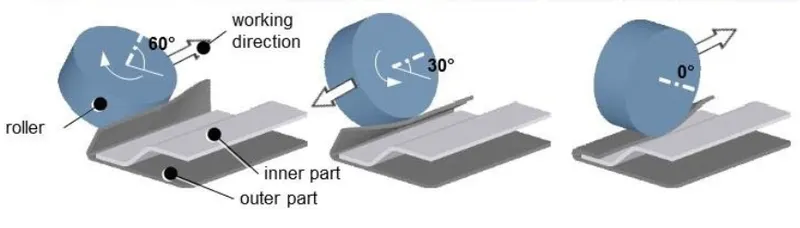
Hemming Roll Hemming
HOOD ASSEMBLY DESIGNED