Project - Speed Control of a Direct Current (DC) motor
SIMULINK PROJECT
SPEED CONTOL OF DC MOTOR
SIMULINK MODEL:
DC motor subsystem:
REPORT:
The mathematical expression of the given DC motor schematic is derived as
- Equation 1: Vs=R*i+L *di/dt+Vb
- where Vs-supply voltage
- R-resistance
- L-inductance
- i-current
- Vb=Back emf
- And Vb=Kb*w ,where Kb-Back emf constant and w-angular speed
- Equation 2: T=J *d^2/dt^2(theta)+b*d/dt(theta)
- Where T-torque
- Torque can be written as T=Kt*i ,where Kt-torque constant
- J-moment of inertia
- b-viscous friction constant
- theta-angular displlacement
- Substituting values of back emf Vb and Torque T in equations 1 &2
- The equations modified as
- Equation 3: Vs=R*i+L*di/dt+Kb*d/dt(theta)
- This equation further modified as
- Equation 5: di/dt=1/L (Vs-R*i-Kb*d/dt(theta))
- The second equation modified as
- Equation 6: Kt*i=J *d^2/dt^2(theta)+b*d/dt(theta)
- This equation further modified as
- Equation 7: d^2/dt^2(theta)=1/J(Kt*i-b*d/dt(theta))
- Equations 5 & 7 used in the designing od DC motor
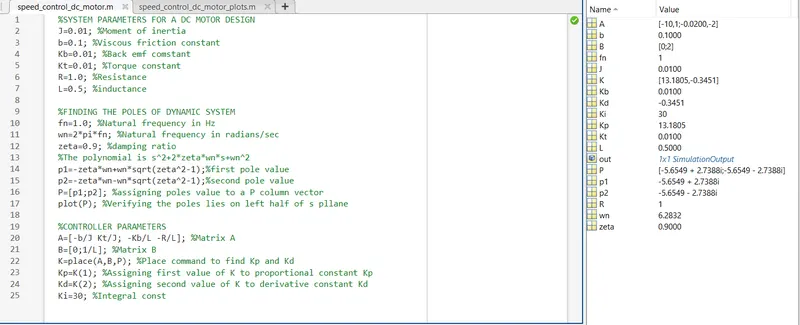
The system parameters ,poles and PID controller parameters defined in the matlab workspace as shown below
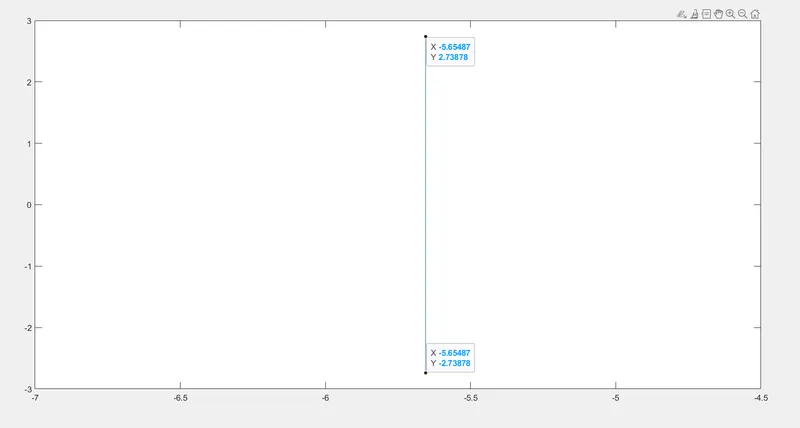
Verifying the poles lies on left half of s plane to ensure the system stability
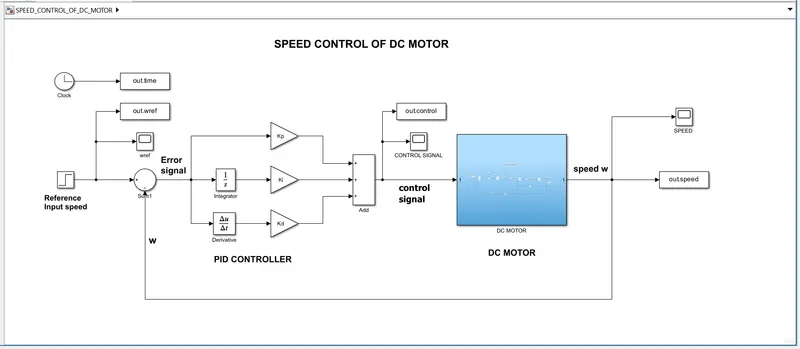
Simulink model for speed contol of dc motor
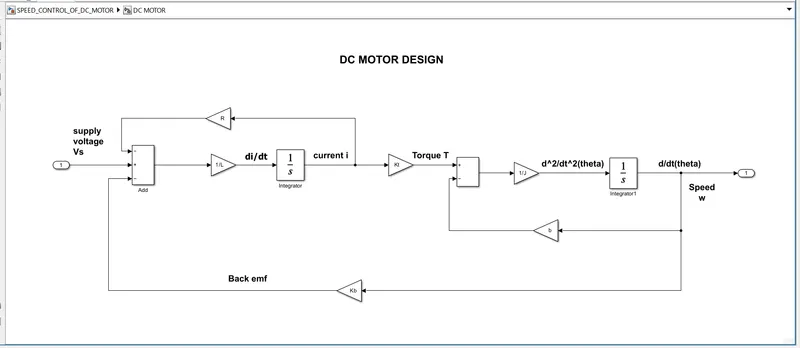
- DC MOTOR subsytem designed using the equation shown below di/dt=1/L (Vs-R*i-Kb*d/dt(theta)) d^2/dt^2(theta)=1/J(Kt*i-b*d/dt(theta))
- The input of the subsystem is Vs supply voltage is subtrated by R*i term and Kb*w
- gain block used to represent resistance R and current i is the feedback signal
- Kb back emf constant created using a gain block and w speed is the feedback signal
- The subtracted value is divided by L inductance using a gain block 1/L
- The output of this gain block resulting in di/dt further integrated to get current i
- This current i further connected to a gain bock Kt torque constant
- This term Kt*i is subtracted by a gain block b viscous friction constant
- Input of this gain block is d/dt(theta) speed of the motor which is a feedback signal
- This subtracted value divided by J moment of inertia using a gain block !/J
- This results in d^2/dt^2(theta) further integrated to get d/dt(theta) or speed w
- This value w is feeded back to Kb block to achieve back emf Vb
- The subsystem input is supply voltage Vs and output is speed w
Design of PID controller
- The PID controller designed using the equation
- C=Kp+Ki/s+Kd*s
- Where Kp-proportional constant
- Ki-Integral constant
- Kd-Derivative control
- A reference input speed wref is created by a step block with vaue 5
- wref is subtracted by speed w which is the feedback signal by a sum block
- This results in the error signal
- This error signal is connected to Kp gain block and connected to add block
- Error signal integrated using integrator block and connected to the add block through Ki gain bock
- Error signal connected to derivative block and further connected to the same add block through Kd gain block
- These sum value results in the control signal ,here the supply voltage Vs is controlll signal and connected to Dc motor subsystem
- The output of DC motor subsystem is speed w which feeded back to get the error signal
- The reference input wref,control signal and speed values logged to workspace to further analyzing the performance ,allso connected to scope block
- The initial condition of speed w set to 0.01
- Simulation run for 10seconds
- The outputs plotted for these values
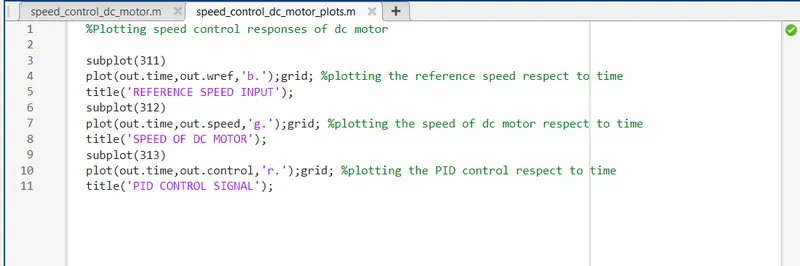
- The PID controller performance of speed control of DC motor is analysed and verified
RESULT:
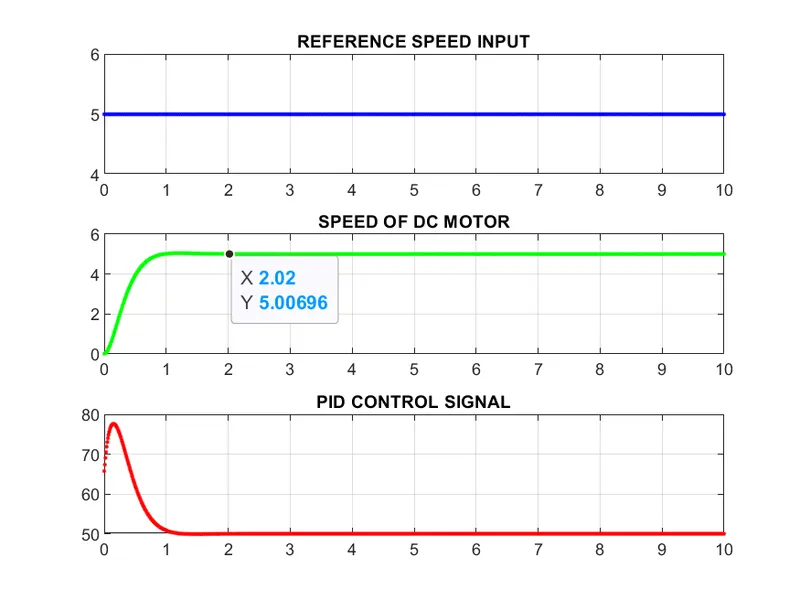
The output performance of the speed control of dc motor using PID contoller is shown below
CONCLUSION:
The simulink model for speed control of DC motor using PID controller is designed.The performance of the controller verified by plotting the speed values.