Week-11 Challenge: Braking
HEV WEEK 11 CHALLENGE
QUESTION 1:
BRAKING ENERGY CALCULATION FOR A DRIVING CYCLE:
DRVING CYCLE:
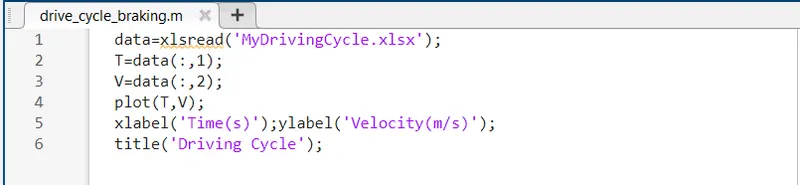
- An excel file used to create a drive cycle with time and velocity values
- Which import to matlab workspace to plot the driving cycle
- The driving cycle graph is shown below
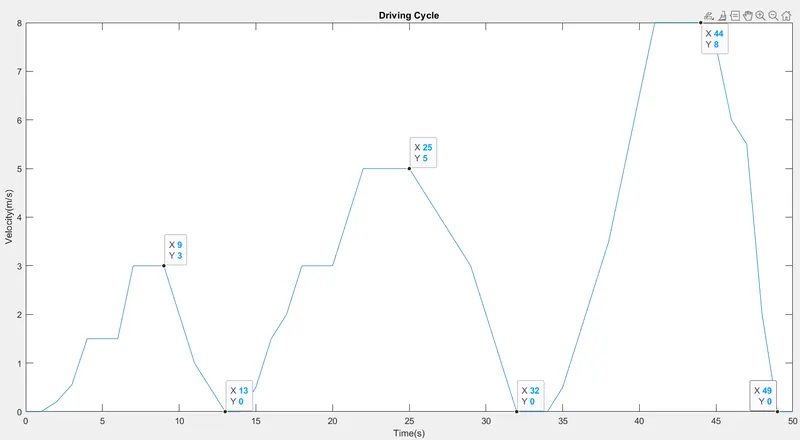
- Braking happen at 3 instances in this driving cycle ,the further calculation is shown below
EXCEL SHEET CALCULATION:
- The braking power and energy calculation done in a excel sheet
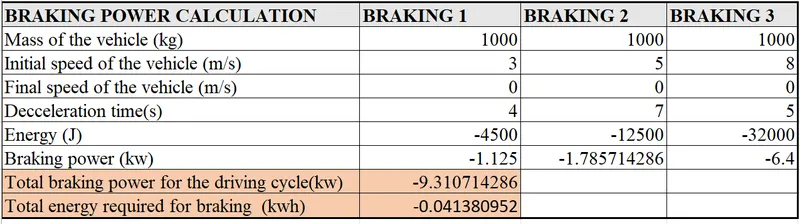
- Mass of the vehicle assumed to 1000kg
- The initial speed, final speed and decceleration time obtained from the driving cycle
- Energy in joules can be calculated
E= m*(Vf^2-Vi^2)/2
- Where,E-energy in Joules
- m-mass of thevehicle in kg
- Vf-final speed of vehicle in m/s
- Vi-initial speed of vehicle in m/s
- Braking power can be calculated as
Pbrake = E/t*1000
- Where,Pbrake - braking power in kw
- t-decceleration time in s
- Total braking power for the driving cycle can be obtained by adding all braking power
- Total energy required for braking in kwh can be calculated as
Ebrake = P*t/3600
- Where Ebrake- energy required for braking in the given driving cycle in kwh
- P-total braking power of the driving cycle in kw
- And t-time in seconds(s) converted to hours by dividing 3600
CONCLUSION:
- The total energy required for braking for the defined driving cycle is -0.0414 kwh
QUESTION 2:
REGENERATIVE BRAKING IN ELECTRIC VEHICLE:
- Regenerating braking is technique when the braking action feed the power back to the battery
- In regenerative braking,the motor runs above the synchronous speed
- And the motor runs as generator and feed the power back to battery or simply charge the battery
- Normally the torque is constant for low speed and gradually decrease as the speed increases (constant power region)
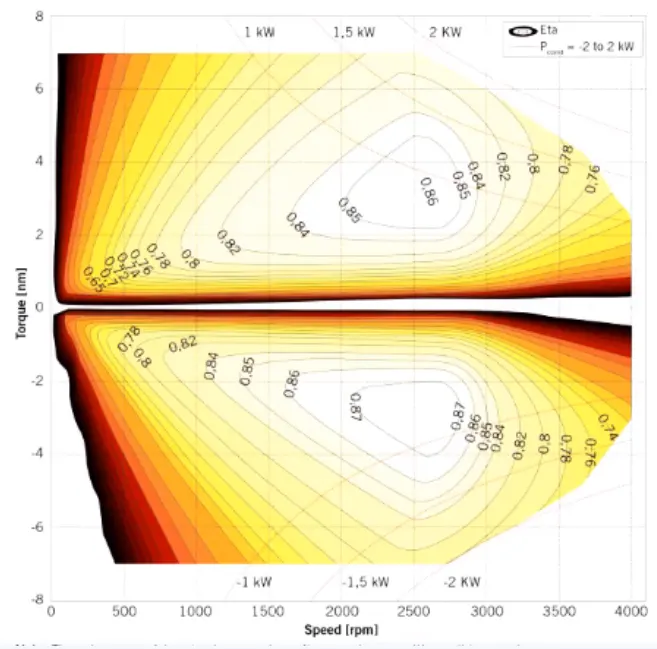
- When the vehicle reach the high speed and we apply the brake ,the negative torque correponding to that speed will act which is lower than the acceleration torque
- So for the high speed ,torque is less,which limits the braking toque
- The peak acceleration torque is always greater than the peak breaking torque or they are not equal
- Thats the reason electric motor cant produce braking torque similar to acceleration
ELECTRIC AND MECHANICAL BRAKES IN A VEHICLE:
- The regenerative and mechanical brakes can be arranged in series or parallel configuration depends on the application
- There will be a limit how much power should be generated back to batttery
- This power converters limitations in the regenerative action,will bring the action of mechanical brakes in to the system
- When we have only regenerative braking ,and we apply brake at high speed ,it may damage the system
- So the electrical and mechanical brakes can work imultaneously to achieve a good braking system
Electric Drives Intelligent Brake (EDIB):
- EDBI is a breaking technique ,in which regenerative and mechanical braking applied with repect to speed
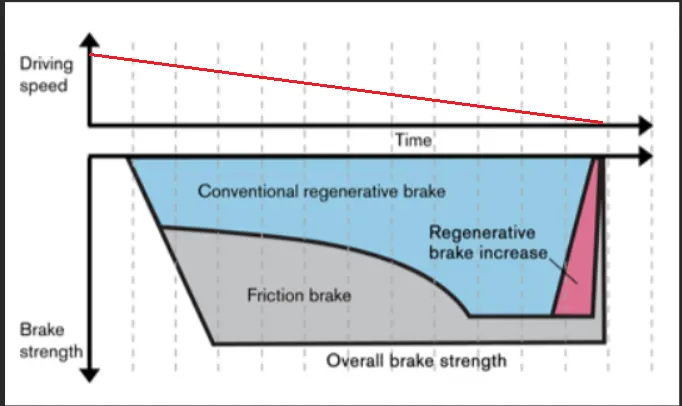
- For high speed ,more mechanical power applied than of regenerative braking
- Because of the limitation of power converter on regeneration of power
- As the speed increase ,the regenerative brake strength increases
- And mechanical brakes applied on low magnitude
- This coordination of electric and mechanical brakes according to speed of the vehicle more reliable
CONCLUSION:
- The peak accelartion torque is higher than the peak braking torque
- This why electric motor cant produce same torque at high speed during braking as of acceleration
- The coordination of electric and mechanical brakess discusssed
QUESTION 3:
PLOTING CONTOUR OF MOTOR SPEED,TORQUE AND EFFICIENCY USING MATLAB
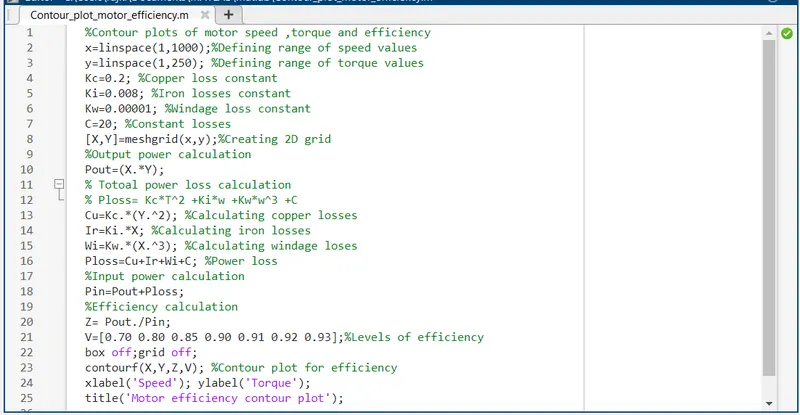
MATLAB CODE:
- The MATLAB code to plot the contour of motor characteristics is shown below
RESULT:
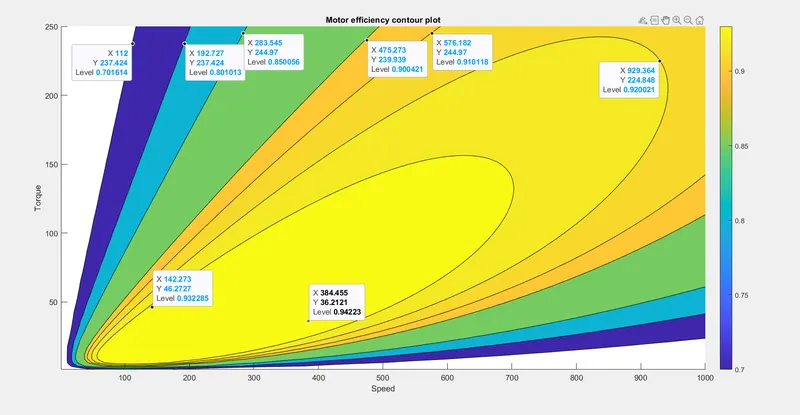
- The result of the matlab code is shown below
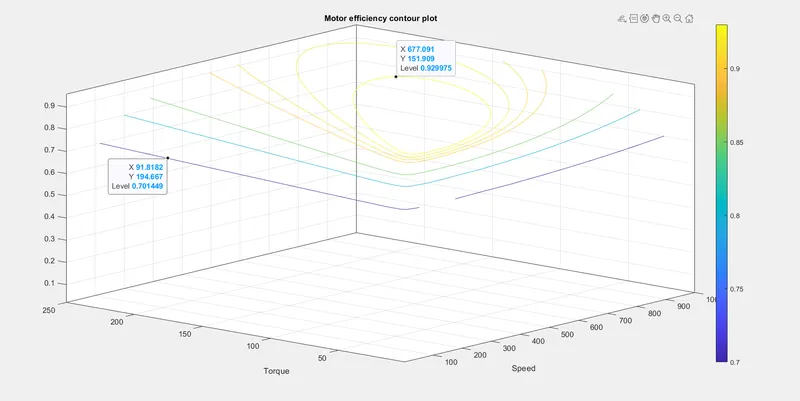
- 3D contour plot for the motor efficiency
CONCLUSION:
- The contour plot for motor speed,torque and efficiency is plotted using MATLAB