Project - Analysis of a practical automotive wiring circuit
Q1.
Identify each of the major elements in the above automotive wiring diagram.
- Battery
- Starter
- Distributer
- Breaker
- Ammeter
- Junction Box
- Fuse
- generator
- Foot Selector Switch
- Current and Voltage Regulator.
Q2.Explain the purpose and working of any three elements briefly.
Battery:
Batteries are used to store energy in the form of chemical energy. The chemical reaction in a battery involves the flow of electrons from one electrode to another through an external circuit. the flow of electrons provides an electric current that can be used to do work.
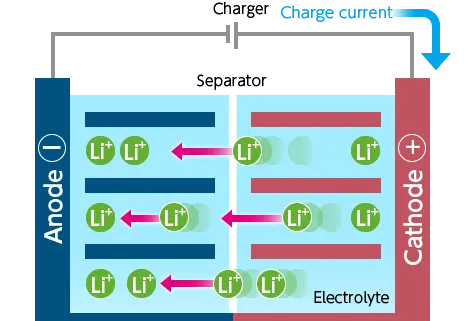
the lithium-ion battery is composed of an anode and cathode,
the separator between two electrodes, and an electrolyte that fills the remaining space of the battery. The anode and cathode are capable of storing lithium ions. Energy is stored and released as lithium ions travel between these electrodes through the electrolyte.
When the charger passes the current to the battery. The lithium-ion moves from cathode to anode through the electrolyte. The battery is charged by the potential difference between the elctrodes.
A discharging circuit is formed between the anode and cathode. Lithium-ion stored in the anode moves to the cathode. Energy is used.
Purpose -
- A powerhouse of the Car.
- Powers the ignition System. without a battery, Engine won't Fire.
- Power Serge Regulator
- works as an alternator.
- it works as a voltage regulator.
- Automotive
- health instruments
- medical
- logistics and construction
- firefighting and emergency.
- military
Generator :
it is also called a dynamo, it converts the mechanical energy into electricity for transmission and distribution over the power lines to domestic, commercial, and industrial customers. Generators also produce electrical power required for automobiles, aircraft, ships, and trains.
working :
The electric generator works on the principle of electromagnetic induction.
an electric generator works by converting mechanical energy into electric energy. it operates based on the electromagnetic induction principle, which creates an electric current by moving a wire. next to a magnet.
for induction to produce a practical amount of electricity through you need a strong and consistent force moving the wire fast enough. That's where the mechanical energy comes into play.
Emergencies.
Routine Power Outages
Standby Power For Businesses
Mining
Agriculture and ranching
Boating
Fuse :
An electrical fuse is a safety device that operates to provide protection against the overflow of current in an electrical circuit. An important component of an electrical fuse is a metal wire or strip that melts when excess current flows through it.
- acts as a barrier between the electric circuit and the human body
- to prevent device failure due to faulty circuit operation
- fuse prevent the short circuits.
- Prevents overload and blackouts.
- Prevents damage that caused due to mismatched loads
Fuse operation is based on the melting temperature of a wire or other metal element. As the current increases, the fuse element heats up and when the rated current is exceeded, the element reaches its melting temperature and opens, thus removing power from the circuit.
Fuse operation is based on the melting temperature of a wire or other metal element. As the current increases, the fuse element heats up and when the rated current is exceeded, the element reaches its melting temperature and opens, thus removing power from the circuit.
Q. 3 If the total load is 10A from the battery, what should be the fuse rating?
Fuse rating should lie somewhere between these two values allowing normal operation but blowing on overload.
Here the total load is 10A, so it allows the normal operation of a 10A load if the load is more than 10 like 12 or 13 it should cut off the connection. So 13A should be fuse rating.
Q. 4 If 500W is the load, what is the voltage and capacity of the battery you recommend?
Given :
Load = 500W
Capacity = load * time
assume time = 24 hr
average volt = 12 v
capacity = 500 * 24 Watt-hr
= 12000 Whr
Amp-hour = watt-hour /volts
= 12000 /12
= 1000 Ah
Q5. Identify any two elements which are connected parallel to each other. Why they are connected in parallel?
as per the above image generator, with current and voltage regulator connected in parallel. two or more components are connected in parallel and have the same differential potential voltage across their ends
Q6. Identify any two elements which are connected in series. Why they are connected in series?
as per the above image, the battery and Stator are in series because the same current is flowing through both