Project
REPORT ON: BAJAJ ATV MODELS
Aim:-To write a technical report on simulation of an BAJAJ all-terrain vehicle(ATV) at verious conditions.
ALL TERRAIN VEHICLE:
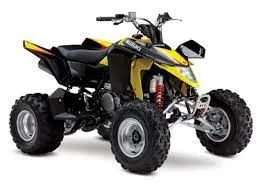
This is a vehicle that travels on low-pressure tires.This is a off road vehicle which is used in agriculture in foreign contries.A seat of vehicle is straddled by the operator, along with handlebars for steering control.
CASE I
MODEL I:
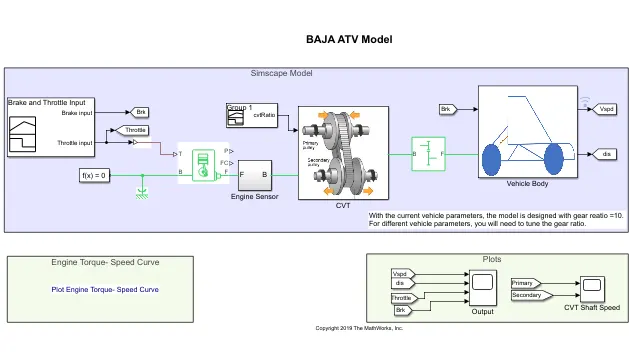
SIMULINK MODEL OF BAJAJ ATV WITH CVT
COMPONENTS USED IN MODEL:
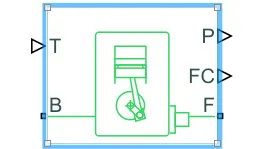
GENERIC ENGIN:
This block represents a general internal combustion engine.Generic engine block represent for spark-ignition and diesel. Speed-power and speed-torque parameters are provided as an input. F and B are mechanical rotational conserving ports combine with the engine crankshaft and engine block, respectively. Connections P and FC are physical signal output ports through which engine power and fuel consumption rate are displayed.
CONTINUOUSLY VERIABLE TRANSMISSION DRIVE (CVT):
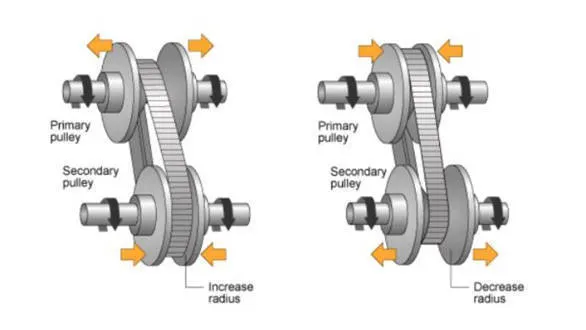
It is an automatic transmission system which can change smoothly through a continuous range of gear ratio. To get limited number of gear ratio in fixed step this can be connected with other transmission.This is very flexible system which can allow continuous engine RPM even if the vehicle is at veriable speed. The common type of CVT used usually is two pully connected with chain or belt called V-Belt.The pulleys are consist of two cone-shaped halves, that can move together and apart.The V-belt runnes in between two halves. To maintain tention both pullys are connected accordingly one bigger and one smaller.
CVT BLOCK:-
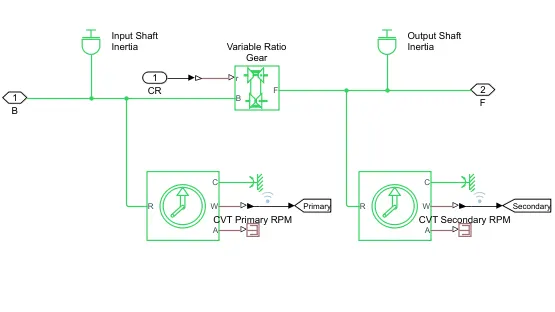
In this subsystem model of CVT there is variable ratio gear block and ideal rotational motion sensor plays important role.
VARIABLE RATIO TRANSMISSION:
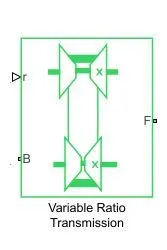
It is a gearbox that dynamically transfers motion and torque between the two connected driveshaft axes. Where B and F are rotational conserving ports and r port is physical signal input with respect to time.
IDEAL ROTATIONAL MOTION SENSOR:
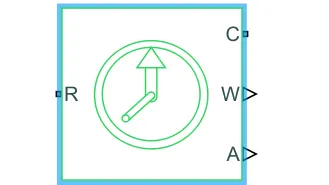
This block measures angular velocity or angle in a mechanical rotational network. W and A are physical signal port to measure angular velocity and angle,respectively, of port R relative to port C.
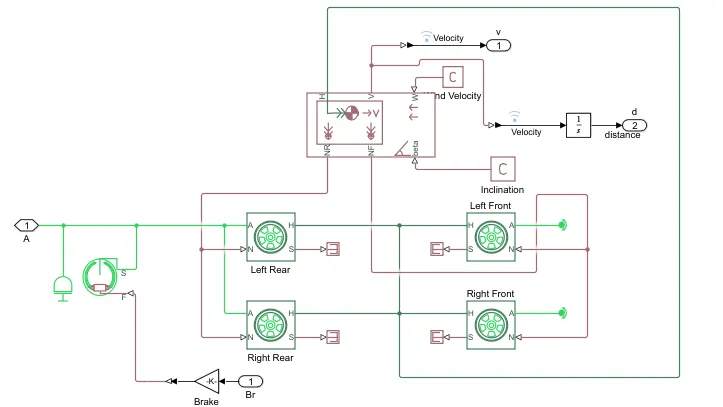
VEHICLE BODY:
INPUT SIGNAL:
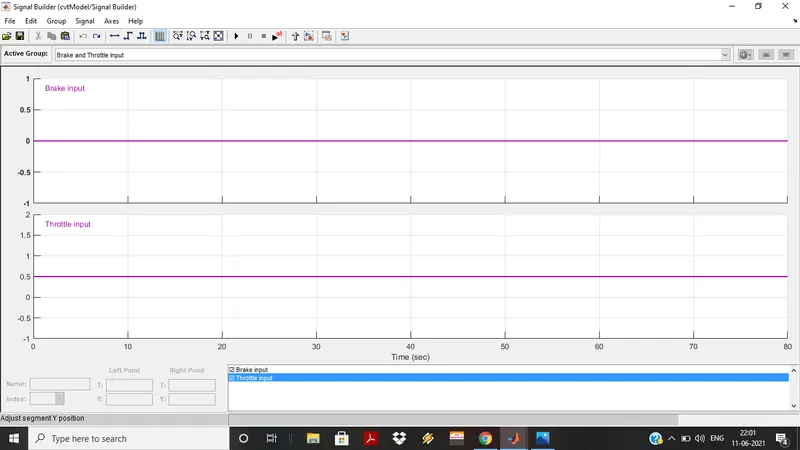
The input signal is provided by signal builder which is break and throttle input, this input is given to the generic engine block.
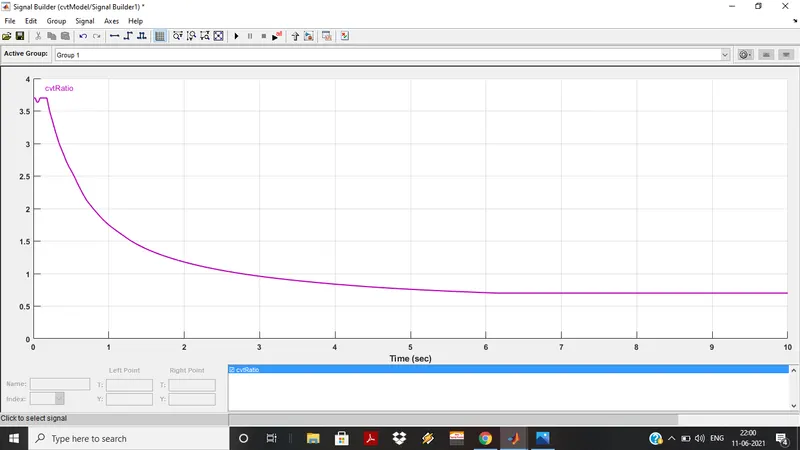
The another input given by second signal builder to the CVT, which is a gear ratio input.
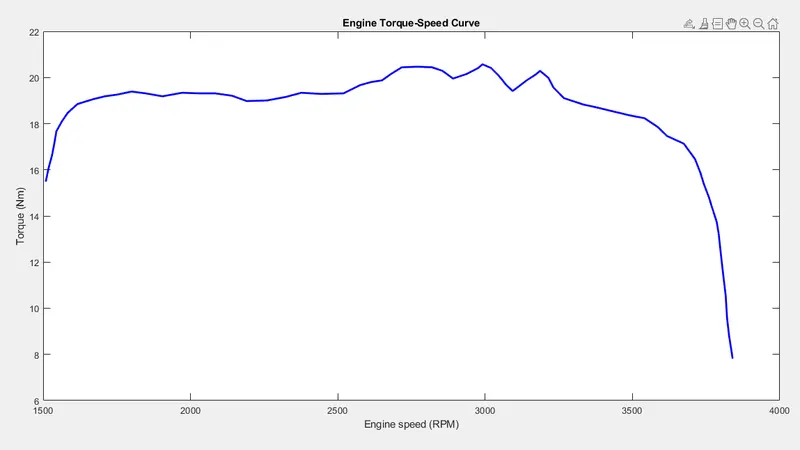
EngineTorque-Speed curve
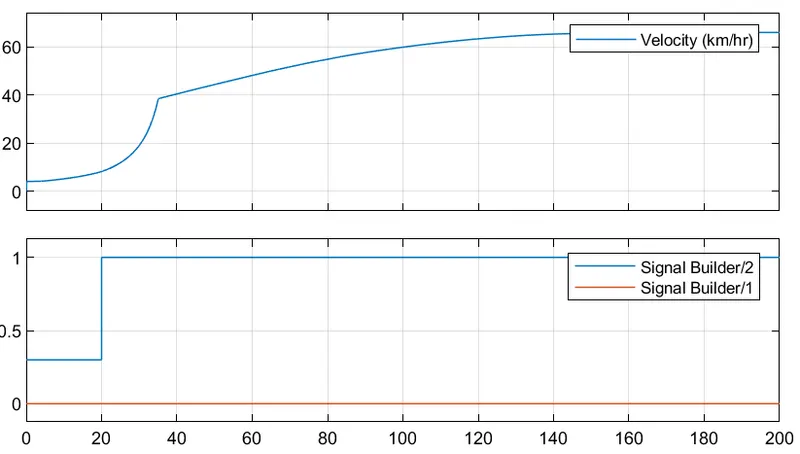
By giving such inputs to the vehicle the output of velocity, distance, trottle, break are obtain as a graph:
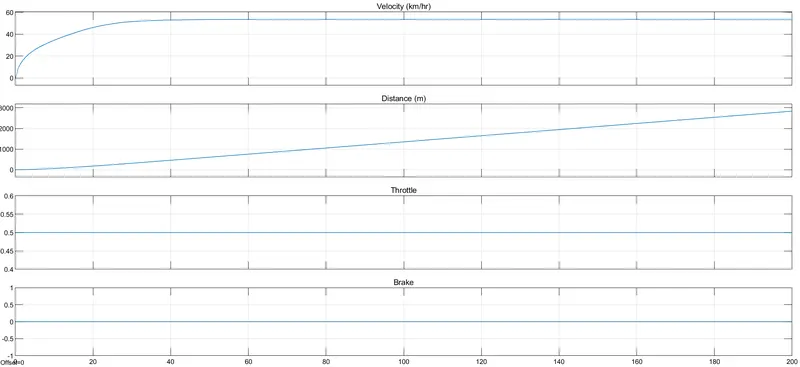
In this output graph
- The velocity increases in first 40 sec and it is constsnt after 50
- Distace is increasing continuously.
- throtal and brake output are conatant as the inputs are constant
Another output result generated from CVT.
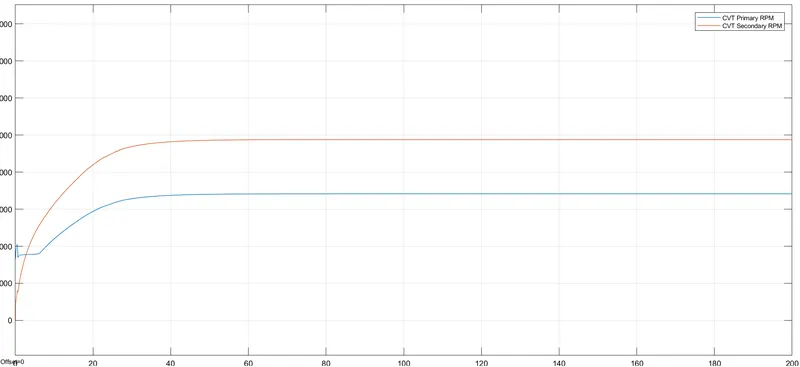
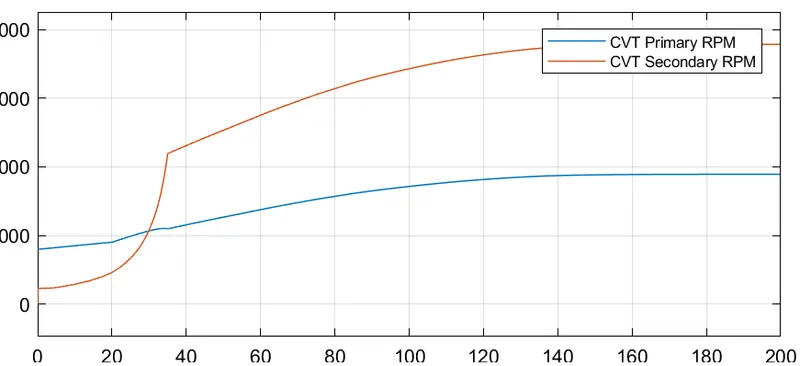
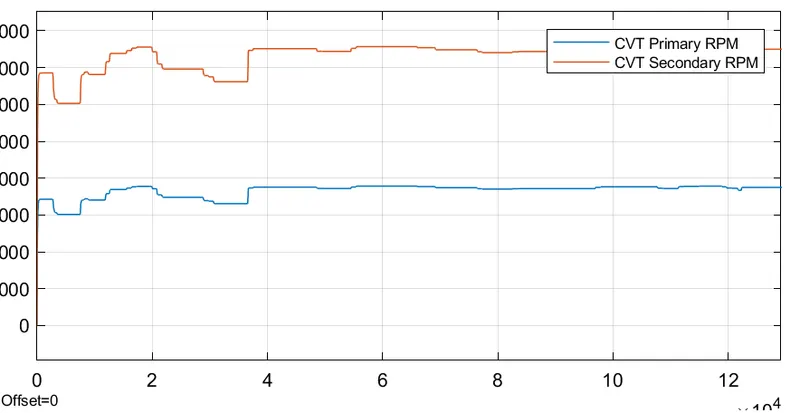
In this result graph primary and secondary RPM are resulted after simulation in blue and red colour respectively.
CASE I
MODEL II:
SIMULINK MODEL OF BAJAJ ATV WITH CVT USING DASHBORD
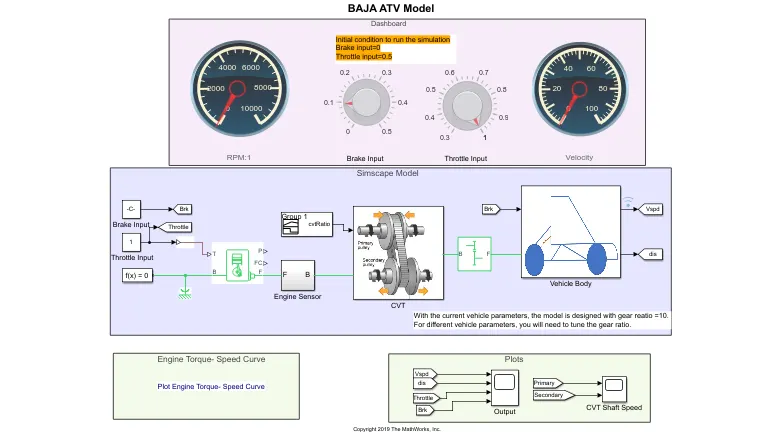
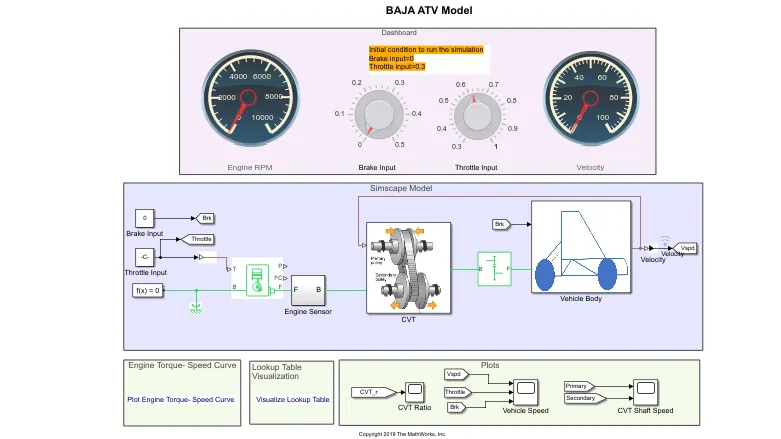
In this simulink model insted of using signal builder block dashbord is used for velocity and throttle inputs. Trottle input starts from 0.5 and break starts from 0.
INPUT:
CVT input ratio:
Torque speed curve:
OUTPUT:
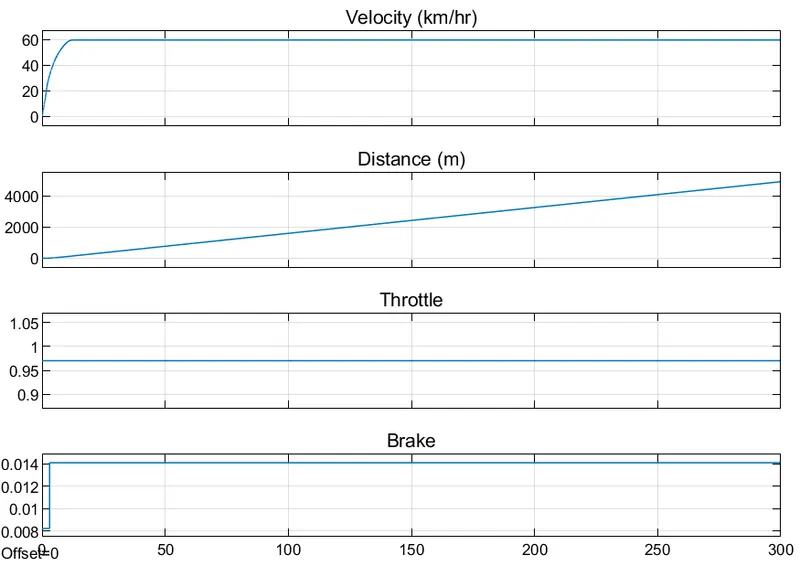
All the outputs are same as that of above, with block change no output change has occur.
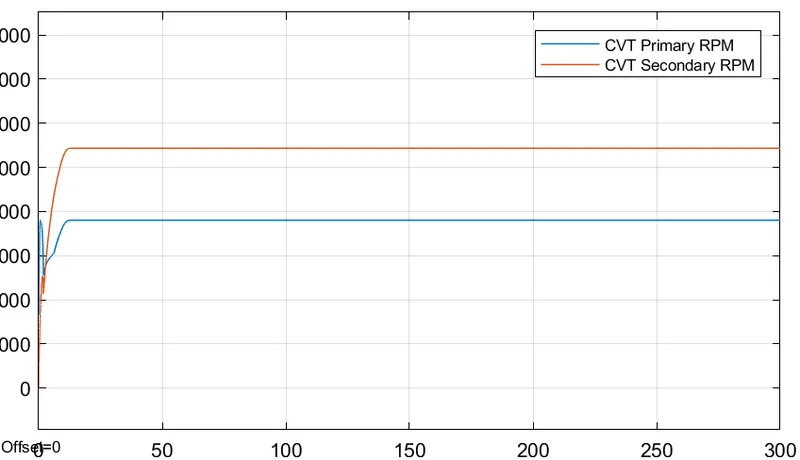
CVT OUTPUT
CASE II
MODEL I:
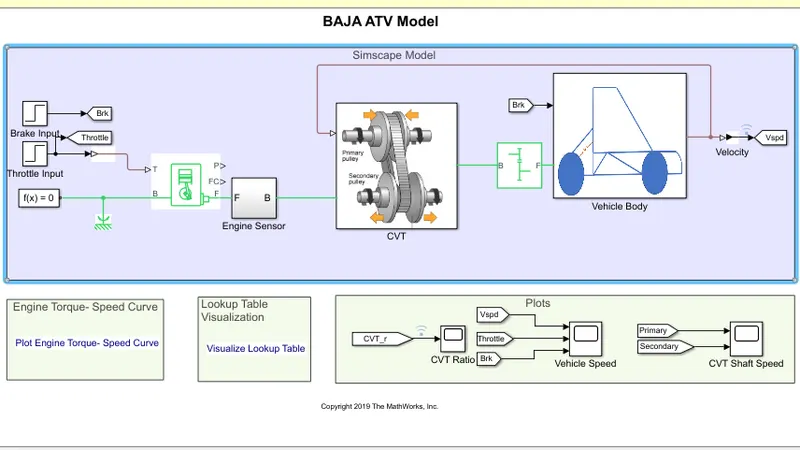
- In this model input is given with the help of step block.
- In which step time for break input is 35, and for trottle input it is 20.
- CVT ratio input is connected CVT as well as vehical body simultaneously.
- All the input values are taken from workspace.
- 1D look up table is used.
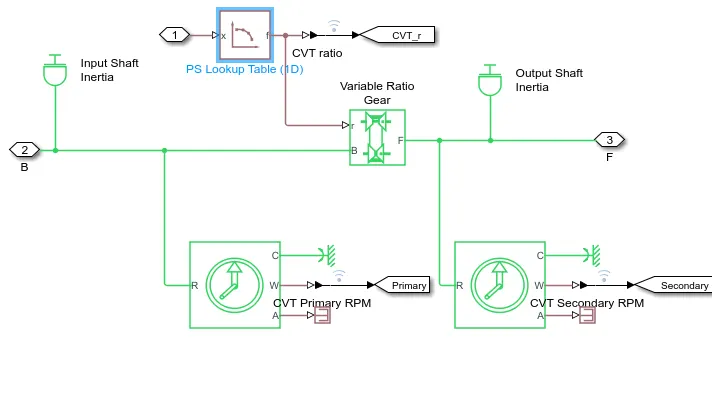
PS LOOK UP TABLE
This block represent physical signal converter whose input-output relationship is specified by a lookup table. For this model grid vector is 3.6 for vehicle speed.

LOOKUP TABLE: provides CVT ratio-vehicle speed graph
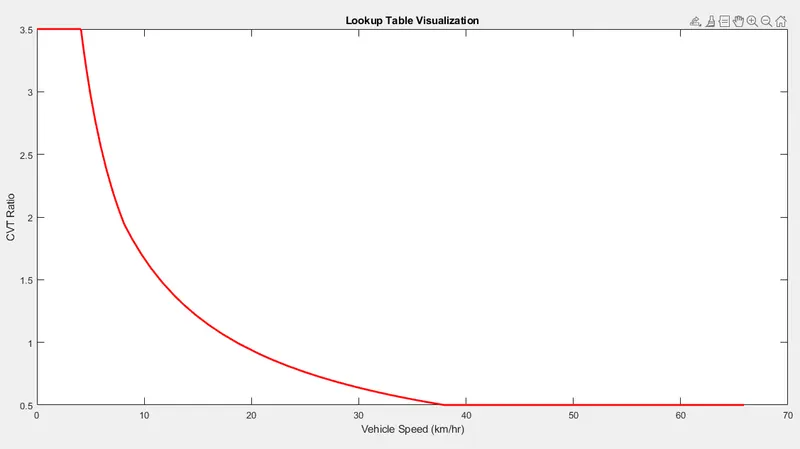
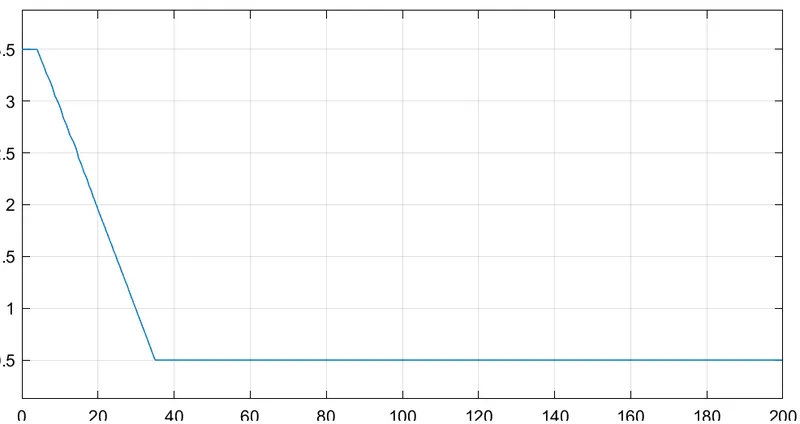
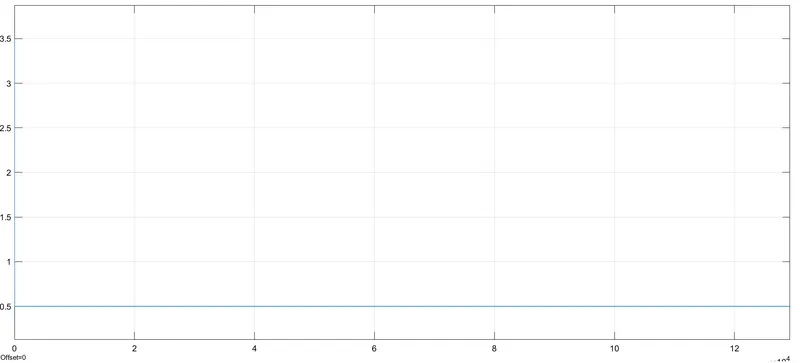
CVT RATIO: It has continuously falls from 3.5 to 0.5 and after it is constant.
CVT SHAFT SPEED:
VELOCITY-SPEED:
CASE II
MODEL II:
BAJAJ ATV LOOKUP TABLE MODEL WITH DASHBORD:
CVT RATIO:
VEHICLE SPEED:
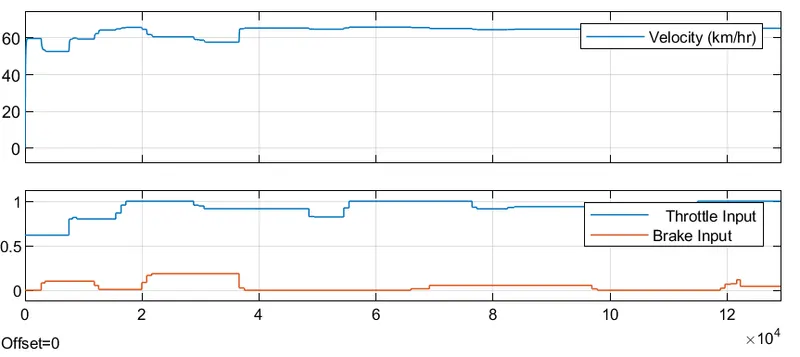
Here we can observed that as we apply the break the speed get decreases accordingly.
CVT SHAFT SPEED
REFERENCES:
- https://www.mathworks.com/matlabcentral/fileexchange/70576-baja-all-terrain-vehicle-atv-model
- https://en.wikipedia.org/wiki/All-terrain_vehicle
CONCLUSION:
BAJAJ-ATV model with different input blocks studied using continuous veriable transmission (CVT).