INDUCTION MOTOR CHARACTERISTICS
INDUCTION MOTOR CHARACTERSTICS
AIM:
- To study on the working principle and characteristics of Induction Motor.
- To evaluate for the starting time for the IM Drive by defining Load Torque and Motor Torque behaviour.
- To evaluate for the state of Stability of Induction Motor with Torque-Speed Characteristics.
INTRODUCTION:
Induction Motor
An Induction motor or Asynchronous motor is an AC electric motor in which the electric current in the rotor needed to produce torque is obtained by electromagnetic induction from the magnetic field of the stator winding. An induction motor can therefore be made without electrical connections to the rotor. An induction motor's rotor can be either wound type or squirrel-cage type. They are self-starting, reliable and economical. Single-phase induction motors are used extensively for smaller loads, such as household appliances like fans. Although traditionally used in fixed-speed service, induction motors are increasingly being used with variable-frequency drives (VFD) in variable-speed service. VFDs offer especially important energy savings opportunities for existing and prospective induction motors in variable-torque centrifugal fan, pump and compressor load applications. Squirrel cage induction motors are very widely used in both fixed-speed and variable-frequency drive applications.
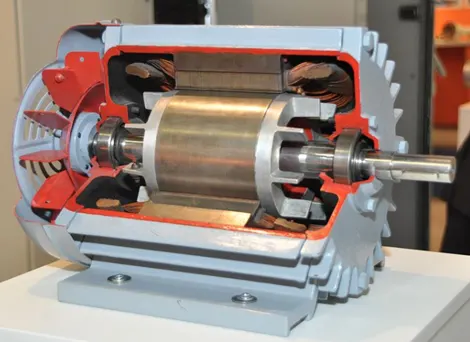
In both induction and synchronous motors, the AC power supplied to the motor's stator creates a magnetic field that rotates in synchronism with the AC oscillations. Whereas a synchronous motor's rotor turns at the same rate as the stator field, an induction motor's rotor rotates at a somewhat slower speed than the stator field. The induction motor stator's magnetic field is therefore changing or rotating relative to the rotor. This induces an opposing current in the induction motor's rotor, in effect the motor's secondary winding, when the latter is short-circuited or closed through an external impedance. The rotating magnetic flux induces currents in the windings of the rotor, in a manner similar to currents induced in a transformer's secondary winding(s).
The induced currents in the rotor windings in turn create magnetic fields in the rotor that react against the stator field. The direction of the magnetic field created will be such as to oppose the change in current through the rotor windings. The cause of induced current in the rotor windings is the rotating stator magnetic field, so to oppose the change in rotor-winding currents the rotor will start to rotate in the direction of the rotating stator magnetic field. The rotor accelerates until the magnitude of induced rotor current and torque balances the applied mechanical load on the rotation of the rotor. Since rotation at synchronous speed would result in no induced rotor current, an induction motor always operates slightly slower than synchronous speed.
Synchronous Speed
An AC motor's synchronous speed, f{s} in hertz, is the rotation rate of the stator's magnetic field,

where f is the frequency of the power supply, p is the number of magnetic poles, and f{s} is the synchronous speed of the machine. For f in hertz and n{s} synchronous speed in RPM, the formula becomes:

Slip
Slip, s, is defined as the difference between synchronous speed and operating speed, at the same frequency, expressed in rpm, or in percentage or ratio of synchronous speed. Thus
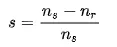
where n{s} is stator electrical speed, n{r} is rotor mechanical speed. Slip, which varies from zero at synchronous speed and 1 when the rotor is stalled, determines the motor's torque.
--------------------------------------------------------------------------------------------------------------------------------
- Induction Motor as Clutch
Induction Motor’s operation can be compared with that of the Mechanical Clutch due to following similarities.
Mechanical Clutch
A clutch is a mechanical device which engages and disengages power transmission especially from driving shaft to driven shaft.
In the simplest application, clutches connect and disconnect two rotating shafts (drive shafts or line shafts). In these devices, one shaft is typically attached to an engine or other power unit (the driving member) while the other shaft (the driven member) provides output power for work. While typically the motions involved are rotary, linear clutches are also possible.
The clutch connects the two shafts so they may be locked together and spin at the same speed (engaged), locked together but spinning at different speeds (slipping), or unlocked and spinning at different speeds (disengaged).
In Clutches Power/Torque is transferred from driving shaft to driven shaft.
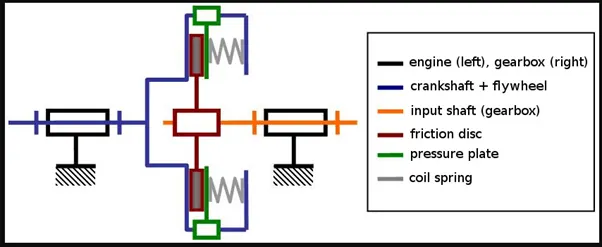
Also known as a slip clutch or safety clutch, this device allows a rotating shaft to slip when higher than normal resistance is encountered on a machine. An example of a safety clutch is the one mounted on the driving shaft of a large grass mower. The clutch yields if the blades hit a rock, stump, or other immobile object, thus avoiding a potentially damaging torque transfer to the engine, possibly twisting or fracturing the crankshaft.
Similarities with Induction Motor Operation
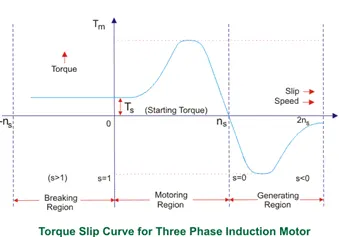
The torque slip curve for an induction motor gives us the information about the variation of torque with the slip. The slip is defined as the ratio of difference of synchronous speed and actual rotor speed to the synchronous speed of the machine. The variation of slip can be obtained with the variation of speed that is when speed varies the slip will also vary and the torque corresponding to that speed will also vary.
The torque-slip characteristic curve can be divided roughly into three regions:
- Low slip region
- Medium slip region
- High slip region
Motoring Mode
In this mode of operation, supply is given to the stator sides and the motor always rotates below the synchronous speed. The induction motor torque varies from zero to full load torque as the slip varies. The slip varies from zero to one. It is zero at no load and one at standstill. From the curve it is seen that the torque is directly proportional to the slip.
That is, more is the slip, more will be the torque produced and vice-versa. The linear relationship simplifies the calculation of motor parameter to great extent.
Generating Mode
In this mode of operation induction motor runs above the synchronous speed and it should be driven by a prime mover. The stator winding is connected to a three-phase supply in which it supplies electrical energy. Actually, in this case, the torque and slip both are negative so the motor receives mechanical energy and delivers electrical energy. Induction motor is not much used as generator because it requires reactive power for its operation.
Braking Mode
In the Braking mode, the two leads or the polarity of the supply voltage is changed so that the motor starts to rotate in the reverse direction and as a result the motor stops. This method of braking is known as plugging. This method is used when it is required to stop the motor within a very short period of time. The kinetic energy stored in the revolving load is dissipated as heat. Also, motor is still receiving power from the stator which is also dissipated as heat. So as a result of which motor develops enormous heat energy. For this stator is disconnected from the supply before motor enters the braking mode.
W = Ws(1-s)
W : Rotor Speed
Ws : Stator Synchronous Speed
S : Slip
--------------------------------------------------------------------------------------------------------------------------------
- Starting time of Induction Motor Drive
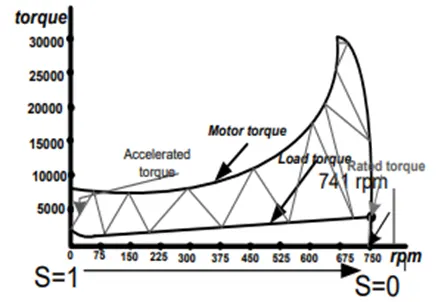
Large motor over current protection is normally set to trip prior to the locked-rotor withstand time (LRWT) provided by the motor manufacturer, after the calculated motor start time. The locked-rotor withstand time is determined by the motor designer based on the heating of the rotor parts for locked rotor condition, where the motor continuously requires a large value of inrush current.
At the time of starting, an induction motor draws high values of current (motor is a constant impedance device during the starting condition), that are very close to the motor’s locked rotor value and remains at this value for the time required to start the motor.
The capability to calculate motor starting time for large induction motor is important in order to evaluate the relative strength of the power system.
Given data,
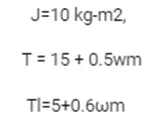
J: Moment of Inertia (Kg-m^2)
T: Motor Torque (Nm)
Tl: Load Torque (Nm)
Motor Torque and Load Torque relation is defined as,
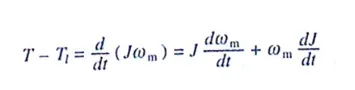
For drives with constant Inertia, (dJ/dt) = 0.
Therefore,
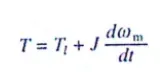
Motor Torque is counterbalanced by Load Torque & Dynamic Torque.
Dynamic Torque Component is present only during Transient Operations like sudden change in the System like during Braking, Acceleration/Deceleration of Motor.
At Equilibrium/Steady state, T = Tl
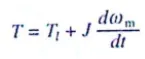
Where dw(m) is synchronous Speed of motor
T = Tl
15 + 0.5wm = 5 + 0.6wm
15 – 5 = 0.6wm – 0.5wm
0.1wm = 10
W(m) = 100 rad/s ………. Steady Speed State
Therefore,
15 + 0.5wm = 5 + 0.6wm + 10 (dwm/dt)
dwm/dt = (10 – 0.1wm) / 10
= 1 – 0.01wm
dt = (1/1-0.01wm)dwm
Integrating the above equation w.r.t time (t)
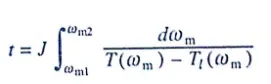
The integral limits should be considered from the initial condition of the motor to the end of transient state after which the motor attains its steady state speed. So we consider wm1 = 0 and wm2 = 95% of wm.
W(m) = 100 rad/s
W(m1) = 0 rad/s
W(m2) = 95 rad/s
Therefore,
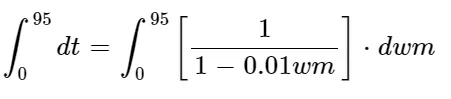

At initial condition when t =0, wm = 0
C = 0
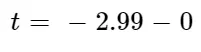
Applying Integral limits,


Therefore
Starting Time of given Induction Motor is t = 3s.
-------------------------------------------------------------------------------------------------------------------------
- Stability & Equilibrium Points of Induction Motor Drive
Stability of the Motor can be defined as the capacity of the Motor to drive the load.
For a Motor to be stable,
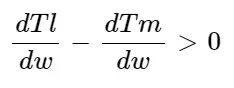
“The difference of the change in the Load Torque with respect to Speed change with that of change in Motor Torque with respect to Speed change should always be greater than zero (0) for a Motor to be stable.”
Given data,
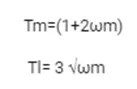
At Steady state,
Tm = Tl
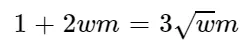
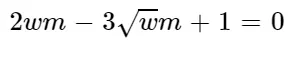
The above Quadratic equation can be solved where, root=sqrt(wm)
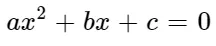
A = 2
B = -3
C = 1
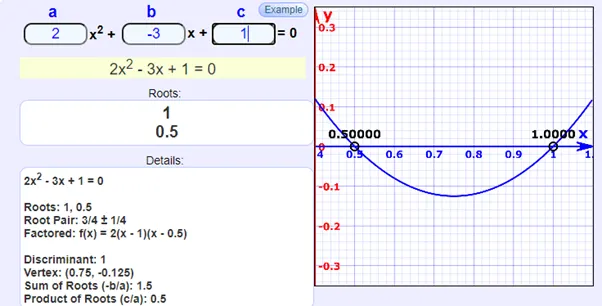
Therefore,
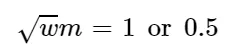
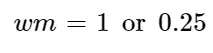
Also,
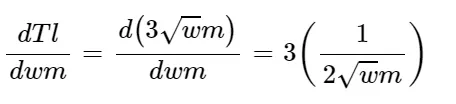
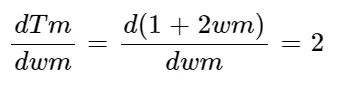
Therefore, Steady State Equation becomes,
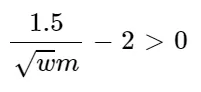
Substituting the values of wm
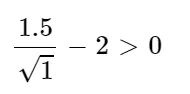
-0.5 > 0, False
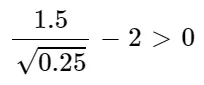
1 > 0, TRUE
Therefore,
Wm = 0.25 rad/s
Equilibrium point is achieved at 0.25 rad/s.
**************************************************************************************************************************************************************************************