Calculation of Stiffness in Structural elements
1. Compute lateral stiffness of the one story frame with an intermediate realistic stiffness of the beam. The system has 3 DOFs as shown. Assume L = 2h and Elb = Elc
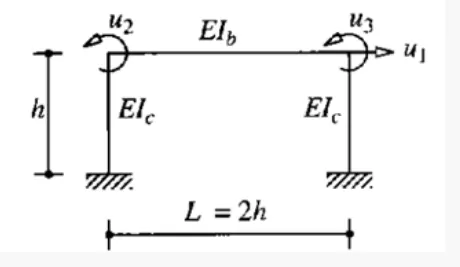
AIM:- To compute the lateral stiffness of one story frame with an intermediate realistic stiffness of the beam
INTRODUCTION:- Computation of lateral stiffness of one story frame is going to be explained with step by step procedure.
SOLUTION:- Stiffness matrix can be developed by giving unit displacements successively at coordinates 1,2 and 3. In order to generate the first column of the stiffnes matrix i.e. u1=1, u2=u3=0
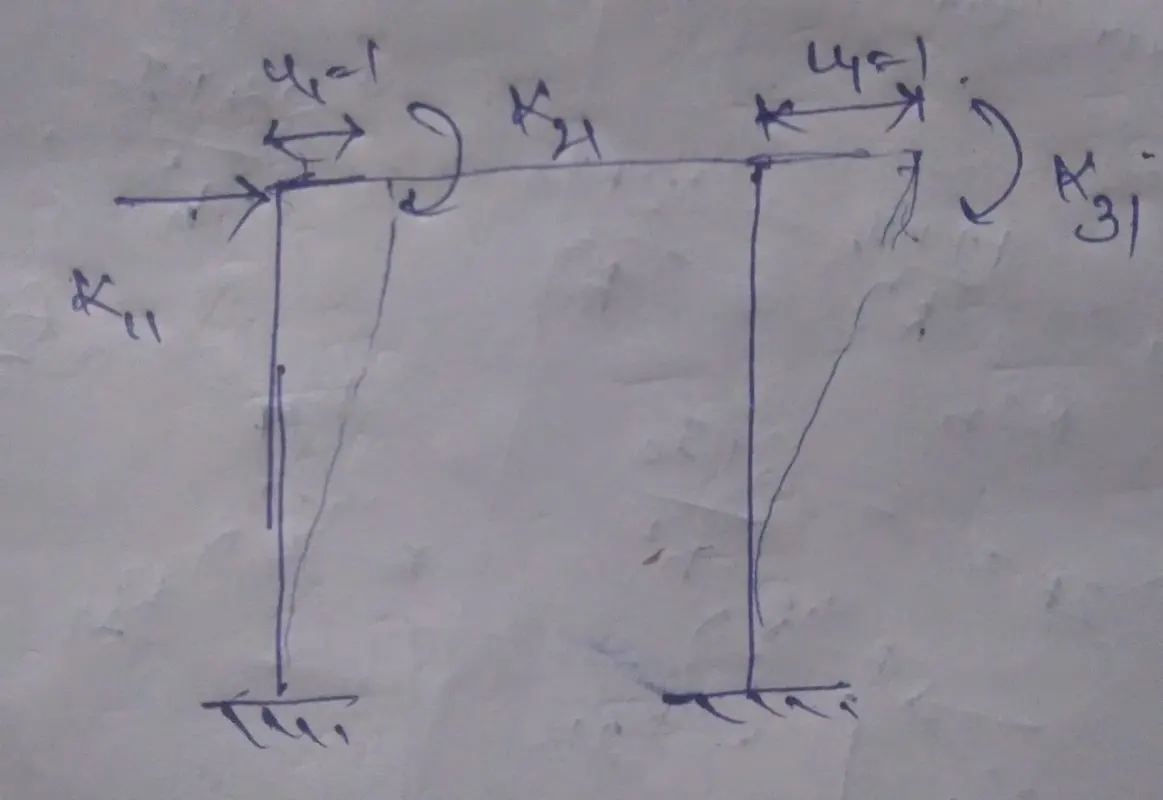
k11 = 12EI/h^3 + 12EI/h^3 = 24EI/h^3, k21 = 6EI/h^2 , k31 = 6EI/h^2
In order to generate the second column of the stiffness matrix, u1=u3=0 and u2=1
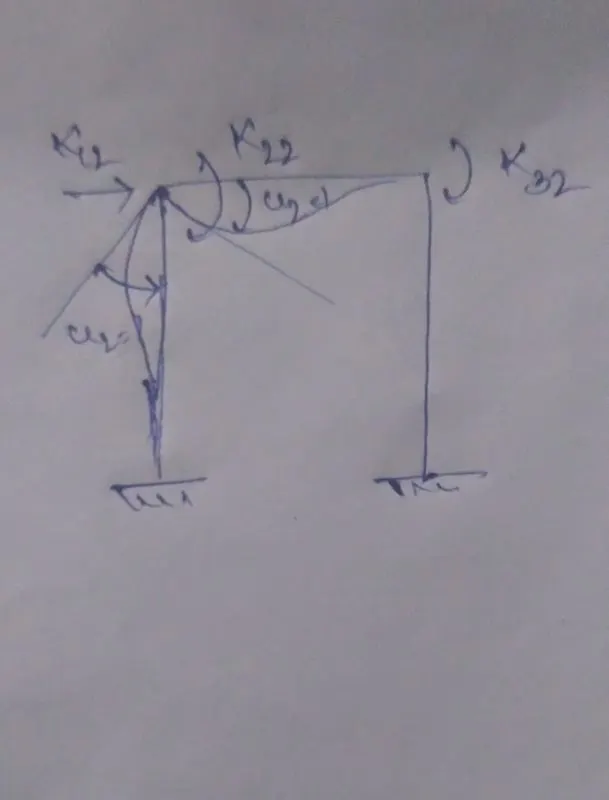
k12= 6EI/h^2, k22 = 4EI/h + 4EI/2h = 6EI/h, k32 = 2EI/2h = EI/h (EIb= EIc = EI)
In order to generate the third column of the stiffness matrix, u1=u2=0, u3 = 1
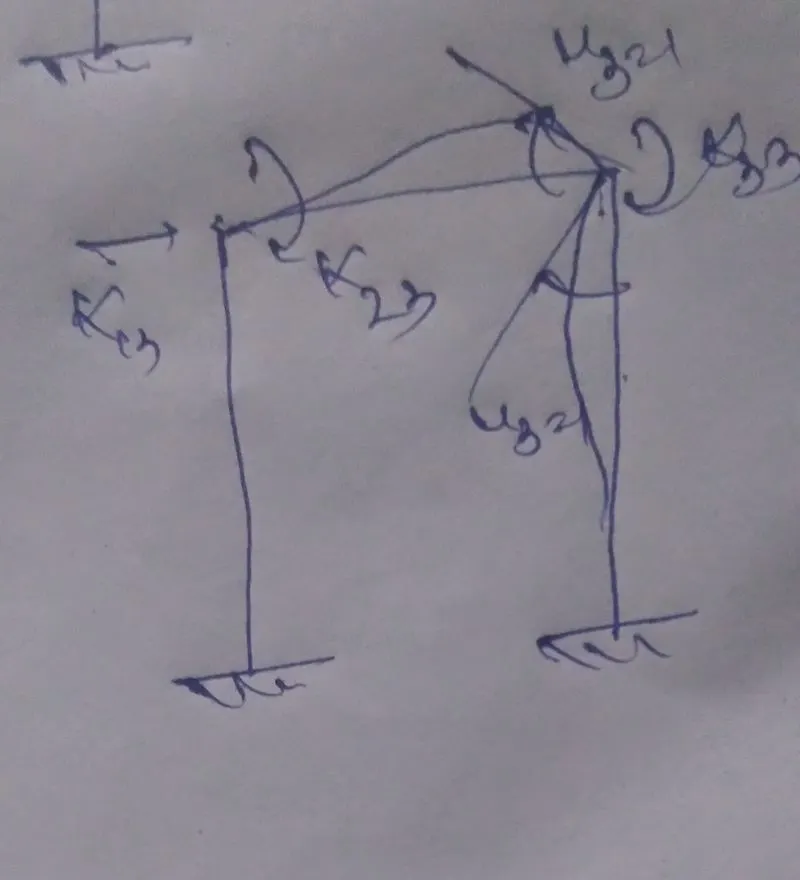
k13 = 6E1/h^2, k23 = 2EI/2h = EI/h, k33 = 4EI/h + 4EI/2h = 6EI/h
Hence the stiffness matrix can be written in the form :-
[ K ] = [ [ k11, k12, k13 ] , [ k21, k22, k23 ] , [ k31, k32, k33 ] ] = [ [ 24EI/h^3, 6EI/h^2 , 6E1/h^2 ] , [ 6EI/h^2 , 6EI/h , EI/h ] , [ 6EI/h^2 , EI/h , 6EI/h ] ]
= EI/h^3 * [ [ 24 , 6h , 6h ] , [ 6h , 6h^2 , h^2 ] , [ 6h , h^2 , 6h^2 ] ]
We know stiffness force , f = K * u = EI/h^3 * [ [ 24 , 6h , 6h ] , [ 6h , 6h^2 , h^2 ] , [ 6h , h^2 , 6h^2 ] ] * [ [u1], [u2], [u3] ] = [ [fs], [0], [0] ]
EI/h^3 [ 6*h*u1 + 6h^2*u2 + h^2*u3] = 0
or 6u1 + 6hu2 + h u3 = 0 .......eqn 1
//y, 6u1 + hu2 + 6 h u3 = 0.....eqn 2
Subtracting eqn 1 and eqn 2 we get, u2 = u3......eqn 3
Substituting eqn 3 in eqn 2 , we get u3 = -6*u1/(7*h)......eqn 4
Now EI/h^3 [ 24u1+ 6hu2 + 6hu3 ] = fs
After simplification we get fs = 96/7 *EIu1/h^3
Thus the lateral stiffness is given as k = fs / u1 = 96/7 EIc/h^3
RESULT:- Computation of lateral stiffness of one story frame has been illustrated
2. For the following structures:
- Determine the number of degrees-of-freedom for dynamic analysis
- Establish the equation of motion
- Calculate their natural frequencies
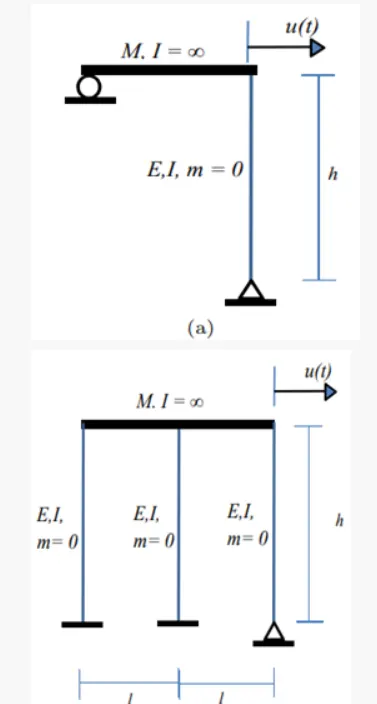
AIM:- To determine the number of degree of freedom for dynamic analysis, equation of motion and calculate its natural frequencies
INTRODUCTION:- Number of degree of freedom for dynamic analysis, equation of motion and its natural frequencies is going to be explained with step by step procedure.
SOLUTION:-
A. Equation of motion is :-
..
mu + ku = 0
K = 3EI/L^3 ( Since column has fixed end at bottom)
Therefore,
..
mu + ku = 0
or
..
mu + 3EI/h^3 = 0
Number of degree of freedom for dynamic analysis = 1
Natural frequencies of the system is
f = ω/2π = √(k/m)*1/2π = √(3EI/h^3*m)*1/2π
B. Equation of motion is :-
..
mu + ku = 0
Now K = 12EI/h^3 + 12EI/h^3 + 3EI/h^3 = 27EI/h^3
Now Equation of motion is
..
mu + 27EI/h^3 = 0
f = ω/2π = √(27EI/h^3*m)*1/2π
Number of degree of freedom for dynamic analysis = 1
RESULT:- Number of degree of freedom for dynamic analysis, equation of motion and its natural frequencies has been illustrated properly.
3. Consider the propped cantilever shown in the figure below. The beams are made from the same steel section and have lengths as shown on the diagram. Determine the natural period of this system if a large mass, M, is placed at the intersection of the beams at point A. The weight of the beams in comparison with the mass M is very small.
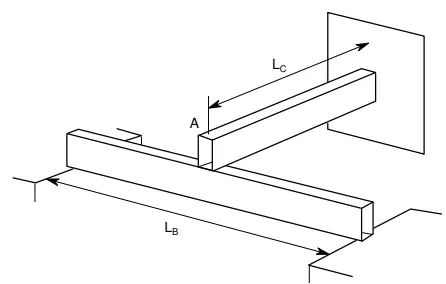
Solution:- Lateral stiffness of the cantilever beam
Kc = 3EI/Lc^3
Lateral stiffness of simply supported beam, Ks = 48EI/Lb^3
K = Kc + Ks = 3EI/Lc^3 + 48EI/Lb^3 = 3EI ( 1/Lc^3 + 16 / Lb^3 )
Natural frequency of the system, ω = √( 3EI ( 1/Lc^3 + 16 / Lb^3 ) /√m
Natural period of the system is Tn = 2π/ω = 2π * √m/√3EI*( 1/Lc^3 + 16 / Lb^3 )
4. Determine an expression for the effective stiffness of the following systems
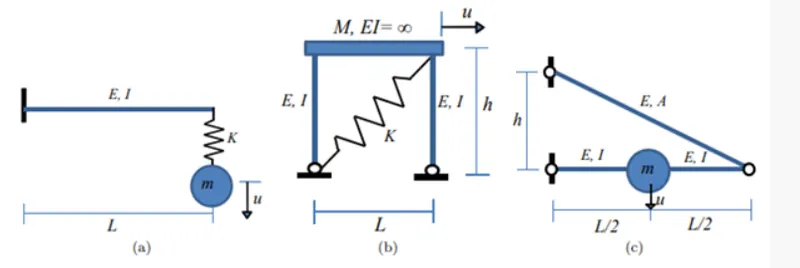
Solution:-
A. Effective stiffness connected in series
1/Ke = 1/Kb + 1/K = L^3/3EI + 1/K
On simplification we get Ke = 3EIK / (L^3*K+ 3EI )
B. Effective stiffness connected in parallel
Kp = 48EI/L^3 + K
C. Ki = 24EI/L^3 + √(h^2+L^2)/EA