NSPCL Field Engineer Recruitment 2026: ₹90,000 a Month, Apply by 4 Dec
NSPCL Advertisement 03/2026 hires Field Engineers for power-station O&M, civil and safety on a fixed term of up to 3 years, at a consolidated ₹90,000 a month, with applications open 20 November to 4 December 2026. Here are the posts, eligibility, age limits, pay, selection and fee from the advertisement itself, what the job involves at a captive coal plant, a prep plan by discipline, and a heat-rate calculation done by script.


NTPC-SAIL Power Company Ltd (NSPCL) is hiring Field Engineers on a fixed-term contract under Advertisement 03/2026. There are 12 posts in power-station O&M (for mechanical, electrical, electronics and instrumentation graduates), 4 or 5 in civil and 1 in safety. The pay is a consolidated ₹90,000 a month. These are not fresher jobs: every post asks for a degree with at least 60% and at least two years of relevant post-qualification experience. Online applications opened on 20 November 2026 at 10:00 AM and close on 4 December 2026 at 11:59 PM.
This post covers everything the advertisement says: posts, eligibility, age, pay, contract terms, selection, dates and fee. Then it explains what a Field Engineer does at a captive coal power plant, gives a prep plan by discipline, and works through a heat-rate and auxiliary-power calculation of the kind plant engineers use every day.
Key facts at a glance
- Advertisement: NSPCL Advertisement 03/2026, "Recruitment of Field Engineers (Power Station) on Fixed Term Basis". It is posted on NSPCL's careers page, nspcl.co.in/page/10. The PDF and the application portal were uploaded on 18 November 2026.
- Posts: Field Engineer (Power Station - O&M) 12, Field Engineer (Power Station - Civil) 5 in the projected vacancies table (4 in the eligibility table), and Field Engineer (Power Station - Safety) 1. That makes 18 posts, or 17 if you go by the eligibility table.
- Pay: ₹90,000 a month, consolidated. Income tax and statutory deductions come out of this amount. On top of it: company accommodation or HRA, a night-shift allowance where it applies, and medical cover for the employee, spouse, dependent parents and two children.
- Contract: fixed term of up to 3 years at first. It can be extended by up to 2 more years, depending on what the organisation needs and how you perform.
- Eligibility: an engineering degree with at least 60% marks (SC/ST/PwBD candidates need pass marks only), plus at least 2 years of post-qualification experience, not counting training. Upper age limit: 32 for O&M and Civil, 45 for Safety, as on 4 December 2026.
- Selection and fee: shortlisting followed by a personal interview. The fee is ₹300 for General candidates. SC, ST, PwBD, ex-servicemen and women candidates do not pay.
Courses: if your two years were on the electrical side, Skill-Lync's Introduction to Electric Power Systems course is a structured revision of generation, transmission and protection. On the thermal side, Foundations of Thermodynamics for Industrial Applications covers the cycle and plant maths used later in this post.
What exactly has NSPCL announced?
NSPCL has published Advertisement 03/2026 to recruit Field Engineers for its power stations on a fixed-term basis, in three streams: O&M, Civil and Safety. The advertisement and its online portal went up on 18 November 2026. Applications run from 20 November to 4 December 2026, online only, at the link on NSPCL's careers page.
NSPCL describes itself in the advertisement as a joint venture of two Maharatna companies, NTPC Limited and SAIL (Steel Authority of India Limited). It has business units at Bhilai, Durgapur and Rourkela, with a total installed capacity of 1,119 MW. It supplies power to SAIL units, the Union Territories of Dadra and Nagar Haveli and of Daman and Diu, and Chhattisgarh State.
Confirmed vs reported. Every figure here comes from three NSPCL sources, which we read on 21 November 2026: the advertisement PDF, the application portal (which repeats the dates, fee and age rules) and the plant page. Job-news sites report "18 posts". That matches the advertisement's projected vacancies table, but the eligibility table in the same document lists Civil as 4 posts, all UR (unreserved), not 5. The PDF is image-only, so we read it from a high-resolution render and checked each table against a crop.
How many NSPCL Field Engineer posts are there, and in which disciplines?
The projected vacancies table lists 18 posts: 12 in O&M (7 UR, 1 SC, 3 OBC, 1 EWS), 5 in Civil (4 UR, 1 OBC) and 1 in Safety (UR). The eligibility table higher up lists Civil as 4 UR posts, which would make 17 in total. No post is reserved for ST candidates.
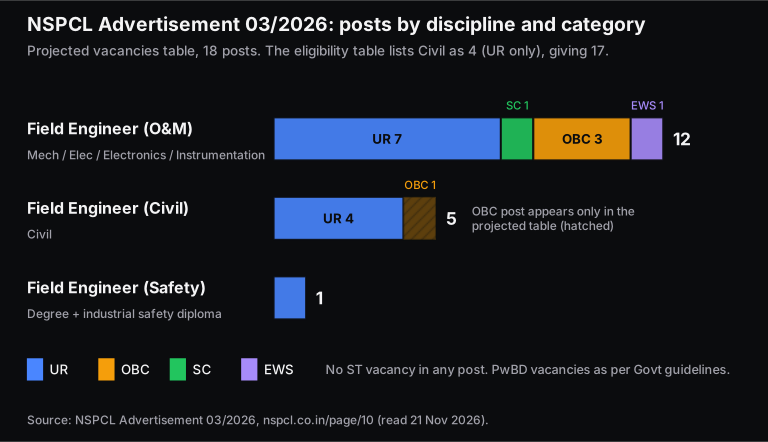
| Post | Degree (at least 60% marks) | Posts (projected table) | Category split |
|---|---|---|---|
| Field Engineer (Power Station - O&M) | Mechanical, Electrical, Electronics or Instrumentation Engineering | 12 | UR 7, SC 1, OBC 3, EWS 1 |
| Field Engineer (Power Station - Civil) | Civil Engineering | 5 (eligibility table: 4) | UR 4, OBC 1 (eligibility table: UR 4) |
| Field Engineer (Power Station - Safety) | Mechanical, Electrical, Electronics, Civil, Production, Chemical, Construction or Instrumentation Engineering, plus an industrial safety diploma (see below) | 1 | UR 1 |
What the Civil discrepancy means for you. If you are an OBC (non-creamy layer) civil engineer, this gap decides whether there is a reserved post for you at all. The advertisement also lets NSPCL cancel, restrict, curtail or increase vacancies without notice, and it says any addendum or corrigendum will appear only on NSPCL's website. So check the careers page before 4 December. Do not assume either figure is final.
Location. The advertisement does not tie posts to a plant. It says posting can be at any of NSPCL's stations, projects, joint ventures or subsidiaries, and that all posts are transferable at the management's discretion. NSPCL's plant page lists its stations as Bhilai, Rourkela and Durgapur.
Who can apply? Degree, marks and experience
You need a recognised engineering degree in the listed branch with at least 60% marks, or pass marks if you are SC, ST or PwBD. You also need at least two years of post-qualification experience, not counting any training period, in the specific area the post names. Only Indian nationals can apply.
| Post | Minimum 2 years of post-qualification experience in |
|---|---|
| O&M | Operations or maintenance at a captive power plant or project (coal) |
| Civil | Geotech, piling, foundations, structural steel, tower structures, switchyards and similar work |
| Safety | The safety department of a power plant or project (coal) |
The Safety post has one more requirement. Along with the degree, you need a Diploma, Advanced Diploma or PG Diploma in Industrial Safety from the Central Labour Institute or a Regional Labour Institute, Government of India.
Three details in the advertisement are easy to miss:
- The cut-off date is the last date. Age, experience and qualification are all counted as on 4 December 2026. Experience you gain after that date does not count.
- Experience must be documented. For private-sector experience, NSPCL will check pay and service from experience certificates, yearly compensation statements if you have them, and 2-3 salary slips per year (including the start and end of each year, plus slips for any variable pay). It will also want Form 16 and ITRs for the period. If you work in a government body, PSU or autonomous body, apply through proper channel with an NOC, or bring an NOC from your employer to the interview.
- Meeting the minimum does not guarantee a call. The advertisement says plainly that meeting the minimum criteria does not give you a right to be shortlisted. NSPCL may also raise the minimum standards if it needs to.
Can freshers apply? No. Every post asks for two years of post-qualification experience. For freshers, the relevant NSPCL route is a different advertisement on the same careers page: Advertisement 02/2026, Engineering Executive Trainees 2027 through GATE 2027. If that is your target, start with Skill-Lync's GATE 2027 study plan and the GATE Electrical topic hubs.
What is the age limit, and what relaxations apply?
The upper age limit is 32 years for O&M and Civil and 45 years for Safety, counted as on 4 December 2026. Where a vacancy is reserved for your category, the limit rises by 5 years for SC/ST, 3 years for OBC (non-creamy layer) and 10 years for PwBD. Ex-servicemen get relaxation as per Government rules. No one can be over 55 after all relaxations.
The key phrase is "where there is a vacancy identified for such category". Applied to the vacancy table, that gives these limits (our reading; NSPCL's decision is final):
| Post | UR / EWS | OBC (NCL) | SC | PwBD |
|---|---|---|---|---|
| O&M | 32 | 35 | 37 | 42 (identified disabilities listed) |
| Civil | 32 | 35, only if the OBC post in the projected table stands | No SC vacancy | 42 (identified disabilities listed) |
| Safety | 45 | No OBC vacancy | No SC vacancy | Post not identified for PwBD |
No post has an ST vacancy. For PwBD candidates, the advertisement lists which disability categories each post is identified for. O&M and Civil cover some hearing, locomotor, specific-learning and mental-illness categories, plus multiple disabilities. The exact codes differ slightly between the two posts. The Safety post is not identified for PwBD candidates. Category claims need a valid certificate from the competent authority in the current Government of India format, and you cannot change your category after you submit the form.
What is the salary of an NSPCL Field Engineer?
NSPCL offers a consolidated ₹90,000 a month, which is ₹10.8 lakh a year before deductions. Income tax and statutory deductions are taken from this amount, so take-home pay is lower. On top of it you get company accommodation or HRA, a night-shift allowance where it applies, and medical cover for yourself, your spouse, dependent parents and two children.
Your entitlement for HRA and TA/DA is set at par with NSPCL's E2 grade, and official tours are reimbursed. The advertisement gives no pay scale, increments or annual raise for the fixed-term engagement, and we have not assumed any. In plain terms, "consolidated" means one fixed monthly figure, not basic pay plus dearness allowance.
For scale: ₹10.8 lakh a year gross is 2.4 times the 4.5 LPA median for experienced-role offers in Skill-Lync's placement records (n = 444). Those records cover 3,711 placements up to 7 November 2026, from a data snapshot of 15 November 2026. They are a self-selected sample of Skill-Lync learners, mostly 2021-23 private-sector offers, so this is context, not a like-for-like comparison. For more on early-career electrical pay and roles, see our role map of electrical engineering jobs for freshers.
Is the NSPCL Field Engineer job permanent?
No. It is a fixed-term engagement of up to 3 years at first. NSPCL can extend it by up to 2 more years, depending on organisational needs and your performance, so 5 years at most. The advertisement does not promise a permanent post or a route to one.
Before joining, you must pass a medical examination at an NSPCL notified, empanelled or project hospital. The advertisement allows no relaxation in health standards, and NSPCL's medical norms are linked on the careers page. As covered above, posting can be at any NSPCL station, project, joint venture or subsidiary, and the post is transferable.
How will candidates be selected?
Eligible candidates will be shortlisted on merit and the post's requirements, and the shortlisted candidates will be called for a personal interview. NSPCL also reserves the right to add stages: screening by marks or years of experience, a written or computer-based test, or a combination of these.
In practice, plan for an interview that tests the plant experience you claim. A panel can quickly tell a candidate who has run a boiler start-up, cleared a relay trip or signed a permit to work from one who has only read about it. The prep plan below is built around that.
How do I apply, and what is the last date?
Apply online through the link on nspcl.co.in/page/10, which leads to NSPCL's registration portal for Advertisement 03/2026. The window is 20 November 2026 (from 10:00 AM) to 4 December 2026 (until 11:59 PM), a Friday. That is just under 14 days and 14 hours in total. Paper applications are not accepted.
- Register with a working email ID and mobile number. Your email ID cannot be changed later and must stay valid for at least a year, because all correspondence comes by email.
- Fill in your personal, qualification and experience details. No change is allowed after you submit.
- Upload your photograph, signature and all supporting documents: degree and mark sheets, experience certificates, photo ID, and a category or PwBD certificate if you are claiming one. Incomplete applications can be rejected.
- Pay the fee: ₹300, non-refundable, online by net banking, card or UPI. The advertisement says General candidates pay. The portal adds that EWS and OBC candidates pay too. SC, ST, PwBD, ex-servicemen and women candidates are exempt.
- Download the registration and application slip. You do not need to post anything.
Apply for one post only. The advertisement says that if you apply for more than one post, or apply more than once, only your last application will be considered. The portal's generic FAQ says multiple posts are allowed. The advertisement is the governing document, so follow it.
What is a captive power plant, and what does NSPCL run?
A captive power plant is built mainly to supply one industrial user, not the public grid. NSPCL's stations are at Bhilai, Rourkela and Durgapur, and its plant list calls three of them captive power plants. The advertisement says it supplies power to SAIL units and some state and UT utilities. NSPCL lists 1,119 MW across seven plants. Three 250 MW units make up 67% of that.
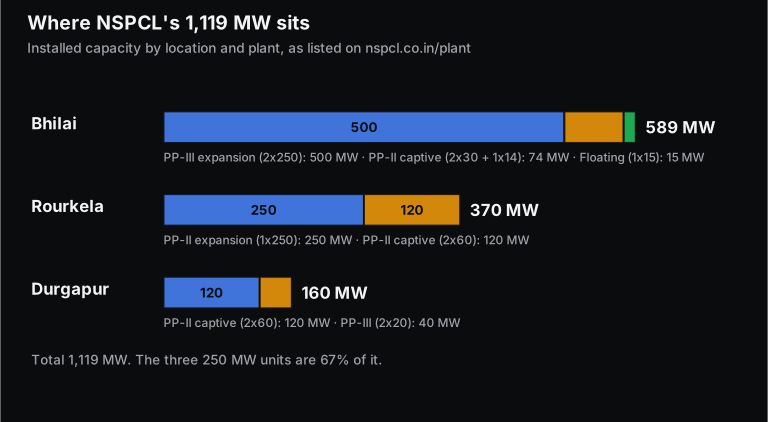
The mix matters for your preparation. NSPCL's unit sizes run from 14 MW to 250 MW, and a Field Engineer could be posted to any station. Expect interview questions about the unit sizes and equipment you have actually handled, and be ready to say how your experience transfers to a different size of unit.
What does a Field Engineer at a captive thermal power plant actually do?
NSPCL's advertisement does not include a job description. It names the experience it wants, and that shows the work. The descriptions below are how these jobs typically run at a coal-fired station. They are not NSPCL's own wording.
- Operations (O&M stream): shift work in the unit control room. You watch and adjust boiler, turbine and generator parameters on the distributed control system (DCS, the computer system that runs the plant's control loops), carry out start-ups, shutdowns and load changes, and isolate equipment for maintenance. The night-shift allowance in the pay package tells you shifts are part of the job.
- Mechanical maintenance: coal mills, pressure parts, boiler feed pumps, fans, valves, the turbine and its auxiliaries. The work is planned overhauls plus fixing breakdowns, and the measure of success is availability: hours the unit could run.
- Electrical maintenance: the generator, generator and station transformers, HT and LT switchgear, large motors, batteries, and protection relays. When a trip happens, you find out which relay operated and why.
- Control and instrumentation (C&I): pressure, temperature, flow and level transmitters, control valves, interlocks and DCS loops. Much of a plant's trip and efficiency performance depends on these working correctly.
- Civil: foundations, piling, structural steel, chimney and tower structures, switchyard civil works, and inspection of ageing structures. This is the experience list the advertisement gives for the Civil post.
- Safety: permit-to-work systems, safety audits and inspections, incident investigation, and contractor safety during overhauls.
How should I prepare for the NSPCL Field Engineer interview?
NSPCL publishes no syllabus for this post, and selection is mainly by interview. So prepare in two layers. First, be able to explain your own plant work in depth, with numbers. Second, revise the core theory behind it. Below is our suggested map by discipline, with free Skill-Lync resources for each part.
| Area | Revise | Be ready to explain from your own work | Skill-Lync resources |
|---|---|---|---|
| Boiler and cycle (Mechanical O&M) | Rankine cycle, boiler efficiency, heat rate, combustion and excess air, heat exchangers | A start-up sequence; why the heat rate rose in a given month; a tube leak you dealt with | GATE thermodynamics PYQs, Thermal Engineering book, Rankine cycle calculator |
| Turbine and auxiliaries | Steam turbine stages, condenser vacuum, pumps and fans, fluid mechanics | Vibration or condenser vacuum problems; BFP or ID fan trips | GATE fluid mechanics PYQs, GATE heat transfer PYQs |
| Electrical systems (Electrical O&M) | Synchronous generators, transformers, induction motors, faults, protection, power flow | Generator synchronisation; a relay operation you analysed; transformer oil tests | GATE machines PYQs, GATE faults and protection PYQs, Power Systems book |
| C&I | Transducers, control loops and PID, measurement errors, interlocks | Drum level or furnace pressure control; a transmitter fault that caused a trip | GATE sensors PYQs, GATE IN control systems PYQs |
| Civil | Pile and shallow foundations, soil behaviour, steel connections, tower structures | A piling or foundation job: soil data, load test, problems on site | GATE foundation PYQs, GATE steel structures PYQs, industrial structures in STAAD.Pro |
| Safety | Hazard identification, permit-to-work, incident investigation | A near miss you investigated and what changed afterwards | Your safety diploma notes and plant procedures |
A simple order of work for the time before 4 December: first collect your documents (experience letters, salary slips, Form 16 and ITRs, NOC). Without them you cannot even apply. Then write a one-page summary of your plant: unit sizes, the equipment you handled, and three problems you solved, each with a number. Then revise the theory for your discipline above. Everyone at a power plant speaks in heat rate and auxiliary power, so the next section shows how to calculate both.
Worked example: how do you calculate a unit's heat rate and auxiliary power?
Heat rate is the heat put into the boiler for each kilowatt-hour generated, in kcal/kWh, so lower is better. Gross heat rate divides by what the generator produces. Net heat rate divides by what leaves the plant after auxiliaries (pumps, fans, mills and other in-plant loads) take their share. Here is a calculation with illustrative numbers. These are not NSPCL's figures.
Assumptions: a 250 MW unit (the size of NSPCL's larger units), running for one day at an 85% plant load factor. It burns 3,500 tonnes of coal with a gross calorific value (GCV) of 3,600 kcal/kg, and auxiliaries use 9% of gross generation. We use 1 kWh = 860 kcal (more exactly, 859.8).
Next, take off the auxiliaries. 9% of 5,100 MWh is 459 MWh, so 4,641 MWh leaves the plant:
The specific coal consumption is 3,500 t ÷ 5,100 MWh = 0.686 kg of coal per kWh generated.
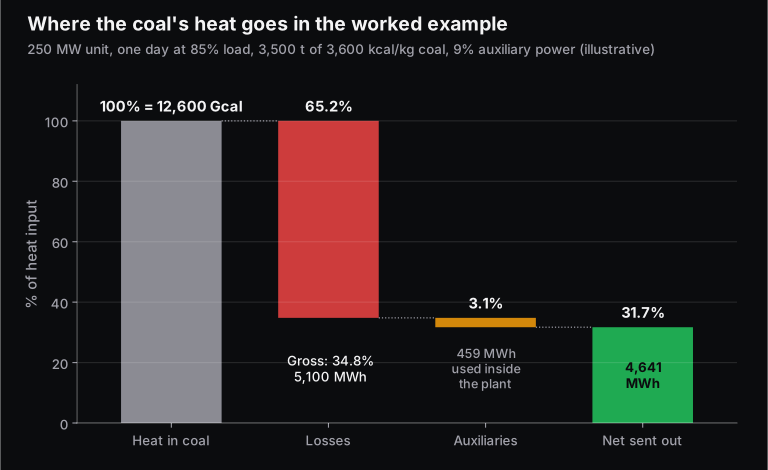
Why auxiliary power gets so much attention. Suppose the same unit cut auxiliaries from 9% to 8% and still sent out the same 4,641 MWh. It would only need to generate 4,641 ÷ 0.92 = 5,044.6 MWh. At the same gross heat rate, that saves
That is roughly 13,900 tonnes a year if every day looked like this one. Gains of this kind come from everyday O&M work: fixing a passing recirculation valve, stopping air ingress in a duct or retuning a mill. How much each one saves depends on the plant. Being able to put a number like this on your own work is what makes an interview answer convincing. To explore the cycle side, try Skill-Lync's Rankine cycle calculator and see how condenser pressure and steam temperature move efficiency.
What does this recruitment mean for power-sector engineers?
If you already work in O&M, civil or safety at a coal-fired plant, this is a fixed ₹90,000-a-month, 3-to-5-year contract with a central PSU joint venture, with transfers anywhere in NSPCL. If you are a fresher, it shows where to aim. NSPCL hires experienced engineers this way and takes freshers through the GATE route. Both reward documented plant experience. Our guide to getting an entry-level electrical engineering job in India covers the first two years. No post or course guarantees selection, which is NSPCL's decision.
Frequently asked questions
What is the last date to apply for NSPCL Field Engineer 2026?
4 December 2026, until 11:59 PM. Applications opened on 20 November 2026 at 10:00 AM. Your age, experience and qualification are all checked as on 4 December 2026, so experience you gain after that date does not count.
Can a fresher apply for the NSPCL Field Engineer post?
No. All three posts require at least two years of post-qualification experience, not counting training. Freshers should look at NSPCL's Advertisement 02/2026 for Engineering Executive Trainees through GATE 2027, which is listed on the same careers page.
Is there a written exam for NSPCL Field Engineer?
The advertisement's selection process is shortlisting followed by a personal interview. NSPCL reserves the right to add screening, a written or computer-based test, or other stages if there are too many applicants. Any change will be announced on its website.
Is the NSPCL Field Engineer salary ₹90,000 in hand?
No. ₹90,000 is the consolidated monthly amount. Income tax and statutory deductions are taken from it, so take-home pay is lower. Accommodation or HRA, the night-shift allowance and family medical cover are on top. The advertisement does not mention increments.
Can I apply for both the O&M and Safety posts?
The advertisement says you can apply for one post only. If you apply for more than one, or apply more than once, only your last application is considered. Choose the post your degree and experience fit best.
Who does not have to pay the ₹300 fee?
SC, ST, PwBD and ex-servicemen candidates, and all women candidates. Everyone else pays ₹300 online. Per the portal, that includes General, EWS and OBC candidates. The fee is not refunded, so check your eligibility before you pay.
Sources and further reading
- NTPC-SAIL Power Company Ltd, Advertisement 03/2026: Recruitment of Field Engineers (Power Station) on Fixed Term Basis (PDF, uploaded 18 Nov 2026; read 21 Nov 2026).
- NSPCL, Careers page, with links to Advertisements 03/2026, 02/2026 and 01/2026 and the medical norms (read 21 Nov 2026).
- NSPCL, Online registration portal, Advt. No. 03/2026: important dates and instructions (notice updated 18 Nov 2026; read 21 Nov 2026).
- NSPCL, Plants: unit list for Bhilai, Rourkela and Durgapur (read 21 Nov 2026).
- Skill-Lync placement records, data snapshot of 15 Nov 2026 (3,711 records up to 7 Nov 2026): experienced-role median offer.
- Worked example and figures: computed by Skill-Lync's script from the stated assumptions. The heat-rate inputs are illustrative, not NSPCL data.