₹2,814 Crore Critical Mineral Processing Scheme: Lithium and Nickel
The Cabinet approved a ₹2,814 crore capex scheme on 4 November 2026 to build two lithium and two nickel processing plants with a 30% subsidy. Here is what PIB confirms and leaves open, the chemistry from spodumene and laterite to battery-grade salts, the subsidy and capacity targets worked in numbers, how it sits with NCMM and the ACC PLI, and what it means for engineers.

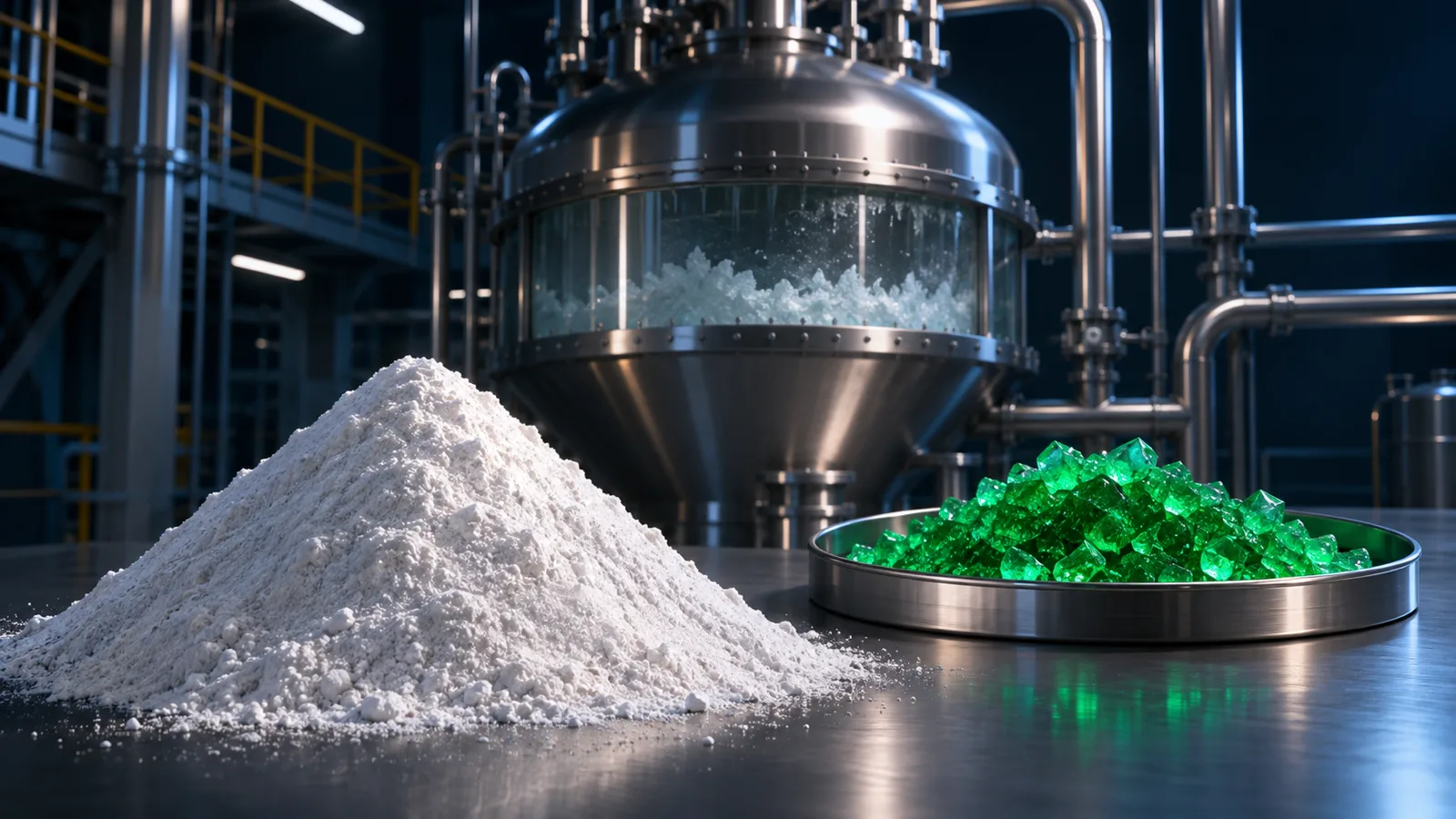
On 4 November 2026 the Union Cabinet approved the Capex Support Scheme to Promote Critical Mineral Processing: ₹2,814 crore over FY 2026-27 to 2030-31, paying a 30% capital subsidy to four plants that turn lithium and nickel ores, concentrates and intermediates into battery-grade compounds. That means two lithium plants of at least 30 kt each, capped at ₹500 crore of support, and two nickel plants of at least 50 kt each, capped at ₹900 crore, chosen by competitive bidding. It fills the gap between the National Critical Mineral Mission, which funds exploration, mining and recycling, and the ACC battery PLI, which pays for cells.
Below: what PIB confirms and leaves open, the chemistry the plants will run, the subsidy and capacity targets worked in numbers, and what it means for engineering jobs.
Key numbers at a glance
- ₹2,814 crore total outlay, FY 2026-27 to FY 2030-31: ₹2,800 crore of capital support plus ₹14 crore (0.5%) for administration (PIB Cabinet release, 4 Nov 2026; PIB backgrounder, 5 Nov 2026).
- 30% capital subsidy on eligible investment for four plants: two lithium plants (at least 30 kt each, support capped at ₹500 crore each) and two nickel plants (at least 50 kt each, capped at ₹900 crore each) (PIB, 4 Nov 2026).
- About ₹10,000 crore of processing investment expected, creating 60 kt of lithium and 100 kt of nickel processing capacity "to meet projected demand by 2030" (PIB backgrounder, 5 Nov 2026).
- 3 tranches of payment tied to capex spent and equity put in. Plants must be commissioned within 3 years of the Letter of Award, and in no case later than 5 years (PIB backgrounder).
- At least 72 g of lithium per kWh of NMC cell (theoretical floor at 3.6 V, Skill-Lync calculation). On that floor, 60 kt of lithium carbonate could feed at most about 157 GWh of cathode a year, against the ACC PLI's 50 GWh cell target.
Courses: to build skills for battery materials and cell work, compare Skill-Lync's battery technology courses, from Li-ion cell basics and pack design to the PG battery program.
What did the Cabinet approve on 4 November 2026?
The Cabinet approved a one-time capital subsidy, run by the Ministry of Mines, for exactly four lithium and nickel processing plants in India, paying 30% of eligible investment up to a fixed cap per plant. PIB published the Cabinet release at 15:29 IST on 4 November 2026. A longer PIB backgrounder followed at 13:56 IST on 5 November with the tranche schedule, the commissioning deadline and the governance structure. Everything in the table below comes from those two documents.
| Term | Lithium | Nickel |
|---|---|---|
| Number of plants | 2 | 2 |
| Minimum capacity per plant | 30 kt | 50 kt |
| Feed | Ores and concentrates (brines excluded) | Ores, concentrates and intermediates |
| Product | Battery-grade lithium products | Class-1 nickel or battery-grade nickel sulphate, with cobalt recovery |
| Subsidy rate | 30% of eligible investment | 30% of eligible investment |
| Cap per beneficiary | ₹500 crore | ₹900 crore |
| Total for the mineral | ₹1,000 crore | ₹1,800 crore |
| Capacity created (target) | 60 kt | 100 kt |
The government's stated reason is supply risk. The Cabinet release says processing of critical minerals "remains geographically concentrated in a few global locations", and that India "remains substantially dependent on imports for refined intermediates and high-purity materials" because domestic beneficiation and processing are at a "nascent stage".
What is confirmed, and what is not known yet?
Confirmed by PIB: the outlay, period, rate, caps, plant count, minimum capacities, the two-stage selection, the three tranches, the commissioning deadlines, the governance tiers and the expected ₹10,000 crore of investment.
Not stated in either PIB document as of 19 November 2026:
- The scheme guidelines and the date applications open.
- How "eligible investment" is defined, for example whether land, buildings or captive power count.
- The unit basis of the 30 kt and 50 kt capacities (carbonate, hydroxide or metal content; nickel sulphate or nickel metal). The worked example below shows why this matters.
- Where the plants will be and who will build them; beneficiaries will be chosen by bidding.
- Whether the ore must be domestic. The release lists "constrained access to raw materials" as a barrier but sets no feed rule.
News reports linking the scheme to particular states or companies are not used here; neither PIB document names any.
How will the companies be chosen and paid?
Selection is a two-stage tender. Applicants first pass a technical qualification. Those who qualify then bid the amount of capital support they want, and the two lowest bids per mineral win (the "least-cost criterion").
| Tranche | Milestone | Cumulative release (% of the quoted bid) |
|---|---|---|
| 1 | 25% of committed capex spent; at least 15% of the minimum required equity contributed | 25% |
| 2 | 50% of committed capex spent; at least 50% of the minimum required equity contributed | 50% |
| 3 | Plant commissioned; 100% of the minimum required equity contributed | 100% |
If commissioning slips past three years, unpaid support tapers until the fifth year, the hard deadline. A Governing Council chaired by the Mines Secretary makes the final selection, on the recommendation of a Techno-Financial Committee of experts from R&D bodies, institutes and PSUs; a Project Management Agency handles implementation.
Worked example: what does a 30% subsidy with a cap mean for one plant?
The cap starts to bind at ₹1,667 crore of eligible investment for a lithium plant and ₹3,000 crore for a nickel plant. Above those sizes the effective subsidy falls below 30%. If all four plants sat exactly at the kink, they would invest about ₹9,333 crore, close to the ₹10,000 crore PIB expects.
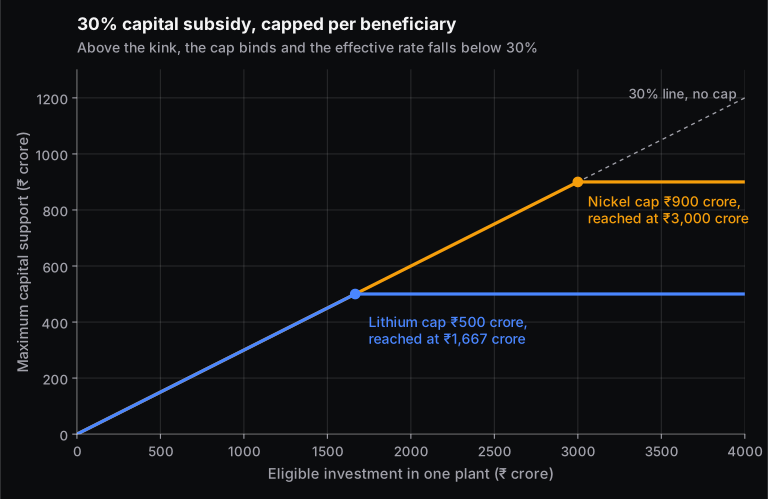
The kink is the cap divided by the rate:
Spread over the expected ₹10,000 crore of investment, the ₹2,800 crore of support works out to 28%.
Now take a hypothetical lithium bidder with ₹2,000 crore of eligible capex. Thirty per cent would be ₹600 crore, but the cap limits support to ₹500 crore, so to win on least cost it bids ₹450 crore (22.5% of capex). PIB does not spell out how the rate and the bid interact; our reading is that a bid cannot exceed either limit. The tranches then pay:
- ₹112.5 crore once ₹500 crore (25%) of capex is spent and at least 15% of the minimum equity is in;
- another ₹112.5 crore (₹225 crore cumulative) at ₹1,000 crore of capex spent and 50% of minimum equity;
- the last ₹225 crore on commissioning.
Half the money arrives only once the plant runs, so commissioning risk sits with the company.
Why does India need lithium and nickel processing?
India has no commercial lithium production and meets its need for refined battery materials largely through imports. The Cabinet release calls India "substantially dependent on imports" for refined intermediates and high-purity materials of lithium, nickel and cobalt. The Ministry of Heavy Industries told the Rajya Sabha on 27 March 2026 that domestic demand for battery cells "continues to be met largely through imports".
The scheme documents give no percentage for import dependence, so we don't quote one. The Ministry of Mines told the Lok Sabha on 7 August 2024 that India "relies on imports" for critical minerals, including lithium, cobalt and nickel. In the US Geological Survey's 2026 lithium summary, India appears only among countries where mineral-based lithium sources are "in various stages of development or exploration", not in the producer table.
Processing is the step the Cabinet release singles out as geographically concentrated, and the one where domestic value addition is lost when India imports refined salts. For scale, USGS reports spodumene concentrate (6% Li2O) at about $970 a tonne in Australia and lithium hydroxide at about $11,200 a tonne in China in November 2025. For the metals a cell actually contains, see the metals used in a lithium-ion battery.
How are lithium and nickel turned into battery materials?
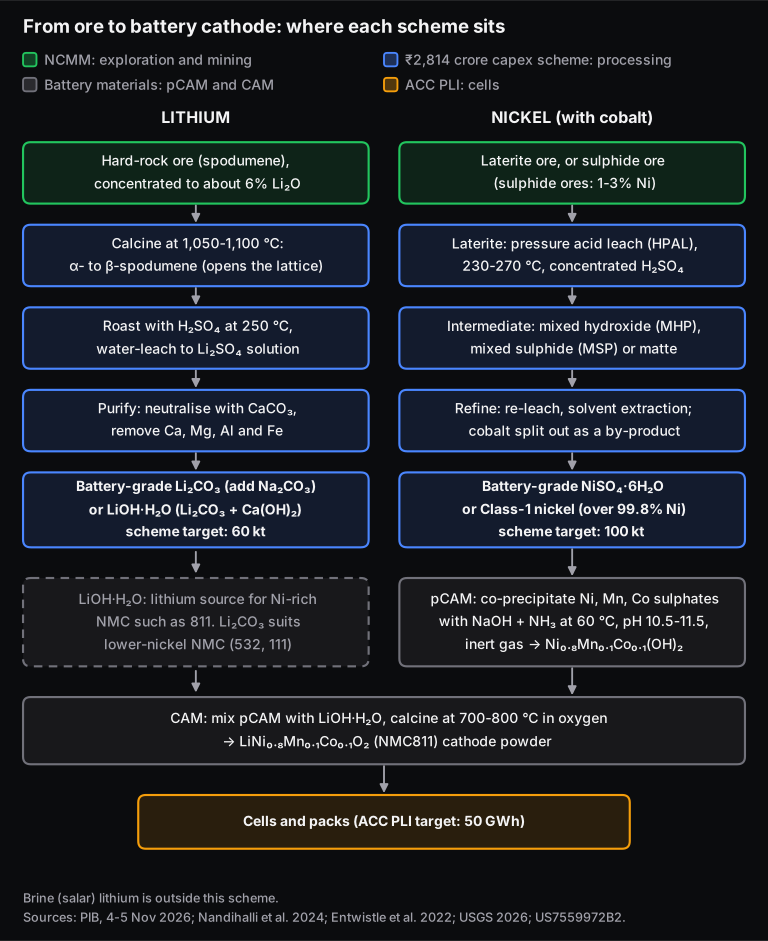
Lithium ore is concentrated, roasted, leached with acid and precipitated as lithium carbonate or converted to lithium hydroxide. Nickel ore is leached, often under pressure, into an intermediate, then refined to nickel sulphate, with cobalt separated along the way. The scheme pays for this middle step: ore or intermediate to battery-grade salt.
Lithium: from spodumene to carbonate or hydroxide
The scheme covers ores and concentrates and explicitly excludes brines. In practice that means hard-rock lithium, mainly spodumene (LiAlSi2O6). A 2024 review by Nandihalli and colleagues at Ames Laboratory calls spodumene the only lithium mineral with reliable industrial production of lithium salts. It describes the sulphuric-acid route, which still dominates, in these steps:
- Calcine the concentrate at 1,050-1,100 °C. This converts α-spodumene to β-spodumene. The crystal expands as its density drops from about 3.2 to 2.4 g/cm³, which opens the structure so acid can reach the lithium. Think of it as cracking a nut before you can get at the kernel.
- Acid-roast the β-spodumene with concentrated H2SO4 at about 250 °C. Hydrogen ions swap places with lithium in the lattice, forming lithium sulphate.
- Water-leach the roasted solid to dissolve the Li2SO4. Neutralise the leftover acid with calcium carbonate, then remove calcium, magnesium, aluminium and iron.
- Precipitate lithium carbonate by adding sodium carbonate. Sodium sulphate is left as a by-product.
The overall reactions are:
Lithium hydroxide can be made from the carbonate by reacting it with slaked lime: Li2CO3 + Ca(OH)2 → 2LiOH + CaCO3. The choice matters because the two salts serve different cathodes (see below).
Why exclude brines? Brine lithium comes from salt lakes (salars), mostly in South America. Its concentration is only about 200-700 ppm, and it is concentrated by open-air evaporation for 10-24 months, according to the same review. India has no such salars.
Nickel: from laterite or sulphide ore to nickel sulphate
Nickel comes from two kinds of ore. USGS estimates that 54% of global nickel resources are in laterites and 35% in magmatic sulphide deposits. Sulphide ores typically carry 1-3% nickel. They are floated into a concentrate and smelted to a matte that is then refined (Wijenayake et al., 2025).
Laterites are often treated by high-pressure acid leaching (HPAL). Ore slurry and concentrated sulphuric acid react in autoclaves at about 230-270 °C, according to a BHP Billiton patent on the process. Iron is rejected as goethite or hematite, and nickel and cobalt go into solution. Indonesia mined about 2.6 million of the world's 3.9 million tonnes of nickel in 2025 (USGS).
The leach liquor is turned into an intermediate. This is usually a mixed hydroxide precipitate (MHP) or mixed sulphide precipitate (MSP), which carries both nickel and cobalt. A refinery re-dissolves it and uses purification steps such as solvent extraction to remove impurities and split cobalt from nickel (Wijenayake et al. describe the same sequence for a nickel intermediate). Battery recyclers use the same separation (see our black mass recycling explainer). Nickel is then crystallised as nickel sulphate hexahydrate (NiSO4·6H2O) or produced as Class-1 nickel (over 99.8% Ni). The scheme names both products and expects cobalt to be recovered as a by-product.
After the scheme: pCAM and CAM
Battery-grade salts are not yet battery material. Cathode makers first co-precipitate a precursor (pCAM), then lithiate and fire it into cathode active material (CAM). Entwistle and colleagues (University of Sheffield, 2022) describe the usual route for nickel-rich NMC:
- Nickel, manganese and cobalt sulphates are fed into a stirred-tank reactor with ammonia (a complexing agent) and sodium hydroxide. The reactor is held at about 60 °C and pH 10.5-11.5 under inert gas. The product is spherical hydroxide particles such as Ni0.8Mn0.1Co0.1(OH)2.
- The precursor is mixed with a lithium salt and calcined at 700-800 °C in an oxidising atmosphere to form LiNi0.8Mn0.1Co0.1O2 (NMC811).
- For nickel-rich grades the lithium salt is usually lithium hydroxide monohydrate, which decomposes at 230-380 °C and so allows the lower firing temperature these grades need. Lithium carbonate works for lower-nickel grades such as NMC532 and NMC111.
So a lithium plant's product choice decides which cathode makers it can sell to. For the chemistries Indian EVs actually use, see LFP vs NMC batteries.
How much lithium and nickel does one kWh of battery need?
At least about 72 g of lithium per kWh for an NMC cell at 3.6 V, and about 78 g for an LFP cell at 3.3 V. That is roughly 0.38-0.42 kg of lithium carbonate equivalent. An NMC811 cell also needs at least about 487 g of nickel per kWh. Real cells contain more, so treat these as floors. The working is below; a script kept with this article reproduces it.
Step 1: lithium per ampere-hour. Each electron that flows through the external circuit is matched by one lithium ion moving between the electrodes. One ampere-hour is 3,600 coulombs. Dividing by the Faraday constant gives moles of lithium, and multiplying by lithium's atomic weight (6.94 g/mol) gives grams:
Step 2: per kWh. One kWh at a nominal 3.6 V (a typical NMC-graphite cell) is 1000/3.6 = 277.8 Ah. That needs 277.8 × 0.259 = 71.9 g of lithium shuttling back and forth. An LFP cell at 3.3 V needs 303.0 Ah, or 78.5 g, because its lower voltage means more charge per kWh.
Step 3: as salts. Lithium is traded as compounds. Lithium carbonate (Li2CO3, 73.89 g/mol) carries two lithium atoms, so 1 kg of lithium is 73.89 / (2 × 6.94) = 5.32 kg of carbonate, the "lithium carbonate equivalent" (LCE). For lithium hydroxide monohydrate (41.96 g/mol) the factor is 6.05. That makes the NMC floor 0.383 kg LCE per kWh, or 0.435 kg of hydroxide.
Step 4: nickel in NMC811. In LiNi0.8Mn0.1Co0.1O2 there are 0.8 nickel atoms per lithium. At 10.36 mol of lithium per kWh:
That is about 2.18 kg of nickel sulphate hexahydrate per kWh, because the salt is only 22.3% nickel by mass.
Why these are floors. This counts only the lithium that must cycle. A real cathode is never fully emptied of lithium, some lithium is lost forming the SEI film on the graphite during the first charge, and manufacturing yields are below 100%. Real figures are higher, so the capacities below are ceilings.
What could 60 kt of lithium and 100 kt of nickel supply?
It depends heavily on what "kt" counts, and PIB doesn't say. We assume the capacities are per year, as plant capacities usually are. If the 60 kt of lithium capacity is lithium carbonate, it holds 11,271 t of lithium, enough at the floor above for at most about 157 GWh of NMC cathode a year. If it is hydroxide monohydrate, the ceiling is 138 GWh. For nickel the basis matters even more: 100 kt of nickel metal could feed up to 205 GWh of NMC811, but 100 kt of nickel sulphate hexahydrate only about 46 GWh.
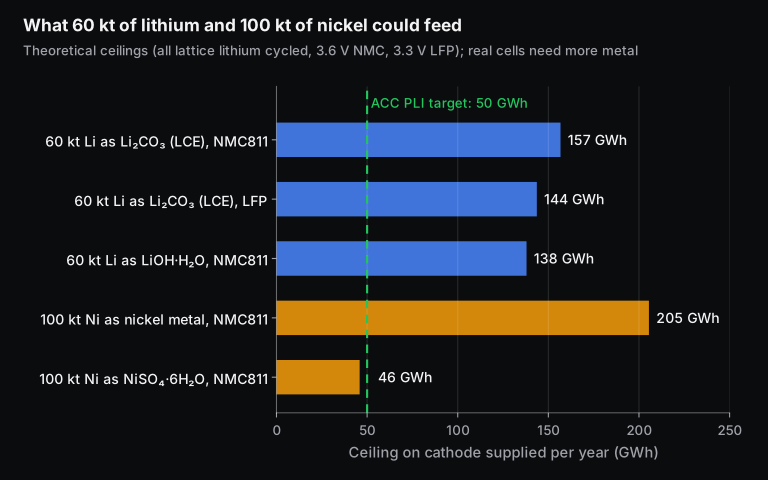
Two things follow. If the lithium target is counted as carbonate or hydroxide, it is sized well beyond the ACC PLI's 50 GWh of cells, consistent with PIB's aim of meeting projected 2030 demand, which includes storage and other uses. And 60 kt of LCE (11,271 t of lithium content) is about 3.9% of the roughly 290,000 t of lithium the world produced in 2025 (USGS): meaningful for India, small globally. The guidelines will need to state the unit basis before anyone can size a plant.
How does the scheme fit with NCMM and the ACC battery PLI?
The three schemes cover different links of one chain. The National Critical Mineral Mission (NCMM) funds finding and mining the ore and recycling scrap. The new capex scheme pays to turn ore into battery-grade salts. The ACC PLI rewards making cells. The step in between, precursor and cathode manufacture, is not the subject of any of these three.
| Scheme | Approved | Money | What it covers | Status (latest official) |
|---|---|---|---|---|
| National Critical Mineral Mission | 29 Jan 2025 | ₹16,300 crore government spend + ₹18,000 crore expected from PSUs etc., 2024-25 to 2030-31 | Exploration, mining, overseas assets, stockpile, processing parks, recycling, R&D | 64 critical and strategic mineral blocks and 11 exploration-licence blocks auctioned by the Centre (PIB, 5 Nov 2026) |
| Critical mineral recycling incentive (under NCMM) | 3 Sep 2025 | ₹1,500 crore | Recovery from e-waste, spent Li-ion batteries and scrap | Approved; separately, black mass exports were banned from 10 Nov 2026 (DGFT) |
| Capex scheme for critical mineral processing | 4 Nov 2026 | ₹2,814 crore, FY 2026-27 to 2030-31 | Lithium and nickel conversion to battery-grade compounds | Guidelines and bidding not yet announced |
| PLI for ACC battery storage | May 2021 | ₹18,100 crore | 50 GWh of cell manufacturing | 40 GWh awarded to four firms, 1 GWh installed (Rajya Sabha, 27 Mar 2026); final 10 GWh round for grid storage drew 22 bids (reported 16 Nov 2026) |
NCMM's own targets for 2024-25 to 2030-31 include 1,200 domestic exploration projects, four mineral processing parks, three centres of excellence and training for 10,000 people (PIB, 9 Apr 2025).
The link to the ACC PLI is domestic value addition. PLI cell makers must reach at least 25% domestic value addition within two years and 60% within five (PIB, 6 Feb 2026). Locally refined salts, and cathodes made from them, help close that gap; the backgrounder says refined output will strengthen "existing downstream schemes". The same logic sits behind India's ₹7,280 crore rare-earth magnet scheme, covered in our post on the rare earth magnet shortage and EV motors. On the demand side, PM E-DRIVE subsidises the vehicles that use these batteries.
What does this mean for engineering jobs and skills?
Four plants are not a hiring boom on their own. But PIB calls India's processing base "nascent", so these plants will be among the country's first commercial-scale lithium and nickel refineries, and each needs process, plant and quality engineers from design through commissioning. Hiring will follow the awards, not the Cabinet note. With three years from award to commissioning, the build phase most likely falls in the second half of this decade.
- Chemical engineers: process design and mass and energy balances for leaching, solvent extraction, evaporation and crystallisation; reagent and water recovery; process simulation and scale-up; hazard studies for acid and caustic handling.
- Metallurgical engineers: ore and concentrate characterisation, calcination and acid roasting, pressure leaching, impurity control to battery-grade specifications, and assay and QC labs. The same skills carry over to recycling refiners, now that black mass has to be refined in India.
- Mechanical engineers: rotary kilns and calciners at about 1,100 °C, pressure vessels and autoclaves, slurry pumps and agitators, materials selection for hot acid service, heat recovery, piping and plant layout and reliability. Flow modelling of stirred tanks and kilns uses the same CFD skills taught in our advanced CFD course.
- Battery engineers: the interface between salt makers and cell makers. That means specifying lithium carbonate versus hydroxide grade, impurity limits, precursor particle size and tap density, and qualifying a new domestic supplier's material in cells. Skill-Lync's PG program in battery technology covers cell chemistry and design.
Two limits are worth stating plainly. The release itself names the bottlenecks as high capital cost, limited access to suitable technology and constrained access to raw materials, and a 30% subsidy addresses only the first. Brines and cathode manufacture are both outside this scheme. So this is a start on the processing gap, not the whole chain. For a lower-lithium alternative chemistry being built in India, see our sodium-ion battery explainer.
Frequently asked questions
What is the Capex Support Scheme to Promote Critical Mineral Processing?
It is a ₹2,814 crore Ministry of Mines scheme, approved by the Union Cabinet on 4 November 2026. It gives a 30% capital subsidy to two lithium and two nickel processing plants that produce battery-grade compounds. Support is capped at ₹500 crore per lithium plant and ₹900 crore per nickel plant, and the scheme runs from FY 2026-27 to FY 2030-31.
Which minerals and products does the scheme cover?
Lithium and nickel only, with cobalt recovered as a by-product of nickel. Lithium plants must process ores and concentrates (not brines) into battery-grade products. Nickel plants must produce Class-1 nickel or battery-grade nickel sulphate. Each lithium plant must have at least 30 kt of capacity and each nickel plant at least 50 kt.
How is this different from the National Critical Mineral Mission?
NCMM, approved on 29 January 2025, is the umbrella mission for the whole value chain, with exploration, mining, overseas assets, recycling and processing parks. The new scheme is a targeted capital subsidy for one missing link: converting lithium and nickel ore into battery-grade chemicals. PIB describes it as complementing NCMM.
Does lithium hydroxide or lithium carbonate matter for EV batteries?
Yes. Nickel-rich cathodes such as NMC811 are usually made with lithium hydroxide monohydrate, because it lets them be fired at the lower temperatures they need. Lithium carbonate is used for lower-nickel NMC grades. A lithium refinery's product choice decides which cathode makers it can supply.
Will this scheme create jobs for engineering graduates?
Some, mainly at the selected companies once plants are awarded and built, for chemical, metallurgical, mechanical and battery engineers. The skills (hydrometallurgy, high-temperature processing, plant equipment, materials qualification) also transfer to battery recyclers and cathode makers.
Sources and further reading
- PIB (Cabinet), Cabinet approves Capex Support Scheme to Promote Critical Mineral Processing with an outlay of Rs.2,814 crore for lithium and nickel processing (4 Nov 2026)
- PIB Research, PIB Backgrounder: CAPEX Support Scheme to Promote Critical Mineral Processing (5 Nov 2026)
- PMIndia, Cabinet approves National Critical Mineral Mission (29 Jan 2025)
- PIB (Ministry of Mines), National Critical Mineral Mission: powering India's clean energy future (9 Apr 2025)
- PIB (Ministry of Mines), Exploration and processing of critical minerals, Lok Sabha reply (7 Aug 2024)
- PIB (Ministry of Heavy Industries), Production-linked incentive for ACC battery manufacturing (6 Feb 2026)
- Ministry of Heavy Industries, Rajya Sabha Unstarred Question 3908: ACC battery PLI scheme (27 Mar 2026)
- Ministry of Heavy Industries, Lok Sabha Unstarred Question 3775: dependence on Chinese lithium-ion batteries (12 Aug 2025)
- Autocar Professional, Ministry of Heavy Industries receives 22 bids for 10 GWh ACC battery manufacturing capacity (16 Nov 2026)
- US Geological Survey, Mineral Commodity Summaries 2026: Lithium and Nickel (Feb 2026)
- Nandihalli, Chouhan, Kuchi and Hlova, Aspects of spodumene lithium extraction techniques, Sustainability 16(19), 8513 (2024); open manuscript at OSTI
- Wijenayake, Moats, Mseteka and Alagha, Selective nickel leaching and preparation of battery-grade nickel carbonate from copper-rich industrial intermediate, Processes 13, 3235 (2025)
- BHP Billiton SSM Technology, US Patent 7,559,972 B2: Process for enhanced acid leaching of laterite ores (2009)
- Entwistle et al., Co-precipitation synthesis of nickel-rich cathodes for Li-ion batteries, Energy Reports 8, 67-73 (2022); open copy at White Rose
- LG Chem, INR18650HG2 product specification (2014): 3.6 V nominal NMC cell; Golubkov et al., Thermal-runaway experiments on consumer Li-ion batteries, RSC Advances 4, 3633 (2014): 3.3 V LFP working voltage
- NIST, CODATA value: Faraday constant; CIAAW, Standard atomic weights