PM E-DRIVE Scheme Explained: Subsidy per kWh, Caps and Rules to 2028
PM E-DRIVE now has ₹11,900 crore and runs to 31 March 2028. Here are the current rules from the gazette, with the date of each: subsidy per kWh and caps for e-2Ws, e-rickshaws, e-trucks and e-ambulances, worked examples showing which cap binds, the localisation rules, the e-voucher, uptake so far and what it means for EV engineering jobs.

PM E-DRIVE (PM Electric Drive Revolution in Innovative Vehicle Enhancement) is the Government of India's main electric vehicle subsidy scheme. It replaced FAME-II and is run by the Ministry of Heavy Industries. As of 17 November 2026 it has an outlay of ₹11,900 crore and runs until 31 March 2028. It pays an upfront discount on electric two-wheelers, e-rickshaws, e-trucks and e-ambulances through an Aadhaar-verified e-voucher, and grants for e-buses, public chargers and vehicle testing labs. Electric cars get no purchase subsidy.
In short (rules in force on 17 Nov 2026)
- Outlay ₹11,900 crore, running to 31 March 2028. Raised from ₹10,900 crore on 10 August 2026 (gazette S.O. 4424(E)): ₹995 crore more for e-2Ws, ₹5 crore for administration.
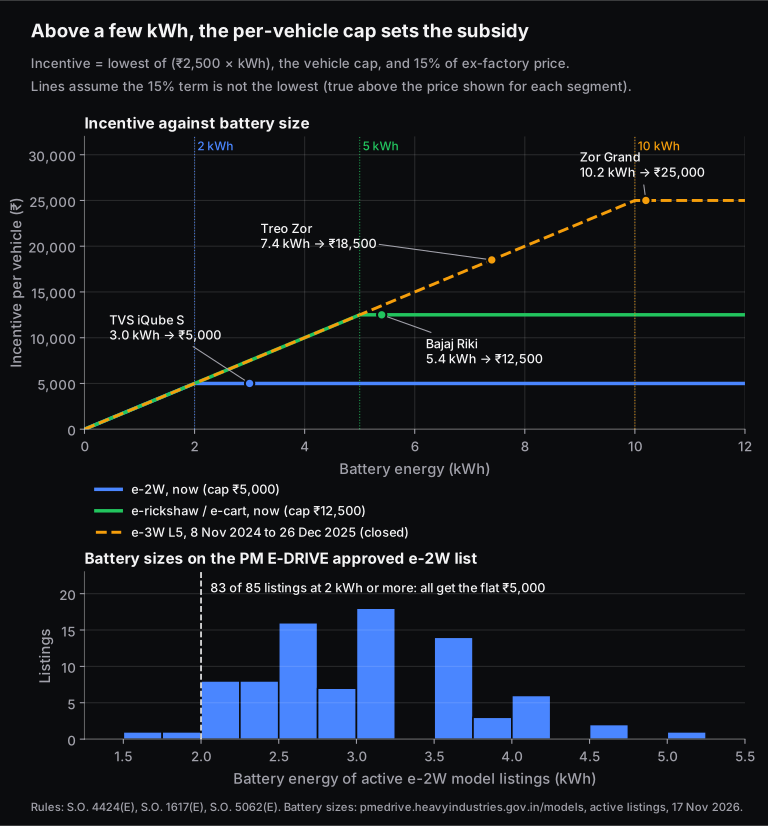
- Electric two-wheelers get ₹2,500 per kWh, capped at ₹5,000 per vehicle and at 15% of the ex-factory price, for vehicles priced up to ₹1.5 lakh ex-factory and registered from 1 April 2025 to 31 March 2028. The cap binds at 2 kWh, so 83 of the 85 active e-2W model listings on the scheme portal get the same flat ₹5,000.
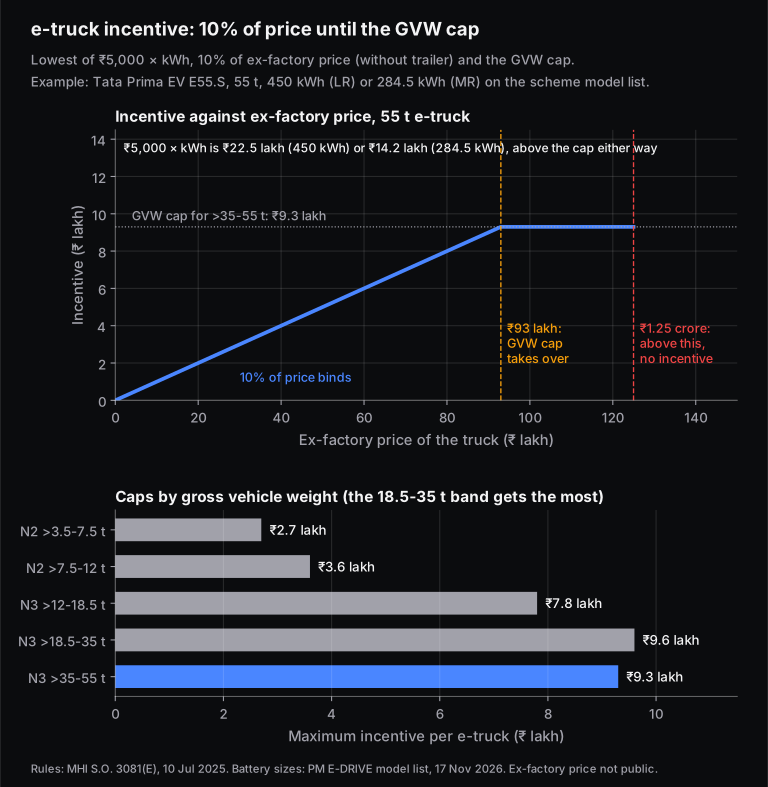
- e-trucks (from 10 July 2025): lowest of ₹5,000 per kWh, 10% of ex-factory price and a weight cap of up to ₹9.6 lakh, against a scrapping certificate. e-ambulances (from 17 June 2026): lower of ₹30,000 per kWh and 35% of price.
- L5 electric autos are closed: the 2,88,809-vehicle target was reached and registrations after 26 December 2025 get nothing. e-rickshaws and e-carts stay open (up to ₹12,500) to March 2028.
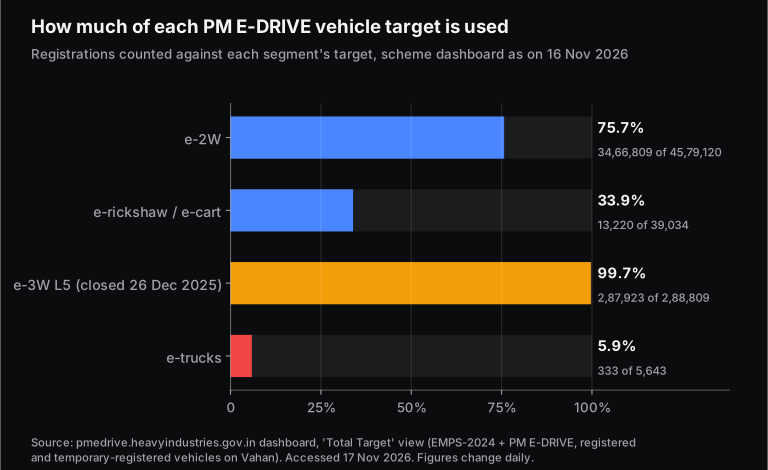
- Uptake, 16 Nov 2026 (scheme dashboard): e-2W 75.7% of target used, e-rickshaw 33.9%, e-trucks 5.9%.
This guide is built from the gazette notifications, not press summaries, with the date of every rule. It works out the subsidy for three real vehicles on the scheme's approved-model list, shows which cap decides the amount, and explains what the localisation rules mean for engineering jobs.
Courses: if you want to work on the hardware this scheme pays for, compare Skill-Lync's electric vehicle courses and battery technology courses, with fees, duration and projects on one page.
What is the PM E-DRIVE scheme?
PM E-DRIVE is a fund-limited central scheme that lowers the purchase price of eligible electric vehicles and funds charging and testing infrastructure. The Union Cabinet approved it on 11 September 2024 with ₹10,900 crore for two years. MHI notified it on 29 September 2024, and has since amended it more than a dozen times. Each segment closes early if its money or vehicle target runs out.
The scheme is a moving target, so here are the notifications that set today's rules, in date order. All are on the scheme portal's notifications page.
| Date | Notification | What it did |
|---|---|---|
| 29 Sep 2024 | S.O. 4259(E) | Launched the scheme: ₹10,900 crore, 1 Oct 2024 to 31 Mar 2026; EMPS-2024 (Apr to Sep 2024) folded in |
| 25 Nov 2024 | S.O. 5062(E) | Halved the L5 e-3W rate for vehicles registered from 8 Nov 2024 |
| 3 Mar 2025 | S.O. 1078(E) | Replaced the localisation rules (PMP) with process-level definitions, from 1 May 2025 for 2W/3W |
| 10 Jul 2025 | S.O. 3081(E) | Added e-trucks (N2, N3) with scrappage condition |
| 7 Aug 2025 | S.O. 3626(E) | Extended the scheme to 31 Mar 2028 (2W/3W still to end on 31 Mar 2026) |
| 13 Aug 2025 | S.O. 3680(E) | Moved ₹142 crore from e-rickshaws to L5 autos |
| 23 Dec 2025 | MHI letter to SIAM | L5 closed for vehicles registered after 26 Dec 2025 |
| 27 Mar 2026 | S.O. 1617(E) | e-2W extended to 31 Jul 2026; e-rickshaw/e-cart to 31 Mar 2028 |
| 17 Jun 2026 | S.O. 3191(E) | Added e-ambulances |
| 10 Aug 2026 | S.O. 4424(E) | Outlay to ₹11,900 crore; e-2W to 31 Mar 2028 with 45,79,120 vehicles; claims close 31 Dec 2027 |
| 3 Sep 2026 | S.O. 4871(E), 4884(E) | Pushed motor magnet-fitment localisation for e-trucks and e-buses to 1 Apr 2027 |
How is the ₹11,900 crore outlay split?
About 60% of the money, ₹7,171 crore, goes to grants for e-buses, public chargers and testing agencies. Purchase subsidies for vehicles now total ₹4,674 crore, up from ₹3,679 crore at launch, because e-2Ws got ₹995 crore of the August 2026 top-up. Grant money for buses, chargers and labs cannot be moved to other components and lapses if unused.
| Component | At launch, Sep 2024 (₹ crore) | Now, Nov 2026 (₹ crore) |
|---|---|---|
| e-2W | 1,772 | 2,767 |
| e-rickshaw and e-cart | 192 | 50 |
| e-3W L5 | 715 | 857 |
| e-ambulances | 500 | 500 |
| e-trucks and other emerging EVs | 500 | 500 |
| Demand incentives, subtotal | 3,679 | 4,674 |
| e-buses (14,028 buses) | 4,391 | 4,391 |
| EV public charging stations | 2,000 | 2,000 |
| Upgrading testing agencies | 780 | 780 |
| Administration and awareness | 50 | 55 |
| Total | 10,900 | 11,900 |
Sources: S.O. 4259(E) Table 1, S.O. 3680(E) and S.O. 4424(E). The column sums were checked by script.
Which vehicles are eligible, and how much subsidy per kWh?
Five vehicle segments can get a purchase subsidy: e-2Ws, e-rickshaws and e-carts, L5 e-3Ws (now closed), e-ambulances and e-trucks. E-buses get a grant through state transport undertakings instead. In every segment the amount is tied to battery energy in kWh, then limited by a per-vehicle cap and a percentage of the ex-factory price (the factory-gate price before taxes).
| Segment | Rate | Per-vehicle cap | % of ex-factory price | Max ex-factory price | Vehicles / status |
|---|---|---|---|---|---|
| e-2W (L1, L2) | ₹5,000/kWh in FY 2024-25; ₹2,500/kWh from 1 Apr 2025 | ₹10,000; now ₹5,000 | 15% | ₹1.5 lakh | 45,79,120; open to 31 Mar 2028 |
| e-rickshaw, e-cart | ₹5,000/kWh in FY 2024-25; ₹2,500/kWh after | ₹25,000; now ₹12,500 | 15% | ₹2.5 lakh | 39,034; open to 31 Mar 2028 |
| e-3W L5 (autos, loaders) | ₹5,000/kWh to 7 Nov 2024; ₹2,500/kWh from 8 Nov 2024 | ₹50,000; then ₹25,000 | 15% | ₹5 lakh | 2,88,809; closed 26 Dec 2025 |
| e-ambulance (Type B, C, D) | ₹30,000/kWh | none stated | 35% | none stated | 3,811 (FY 2026-27 and 2027-28); ₹500 crore |
| e-truck (N2, N3) | ₹5,000/kWh | ₹2.7 to 9.6 lakh by weight | 10% (without trailer) | ₹1.25 crore | 5,643; scrapping certificate needed |
| e-bus (grant to STUs) | ₹10,000/kWh | ₹20 lakh (6-8 m), ₹25 lakh (8-10 m), ₹35 lakh (10-12 m) | 20% of CESL-discovered price | ₹2 crore | 14,028 buses |
Two rules apply only to 2W and 3W buyers. One person can claim for only one vehicle per category. And an e-3W subsidy is only for vehicles registered for commercial or public transport use, while e-2Ws can be bought privately.
Public chargers get a share of cost (operational guidelines, 26 September 2025): 100% of the upstream power infrastructure (transformer, cables, switchgear, civil works) and the charger on government premises with free public access; 80% and 70% at government-run sites such as railway stations, public sector fuel outlets and metro stations; and 80% of upstream infrastructure only at other public sites and battery-swapping stations.
How is the PM E-DRIVE subsidy calculated?
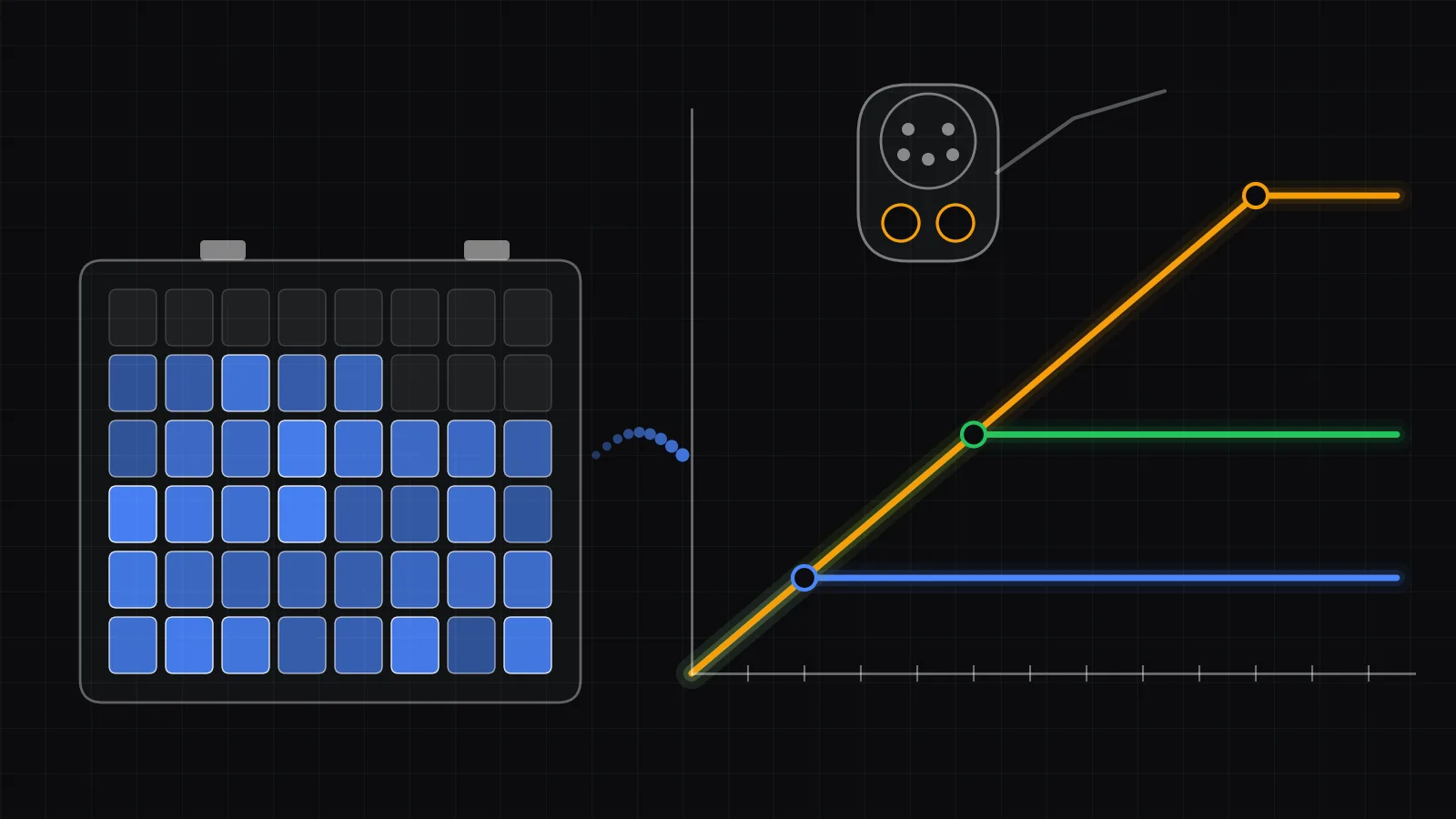
The subsidy is the lowest of three numbers: the per-kWh rate times battery energy, the segment's rupee cap, and a percentage of the ex-factory price. The vehicle must also be priced at or below the segment's ex-factory ceiling. Whichever term is smallest is the one that "binds".
Here is the rate in ₹ per kWh, the battery energy in kWh, the per-vehicle cap, the percentage cap and the ex-factory price. Two break points follow. The cap takes over from the per-kWh term once exceeds . And the percentage term only matters when the price is below .
For e-2Ws today, kWh. In FY 2024-25 it was also 2 kWh (₹10,000 / ₹5,000). For e-rickshaws it is 5 kWh and for L5 autos it was 10 kWh. Above those sizes, a bigger battery earns nothing extra.
Worked examples: which cap binds for a scooter, an auto and an e-truck?
Battery sizes below are from the scheme's approved-model list (17 November 2026). Ex-factory prices are not published, so each example gives the price below which the percentage cap would take over. A script kept with this article re-runs every number.
1. A 3 kWh electric scooter: TVS iQube Electric S
The portal lists the iQube Electric S with a 3.0 kWh battery. Bought and registered today:
The ₹5,000 cap binds for any ex-factory price above ₹33,333 (where 15% equals ₹5,000), and the scooter must be at or under ₹1.5 lakh to qualify at all. That works out to about ₹1,667 per kWh in practice. Under the FY 2024-25 rules the same scooter got ₹10,000 (₹15,000 per-kWh value, capped at ₹10,000). Only below 2 kWh does the rate itself decide: the 1.5 kWh TVS Orbiter V1 on the same list gets ₹3,750.
2. An L5 electric auto: Mahindra Treo Zor (7.4 kWh) and Zor Grand (10.2 kWh)
The L5 segment is closed, but it shows the other kind of result: a battery below the cap's break point.
| Vehicle (battery) | Registered 1 Apr to 7 Nov 2024 | Registered 8 Nov 2024 to 26 Dec 2025 |
|---|---|---|
| Treo Zor (7.4 kWh) | min(₹37,000, ₹50,000) = ₹37,000, per-kWh binds | min(₹18,500, ₹25,000) = ₹18,500, per-kWh binds |
| Zor Grand (10.2 kWh) | min(₹51,000, ₹50,000) = ₹50,000, cap binds | min(₹25,500, ₹25,000) = ₹25,000, cap binds |
The 15% term would bind only for ex-factory prices below ₹1,23,333 (Treo Zor) or ₹1,66,667 (Zor Grand) in the later period. Below the 10 kWh break point, every extra kWh earned ₹2,500. So when the segment closed, bigger-battery models lost the most: up to ₹25,000 each.
3. A 55-tonne electric truck: Tata Prima EV E55.S
The portal lists two versions of this N3 tractor: LR with 450 kWh and MR with 284.5 kWh. electrive reported its GVW rating as 55 tonnes, which puts it in the top weight band (over 35 and up to 55 t, cap ₹9.3 lakh). The MHI e-truck FAQ uses a 55-tonne e-truck as its example. The per-kWh term is far above that cap:
So the incentive is ₹9.3 lakh if the ex-factory price (without trailer) is between ₹93 lakh and the ₹1.25 crore ceiling, and 10% of the price below ₹93 lakh. Above ₹1.25 crore it is zero. The buyer must also hand in scrapping certificates for diesel trucks of at least 55 tonnes gross vehicle weight (GVW, the loaded weight rating) in total. MHI's FAQ says two 28-tonne trucks count.
e-ambulances work the other way round. With ₹30,000 per kWh and 35% of price and no rupee cap, a ₹25 lakh ambulance would be limited by the 35% rule only if its battery exceeded about 29 kWh.
What is the 15% ex-factory price cap, and when does it bite?
The 15% cap limits the e-2W and e-3W subsidy to 15% of the vehicle's ex-factory price. With today's small rupee caps it only binds for very cheap vehicles: an e-2W priced under ₹33,333, an e-rickshaw under ₹83,333. The ceilings on price (₹1.5 lakh for e-2W, ₹2.5 lakh for e-rickshaws) matter far more.
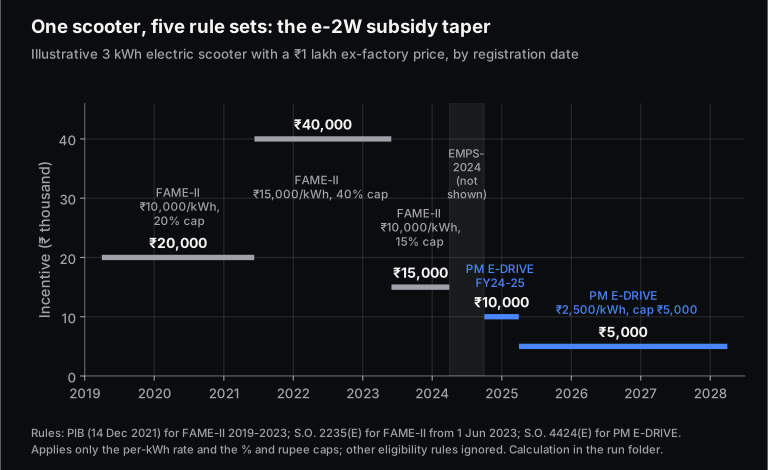
The cap is a hangover from FAME-II, where it did real work. FAME-II paid ₹15,000 per kWh capped at 40% of vehicle cost from 11 June 2021, then cut that to ₹10,000 per kWh and 15% from 1 June 2023 (S.O. 2235(E)). At those rates the percentage, not a rupee figure, decided most scooter subsidies.
What are the PMP localisation and advanced-battery rules?
To qualify, a vehicle must be made in India, type-approved under the Central Motor Vehicles Rules (CMVR), certified by an MHI testing agency, and follow the Phased Manufacturing Programme (PMP). The PMP lists which parts must be manufactured in India. Batteries must be "advanced" chemistries with at least 70 Wh/kg and 1,000 cycles.
The technical floor for e-2Ws (S.O. 4259(E), Annexure-3) is 80 km range, at most 7 kWh per 100 km, at least 40 km/h and 0.65 m/s² at gross vehicle weight, plus regenerative braking and a three-year warranty that includes the battery.
Since 1 May 2025 the PMP for e-2Ws and e-3Ws (S.O. 1078(E)) defines localisation by process, not just by part name:
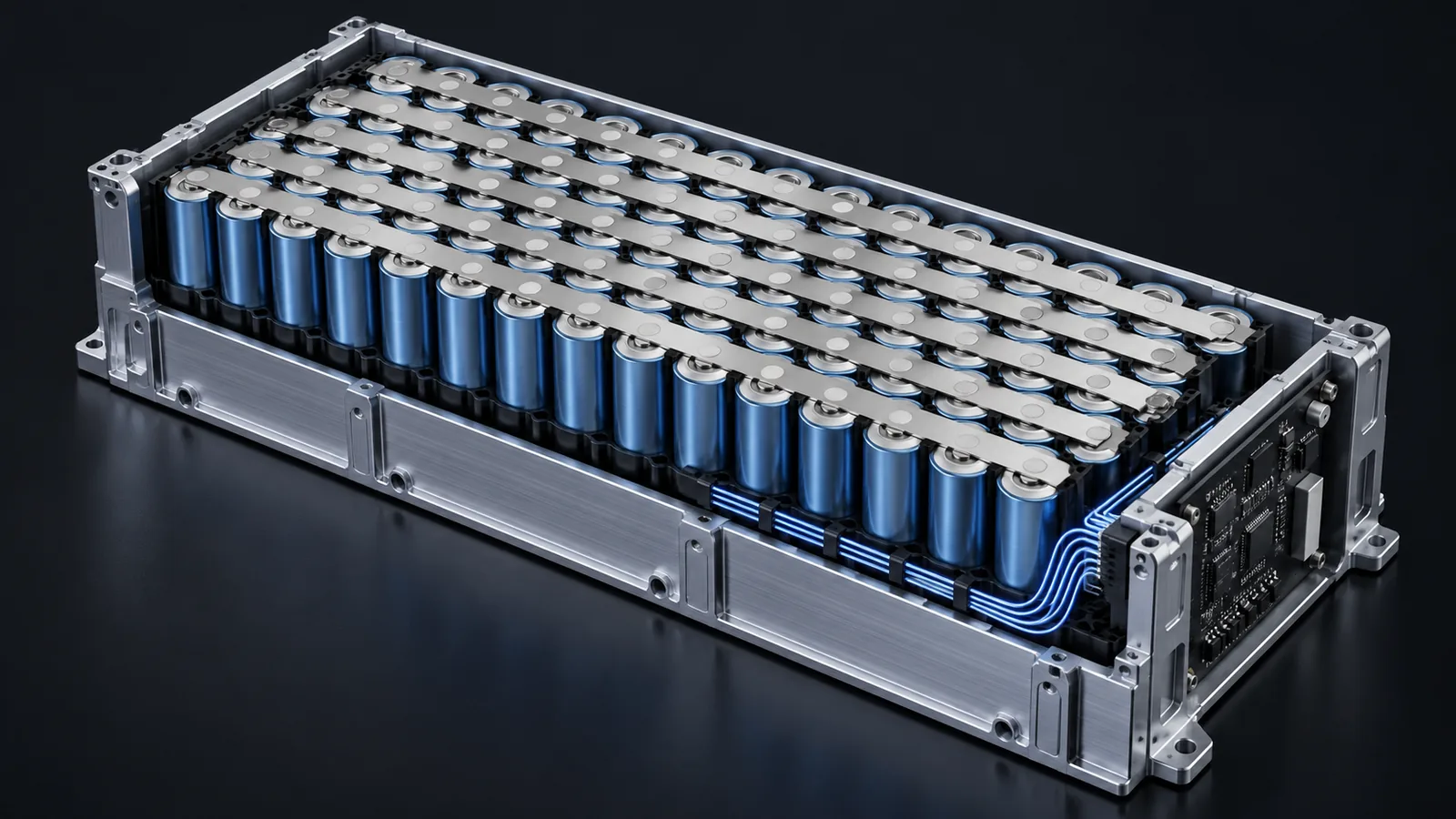
- Battery pack: cell-to-cell connections, busbars, sensors, wiring, contactors and fuses, BMS and thermal system integration, vent valves and enclosure must be done in India. Cells may be imported; ready-made modules may not.
- Electronics: the BMS, DC-DC converter, vehicle control unit, on-board or portable charger, motor controller/inverter and instrument cluster need PCB assembly and firmware flashing in India. A 3-in-1 combined unit is checked part by part.
- Traction motor: coil winding, magnet fitment, rotor and stator assembly, shaft, bearings and enclosure in India.
- Importing PMP parts as a kit from a single supplier is not allowed. Public chargers must meet their own PMP, with AC-DC power modules made in India from 1 December 2025 (S.O. 3318(E)).
For e-buses and N2 e-trucks, the deadline for fitting motor magnets in India has slipped three times: from September 2025 to March 2026, then to 1 September 2026, then to 1 April 2027 (S.O. 4480(E) and 4481(E), 1330(E) and 1331(E), 4871(E) and 4884(E)). The notifications give no reason. Autocar Pro reported on 1 October 2025 that China's suspension of magnet exports was the cause.
How does the PM E-DRIVE e-voucher work?
The buyer never applies. The dealer deducts the subsidy at the time of sale after an Aadhaar face check, and the maker claims it back from MHI against the signed e-voucher. The steps, from the operational guidelines of 30 September 2024:
- The dealer runs Aadhaar e-KYC with face authentication on the PM E-DRIVE app (with the AadhaarFaceRD app installed) and uploads one photo ID of the buyer. Firms give PAN and GST details and their representative is face-verified.
- The portal checks that the buyer has not already claimed a vehicle in that category. If they have, the sale is not eligible.
- After registration at the RTO, the portal generates an e-voucher with a unique number and sends the link to the buyer's Aadhaar-linked mobile.
- Buyer and dealer sign a printout, which the dealer uploads with a selfie of the buyer taken at a branded booth.
- The dealer claims from the maker within 90 days. The maker claims from MHI within 120 days of the sale. The last date for any claim is 31 December 2027.
How much of PM E-DRIVE has been used so far?
As on 16 November 2026, the scheme dashboard shows 37,68,285 vehicles registered against targets of 49,12,606 for the four segments it tracks. That is 76.7%, counting EMPS-2024 sales and temporary registrations. The e-2W pool has about 11.1 lakh vehicles left. The e-truck pool has barely started.
The grant side, from PIB's factsheet of 1 October 2026: 14,000 of the 14,028 e-buses had been allocated as of August 2026, 13,800 of them to Delhi, Bengaluru, Hyderabad, Mumbai, Ahmedabad, Pune and Surat. ₹851 crore had been approved for 8,147 chargers for three oil marketing companies and 10 states as of 28 September 2026. These are allocations and approvals, not buses on the road or chargers switched on.
What changed from FAME-II?
PM E-DRIVE pays far less per scooter than FAME-II did and drops electric cars from purchase subsidies. In their place it adds e-trucks, e-ambulances, a ₹780 crore fund for testing labs and a stricter, process-level localisation test, and it checks every individual buyer through an Aadhaar face-verified e-voucher.
| FAME-II (1 Apr 2019 to 31 Mar 2024) | PM E-DRIVE (now) | |
|---|---|---|
| Outlay | ₹10,000 crore, raised to ₹11,500 crore | ₹10,900 crore, raised to ₹11,900 crore |
| e-2W subsidy | ₹10,000/kWh (20% cap), then ₹15,000/kWh (40% cap) from 11 Jun 2021, then ₹10,000/kWh (15% cap) from 1 Jun 2023 | ₹2,500/kWh, capped at ₹5,000 and 15% |
| Electric cars | Supported (target 55,000 e-4W) | No purchase subsidy; charging only |
| e-trucks, e-ambulances | Not covered (PIB calls both new) | Covered, trucks against scrappage |
| E-voucher | No (PIB in 2024: the scheme "now includes e-vouchers") | Aadhaar face-verified e-voucher for every sale |
Confirmed vs reported: where outlets differ
- Did the outlay rise in August 2026? Yes. S.O. 4424(E) sets total payout at ₹11,900 crore, against ₹10,900 crore in S.O. 3626(E). Inc42 (11 August 2026) reported the ₹1,000 crore increase, which matches. Some summaries describe the whole ₹1,000 crore as e-2W money; the gazette gives ₹995 crore to e-2Ws and ₹5 crore to administration.
- Was there a gap for e-2Ws? S.O. 1617(E) ended e-2W support on 31 July 2026. S.O. 4424(E), published on 10 August 2026, set one rate for registrations from 1 April 2025 to 31 March 2028, so on paper the gap is covered. How claims for 1 to 9 August were handled is not stated.
- When did the scheme start? The 2024 notification says 1 October 2024. The August 2026 notification says "from 1st April 2024", because EMPS-2024 (April to September 2024) was folded in. Reports give both dates, and both are correct readings.
- How many vehicles? PIB's 1 October 2026 factsheet says "~28.30 lakh EVs". That matches the targets before August 2026 (28,30,445 including buses and ambulances). With the 21 lakh e-2Ws added on 10 August, the targets total 49,30,445.
What does PM E-DRIVE mean for engineering jobs?
With the scooter subsidy down to ₹5,000, the scheme's bigger effect on jobs comes from its localisation rules and lab funding. Every OEM that wants the subsidy must assemble packs, build electronics, wind motors and test vehicles in India. That puts demand on battery, power electronics, motor and homologation engineers, not just sales staff.
- Battery pack and BMS engineers. Pack assembly, BMS boards and firmware must be Indian, and modules cannot be imported. Start with cell chemistry (LFP vs NMC) and how a BMS estimates state of charge.
- Power electronics and embedded engineers. DC-DC converters, chargers, inverters, vehicle control units and charger AC-DC modules need local board assembly and firmware flashing. Skill-Lync's power electronics for EV applications course covers these converters.
- Motor engineers. Winding and magnet fitment are on the PMP list, and the magnet deadline for buses and trucks is now 1 April 2027. See electric motor design.
- Homologation and testing engineers. Every model needs CMVR type approval, a PM E-DRIVE eligibility certificate (range, consumption, speed, acceleration) and PMP verification from MHI testing agencies, which the ₹780 crore upgrade equips.
- Charging engineers. Chargers must meet IS 17017, with indigenous OCPP and back-end software.
For salary data, see Skill-Lync's EV engineer salary page. For how the market itself is moving, our October 2026 EV sales analysis shows L5 autos kept growing after their subsidy ended.
A caution: this covers the central scheme only, not state road-tax waivers or subsidies. Because PM E-DRIVE is fund-limited, a segment can close before its terminal date, as L5 did, so check the dashboard and the latest notification before counting on a subsidy.
Frequently asked questions
How much subsidy do I get on an electric scooter under PM E-DRIVE now?
₹5,000 for almost any electric scooter registered between 1 April 2025 and 31 March 2028, provided its ex-factory price is up to ₹1.5 lakh and the model is approved on the scheme portal. Only scooters with batteries under 2 kWh get less (₹2,500 per kWh).
Is there a PM E-DRIVE subsidy on electric cars?
No. PM E-DRIVE gives no purchase subsidy for electric cars, private or commercial. Cars benefit only indirectly through the ₹2,000 crore public charging component. PIB's 2024 release planned 22,100 fast chargers for e-4Ws.
Is the PM E-DRIVE subsidy for electric autos (L5) still available?
No. MHI closed the L5 segment for vehicles registered after 26 December 2025 because the 2,88,809-vehicle target was reached. e-rickshaws and e-carts can still get up to ₹12,500 until 31 March 2028.
Who applies for the PM E-DRIVE subsidy, the buyer or the dealer?
The dealer. It verifies your Aadhaar by face scan, generates the e-voucher after RTO registration and deducts the subsidy from your price. The maker then claims it from MHI. You sign the e-voucher and pose for a selfie at the dealership.
How much is the PM E-DRIVE incentive for electric trucks?
The lowest of ₹5,000 per kWh, 10% of ex-factory price (without trailer) and a weight cap from ₹2.7 lakh (3.5 to 7.5 t) to ₹9.6 lakh (18.5 to 35 t). The truck must cost at most ₹1.25 crore ex-factory, and you must scrap diesel trucks of equal or higher total GVW.
Sources and further reading
- PM E-DRIVE scheme notifications, Ministry of Heavy Industries: S.O. 4259(E) 29 Sep 2024; S.O. 5062(E) 25 Nov 2024; S.O. 1078(E) 3 Mar 2025; S.O. 3081(E) 10 Jul 2025; S.O. 3318(E) 18 Jul 2025; S.O. 3626(E) 7 Aug 2025; S.O. 3680(E) 13 Aug 2025; S.O. 4480(E) and 4481(E) 30 Sep 2025; S.O. 1330(E) and 1331(E) 13 Mar 2026; S.O. 1617(E) 27 Mar 2026; S.O. 2131(E) 29 Apr 2026; S.O. 3191(E) 17 Jun 2026; S.O. 4424(E) 10 Aug 2026; S.O. 4871(E) and 4884(E) 3 Sep 2026. Accessed 17 Nov 2026.
- PM E-DRIVE guidelines, MHI: operational guidelines for e-2W/e-3W (30 Sep 2024) and e-trucks (11 Jul 2025), EV PCS operational guidelines (26 Sep 2025), e-truck FAQs (27 Feb 2026), MHI letter to SIAM on L5 closure (23 Dec 2025). Accessed 17 Nov 2026.
- PM E-DRIVE approved models and scheme dashboard, MHI, accessed 17 Nov 2026 (dashboard "as on 16-11-2026").
- PM E-DRIVE Scheme factsheet, PIB, 1 Oct 2026.
- Cabinet approves PM E-DRIVE Scheme, PIB, 11 Sep 2024.
- MHI extends PM E-DRIVE to 31 March 2028, PIB, 8 Aug 2025.
- India rolls out first-ever e-truck incentive scheme, PIB, 11 Jul 2025.
- Reducing the cost of electric vehicles (FAME-II e-2W rates), PIB, 14 Dec 2021; OEMs registered under FAME-II (FAME-II targets), PIB, 7 Dec 2021.
- S.O. 2235(E), FAME-II amendment, MHI, 19 May 2023 (copy hosted by ACMA).
- Govt eases PMP guidelines under PM E-Drive for e-trucks, buses to import motors, Autocar Pro, 1 Oct 2025 (reported reason for magnet deferrals).
- PM E-DRIVE e2W subsidy extended till March 2028, Inc42, 11 Aug 2026 (compared against the gazette).
- Tata Motors unveils six electric CVs at Auto Expo 2025, electrive, 30 Jan 2025 (Prima E.55S 55 t rating).