DussehraFestive scholarship on Skill-Lync courses, this week onlyFestive scholarship is openOffer ends Wed, 21 Oct, 11:59 pm IST.
Dussehra 2026

Start your next chapter this Dussehra

Tell us where you want to work. A counsellor will match you to the right course and confirm the festive scholarship you qualify for.

  • Festive scholarship on course fees, confirmed on your call
  • Free 20-minute call to map the right course to your goal
  • Real industry projects and placement support with every course

Offer ends Wed, 21 Oct, 11:59 pm IST

3,905 engineers placed since 2019 · 1,277 hiring companies

By submitting you agree to our Terms and Privacy Policy.

You're on the list

Browse courses
Mechanical · Course

Introduction to GUI based CFD using ANSYS Fluent

If you have a keen interest in Aviation and Thermal Industries and have been meaning to dig deep and understand a powerful Computational Fluid Dynamics (CFD) tool like ANSYS Fluent, this is the course for you

Duration
12 weeks
Content
16 hours
Projects
2
Mode
Online
Overview

What you'll
be able to do.

  • Students will be able to understand and practice the general workflow needed to solve a problem in CFD all the way from setting up the computational domain using Ansys SpaceClaim to post-processing the results in CFD-Post.
  • Multi-Phase modelling, Discrete Phase modelling, Conjugate Heat Transfer, Combustion modelling and External aerodynamics are the concepts covered in this course.
  • Students shall gain insights into standard modelling techniques like geometry clean up, standard meshing strategies, assigning proper boundary conditions and post-processing.
  • By the end of the course, students will have the technical know-how to solve CFD problems using the Fluent software package.
Tools you'll use
ANSYS FluentSpaceClaimCFD Post
Curriculum

9 modules,
built with industry.

Get the full syllabus ↓
  1. 01Introduction to GUI based CFD using ANSYS Fluent9 modules
    1. Introduction to CFDW01
      • In this module, you will understand what CFD is and its uses. You will also be introduced to the basic governing equations solved and many schemes and algorithms used to stabilize and improve the accuracy of the solution.
        • Governing Equations of Fluid Motion
        • Numerical Discretization
        • Fluid Solver
        • Boundary Conditions
        • Post-Processing
    2. Simulating Laminar and Turbulent Flows in ANSYS FluentW02
      • In this module, the focus is to simulate basic compressible and incompressible flows using ANSYS Fluent. You will be introduced to the streamlined workflow on the Workbench tool, from geometry creation to the solution post-processing procedure. You will get hands-on experience in
        • Geometry Creation
        • Meshing
        • Boundary and Initial Condition Calculation
        • Setting up solution algorithms
        • Solving and post-processing
    3. Performing Steady State SimulationsW03
      • In this module, the focus is to simulate basic compressible and incompressible steady-state simulations. This provides you with an introduction to the solution setup procedure for a steady-state simulation. You will get hands-on experience in
        • Geometry created using SpaceClaim
        • How to set up Steady-State Simulations?
        • Checking for Convergence and understanding when the simulation converges for different boundary conditions
        • How to create Runtime Animation of Engineering Parameters?
        • Project 1: HVAC Simulation Inside a Mixing TEE
        • Project 2: Performing Parametric Study on Flow Inside a Gate Valve
        • Project 3: Performance Characterization of a Cyclone Separator
    4. Exploring Meshing strategiesW04
      • Meshing is an important component in CFD analysis. Improper meshing can lead to bad results. In this module, you will learn the different meshing techniques that can improve the solution accuracy with a balanced computational cost. More hands-on experience in
        • Methods of providing local refinement like Sphere of Influence, Body Sizing, etc.
        • Concept of Y plus and its importance
        • Inflation Layers and Controls
        • Mesh Dependence Test
    5. External AerodynamicsW05
      • You will learn the fundamentals of performing external flow analysis using ANSYS Fluent. It provides you with knowledge on boundary layer concepts, needs of Y plus, and wall functions. Here, we will focus on the following topics.
        • Setting up Virtual Wind Tunnels using the Enclosure Utility
        • Understand Vortices, calculating Downforce & the drag on a Vehicle
        • Y+ Estimation & Grid Refinement
    6. Conjugate Heat TransferW06
      • In this module, you will learn how to simulate solid-side heat transfer along with the fluid flow. Conjugate Heat Transfer (CHT) refers to simulating multiple modes of heat transfer. For example, in one of the projects, you will simulate the heat transfer in an exhaust manifold when hot exhaust products are flowing through it. When you complete this module, you will be able to do the following:
        • Extracting solid and fluid volumes
        • Creating Shared Topologies for Creating Conformal Meshes
        • Setting up Volumetric Heat Sources
        • Visualizing Heat Transfer Coefficient Distribution
    7. Discrete Phase ModellingW07
      • Discrete Phase Modelling (DPM) is used to model particles, fuel drops, coal, and any other type of suspended phase. You will work on problems like the Cyclone Separator, where you will incorporate the DPM approach to simulate how suspended impurities travel through a Cyclone Separator. You will get hands-on experience in
        • Different types of discrete phase boundary conditions and their effects
        • Methods of tracking the Discrete Phase Particles
        • Turbulence Intensity and Vortex Core Visualisation
    8. Introduction to User Defined FunctionsW08

      You will learn how to write a customized program, create different monitor points, and extract the relevant information you need to form a simulation.

    9. Basic Reacting Flows W09

      In this module, you will learn how to simulate reacting flows using ANSYS Fluent. This includes combustion applications.

Industry projects

2 projects
you'll ship.

Our projects are designed by experts in the industry to reflect industry standards. By working through our projects, Learners will gain a practical understanding of what they will take on at a larger-scale in the industry. In total, there are 2 Projects that are available in this program.

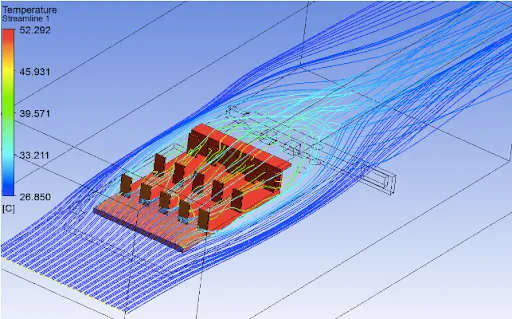
Conjugate Heat Transfer Analysis on a Graphics Card

Conjugate Heat Transfer Analysis on a Graphics Card

In order to achieve effective cooling of the GPU, you will analyze the heat transfer coefficient and high-temperature concentration zones of the system.
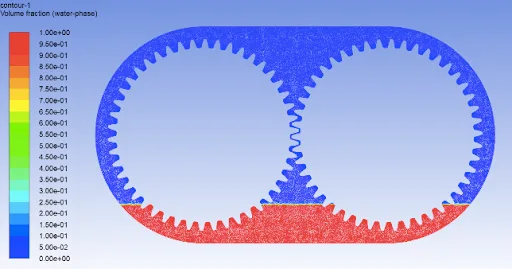
Oil Sloshing Analysis through Dynamic Meshing

Oil Sloshing Analysis through Dynamic Meshing

In this project, you will define the motion of the gear using the pre-existing functions present in ANSYS Fluent and analyze the sloshing effect produced by lubricants in the gear …

Fee

One fee.
Everything included.

Become job ready with our comprehensive industry focused curriculum for freshers & early career professionals

Premium
₹40,000
Inclusive of all charges
  • 1 Year Access
  • Personalized Page
  • Live Individual & Group Sessions
  • Personalized & Hands-On
  • Job-Oriented Industry Relevant Curriculum
Check eligibility →
FAQ

Questions,
answered.

Why should you join the ANSYS fluent course?

With an annual growth of 7.6% in the CFD market, there will be a huge demand for ANSYS Fluent certified engineers. 

How long will it take to complete the Introduction to GUI Based CFD using the ANSYS Fluent course?

It usually takes three months to complete this course. Apart from this, extra time will be required to complete the project work. 

What are the advantages of doing this course?

The market for CFD is growing at a rapid pace, and there are multiple high-paying job opportunities for learners who have completed the ANSYS CFD online course.

Which companies hire CFD engineers in India?

The top companies in India hiring CFD engineers include Tata Consultancy Services, General Motors, HDL Technologies, Cummins, and Infosys. 

Who is eligible for this course?

Students with an engineering background interested in Thermal Systems and Fluid Mechanics can do this course. MS or MTech students with no CFD specialization and who want to add this to their profile are also eligible.

Next step

Not sure it's
the right fit?

A counsellor will walk you through the syllabus, projects and fee options — and tell you honestly if another course suits you better.

Get the syllabus + a call back

We'll email the full syllabus and call within one working day.

By submitting you agree to our Terms and Privacy Policy.

Call usEnquire

Talk to a career counsellor

Free 20-minute call. We'll map the right course to where you want to work.

By submitting you agree to our Terms and Privacy Policy.