Rare Earth Magnet Shortage: What It Means for EV Motors in India
China's April 2025 licence rule on dysprosium- and terbium-containing magnets is still in force, and the wider October package is paused only until 10 January 2027. Here is the dated record of what it did to Bajaj, Ather and Maruti, where India's ₹7,280 crore magnet scheme stands, how much magnet an EV motor holds (worked by script), and the ferrite, wound-rotor, induction and reluctance alternatives.

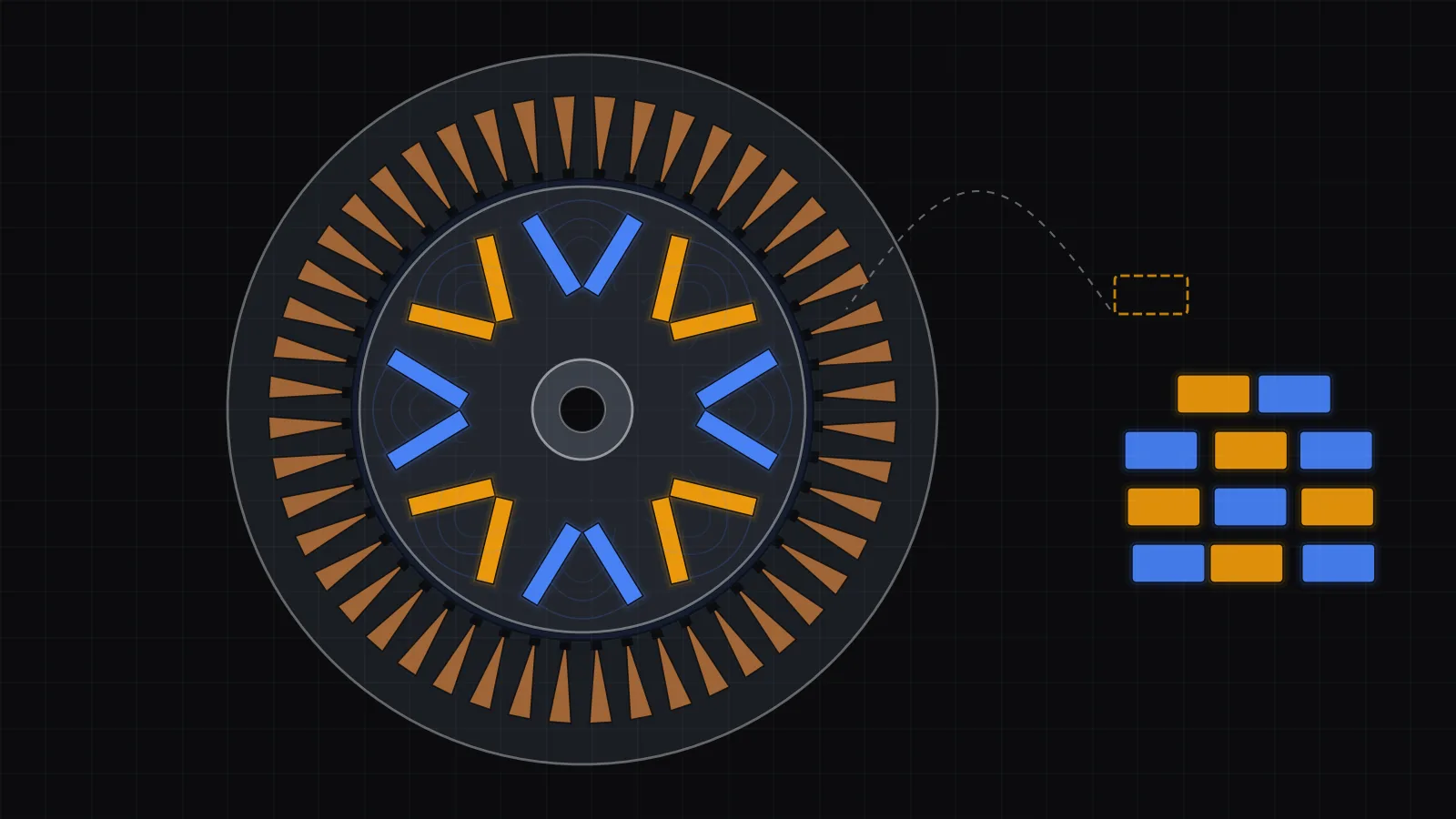
Many Indian EVs, including the Bajaj, Ather and Maruti models hit in 2025, use permanent magnet synchronous motors (PMSMs) with neodymium-iron-boron (NdFeB) magnets, and the grades that survive motor heat contain dysprosium or terbium. On 4 April 2025 China, which made 94% of the world's sintered permanent magnets in 2024, put those heavy rare earths and the magnets containing them under export licensing, and that rule is still in force. India's answer is a ₹7,280 crore magnet scheme, which drew 20 bids in August 2026 but has no winner yet. For engineers, the near-term way out is motor design: less dysprosium, ferrite magnets, or magnet-free wound-rotor, induction and reluctance machines.
Below is the dated record, with confirmed and reported items kept apart, a worked estimate of how much magnet a motor holds, and a comparison of the alternatives.
Key numbers at a glance
- 4 April 2025: China put seven medium and heavy rare earths, and NdFeB magnets containing terbium or dysprosium, under export licensing (MOFCOM/GAC Announcement No. 18 of 2025).
- July 2025: Bajaj built 10,824 Chetak scooters, against 20,384 in July 2024, a fall of 47% (SIAM data, via Autocar Professional, 14 Aug 2025).
- 26 November 2025: India's Cabinet approved a ₹7,280 crore scheme for 6,000 tonnes a year of sintered magnet capacity (Akashvani; PIB, 20 Mar 2026).
- 2024-25: India imported 19,573 tonnes of metal permanent magnets, 90.4% from China (Rajya Sabha reply, 1 Aug 2025).
- 1.895 kg: the NdFeB magnet mass in an 80 kW Nissan LEAF motor measured by Oak Ridge National Laboratory, about 23.7 g per kW of peak power.
Courses: to build these skills, see Skill-Lync's electric vehicle courses. They include Electric Motor Design using MATLAB and ANSYS Maxwell, which covers PMSM, induction and switched reluctance machines.
Why do EV motors use rare earth magnets?
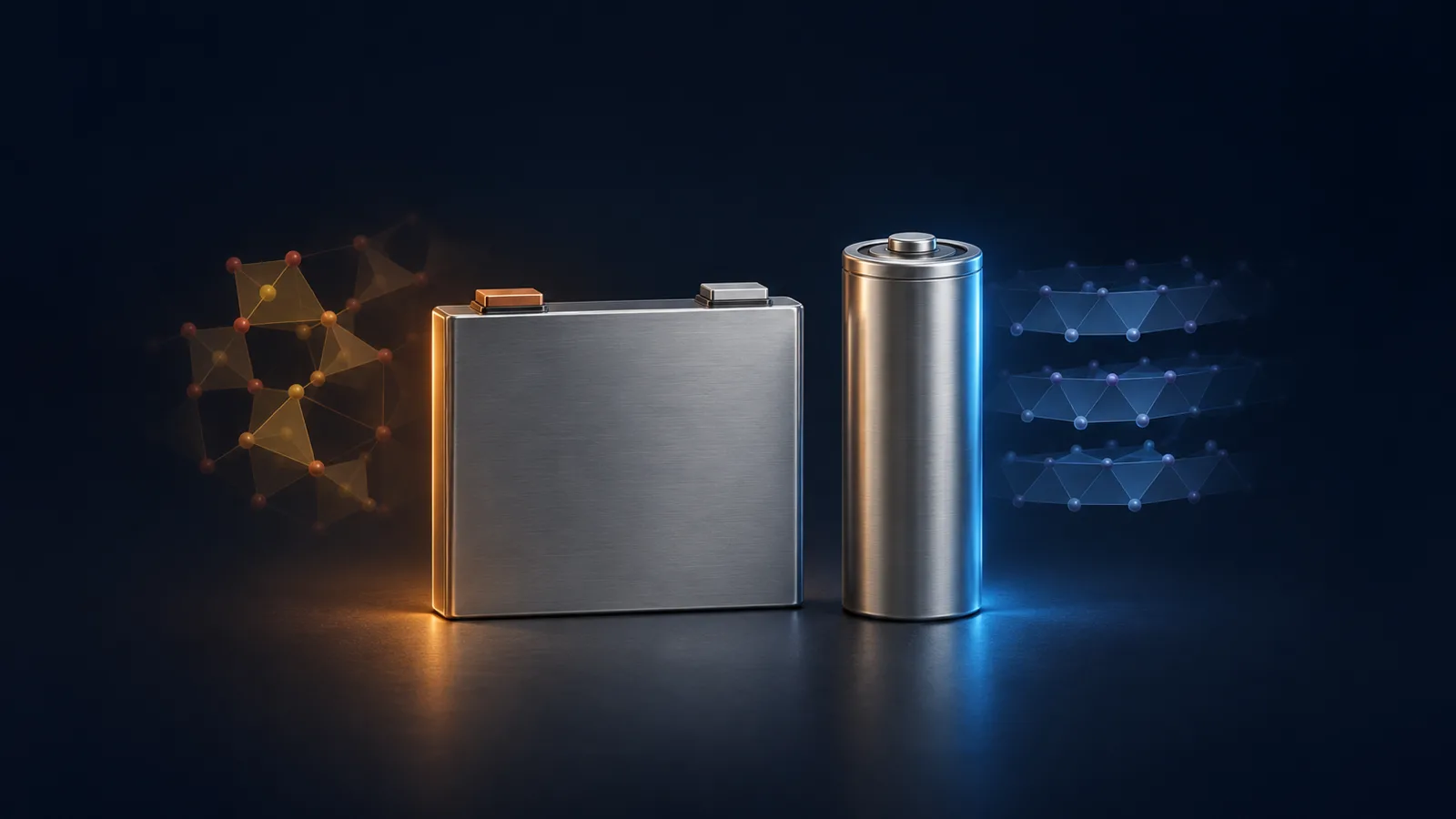
EV makers use NdFeB magnets because they give the most torque from the smallest, lightest motor. An NdFeB magnet holds a field about three times stronger than a ferrite magnet of the same size. And because the rotor field is built in, no current is spent making it, which helps efficiency at the light loads of city driving.
In a PMSM, stator currents make a rotating magnetic field and the rotor magnets lock on to it, like a compass needle following a magnet moved around it. Our explainer on how magnetism works covers where a magnet's field comes from.
Two magnet properties matter most to a motor designer:
- Remanence (Br) is the field the magnet keeps on its own, in tesla. More remanence means more air-gap flux, which means more torque from the same current.
- Intrinsic coercivity (HcJ) is how hard the magnet resists being demagnetised, in kA/m. Under hard acceleration the stator field pushes against the magnets; if it wins, they lose strength for good.
The trouble is that NdFeB loses coercivity quickly as it heats up. A Honda R&D technical paper (October 2012) notes that hill climbing or sustained high-speed driving can raise magnet temperature from 160 °C to 200 °C. The fix is to replace part of the neodymium with dysprosium, whose anisotropy field is about twice that of neodymium, so the magnet resists demagnetisation at higher temperature. Terbium does the same job. Both are heavy rare earths, and those are exactly the elements China put under licensing in April 2025.
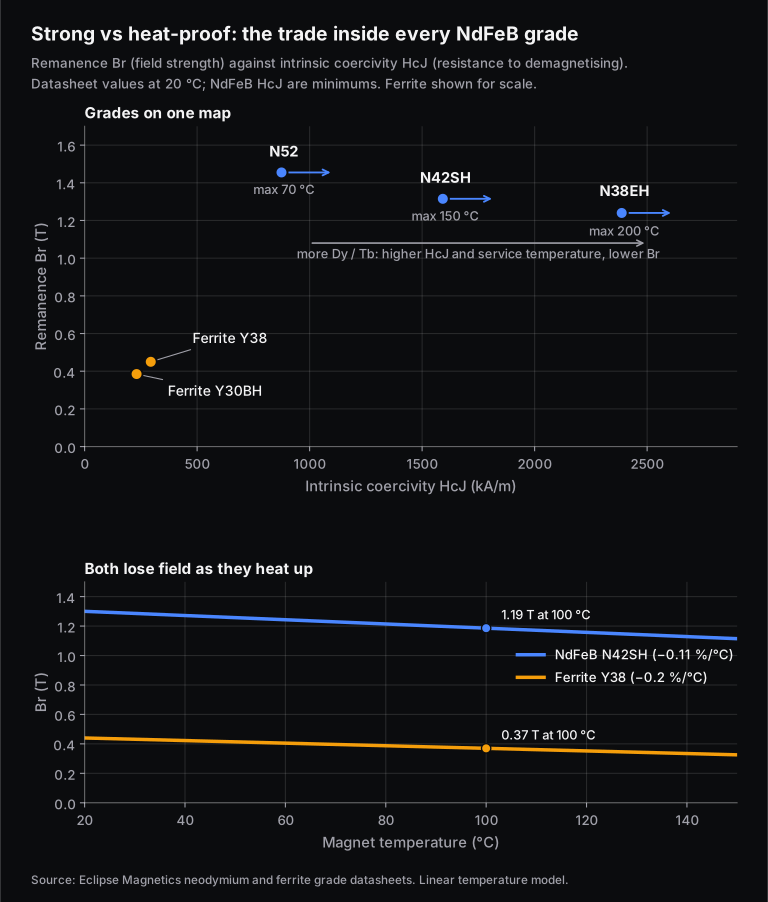
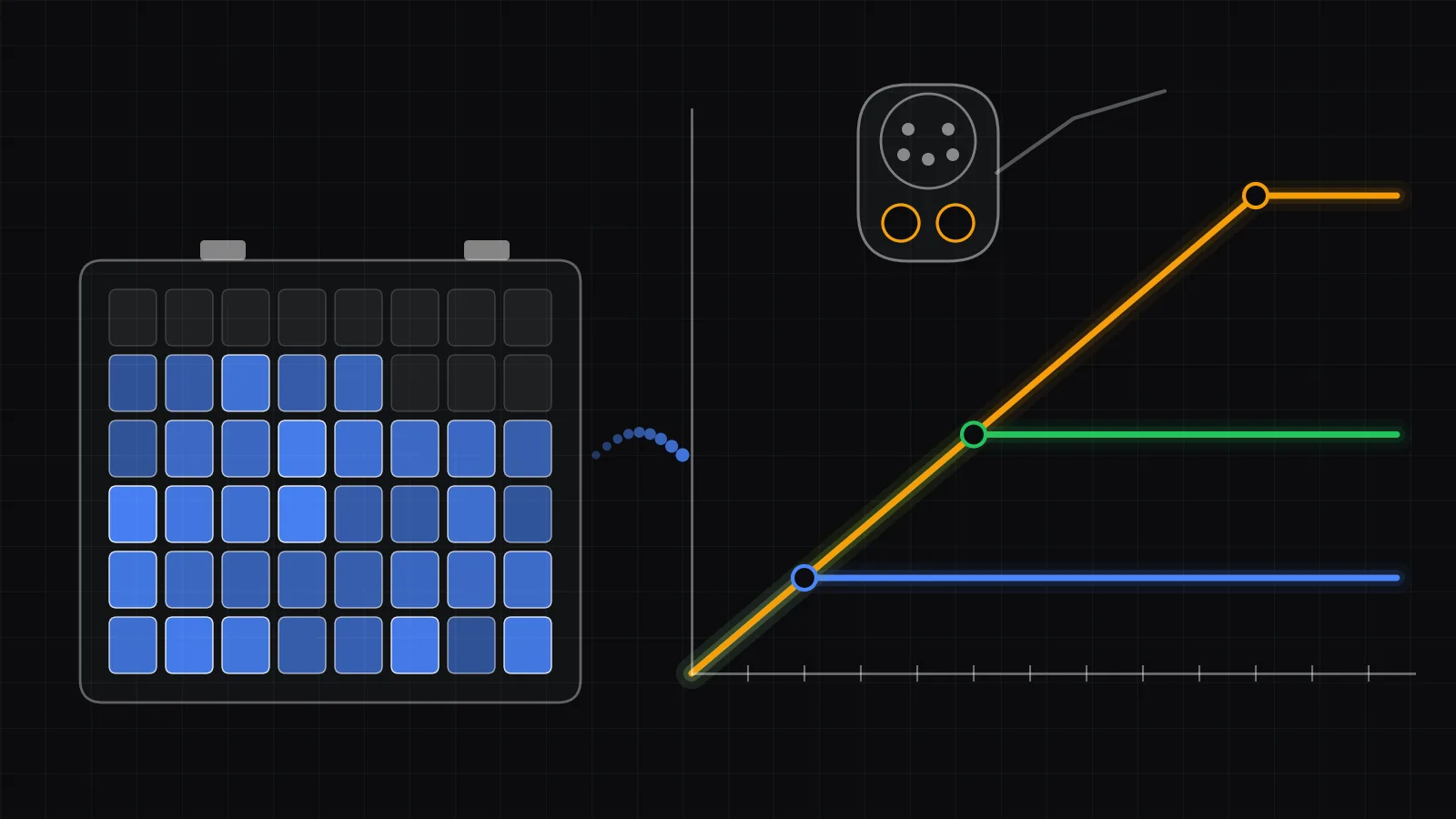
The chart shows the trade. N52, the strongest grade, is rated only to 70 °C. N42SH is rated to 150 °C and N38EH to 200 °C, but each step to the right costs remanence. Ferrite sits far below all three at 0.44-0.46 T. Ferrite has one useful quirk, though: its coercivity rises as it warms (+0.27%/°C on the same datasheet), so its demagnetisation risk is worst in the cold, not the heat.
What did China restrict, and when?
China's April 2025 rule requires an export licence for seven medium and heavy rare earths and their products, including NdFeB magnets that contain dysprosium or terbium. It took effect on the day it was published, 4 April 2025, and is still in force. A wider package from 9 October 2025 was suspended a month later, and that suspension has reportedly been extended to 10 January 2027.
Here is what each notice says, in order:
- Announcement No. 18 of 2025 (4 April 2025), confirmed. It covers metals, alloys, targets, oxides and compounds of the seven elements, plus samarium-cobalt magnets and terbium- or dysprosium-containing NdFeB magnets, both finished magnets and powder. Exporters need a commerce-ministry licence, and customs can hold any shipment it questions.
- Announcements No. 55-58, 61 and 62 of 2025 (9 October 2025), confirmed. These widened controls to more rare earth items, rare earth equipment and technology, lithium batteries and graphite anodes. No. 61 reached rare earth items made outside China.
- Announcement No. 70 of 2025 (7 November 2025), confirmed. It suspended the six October notices "from today until 10 November 2026". It does not mention No. 18, so the April licensing rule kept running.
- 9 November 2026, reported. Shanghai Metals Market and Japan's JETRO report that MOFCOM and customs issued Announcement No. 58 of 2026, keeping the October package suspended from 11 November 2026 to 10 January 2027. We could not open the notice on MOFCOM's own site, so treat the exact wording as reported.
The practical meaning for an Indian buyer: a magnet that contains dysprosium or terbium still needs a Chinese export licence. Reported cases describe end-use undertakings and a promise not to re-export. India's External Affairs Ministry said on 30 October 2025 that "some Indian companies" had received such licences. Media named Jay Ushin, De Diamond Electric India and the Indian units of Continental and Hitachi Astemo, but the ministry named no firms.
How did the magnet shortage hit Indian EV makers?
The impact landed in mid-2025 and was worst for electric two-wheelers. Bajaj cut Chetak output almost in half in July 2025, Ather deferred ₹26.25 crore of subsidy claims, and Maruti was reported to have cut its first EV's early production plan by two-thirds. Bajaj, Ather and Ola responded with motor changes, not just new suppliers.
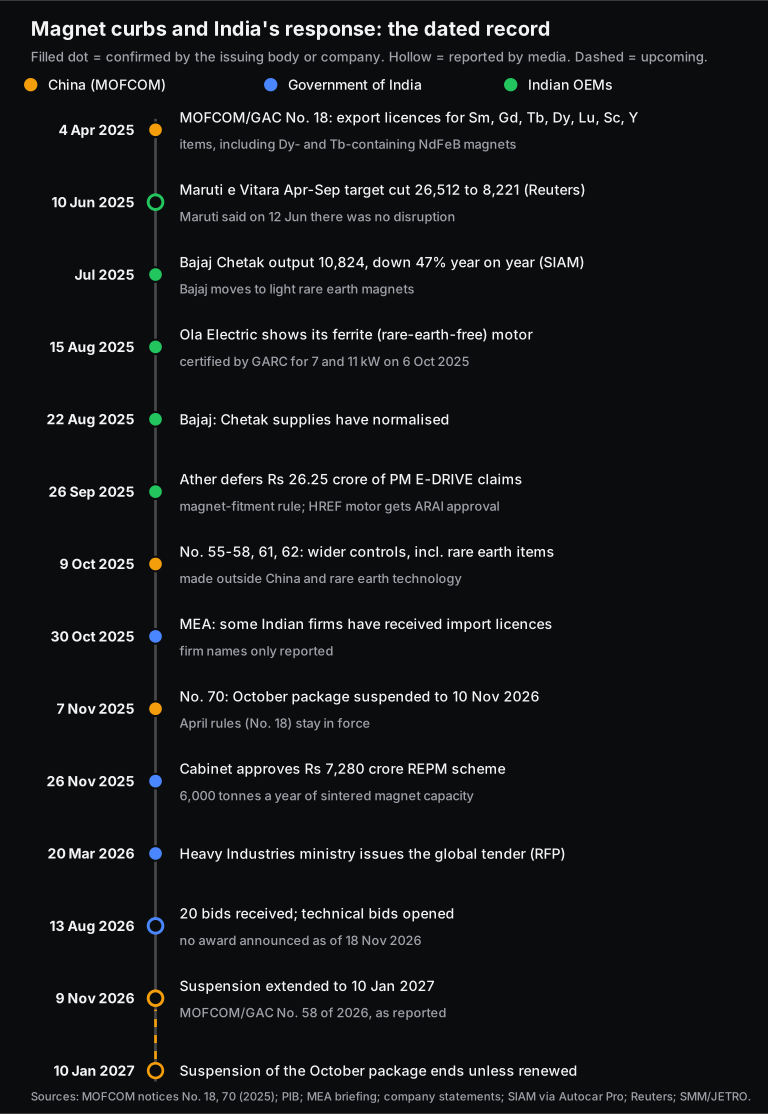
- Bajaj Auto (confirmed). SIAM data show 10,824 Chetaks built in July 2025, down 47% year on year and 41% from June's 18,479. Executive director Rakesh Sharma said Bajaj had expected zero output in August, and was instead switching to more easily available light rare earth magnets. On 22 August 2025 Bajaj said "supplies have normalised".
- Maruti Suzuki (reported, then partly denied). On 10-11 June 2025 Reuters reported internal documents cutting the e Vitara's April-September 2025 target from 26,512 to 8,221 units, a 69% cut, with a catch-up planned later. On 12 June Maruti said there had been no disruption to its operations.
- Ather Energy (confirmed). On 26 September 2025 Ather deferred ₹26.25 crore of PM E-DRIVE claims for up to 52,500 scooters. That is ₹5,000 per vehicle, the scheme's e-2W cap. Its motor suppliers had made temporary changes that broke the rule requiring magnets to be fitted in India. Ather also said its heavy-rare-earth-free (HREF) motor had type approval from ARAI.
- Ola Electric (company claim, certified). Ola showed a ferrite motor on 15 August 2025. On 6 October 2025 it said the Global Automotive Research Centre had certified 7 kW and 11 kW versions under AIS 041, with net power matching its rare earth motors. Efficiency figures were not published.
The shortage also changed policy. The government has pushed back the in-India magnet-fitment deadline for e-buses and e-trucks under PM E-DRIVE three times, now to 1 April 2027. Our PM E-DRIVE scheme explainer has the notification numbers and the localisation rules.
How dependent is India on imported magnets?
Almost completely. In 2024-25 India imported 19,573 tonnes of metal permanent magnets, the customs code the Heavy Industries ministry uses for rare earth magnets, and 90.4% of that tonnage came from China. The government's Cabinet briefing said India's demand "is met primarily through imports" and expects consumption to double by 2030.
| Customs code (2024-25) | Imports from world | Share from China | Value from world |
|---|---|---|---|
| 8505.11.90: permanent magnets of metal (includes NdFeB) | 19,573 t | 90.4% | USD 136.1 million |
| 8505.19.00: permanent magnets of other material (mainly ferrite) | 25,826 t | 84.8% | USD 84.7 million |
Source: Ministry of Heavy Industries, Rajya Sabha unstarred question 1563, answered 1 August 2025 (DGCIS data). Read these as upper bounds. The "metal" code also covers non-rare-earth metal magnets such as AlNiCo, so the true NdFeB tonnage is lower.
The second row is the uncomfortable one. Ferrite, the obvious rare-earth-free substitute, is also 84.8% imported from China by tonnage. Ferrite is not under export control, and its raw materials (iron oxide and strontium or barium carbonate) are widely available. Still, switching from NdFeB to ferrite moves the dependence; it does not remove it until India makes more of its own ferrite magnets too.
What is India's rare earth permanent magnet scheme?
The Scheme to Promote Manufacturing of Sintered Rare Earth Permanent Magnets, approved by the Union Cabinet on 26 November 2025, offers ₹7,280 crore to build 6,000 tonnes a year of integrated NdFeB magnet capacity in India. It runs seven years from the award: two years to build plants, then five years of incentives on magnet sales.
- Money (confirmed): ₹6,450 crore of sales-linked incentives and ₹750 crore of capital subsidy (₹7,200 crore; the other ₹80 crore is not broken down).
- Scope (confirmed): fully integrated plants, from rare earth oxide to metal, alloy and finished magnet. The three lowest bidders get a limited assured supply of NdPr oxide from IREL (India) Ltd.
- Allocation (confirmed): five beneficiaries chosen by global competitive bidding under a least-cost system, each allotted 600 to 1,200 tonnes a year in steps of 100 tonnes.
- Bids (reported): the tender opened on 20 March 2026; 20 bids arrived by the extended 12 August deadline and technical bids were opened on 13 August. Named bidders include Coal India, Larsen & Toubro, NEO Performance Materials, Proterial (India), Lohum, Attero and ReNew (PSU Watch, quoting the ministry).
- Status on 18 November 2026: we found no announcement of financial bids or awards. With a two-year build period after the award, magnets from these plants are unlikely before 2028.
For scale, 6,000 tonnes is 30.7% of the 2024-25 import tonnage of metal magnets. At the LEAF's 1.895 kg per motor, it would also be enough magnet for about 3.17 million car-sized traction motors a year. Both comparisons are rough. Wind turbines, electronics, aerospace and defence will compete for the same output.
How much magnet is in an EV motor? A worked estimate
About 1.9 kg, in the one car motor with a published, measured figure that we found. Oak Ridge National Laboratory's teardown of the 2012 Nissan LEAF motor for the US Department of Energy measured 1.895 kg of magnet in an 80 kW, 280 N·m machine that weighs 55.9 kg. The magnet is 3.4% of the motor's mass and, in ORNL's cost model, a much larger share of its cost.
That is 23.7 g of magnet per kW of peak power, or 6.77 g per N·m of peak torque. A simple physics model checks that figure and shows why ferrite needs a bigger machine.
Step 1: torque from rotor size
Torque comes from a tangential "shear stress" acting on the rotor surface. For a rotor of diameter and length :
The LEAF rotor is 129.97 mm across and 151.16 mm long, a volume of 2.005 litres. At 280 N·m that works out to kPa, or 139.6 kN·m of torque per cubic metre of rotor. Shear stress is set by air-gap flux density times the stator's current loading. At a fixed current loading (limited by cooling), torque scales with air-gap flux density, which is set by the magnet.
Step 2: magnet thickness for a target air-gap field
Treat the magnet as a source driving flux across an effective magnetic gap , which includes the physical air gap plus allowances for slotting and the steel. For a surface magnet of thickness :
Here is the air-gap flux density and the magnet's recoil permeability. Magnet mass is then , where is the fraction of the rotor surface covered by magnet.
Our assumptions are stated, not measured: mm, , for NdFeB and 1.10 for ferrite, and a magnet temperature of 100 °C. The datasheet values are N42SH at 1.30 T and −0.11%/°C, which gives 1.186 T at 100 °C, with density 7.5 g/cm³. Ferrite Y38 is 0.44 T and −0.2%/°C, giving 0.370 T at 100 °C, with density about 5.0 g/cm³.
- NdFeB, T: mm, giving 0.98 kg on the LEAF-size rotor. If the magnet runs at 150 °C, it needs 3.38 mm and 1.25 kg.
- Ferrite: a surface ferrite magnet can never push the gap field above its own remanence, about 0.37 T at 100 °C. At a realistic T it needs mm. To get the same torque at the same current loading, the rotor must be 0.85 / 0.30 = 2.83 times longer (428 mm instead of 151 mm). That takes 3.32 kg of ferrite, 3.4 times the NdFeB mass.
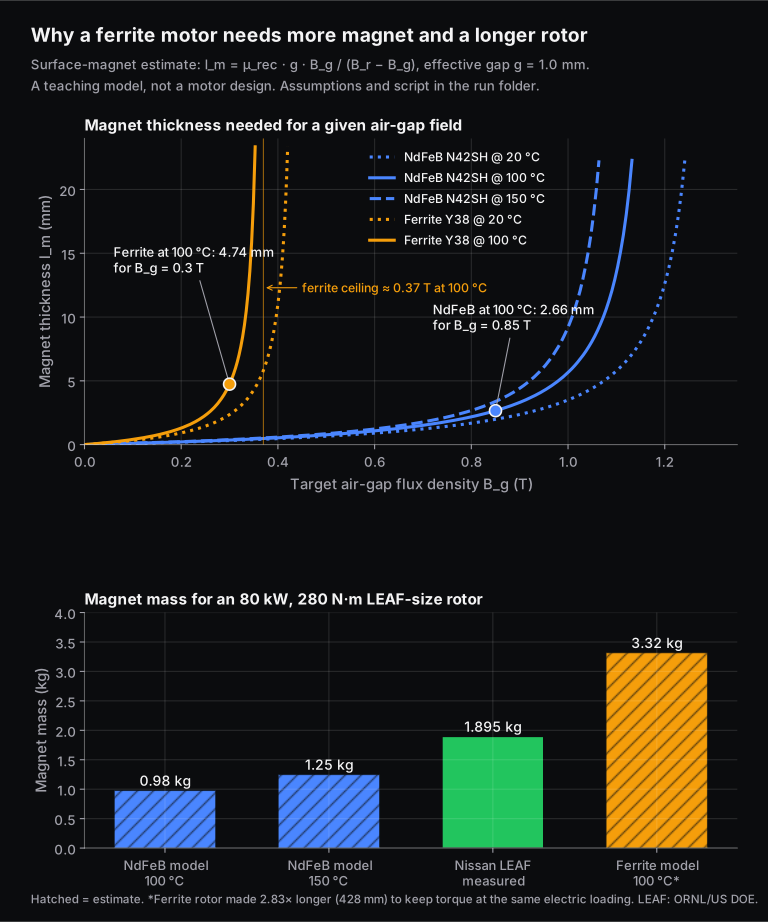
Here is the catch. The simple model gives 0.98 kg, while the real LEAF uses 1.895 kg, 1.92 times more. The real motor is an interior-magnet design, with the magnets buried in the rotor steel. Some flux leaks through the steel bridges that hold the magnets in place. Designers also add magnet for margin against demagnetisation and to support field weakening at high speed. Use the model for direction and ratios, and use finite-element analysis for real numbers. The same applies to ferrite. Real ferrite traction motors use "spoke" or multi-layer rotors that concentrate flux, so they get more out of ferrite than a surface magnet can. The 2.83× length penalty is a ceiling for the crude case, not what Ola or anyone else actually built.
Scaled at the LEAF's 23.7 g/kW, a 7 kW scooter motor would carry about 166 g of NdFeB and an 11 kW one about 261 g. Take that as a floor. Magnet mass tracks torque more than power, and low-speed hub motors make a lot of torque per kW.
What are the alternatives to rare earth magnets in EV motors?
There are five practical routes. You can keep NdFeB but use much less dysprosium or terbium. You can switch to ferrite magnets. Or you can drop magnets entirely with a wound-rotor synchronous motor, an induction motor or a switched reluctance motor. Each one trades away something: torque per litre, efficiency, cost or noise.
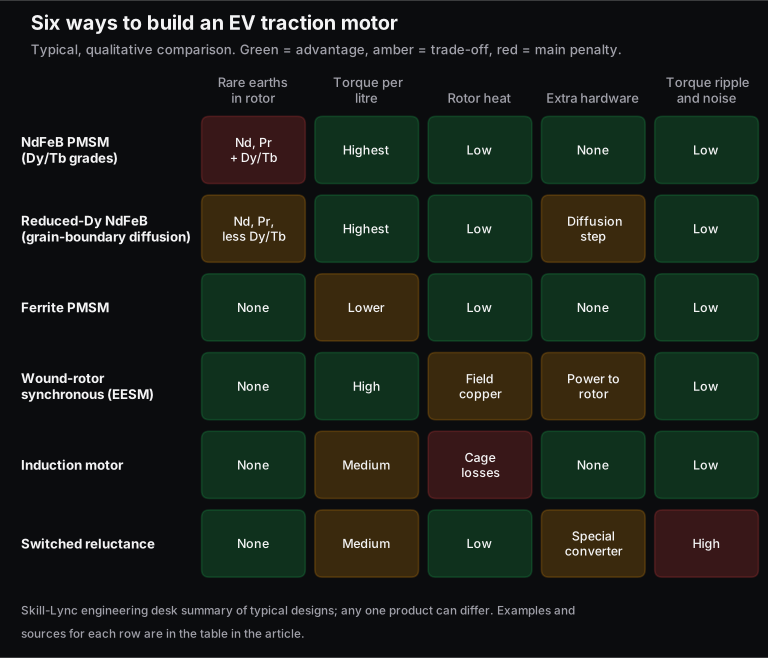
| Option | How the rotor field is made | Main penalty | Real example (source) |
|---|---|---|---|
| Reduced-Dy NdFeB (grain-boundary or local diffusion) | NdFeB magnets with Dy/Tb diffused only near the surface or the corners, where demagnetisation starts | Still needs Nd/Pr; plain grain-boundary diffusion saves only about 10-15% of the Dy | Honda's localised diffusion cut Dy by 30% or more at equal demagnetisation performance (Honda R&D, 2012) |
| Heavy-rare-earth-free NdFeB | Hot-deformed NdFeB made to keep its heat resistance without Dy/Tb | Still needs Nd/Pr; needs a matched rotor design | Honda and Daido Steel, in the 2016 Freed hybrid (Honda, 12 Jul 2016); Ather's HREF motor (ARAI type approval, 2025) |
| Ferrite PMSM | Strontium-ferrite magnets, usually in flux-concentrating rotors | Lower torque per litre; cold demagnetisation risk | Ola Electric, 7 and 11 kW certified (6 Oct 2025); Tesla said its next drive unit would use a rare-earth-free permanent magnet (Investor Day, 1 Mar 2023, as reported by Electrek) |
| Wound-rotor synchronous (EESM) | Copper field winding on the rotor, fed with current | Rotor copper losses; power must be transferred to the spinning rotor | Renault ZOE from 2012, Renault 5 (Renault Group, 16 Oct 2025); BMW iX3 from 2020 (BMW, 18 Dec 2019) |
| Induction motor | Currents induced in a copper or aluminium rotor cage | Rotor cage losses and heat; lower part-load efficiency | Tesla's early cars before the Model 3 (Electrek, 1 Mar 2023) |
| Switched reluctance (SRM) | No rotor field: the steel rotor is pulled toward energised stator poles | Torque ripple and noise; needs a special converter | Few production cars; active research (Abdel-Aziz et al., Energies, 2024) |
Two points the table cannot hold. First, ferrite: a 2024 review in Energies called it "not a viable alternative" for main drives because of its low flux and demagnetisation risk, yet Ola's certified 7-11 kW scooter motors show the scooter class is a different case. Check the cold start, where ferrite is weakest. Second, the wound rotor: because its field comes from a coil, the controller can turn the field down at high speed instead of fighting the magnets with stator current, which helps highway efficiency. Renault says its wound-rotor motors are "slightly bigger" than PMSMs.
What does this mean for motor-design and EV engineers in India?
Motor design has become a supply-chain skill. In 2025 Bajaj, Ather and Ola all answered the shortage with motor changes: a light-rare-earth grade, a heavy-rare-earth-free motor and a ferrite design. Each change needs electromagnetic and thermal simulation, demagnetisation checks, control retuning and fresh homologation tests.
- Electromagnetic FEA. Model an interior PM rotor in a tool such as ANSYS Maxwell, predict torque, back-EMF and losses, then swap the magnet grade and see what changes. Skill-Lync's electric motor design course uses MATLAB and Maxwell for this.
- Demagnetisation and thermal checks. Check NdFeB at its hottest point and ferrite at its coldest, under the worst peak-current or short-circuit case. A cooler rotor lets you use a grade with less dysprosium, so cooling design is now a materials decision.
- Control. Field weakening and maximum-torque-per-amp tuning change when the magnet changes, and a wound rotor adds a second current loop. See Control Theory PMSM, or the PG Program in EV Design & Development for the whole vehicle.
- Localisation rules. PM E-DRIVE's phased manufacturing programme counts magnet fitment and winding, so knowing both the motor and the rules is useful at OEMs and suppliers.
The magnet question also links to the rest of the EV. Batteries face the same supply-chain risks, covered in our LFP vs NMC comparison. A motor change also means new inverter and motor-control software, which ties into software-defined vehicle architectures. For pay and roles, see the EV engineer salary page.
A word on the limits of this article. China's rules can change at short notice. The suspension date reported for 9 November 2026 still needs to be read in MOFCOM's own text, and India's scheme has no named winners yet. The magnet-mass figures here come from one measured motor and a simple model, not from any Indian product.
Frequently asked questions
Do all electric scooters in India use rare earth magnets?
No. Many use NdFeB PMSMs because they give the most torque for their size, but since 2025 Ola has certified a ferrite motor, Ather has an ARAI-approved heavy-rare-earth-free motor and Bajaj has moved to light rare earth magnets. Makers rarely publish the magnet grade, so check each model's technical details.
Is the rare earth magnet shortage over?
Not formally. China's licensing rule of 4 April 2025 for dysprosium- and terbium-containing magnets still applies, so every shipment needs a licence. Supply eased in the second half of 2025: Bajaj said supplies had normalised in August, and some Indian firms received licences in October. The wider October 2025 controls are suspended, reportedly until 10 January 2027, and could return after that.
What is the difference between light and heavy rare earth magnets?
"Light rare earth" magnets use neodymium and praseodymium without added dysprosium or terbium. "Heavy rare earth" grades add Dy or Tb to raise coercivity so the magnet survives higher motor temperatures. China's April 2025 rule targets the heavy elements, which is why switching to light-rare-earth grades, with better rotor cooling, was the quickest fix.
When will India make its own rare earth magnets?
Not before about 2028 at scale under the national scheme. The ₹7,280 crore scheme allows two years after the award to build plants, and as of 18 November 2026 the 20 bids received in August were still being evaluated, with no award announced.
Is a ferrite motor worse than a rare earth motor?
For the same size, yes: ferrite has about a third of NdFeB's remanence, so a ferrite motor is bigger or heavier for the same torque. Our worked estimate shows a crude surface-magnet ferrite rotor would need to be 2.83 times longer. Flux-concentrating designs close much of that gap. In scooters, Ola's certified 7 and 11 kW ferrite motors show it is workable.
Sources and further reading
- MOFCOM and General Administration of Customs, Announcement No. 18 of 2025: export controls on certain medium and heavy rare earth items (4 Apr 2025)
- MOFCOM and General Administration of Customs, Announcement No. 70 of 2025: suspension of Announcements No. 55-58, 61 and 62 (7 Nov 2025)
- Shanghai Metals Market, China extends suspension of rare earth export controls until January 2027 (9 Nov 2026); JETRO, business short on the 9 Nov 2026 announcements (13 Nov 2026, Japanese)
- IEA, Rare earth elements: executive summary (2025): China's 94% share of sintered permanent magnet production in 2024
- PIB, Ministry of Heavy Industries invites bids through global tender under the REPM scheme (20 Mar 2026)
- Akashvani (All India Radio) News, Cabinet approves rare earth magnet manufacturing scheme (26 Nov 2025)
- Ministry of Heavy Industries, Lok Sabha unstarred question 2603 (16 Dec 2025) and Rajya Sabha unstarred question 1563 (1 Aug 2025, import data)
- PSU Watch, Coal India, L&T, NEO Performance among 20 bidders under REPM scheme (14 Aug 2026); Autocar Professional, Heavy Industries ministry receives 20 bids (13 Aug 2026)
- Business Today, China issues licences to Indian firms to import rare earth magnets (31 Oct 2025, MEA briefing of 30 Oct)
- Autocar Professional, Bajaj Chetak production plunges by 47% in July (14 Aug 2025); Autocar India, Bajaj Chetak production resumes (22 Aug 2025)
- Autocar Professional, Maruti Suzuki cuts e Vitara production by two-thirds: Reuters (Jun 2025); Business Today, Maruti Suzuki navigates rare earth magnet scarcity (12 Jun 2025)
- Autocar Professional, Ather Energy defers ₹26.25 crore incentive claims (26 Sep 2025)
- The Week (PTI), Ola developing indigenous cell, alternate tech for rare earth magnet (15 Aug 2025); Autocar Professional, Ola Electric receives government certification for ferrite motor (6 Oct 2025)
- Oak Ridge National Laboratory for US DOE, APE051 (2013): LEAF IPM motor geometry and 1.895 kg magnet mass and APE006 benchmarking (2013)
- Honda R&D Technical Review, Development of rare earth-saving magnet using localized diffusion method (Oct 2012); Honda, Daido Steel and Honda adopt hybrid motor magnet free of heavy rare earths (12 Jul 2016)
- Eclipse Magnetics, Neodymium grades data and Ferrite/ceramic magnets datasheet
- Renault Group, All about electric motors with no rare earths (16 Oct 2025); BMW Group, The efficient drivetrain for the purely electric BMW iX3 (18 Dec 2019)
- Electrek, Tesla is going back to EV motors with no rare earth elements (1 Mar 2023)
- Abdel-Aziz, Elgenedy and Williams, Review of switched reluctance motor converters and torque ripple minimisation techniques for EV applications, Energies 17, 3263 (2024)