Sodium-Ion Batteries in India: How They Work, Pack Maths and Who Makes Them
How a sodium-ion cell works and why it needs hard carbon instead of graphite, what it stores against LFP and NMC in a worked e-3W pack, how it handles 0 V storage and the cold, why lithium prices decide its cost, and which Indian companies have confirmed plans versus claims.

A sodium-ion battery is a rechargeable cell that stores energy by moving sodium ions, not lithium ions, between two electrodes. It matters in India because the country imports most of its lithium-ion cells, while sodium comes from salt, which India produces in bulk. The trade-off is energy density: today's Na-ion cells hold less per kilogram and per litre than LFP, so they suit e-3Ws, entry e-2Ws and stationary storage better than long-range cars.
In short
- A sodium-ion (Na-ion) cell works like a lithium-ion cell, but it moves sodium ions into a hard carbon anode, because graphite stores almost no sodium (2021 Na-ion roadmap, J. Phys. Energy).
- The best Na-ion cells reach about 175 Wh/kg, against up to 205 Wh/kg for the latest LFP and 265 Wh/kg for NMC (IEA Global EV Outlook 2026). In our worked 8 kWh e-3W pack, Na-ion is about 8 kg heavier than LFP with the best cells and about 14% bulkier with typical ones.
- Na-ion cells can be stored and shipped at 0 V because both electrodes use aluminium foil (Rudola et al. 2021), and the latest cells keep about 90% of capacity at −40 °C (IEA, Feb 2026).
- Lithium carbonate fell 86% between 2022 and 2025, from $63,700 to $9,000 a tonne (USGS). In February 2026 the IEA said lithium is still too cheap for Na-ion to undercut LFP in most uses.
- Indian activity so far is pilot lines, storage products and company claims: Reliance (Faradion), KPIT with Trentar, Naxion, Rechargion, Macsen Energy (lab results, Oct 2026) and JNCASR research. China holds more than 95% of planned 2030 Na-ion cell capacity (IEA).
This guide covers how the cell works, why it needs a different anode, the three cathode families and a scripted pack comparison against LFP and NMC. It then looks at safety, cold weather, cost, the Indian companies and the jobs. For the two lithium chemistries in depth, see our LFP vs NMC comparison; this post does not repeat it.
Courses: Skill-Lync's battery technology courses cover cell chemistry, pack design, BMS and battery cooling, from short courses to the PG Battery program.
What is a sodium-ion battery and how does it work?
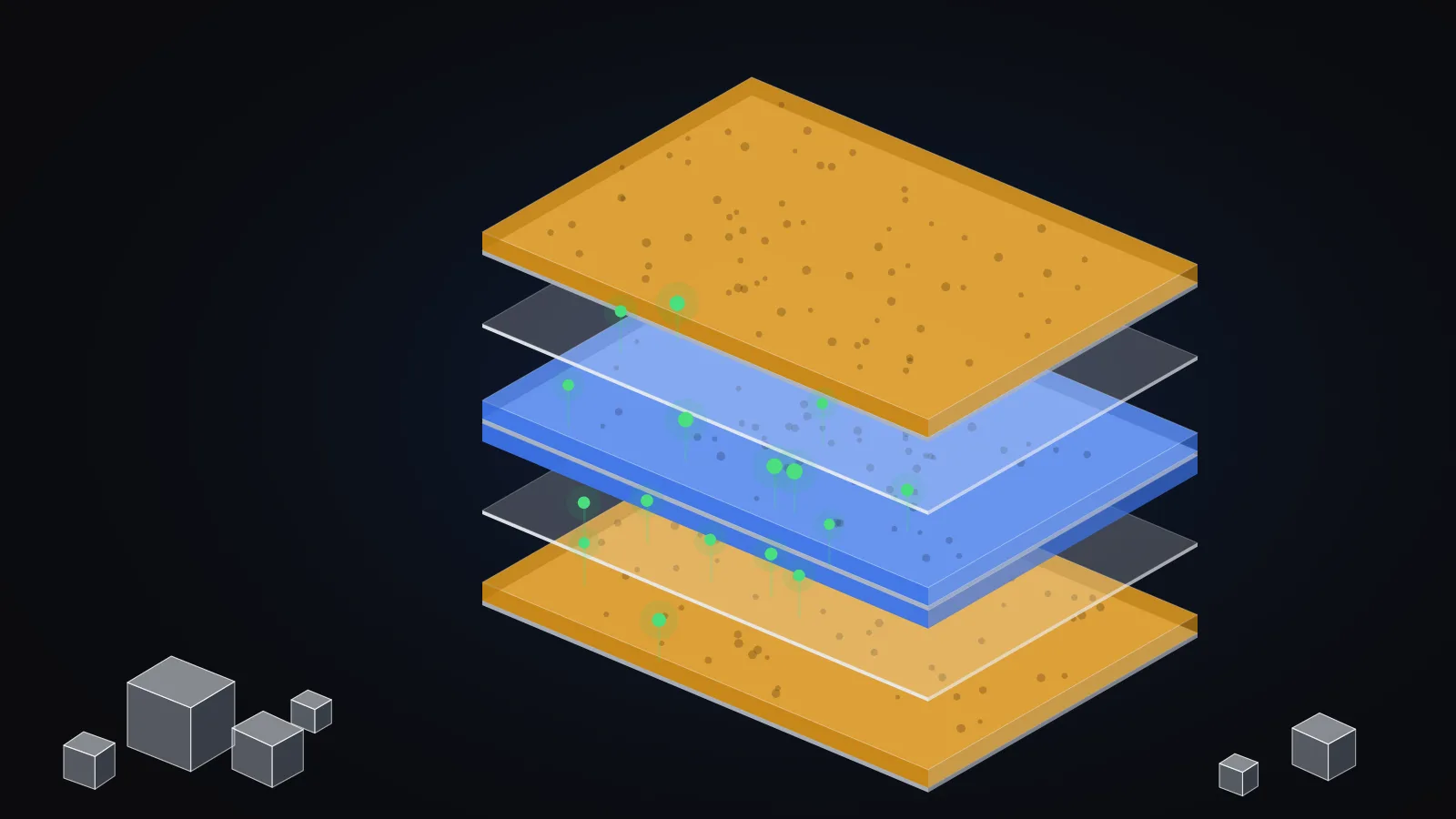
A sodium-ion battery is a "rocking-chair" cell. On charge, sodium ions (Na⁺) leave the cathode, cross the electrolyte and enter the anode. On discharge they travel back while electrons flow through the external circuit. The cell design, manufacturing steps and most of the equipment are the same as for lithium-ion.
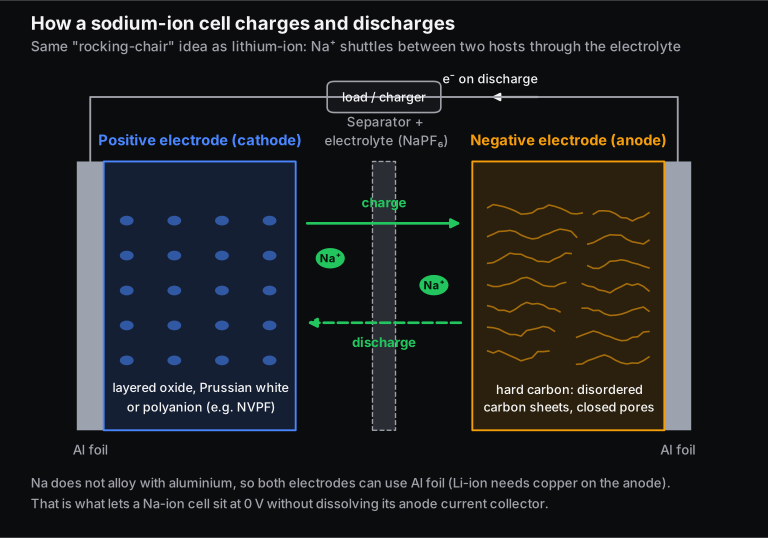
Three facts about sodium drive most design decisions:
- It is bigger. Na⁺ has a radius of 1.02 Å against 0.76 Å for Li⁺, about 34% larger, so it strains the host materials more (Tapia-Ruiz et al. 2021).
- It is heavier and gives less voltage. Sodium weighs 22.99 g/mol against 6.94 for lithium, and its standard potential is −2.71 V against −3.04 V (Ahangari et al. 2025).
- It does not alloy with aluminium. Lithium does, so lithium-ion anodes sit on copper foil. Na-ion cells can use lighter, cheaper aluminium on both sides (Bischof et al. 2024).
The mass penalty is easy to calculate. Theoretical capacity is the charge a material carries per gram:
Here is electrons per formula unit, the Faraday constant (96,485 C/mol) and the molar mass in g/mol. Sodium metal carries 3.3 times less charge per gram. In a real cell most of the mass is host material, foil, electrolyte and casing, so the gap shrinks a lot, but it is still why Na-ion trails on energy density.
Why can't sodium-ion batteries use a graphite anode?
Graphite, the standard lithium-ion anode, stores almost no sodium in conventional electrolytes. Na-ion cells use hard carbon instead, a disordered carbon that never turns into graphite however hot it is fired. Practical hard carbons store about 300 mAh/g, close to graphite's 372 mAh/g with lithium (Tapia-Ruiz et al. 2021).
The reason is binding strength. A 2016 quantum-mechanics study in PNAS found that sodium binds more weakly to almost any host, carbon included, than the other alkali metals do (Liu, Merinov and Goddard 2016). Lithium above it and potassium below it in the periodic table both enter graphite readily.
Think of hard carbon as a house of cards: small curved graphite-like sheets at random angles, with gaps wider than 0.34 nm and closed pores between them. Sodium enters the gaps along a sloping voltage curve from about 1 V to 0.1 V, then fills the pores on a flat plateau below 0.1 V (Tapia-Ruiz et al. 2021).
The weakness is first-cycle efficiency: below 78% for hard carbon against more than 92% for graphite (Tapia-Ruiz et al. 2021). More than a fifth of the sodium can be lost into the surface film on the first charge, so designers load extra cathode, which costs energy density.
Which cathode materials do sodium-ion batteries use?
There are three main families: layered transition-metal oxides, Prussian blue analogues (including Prussian white), and polyanion compounds such as NVPF. Companies have not settled on one; each trades energy, cost, stability and critical-mineral content differently (Tapia-Ruiz et al. 2021).
| Family and example | Reported numbers | Trade-off | Who uses it |
|---|---|---|---|
| Layered oxide (O3/P2), e.g. Na–Ni–Fe–Mn oxide | Commercial 18650: 3.0 V nominal, 1.5–4.1 V, about 128 Wh/kg (Bischof et al. 2024) | Highest energy so far; needs nickel and manganese; can lose lattice oxygen above about 4.1 V | Faradion (Reliance), HiNa |
| Prussian blue / white, NaxFe[Fe(CN)₆] | Best stable result in 2021: 120 mAh/g for 800+ cycles; goal more than 160 mAh/g | Cheap, abundant elements and a porous framework; moisture-sensitive; vacancies cut capacity | CATL (first-generation cell, 2021), Altris; Macsen Energy in India |
| Polyanion, Na₃V₂(PO₄)₂F₃ (NVPF) | 3.9 V average, 128 mAh/g theoretical; Na₃V₂(PO₄)₃ works at 3.4 V | Very stable and long-lived; vanadium is costly; lower capacity | Tiamat; Rechargion in India (polyanionic, about 3.7 V) |
The NVPF figure checks out with the same formula, using sodium ions and g/mol:
One point is easy to miss. Layered oxides, the chemistry closest to mass production, still use nickel and manganese, whose processing is geographically concentrated. Polyanion and Prussian-type cathodes need fewer critical minerals but can still contain vanadium or manganese (IEA, 17 Feb 2026). "Sodium-ion" does not automatically mean "free of critical minerals".
How much energy does a sodium-ion cell store compared with LFP and NMC?
Less than lithium-ion, but the gap to LFP is narrowing. The IEA puts the latest Na-ion cells at up to about 175 Wh/kg, against up to 205 Wh/kg for the latest LFP and 265 Wh/kg for NMC (Global EV Outlook 2026). It adds that the gap is larger in Wh/L, and volume is what limits vehicle range.
| Cell | Wh/kg | Wh/L | Source |
|---|---|---|---|
| Na-ion, Faradion 32 Ah pouch | 160 | 290 | Company data in the 2021 roadmap |
| Na-ion, commercial 18650 (2024 test) | 128 | ≈289* | Bischof et al. 2024 (37.4 g cell) |
| Na-ion, best 2026 cells | ≈175 | – | IEA 2026; CATL rates Naxtra at 175 |
| LFP, large cell | ≈160 | ≈330 | Frith et al. 2023 (latest up to 205, IEA) |
| NMC811 | ≥270 | ≥650 | Frith et al. 2023 |
*Our calculation from the measured 4.79 Wh and a nominal 18 × 65 mm can. The 18650 test matters because it is an independent measurement of a product on sale. Those Na-ion cells beat the high-power LFP 18650s in the same study (88–105 Wh/kg), but power-optimised cells are not the best LFP, so read it as "comparable to LFP".
Worked example: an 8 kWh e-3W pack in sodium-ion, LFP and NMC
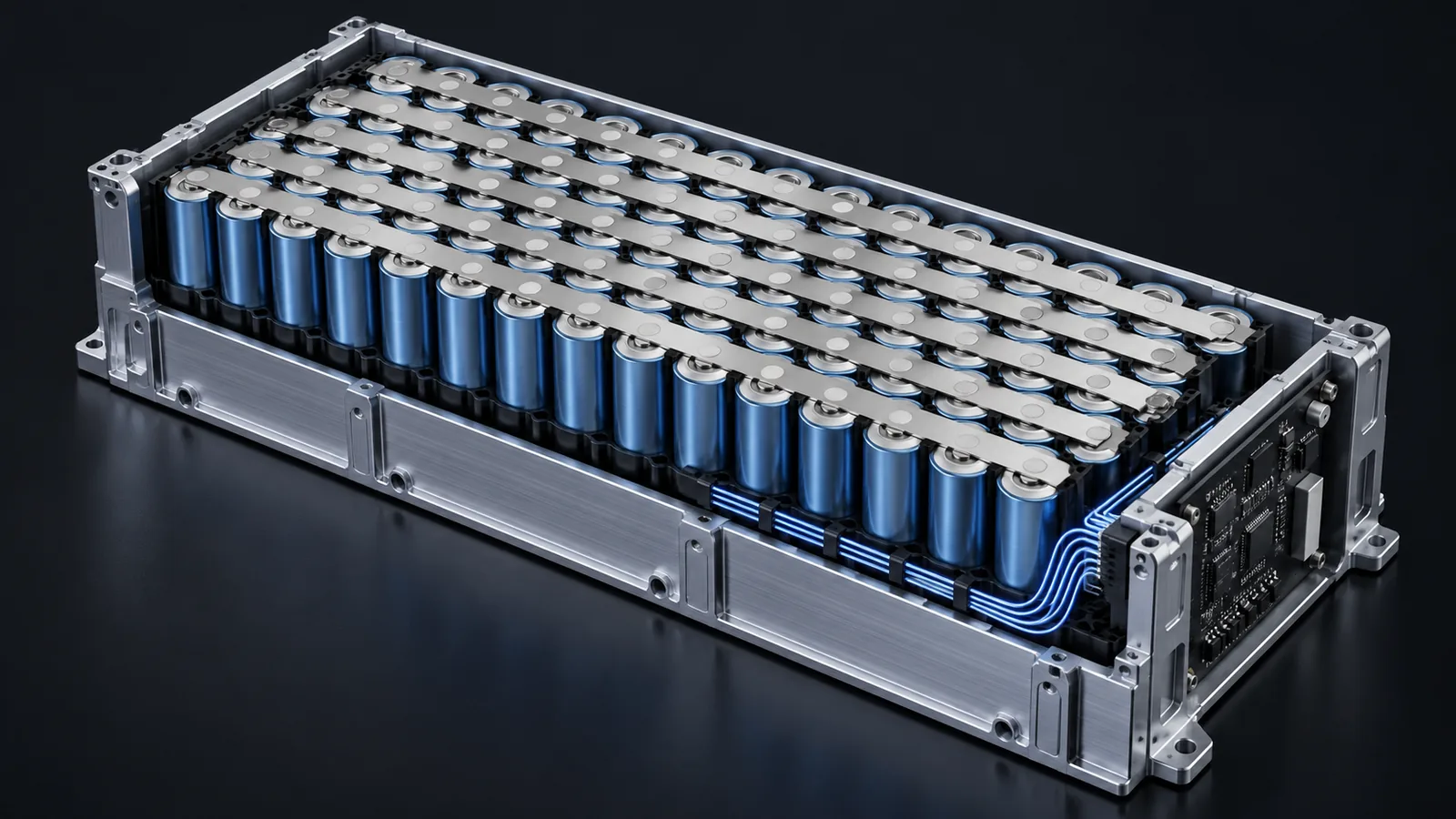
For an illustrative 8 kWh electric three-wheeler pack, Na-ion and LFP weigh about the same with typical published cells (59 kg each), but Na-ion needs 14% more volume: 43 L against 38 L. With the best 2026 cells, Na-ion is about 8 kg heavier. NMC811 saves about 24 kg, but LFP packs were more than 40% cheaper per kWh than NMC in 2025 (IEA GEVO 2026).
Cell mass is energy divided by specific energy. To go from cells to a pack, we apply one published benchmark to every chemistry: Frith et al. (2023) describe a cell-to-pack LFP design going from 160 Wh/kg at cell level to 135 Wh/kg at pack level, with cells filling 64% of the pack volume. For the Na-ion pouch cell:
| 8 kWh pack | Cells (kg) | Pack (kg) | Pack (L) | Pack (kg), best 2026 cells |
|---|---|---|---|---|
| Na-ion pouch (160 Wh/kg, 290 Wh/L) | 50.0 | 59.3 | 43.1 | 54.2 |
| Na-ion 18650 (128, 289) | 62.5 | 74.1 | 43.2 | – |
| LFP (160, 330) | 50.0 | 59.3 | 37.9 | 46.3 |
| NMC811 (270, 650) | 29.6 | 35.1 | 19.2 | 35.8 |
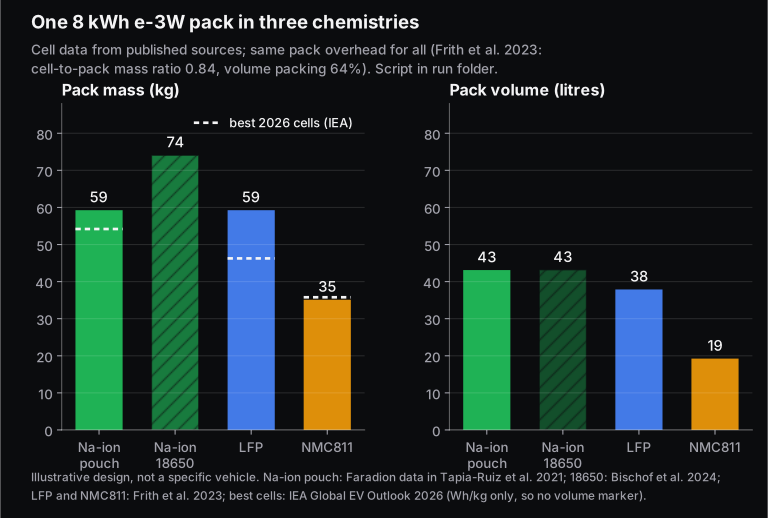
Here is the catch: those pack factors are a modern cell-to-pack benchmark. A conventional module-based pack fills only 35–40% of its volume with cells (Frith et al. 2023). At that level the Na-ion cells need 69–79 L and the LFP cells 61–69 L. When a pack has to fit under a seat or a floor, those extra litres can decide whether it fits at all.
The pack-voltage problem
A Na-ion pack swings across a much wider voltage range than an LFP pack of the same nominal voltage. The commercial 18650 cells above are rated from 1.5 V to 4.1 V, 3.0 V nominal (Bischof et al. 2024). With 17 in series for a 51 V class pack, the full window runs from 25.5 V to 69.7 V.
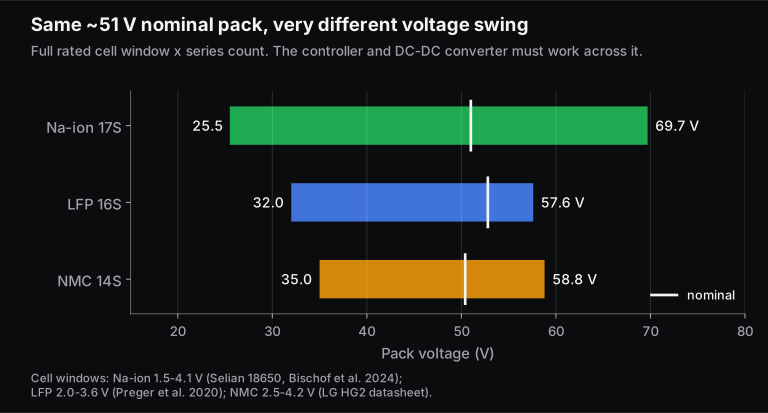
That is a 2.7:1 ratio between highest and lowest voltage, against 1.8:1 for LFP (16 cells, 32.0–57.6 V) and 1.7:1 for NMC (14 cells, 35.0–58.8 V). The motor controller and DC-DC converter must work across it, or the BMS must stop at a higher minimum voltage. There is an upside. Because a layered-oxide Na-ion cell's voltage changes steadily across that window, voltage tells the BMS roughly how much charge is left, which is much harder on LFP's flat curve.
Are sodium-ion batteries safer than lithium-ion?
Partly. Na-ion cells can be discharged to 0 V and stored or shipped with no energy in them, because the anode sits on aluminium, not copper (Rudola et al. 2021). In thermal runaway, one independent test placed a layered-oxide Na-ion cell between LFP and NMC, closer to LFP (Yue et al. 2024).
A "fully discharged" lithium-ion cell is not really at zero. Push it to 0 V and the copper current collector starts to dissolve, which harms cycle life and safety; that is why rules require lithium-ion cells to ship at 30% charge or less. A Na-ion cell can go to true 0 V, and even slightly negative, without that damage (Rudola et al. 2021). Transport rules now reflect this. IATA's Dangerous Goods Regulations (66th edition, effective 1 January 2025) give sodium-ion batteries their own UN numbers, UN 3551 and UN 3552. They also exempt sodium-ion-powered vehicles whose battery is short-circuited to zero charge (special provision A231).
Here is the catch: Na-ion cells still use a flammable organic electrolyte. In accelerating-rate calorimetry on 18650 cells, the Na-ion cell peaked at 511.7 °C with a maximum heating rate of 2,285.5 °C/min, between the LFP and NCM523 cells. The authors estimate a fully charged cell could self-ignite if stored above 169.6 °C (Yue et al. 2024). "Closer to LFP" is fair; "cannot catch fire" is not. The pack protections in why EVs catch fire in India still apply.
Do sodium-ion batteries work better in the cold?
For delivering energy, yes. The IEA reports that the latest Na-ion cells keep around 90% of nominal capacity at −40 °C and can run at up to 70 °C, significantly better than lithium-ion and especially LFP (IEA, Feb 2026). CATL claimed more than 90% at −20 °C for its first-generation cell in July 2021.
Most of India never sees −40 °C, though Ladakh and Himalayan winters come close enough to matter. Heat tolerance may matter more elsewhere in the country, but running without active cooling is still being tested: Sandia lists it as an open question.
Here is the catch: holding capacity in the cold is not the same as charging in the cold. Sandia cycled two types of commercial layered-oxide 18650 Na-ion cells at 15 °C. All of them faded fast. Teardowns showed sodium plating, and CT scans of most cells showed cracked jelly rolls (Wittman, Preger et al., SAND2026-23913C, July 2026). Earlier Sandia tests of LFP, NMC811 and NCA cells at 15 °C showed no change or only deformation. It is a preliminary poster on two cell types, but it is a good reason to validate charging limits yourself.
Is sodium-ion cheaper than lithium-ion?
Not yet, in most uses. On 17 February 2026 the IEA said lithium prices are not high enough for Na-ion to undercut LFP in most applications, though Na-ion is already cost-effective for EVs and storage in very cold climates. The cost case depends mainly on lithium prices and on Na-ion energy density.
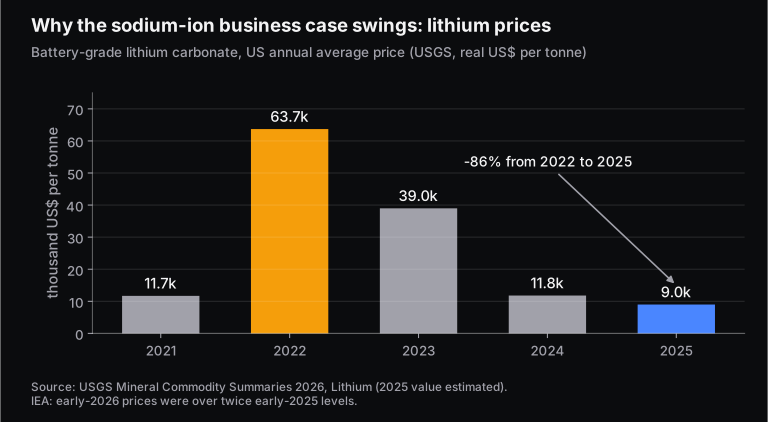
When lithium carbonate hit $63,700 a tonne in 2022, sodium looked like an escape route. By 2025 lithium was down to $9,000 and LFP packs averaged $81/kWh (BloombergNEF, Dec 2025), a hard price for a new chemistry to beat. Early-2026 lithium prices were more than twice their level a year earlier, though still about 70% below the 2022 peak, and the IEA notes that big cell makers treat Na-ion capacity as a hedge against another spike.
Na-ion's structural advantages are real: no cobalt, aluminium instead of copper foil, abundant raw materials. In 2021 Faradion put its cell bill of materials 25–30% below an LFP pouch cell (Tapia-Ruiz et al. 2021), a company estimate from a time of dearer lithium. Scale is the bigger problem today. Na-ion output in 2025 was less than 1% of lithium-ion's (IEA, Feb 2026), and the hard carbon supply chain is small and mostly in China (IEA GEVO 2026).
Why does sodium-ion matter for India?
India is "mostly dependent on other Asian countries" for lithium-ion batteries, the government told the Lok Sabha on 12 August 2025. As of December 2025, only 1 GWh of the 40 GWh of cell capacity awarded under the PLI scheme for advanced chemistry cells (ACC) was installed. Sodium-ion is attractive as a second chemistry whose main raw material India already has.
- Demand: lithium-ion battery demand is projected to rise from 40 GWh in 2025 to about 210 GWh by 2030 (NITI Aayog projection, cited in the Lok Sabha on 16 Dec 2025).
- Lithium: world output was about 290,000 tonnes in 2025. India is not among the producers; USGS lists it among countries still exploring lithium deposits. The state-owned KABIL has acquired five lithium brine blocks in Argentina.
- Sodium: India produced an estimated 30 million tonnes of salt in 2025, third after China and the United States (USGS 2026).
- Policy: the PLI ACC scheme is "technologically agnostic", so Na-ion cells are not excluded by chemistry (Lok Sabha, 16 Dec 2025).
Here is the catch for India. Sodium is abundant, but the sodium-ion industry is not spread out. China holds nearly all existing Na-ion cell capacity and more than 95% of the capacity planned for 2030, and the cathode and hard carbon supply chains are just as concentrated (IEA, Feb 2026). Switching to sodium only cuts import dependence if India also makes the cathode powder, the hard carbon and the cells.
Where does sodium-ion fit, and where doesn't it?
Na-ion fits where cost, safety, cycle life and temperature tolerance matter more than mass and volume. The IEA names small-range cars, urban light commercial vehicles, two- and three-wheelers, forklifts and stationary storage as the best matches (GEVO 2026).
| Use | Fit | Why |
|---|---|---|
| Grid, C&I and inverter storage | Good | Mass and volume matter less; 0 V storage and temperature range help. Indian launches started here. |
| e-3W, passenger and cargo | Good, if it fits | Similar mass to LFP in our example, about 14% more volume; daily cycling suits it. |
| Entry e-2W | Possible | Small, price-sensitive packs; floorboard volume is the limit. |
| 12/24 V starter batteries | Good | Replaces lead-acid; CATL claims a 24 V truck battery that starts at −40 °C. |
| Long-range cars, premium e-2W | Poor | The IEA estimates an average SUV would reach about 350 km on Na-ion against 400–600 km on lithium-ion. |
Who is making sodium-ion batteries in India?
No Indian company had announced gigawatt-scale Na-ion cell production as of 17 November 2026. The activity so far is an acquisition, a licensing deal, pilot lines, packs and storage systems, and research. Performance figures in the right-hand column are the companies' own claims.
| Company or lab | Confirmed | Company claims |
|---|---|---|
| Reliance New Energy (Faradion, UK) | Agreed to buy Faradion on 31 Dec 2021 (enterprise value £100 million, plus £25 million growth capital); fully owned since 28 Oct 2024. | Faradion 2021 data: 160 Wh/kg pouch cells, 3,000 cycles. We found no public confirmation of commercial Na-ion cell output at Jamnagar. |
| KPIT Technologies (Pune) and Trentar Energy | Technology unveiled 12 Dec 2023 with an IISER Pune team; transferred to Trentar on 12 Feb 2025 for upfront fees and royalties over eight years. | 100–170 Wh/kg by variant; 80% capacity after 3,000–6,000 cycles; Trentar to invest in 3 GWh of capacity. |
| Naxion Energy (formerly Sodion, Coimbatore) | Launched sodium-ion storage systems (3.5, 5 and 10 kW) for homes and businesses in December 2025. | 1.5 GWh a year of pack capacity; a ₹200 crore, 500 MWh pilot cell plant (2027 target per pv magazine; other reports say end-2026). |
| Rechargion Energy (Pune, CSIR-NCL spin-off) | Pilot plant commissioned in 2024; cells validated by ARAI under IEC 62660 (NITI Aayog case study, 23 Jul 2026). | Polyanionic cathode, about 3.7 V, 110–120 Wh/kg, more than 15,000 cycles in testing, tested to −20 °C. |
| Macsen Energy (Macsen Labs spin-off) | Lab results announced 5 Oct 2026; 10,000 m² allocated for a cathode plant and cell pilot line, construction from 2027. | Prussian white with hard carbon: 1,500+ cycles, at least 90% capacity after 1,000, more than 150 mAh/g. Third-party verification not disclosed. |
| JNCASR, Bengaluru (research) | Peer-reviewed in Advanced Materials (2025): a carbon-coated NASICON anode for fast-charging cells. | 80% charge in six minutes and 3,000+ cycles in lab cells (DST, pv magazine, 23 Jun 2025). |
The useful question for each row is who tested it. ARAI's validation and the JNCASR paper are outside checks; most cycle counts and energy densities are not, and may come from small lab cells. Until independent large-format data appears, compare them with the 128 Wh/kg that independent testers measured on a commercial 18650.
What is happening with sodium-ion globally?
China leads. CATL launched its second-generation Naxtra cell on 21 April 2025, rated at 175 Wh/kg, and said in April 2026 that it would reach full-scale mass production by the end of 2026. On 5 February 2026, Changan and CATL unveiled what they call the first mass-production passenger car with Na-ion batteries, due on sale by mid-2026; we could not confirm delivery figures. The IEA also reports that BYD began building its first Na-ion plant in January 2024, LG Energy Solution announced a pilot line in Nanjing, China, and US-based Natron Energy has shut down (IEA, Feb 2026). Na-ion is now an industrial race, and it is being run on supply chains as much as chemistry.
What engineering jobs and skills does sodium-ion create?
Most Na-ion jobs are lithium-ion jobs plus new chemistry knowledge. The cells are made on similar equipment, packed into similar modules and run by a BMS. Engineers who understand where Na-ion behaves differently are what Indian pilot lines and storage firms need.
| Role | What changes with Na-ion | Skills to build |
|---|---|---|
| Cell / materials engineer | Hard carbon precursors, Prussian white moisture control, first-cycle loss | Electrochemistry, XRD/SEM, coin and pouch cell testing |
| Electrode process engineer | Dry rooms for moisture-sensitive cathodes; aluminium on both electrodes | Mixing, coating, calendering, formation |
| BMS engineer | Sloping voltage curve, wide window, 0 V storage, cold-charging limits | Cell modelling, SOC/SOH estimation, MATLAB/Simulink |
| Pack and thermal engineer | More volume per kWh; different cooling needs | Packaging, thermal and CFD analysis, vibration |
| Test and validation engineer | UN 3551/3552 transport rules; checking company claims | IEC 62660 cell tests, abuse testing, data analysis |
If you are starting out, learn lithium-ion cell and pack basics first; nearly all of it carries over. Skill-Lync's battery technology for EVs course using MATLAB and Simulink covers cell modelling and BMS logic, and the PG program in battery technology goes deeper into pack and thermal design. See also how a battery management system works and, for end of life, lithium-ion battery recycling in India.
Frequently asked questions
Is sodium-ion better than lithium-ion?
It depends on the job. Na-ion is easier to store and ship, handles cold better and avoids lithium, but it stores less energy per kilogram and per litre: about 175 Wh/kg at best against up to 205 Wh/kg for LFP (IEA 2026). It competes in storage and small vehicles, not yet in long-range cars.
Are sodium-ion batteries available in India?
In limited form. Naxion Energy launched sodium-ion storage systems in December 2025, and Rechargion has ARAI-validated cells and a pilot plant. As of November 2026, no Indian company had announced gigawatt-scale Na-ion cell production.
Can a sodium-ion battery replace the LFP pack in my e-scooter?
Not as a direct swap. A Na-ion pack of the same energy is bulkier and has a much wider voltage window, so the charger, motor controller and BMS must be designed for it, and the vehicle must be approved with it.
How long do sodium-ion batteries last?
Company claims range from 3,000 cycles (Faradion) and 3,000–6,000 (KPIT) to more than 10,000 (CATL Naxtra) and more than 15,000 in testing (Rechargion). Independent long-term data on large cells is still limited, so treat these as claims.
Why don't sodium-ion batteries use graphite?
Sodium binds too weakly to carbon to form a useful graphite compound, so graphite stores almost no sodium in normal electrolytes. Hard carbon, with wider gaps and closed pores, stores about 300 mAh/g and is the standard Na-ion anode (Tapia-Ruiz et al. 2021; Liu et al. 2016).
Sources and further reading
- N. Tapia-Ruiz et al., 2021 roadmap for sodium-ion batteries, J. Phys. Energy 3, 031503 (July 2021)
- K. Bischof et al., Evaluation of commercial 18650 and 26700 sodium-ion cells and comparison with well-established lithium-ion cells, J. Power Sources Advances 27, 100148 (June 2024)
- Y. Liu, B. V. Merinov and W. A. Goddard, Origin of low sodium capacity in graphite and generally weak substrate binding of Na and Mg, PNAS 113, 3735 (2016)
- M. Ahangari, M. Zhou and H. Luo, Review of layered transition metal oxide materials for cathodes in sodium-ion batteries, Micromachines 16, 137 (Jan 2025)
- A. Rudola, C. J. Wright and J. Barker, Reviewing the safe shipping of lithium-ion and sodium-ion cells: a materials chemistry perspective, Energy Material Advances (2021)
- Y. Yue et al., Thermal runaway hazards comparison between sodium-ion and lithium-ion batteries using accelerating rate calorimetry, Process Safety and Environmental Protection 189, 61 (Sep 2024)
- R. M. Wittman, Y. Preger et al., Sandia National Laboratories, Exploring low-temperature performance of Na-ion cells to support new ESS applications, SAND2026-23913C (July 2026)
- J. T. Frith, M. J. Lacey and U. Ulissi, A non-academic perspective on the future of lithium-based batteries, Nature Communications 14, 420 (Jan 2023)
- Y. Preger et al., Degradation of commercial lithium-ion cells as a function of chemistry and cycling conditions, J. Electrochem. Soc. 167, 120532 (2020)
- IEA, Sodium-ion battery momentum grows, but challenges remain (17 Feb 2026); Global EV Outlook 2026: Electric vehicle batteries (2026)
- U.S. Geological Survey, Mineral Commodity Summaries 2026: Lithium and Salt (2026)
- BloombergNEF, Lithium-ion battery pack prices fall to $108 per kilowatt-hour (9 Dec 2025)
- IATA, Dangerous Goods Regulations 66th edition: significant changes (effective 1 Jan 2025)
- Ministry of Heavy Industries, Lok Sabha unstarred questions 3775, Dependence on Chinese lithium-ion batteries (12 Aug 2025) and 2624, Demand for lithium-ion batteries (16 Dec 2025)
- Reliance Industries, Reliance New Energy Solar to acquire Faradion Limited (31 Dec 2021); Business Today, Reliance New Energy takes over remaining stake in Faradion (29 Oct 2024)
- Autocar Professional, KPIT unveils sodium-ion battery technology (12 Dec 2023); pv magazine India, KPIT selects Trentar Energy as manufacturing partner (12 Feb 2025)
- pv magazine, Indian company rolls out sodium-ion storage systems for homes, businesses (Naxion Energy, 12 Dec 2025)
- NITI Aayog Frontier Tech Hub, How a Pune startup cut battery-mineral import dependence with sodium-ion cells (Rechargion, updated 23 Jul 2026)
- pv magazine India, Indian startup claims over 1,500 cycles for sodium-ion cell with Prussian white cathode (Macsen Energy, 6 Oct 2026)
- B. Patra et al., NASICON-NaV0.25Al0.25Nb1.5(PO₄)₃/C: a high-rate and robust anode for fast charging and long-life sodium-ion batteries, Advanced Materials 37 (2025); pv magazine, Indian researchers develop fast-charging sodium-ion battery (23 Jun 2025)
- CATL, first-generation sodium-ion battery (29 Jul 2021); Naxtra battery breakthrough (21 Apr 2025); CATL and Changan launch mass-production sodium-ion passenger vehicle (5 Feb 2026); CATL unveils six major innovations (21 Apr 2026)