Week-6 Challenge: EV Drivetrain
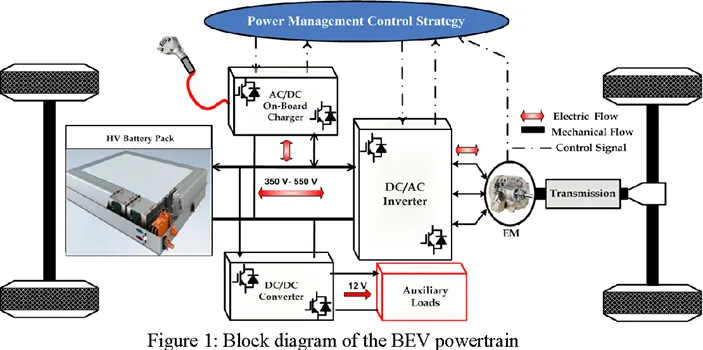
- In EV’s & HEV’s the power converter circuits play an important role. The power converters are one of the main components those determine the overall efficiency of the vehicles. The power converter circuits modulate the power signals to suit the users load requirements. The types of power converters used inside the EV’s & HEV’s are:
- AC to DC (Rectifiers)
- DC to AC (Inverters)
- DC to DC (Choppers)
AC to DC (Rectifiers)
These converters are mainly used in a Plug-in charging case. When the PHEV or PEV is plugged in an external power supply, the AC power is taken in and it is converted to DC for storing it inside the Battery.
DC to AC (Inverters)
These converters are used for the conversion of stored DC energy from the battery to AC energy for using to drive the motor to overcome the propulsion force. It also
DC to DC (Choppers)
The different configurations of EV power supply show that at least one DC/DC converter is necessary to interface the FC, the Battery or the Supercapacitors module to the DC-link.
In electric engineering, a DC-to-DC converter is a category of power converters and it is an electric circuit which converts a source of direct current (DC) from one voltage level to another, by storing the input energy temporarily and then releasing that energy to the output at a different voltage. The storage may be in either magnetic field storage components (inductors, transformers) or electric field storage components (capacitors
- The Given data are:
Rated Armature voltage= 72 V
Rated armature current= 400 A
Ra= 0.5Ω,
KΦ= 0.7 Volt second
Chopper Switching frequency= 400 Hz
Duty cycle = 70% = 0.7
Solution:
Vehicle output Voltage, Vo = Duty cycle x Armature Voltage
- Vo = 0.7 x 72 = 4V
The Torque Speed Equation is:
T = ((V x K)/Ra) - (K2/Ra) x ω)
Putting all the values in this equation we get:
T = 70.56 – 0.98 ω
And we know:
T = 24.7 + 0.0051 ω2
By equating both of these equation we get,
70.56 – 0.98 ω = 70.56 – 0.98 ω
=> 0.0051 ω2 + 0.98 ω – 46.94 = 0
Therefore,
ω = 38.85 rad/s and -230.95 rad/s
Vehicle speed can’t be negative so we take positive value
Steady state speed of vehicle, ω = 38.85 rad/s
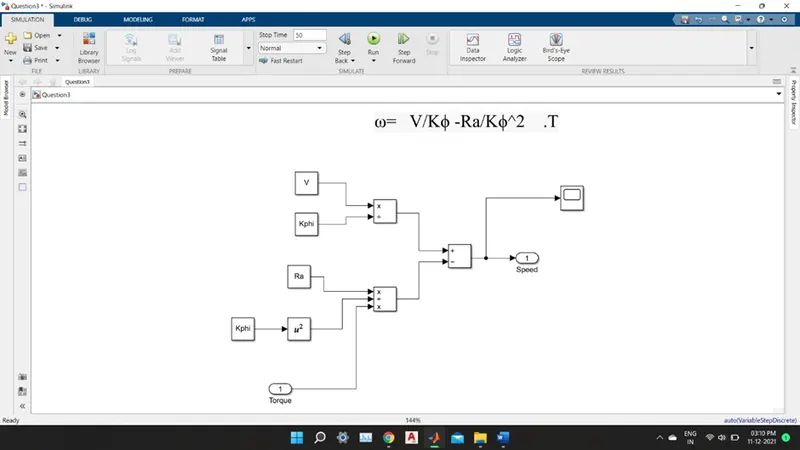
- Mathematical model of a DC Motor for the below equation using Simulink.
ω= V/Kϕ -Ra/Kϕ^2 .T
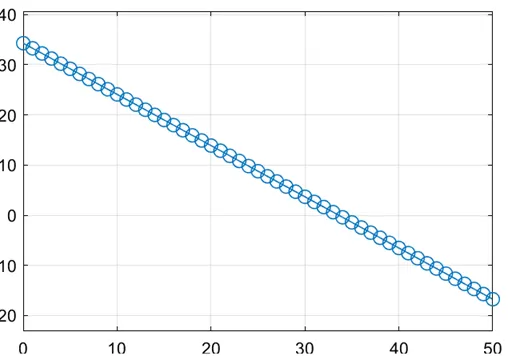
Output Graph:
- Form the blog topic Induction versus DC brushless motors by Wally Ripple, Tesla., we can understand the following points:
- In the introduction we can see that the author explains that all the engines are similar and it was up the customer to select the motor according to their requirement and budget. He also adds the point that the induction motor and dc motor both will continue have a great deal of demand for a long time.
- Now the author studies the working principle of both induction and DC motor and evaluates the advantages and disadvantages of both the machines.
- The advantages of the DC motor as pointed out by the author was that they dissipate very less heat with brushless drive. And the efficiency of the motor drive will be a bit greater than that of the induction motor drive.
- The disadvantages of the DC motors were, it is heavy, large in size and a lot more expensive as it uses permanent magnets. Also, it is very had to handle the strong magnetic force produced by those permanent magnets.
- The advantages of an Induction motor were, it didn’t had any permanent magnets, it didn’t’ need any inverter and also it could start under loaded condition.
- The Disadvantages of Induction motors were, they always needed AC supply and it could never operate under a DC supply. And its shaft speed was proportional to line frequency, so when driven with the utility supply is runs on constant speed which leads to less starting torque and limited peak torque.
- On the concluding note the author states that both eth motors are good and the DC motor will be dominating the HEV and PHEV market while the induction motor will be dominating the Pure EV domain.