Project 1 Mechanical design of battery pack
ANR26650M1-B Datasheet:
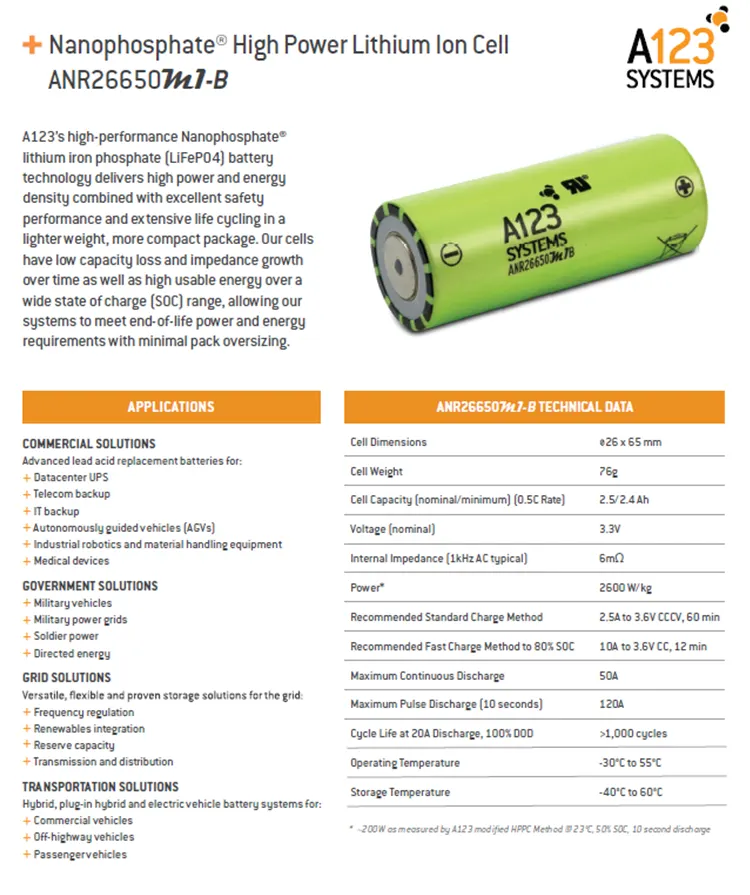
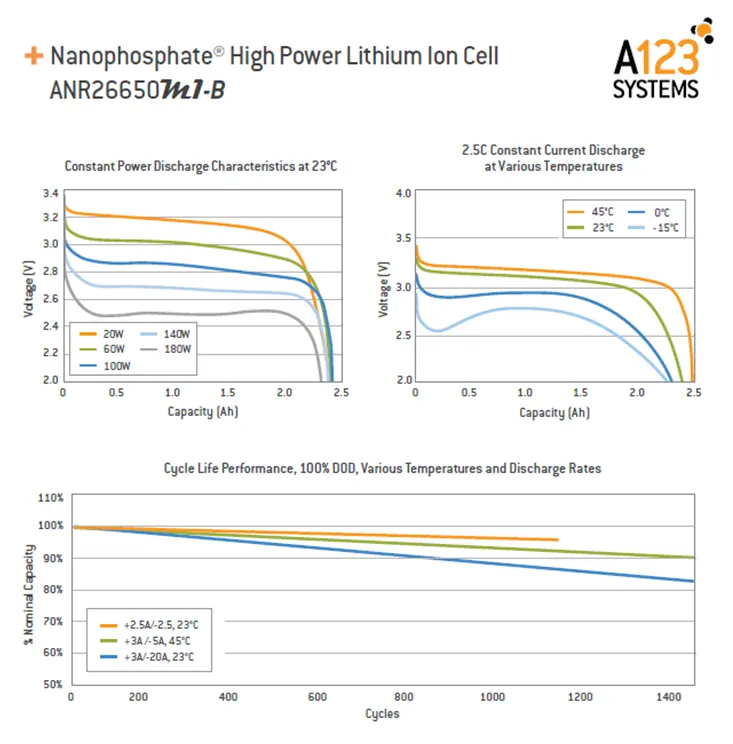
ANR26650M1-B Specifications
Nominal Ratings
Voltage: 3.3 Volts
Capacity: 2.5 Ah
Energy: 8.25 Wh
Specific Power: 2600 W/kg
Impedance (1KHz AC Typical) 6 mΩ
Cycle Life at 1C/1C, 100% DOD: > 4000 cycles
Cell Type: 26650 Lithium-Ion Power Cylindrical Cell
Discharging
Max Continuous Discharge: 50 A
Max Pulse Discharge Current >50% SOC (10s): 120 A
Minimum Voltage: 2 Volts
Temperature: -30°C to 55°C
Charging
Recommended Standard Charge: 2.5 Amps
Max Charge Rate: 10 Amps
Max Pulse Charge Current <50% SOC (10s). 25 A
Float Voltage: 3.45 Volts
Recommended charge V & Cut-off Current: 3.6 Volts, taper to 125mA
Temperature
(Reduce charging current to 250mA when under 0°C): 0°C to 55°C
Mechanical
Diameter: 25.96 +/-0.5 mm (1.0”)
Length: 65.15 +/-0.5 mm (2.6”)
Mass: 76 g
Calculation as per assumptions-18kWh Battery Pack
Calculation for designing an 18kWh battery pack, basically 18kWh is energy require to achieve the vehicle its proper range. It is depending upon the voltage (V) parameter and ampere-hour or capacity (Ah). Here we design a high voltage battery pack for an electric vehicle to achieve its range up to 220 km. For this calculation, I assumed 1452 V a nominal voltage for series connection
Basically, the value of the volume of the cell is used to find out the total volume of the battery pack
Volume of the cell = 𝜋r2h
= 3.14x0.0132x0.065
= 0.0000344929m3
Single Cell Energy (Wh) = Cell Capacity (Ah) x Cell Voltage (V)
= 2.5x3.3
= 8.25Wh
The value of a single cell is used to calculate the total energy of the battery pack
Single Cell Energy Density
Volumetric energy (Wh/m^3) = Single Cell Energy / Volume of each cell
= 8.25 Wh/0.0000344929 m^3
= 2,39,179.657 Wh/m^3
Gravimetric energy (Wh/kg) = Single Cell Energy / Single Cell Moss
= 8.58 Wh/0.076 kg
= 112.89 Wh/kg
Calculation of High Voltage Battery Pack
For design and calculation of battery pack here, I assume a vehicle to achieve 250 km in 18kWh battery pack. Also, I assume 145.2 nominal voltage for series connection.
So, Vehicle Range = 250 KM (assumed)
Battery Pack capacity = 18 kWh or 18000 Wh
Now, we will calculate per km average energy = 18000 / 250
= 72.483 Wh/km
Let's assume Nominal voltage for series connection = 145.2 V. Basically, this depends upon the motor power, We can decide the value according to the motor.
Number of cells connected in series
= Nominal voltage of series connection / Nominal voltage of a single cell
=145.2 V / 3.3 V
= 44
Therefore, 44 Cells will be connected in a series connection to provide a proper voltage.
Energy for battery pack (Wh)
= No. of cells connected in series x Single-cell energy
= 44 x 8.25Wh
= 363Wh
Number of cells connected in parallel
= Battery pack total energy (Wh) / Energy for battery pack (Wh)
= 18000/363
= 49.586
Therefore, 50 cells will be connected in parallel to provide a proper capacity power.
Battery pack calculation:
Now we calculated parallel and series combinations so we can now calculate total no of cells required
Total no of cells = Series cells parallel cells
= 50*44
= 2200.
Total no of cells required are 2200.
So, from series and parallel combination, we can calculate the voltage of battery pack and the current of the battery pack
Voltage= no of cell in series* nominal voltage
= 50*3.3
=165V
The total value of voltage is 165V.
Current = No of parallel cells x cell capacity
=44 x 2.5
=110Ah.
The total value of Current is 110Ah
So now we can calculate the how much mount of energy this combination have by product of voltage and current, and check the it will satisfied or not our requirement
Energy = Voltage x Current
= 165 x 110
= 18150Wah
The total value of Energy is 18150WAh.
So, our calculation is satisfied requirement what we need. Now we have total no of cells and volume of single cell so we can calculate the total volume required for battery pack
Total volume = no of cells x Volume of single cell
= 2200 x 0.0000344929
= 0.07588438m^3
Total volume required for battery pack is 0.07588438m² We also have single cell weight from that we can calculate the total weight of battery pack without other mechanical and electrical
connections. Weight = No of cells weight of single cell.
= 2200 * 0.076
= 167.2kg
Weight of battery pack is 167.2kg
Energy density = volume x battery pack energy
= 0.07588438*18150
= 1,377.301497kWh/m^3
Energy density is 1,377.301497kWh/m^3
Now we have all parameters which we need to construct the battery pack physically.
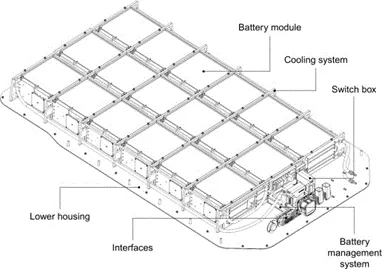
The arrangement design of single-cell is shown below:
Assembly of the full battery pack with 50s/ 44P. The arrangement of the pack is as follow:
Then, 2112 cells will have 50S/44P
Here I arrange the pack such that it will build a proper battery pack. The detail technical specification of 2112 battery pack is as follow:
- Package: 50s/44P
- Capacity: 110 Ah • Voltage: 165 V
- Weight: 167.2kg (Only Cells)
- No of Cells: 2100
- Power: 18150Wh or 18,15 kWh
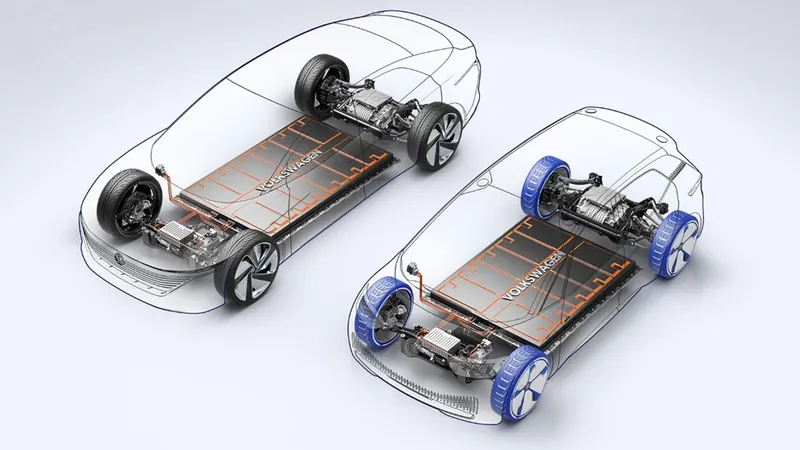
Here I also configure battery pack into electric vehicle lower floor panel case, a simple layout of the battery pack in an electric vehicle is shown below:
Design of cell holder (Bottom and Top)
The main function of a battery holder is to keep cells fixed in place safely and securely also it is used to keep cells in a proper arrangement so that there will be a decrease in mechanical vibration, and have a better thermal runway in between the cell gaps. Most of the cell holder is made up of polypropylene or nylon bodies rated for 80-100 °C.

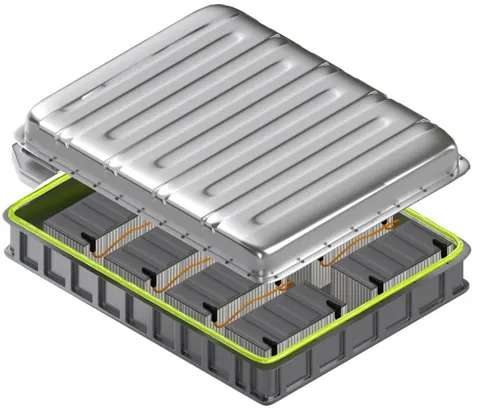
Design of pack cover
Basically, Pack cover is made up of Aluminium and the reason behind is to keep battery pack for lightweight. The casing/cover thickness is 0.5 mm and the design is as shown below. A bottom cover is shown to cover below the bottom battery holder.
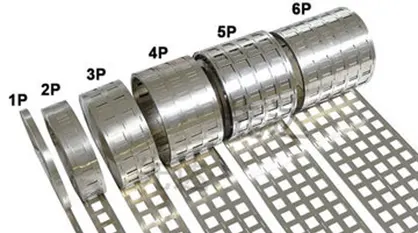
Positive and Negative Clip
A positive and negative clip is used to connect the battery end cap i.e (+) and (-). To make the battery pack, you have to connect the many cells together by means of Nickel strips or thick wire. Generally, Nickel strips are widely used for this. In general, two types of nickel, strips are available in the market: nickel-plated steel strips and pure nickel strips. I will suggest buying a pure nickel. It is a little bit costlier than nickel-plated steel, but it has much lower resistance. Low resistance means, less heat generation during the charging and discharging. which leads to longer useful battery life. Nickel strips come with different dimensions and lengths.
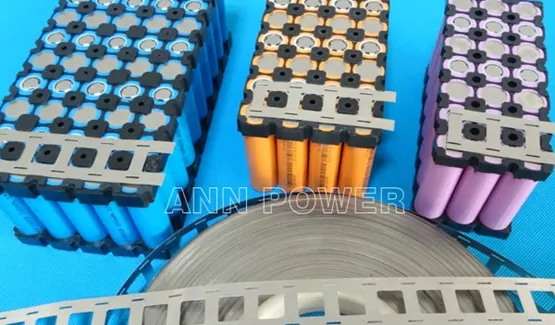
Joining of Cylindrical Cell Battery Pack
Cylindrical cells have improved thermal management efficiency because of compact shape, but have low packaging efficiency because of their round cross-section. Here I use a positive and negative tab to connect multi cells.
The suitability of joining methods to build battery packs using cylindrical cells is shown below:
Conclusion:
|
Slno. |
Calculated Parameters |
Value |
|
1. |
Cell Volume |
0.0000344m^2 |
|
2. |
Cell Energy |
8.25Wh |
|
3. |
Cell Density |
239179.65kWh/m^2 |
|
4. |
Battery Arrangement |
50s 44p |
|
5. |
Total no. of Cells |
2200 |
|
6. |
Voltage |
165V |
|
7. |
Capacity |
110Ah |
|
8. |
Energy |
18150Wah |
|
9. |
Total Volume |
0.07588m^2 |
|
10. |
Total Density |
1377.30kWh/m^2 |
|
11. |
Weight |
167.2kg |