Week-4 Challenge WOT Condition Part-2
1. MAPPED MODEL:
Data required for simulation and processing is in the form of lookup table data, which is configured with parts of engine, motor or generator. If lookup table is available with us then the simulation becomes easier and gives the output based on it. So this model is also called as global based model.
MAPPED ENGINE:
Power , Air , Fuel , Temperature , Efficiency , Hydrocarbon (HC) emissions , Carbon monoxide (CO) emissions , Nitric oxide and nitrogen dioxide (NOx) emissions , Carbon dioxide (CO2) emissions and Particulate matter (PM) emissions
These are the engine characteristics that a lookup table has to specify.
Hardware-in-the-loop (HIL) engine control design and Vehicle-level fuel economy and performance simulations are usage of these block.
Output data of this block is torque, fuel mass per injection, fuel economy, power stored, brake torque etc.
MAPPED MOTOR:
we can specify in the look up table such as:
Port configuration such as Input torque or speed, Electrical torque range such as Torque speed envelope or maximum motor power and torque and Electrical loss such as Single operating point, measured efficiency, or measured loss.
Block produces an output :
Mechanical power, power loses, battery current, motor torque at each instant and also motor shaft speed.
MAPPED GENERATOR:
Input for a Genearator in a look up table is battery torque, battery current , motor torque, and more others are entered in it.
DYNAMIC MODEL:
Based on the name plate details in each of the engine, motor, generator. So based on these data each part in the block functions. Based on the situation of operation, block behaviour varies dynamically. So dynamic model is also called as the real time model.
DYNAMIC ENGINE:
Based on the real or original engine specification , results are developed . So these are real time details.
DYNAMIC MOTOR:
Based on the name plate details, motor fuction in a real time data.
DYNAMIC GENERATOR:
Here also based on the real time data of the generator it operates.
TO CHANGE THE MODEL TYPE:
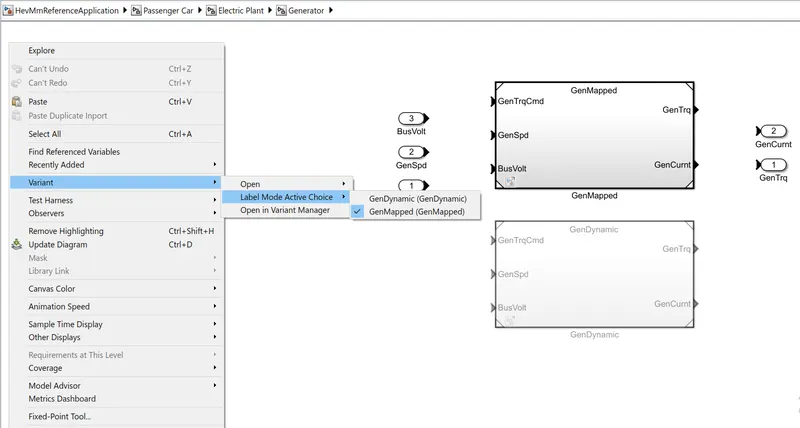
- Open any of the power train blockset for required vehicle ( maybe EV or HEV) open “passenger car” subsystem we can find “ Electric plant” subsystem , open it we get “generator” block, while opening it we can find two systems as”Genmapped” and “Gendynamic”.
- So to switch between two models, right-click on the open space and we can find a option of variant, there we can find “Label Mode Active Choice”, over there we can switch between two modes.
- MILES PER GALLON (MPG) :
- MPG is defined as fuel economy rating is determined by how far a car can travel on a gallon of gasoline or diesel. Fuel consumption does not decrease linearly as MPG increases.
- For example, to travel 1500 miles, car that gets 10 MPG will require 150 gallons of fuel. Now if the car gets 15 MPG that will require 100 gallons of fuel. Now just by increasing the MPG by 5 so fuel consumption gets cut by 33%.
Model Calculation of MPG:
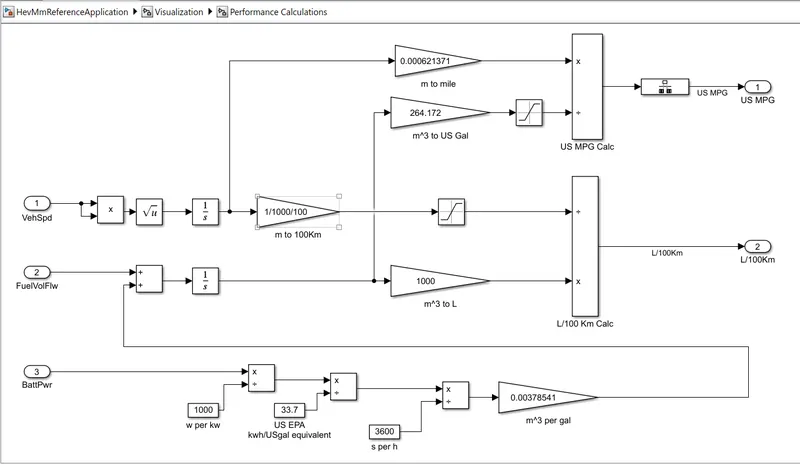 The block “L/100km” is used to represent the miles per gallon by the vehicle. One set of block is used to convert battery usage or power into an equivalent amount of fuel.
The inputs given are speed, fuel flow and battery power. Speed is converted into distance by an integrator block. Then we have to place a saturation block with upper and lower limits for the distance travelled.
Battery fuel and fuel flow is added up and then we will integrate to conert volume in m^3 to liters. Then we calculate using latter one and distance with limits to get the final MPG.
Factors that affects the fuel economy:
- Speeding
- Heavy braking
- Heavy acceleration
- Huge vehicle weight
- Frequent cold weather travel
- HEV reference application :
In this application, there is drive cycle block choose it as WOT ( Wide Open Throttle) and click apply and the OK. Since we can notice the effect of gradeablity with WOT only not with any other kind of drive cycles. So grade is 0 in this case.
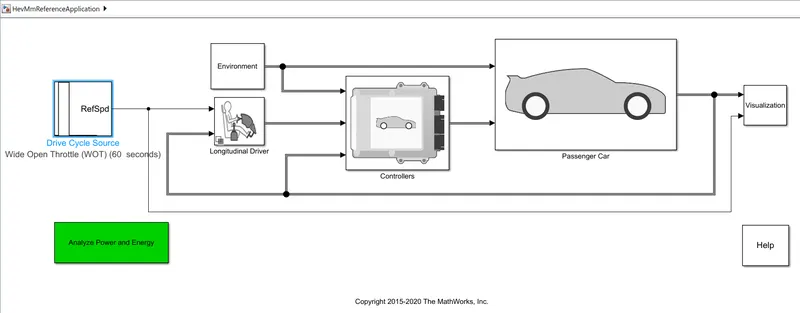 Run the above model and the results are obtained as shown below.
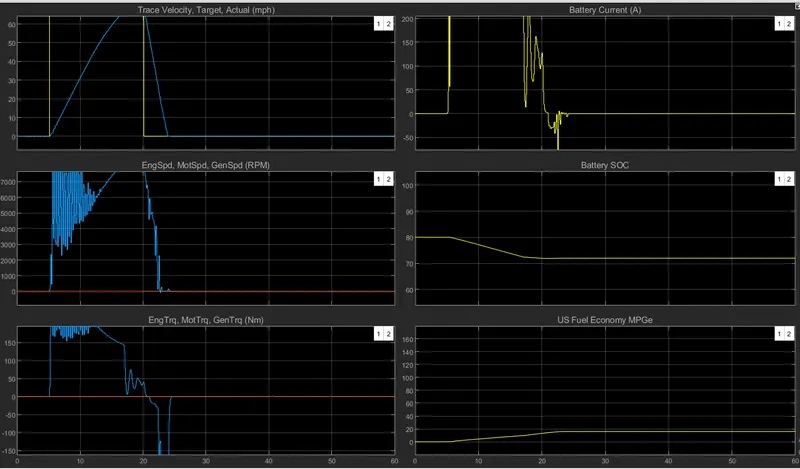 Plot-1 shows the plot between velocity with respect to time and also actual mph with respect to time. Velocity is raised to certain limit by the torque and power is converted into acceleration force. The maximum velocity is 60mph for the vehicle, later speed of the vehicle is driven at a constant speed, then it start to decelerate.
Plot-2 show the engine and motor speed at each level of acceleration with respect to time.
Plot-3 shows the engine and motor torque. Initial raise of velocity is done by the raise of motor torque and engine torque.
Plot-4 shows battery current such that battery capacity depends on the type of drive cycle. Initially, high acceleration and torque is provided by the battery current ot the motor. Once it reach the m,ax torque or velocity limit the power is continuous by the engine. During deacceleration, the motor is idle so battery starts to charge. So the current at that stage is constant.
Plot-5 shows battery state of charge (SOC) . During acceleration, battery SOC starts to decrease. Once it reaches the slope, it starts to decelerate so battery SOC start to charge and raises.
Plot-6 show fuel economy which remain constant when battery SOC is constant.
Change in Grade and wind velocity in the Environment block:
Now we will change the grade to 7 from 0 and also the wind velocity in x axis from 0 to 20 kmph.
These all changes are made in environment block. Those changes are shown below:
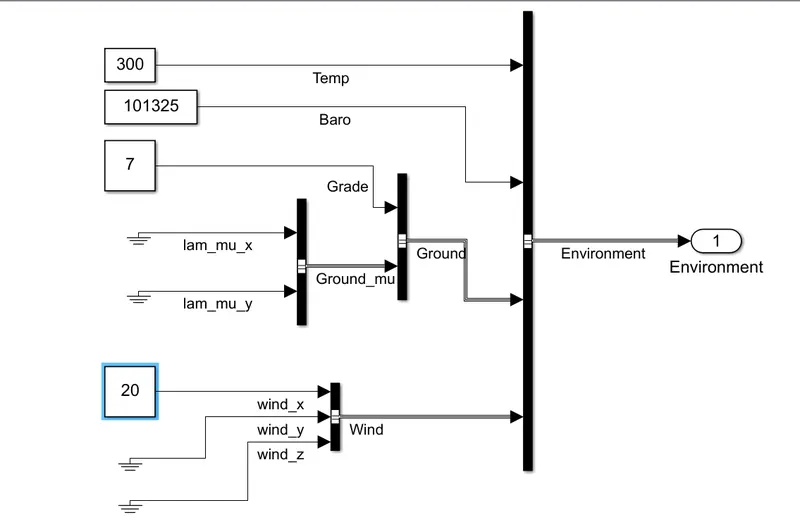 Output plots are shown below:
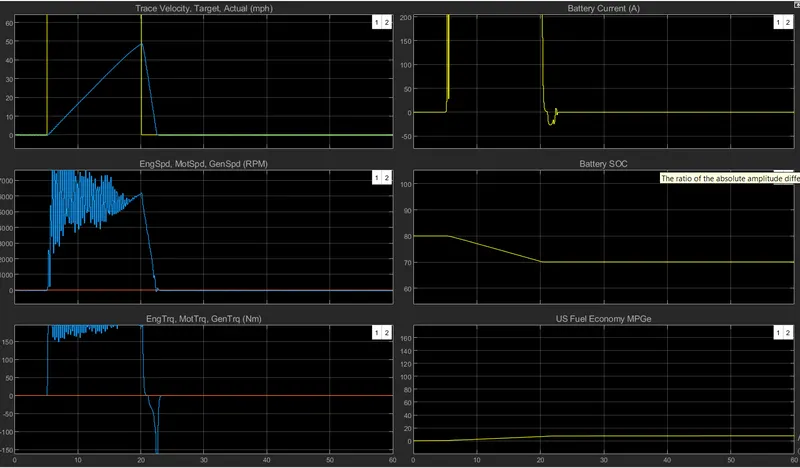 Plot-1 Maximum velocity is decreased to 48 mph since the grade is increased.
Plot-2 Speeds of motor and engine is compared with the default plots.
Plot-3 torque required increased since the wind velocity is increased to 20kmph.
Plot-4 Battery current required also is more since the torque required is more, alos more power is required for increase in grade.
Plot-5 SOC is not possible initially because of acceleration with grade. Once the vehicle start to decelerate SOC of the battery is increased based on the grade value.
Plot-6 Fuel consumption is more since the grade and wind velocity factor is included.
- Comparing the results of HEV and Pure Electric vehicle:
All the parameters are kept constant and models are simulated in both HEV and pure EV.
HEV Model:
Initally, torque is provided by the battery for some speed limit and after that limit, power gets interchanged with IC engine after it reached the required speed. So HEV can attain high speed in less time due to torque of both battery and engine together. 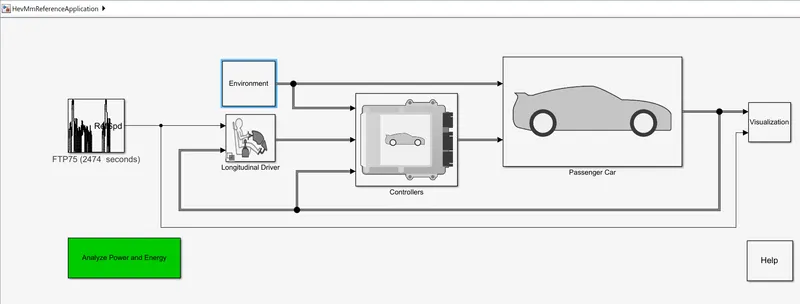
Results of HEV: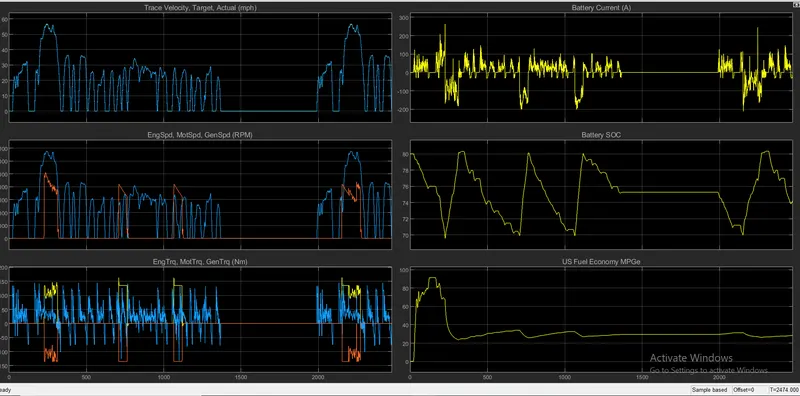
EV Model:
In this case, it consist of motor, generator, battery, drive transmission, and associated power train controls.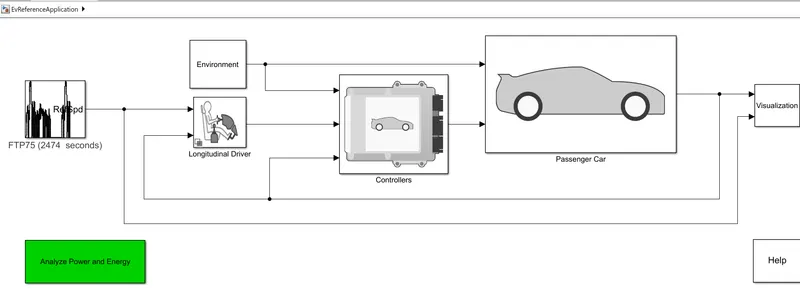
Results of EV :
Comaprison of HEV model with EV model:
HEV gives emission due to the results of fuel consumption, while the EV power train is giving 0% 0% emission so it is green technology.
Power loss in EV is less than HEV but drivetrain loss is more in EV than in HEV.
In case of EV, battery used is lithium-ion which has a low discharge rate than Ni-metal battery used in HEV. So in case of battery, EV have more advantage over HEV.
COMPARISON:
| PARAMETER | HEV MODEL | EV MODEL |
| Battery SOC | flutuate between 80 to70 % | flutuate between 80 to72 % |
| Battery Current(A) | 250A | 100A |
| Motor Speed (RPM) | 4000 to 8000 flutuate | 6000 |
| Motor Torque (NM) | 150 | 100 |