Week 2 Bevel Gear Challenge
OBJECTIVE:
1)Write a few words on what a grid dependency test is and its use.
2)Perform a grid dependency test for the Bevel gear simulation for mesh sizes of 6,5 and 4 mm
3) Solve for Von-Mises stress, Equivalent elastic strain and Total Deformation using the previously mentioned mesh sizes.
4) Present your findings in an organized manner.
1.Grid dependency test:
- The most fundamental method of checking the mesh quality is to refine a mesh until a critical result such as Equivalent stress does not change significantly with each refinement.This is grid dependency test where analysys begins with coarse mesh and is refined to finer mesh for each run until the results do not change significantly and depend of the grid size anymore.
- as the grid size approch to zero the approximate sollution is almost equal to the actual sollution.
- the aim of this test is to find the optimum mesh size for the solution ,where it is neither too coarse to produce inaccurate results nor too fine where it will consume more time and system memory
PROCEDURE:
- Open ansys<static structural<insert geometry<edit the model
contacts:
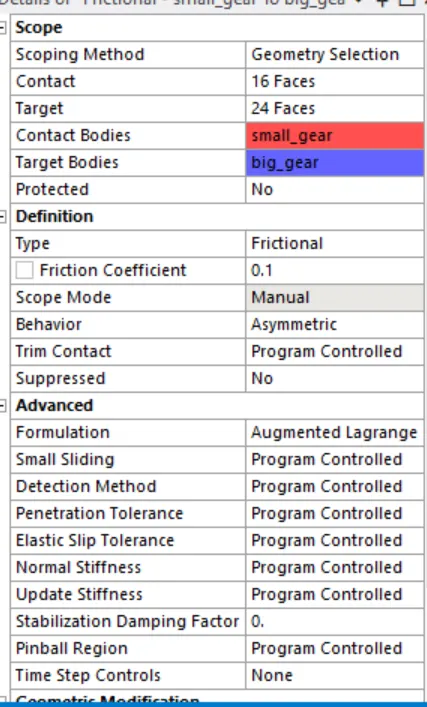
A frictional contact is defined between the tooth faces of the teeth in contact for both the gears with the behavior being set symmetric and "augment lagrange"is being set to reduce chatter and penetration.
- Go to connnections<contacts
- go to type as select frictional,behaviour as asymmetric,formulation as augmented Lagrange,Interface treatment As Adjust to touch
joints:
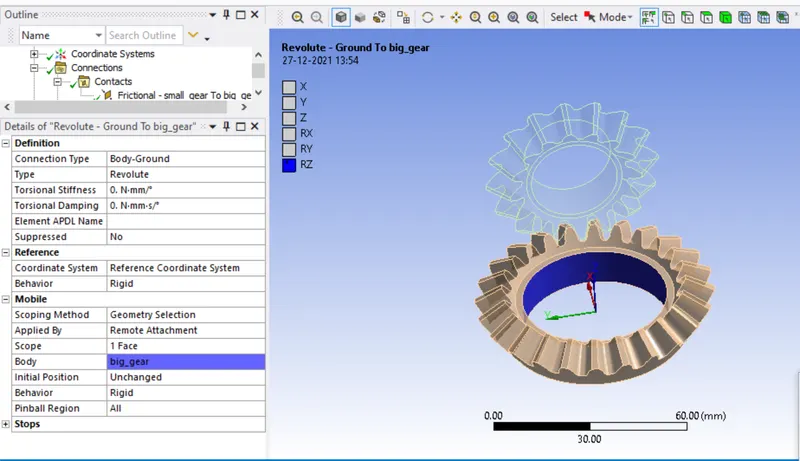
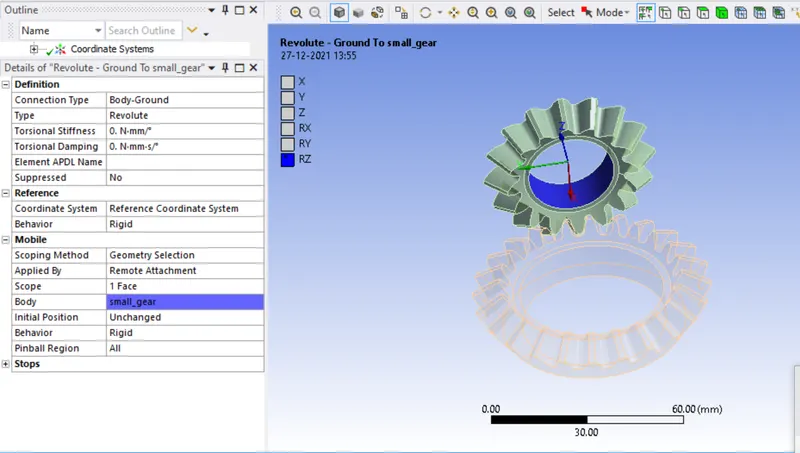
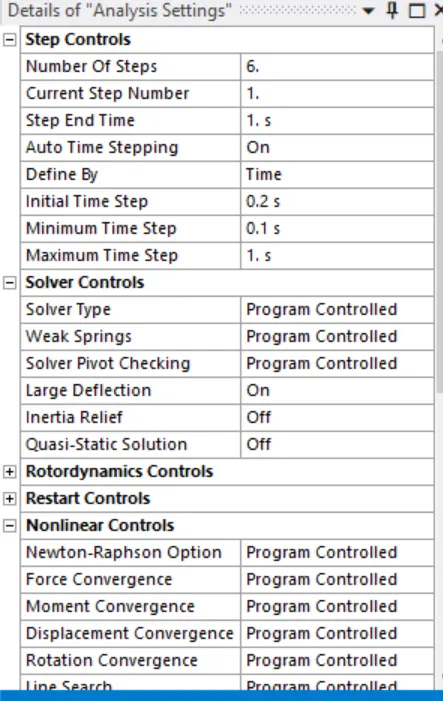
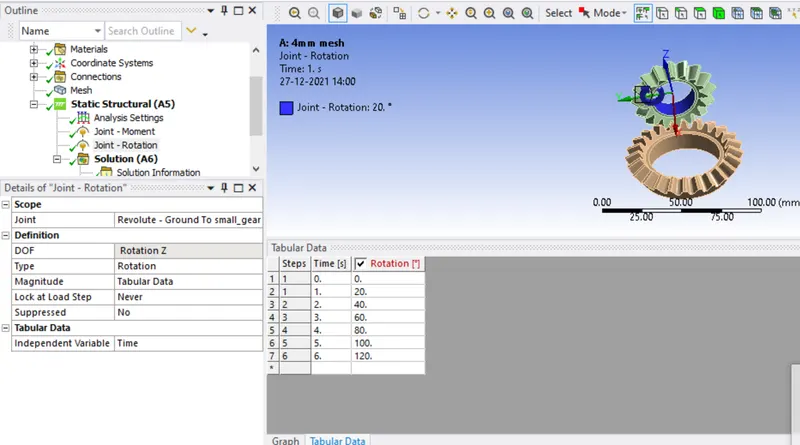
Revolute joints are created for two gears for left gear give rotation in 6steps with 30 degrees each.and for right gear give moment 10N-mm for all steps
- Go to connections<contacts< li=""> </contacts<>
- Go to connections<contacts< li=""> </contacts<>
- now go to static structural<analysis settings
- Go to static structural<insert joint<moment of 100N-MM
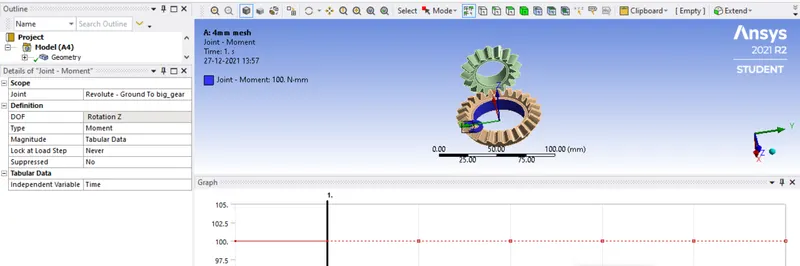
- same procedure for joint2 but we need to give rotation about z axis
- go to mesh
for c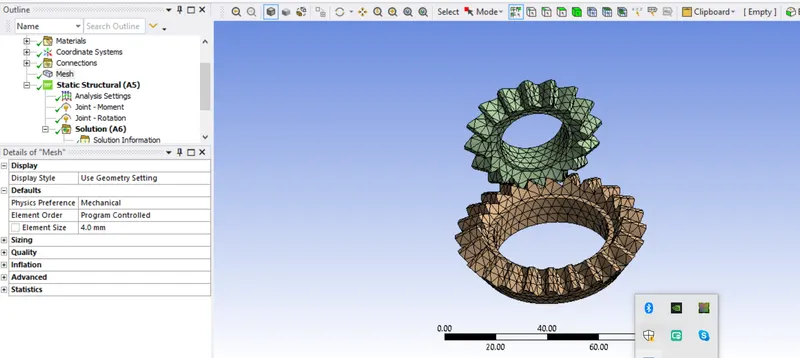
for case 2 change the mesh size to 6mm and for case3 change mesh size to 6mm and compare the results with 3cases
Results:
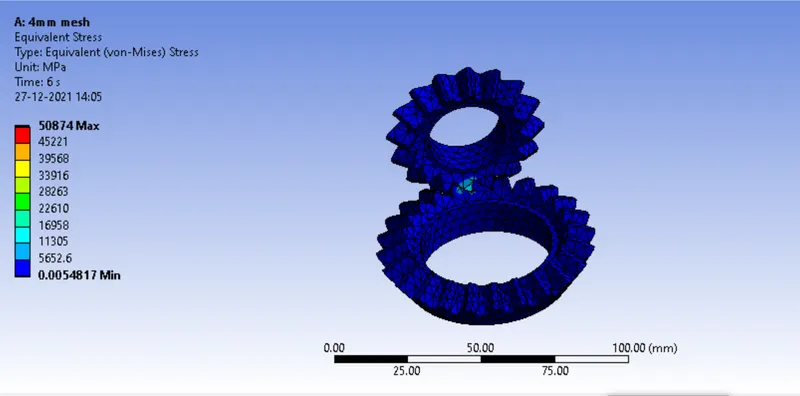
Case1:
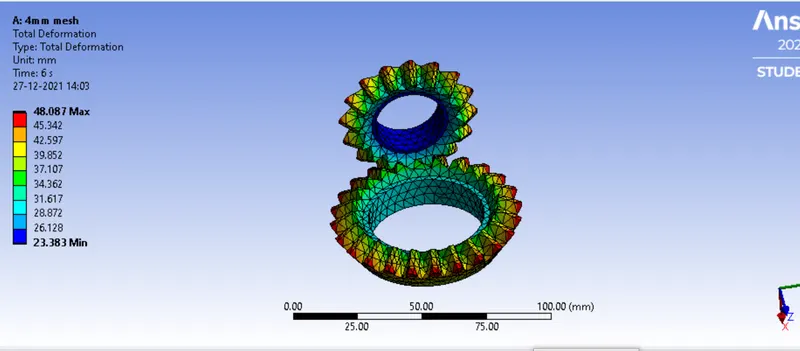
Total deformation:
Equivalent stress:
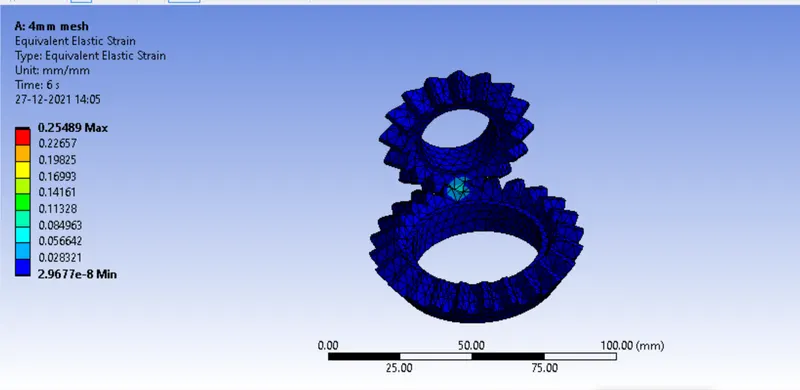
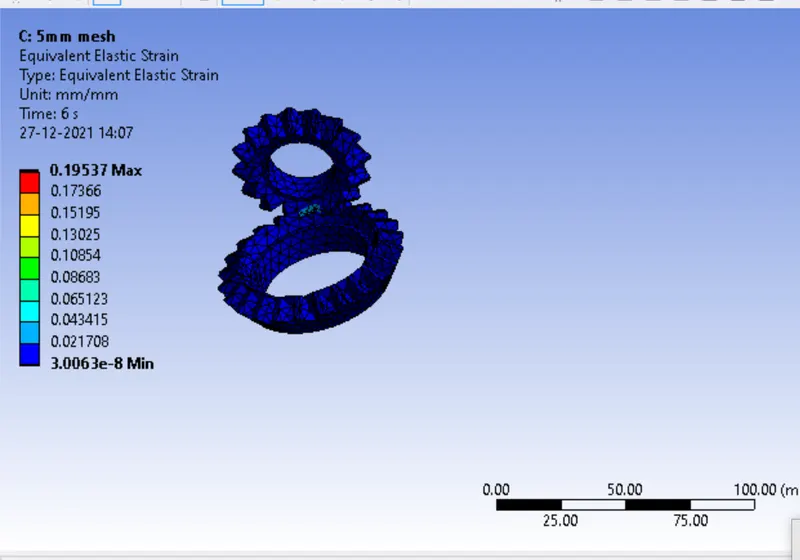
Equivalent strain:
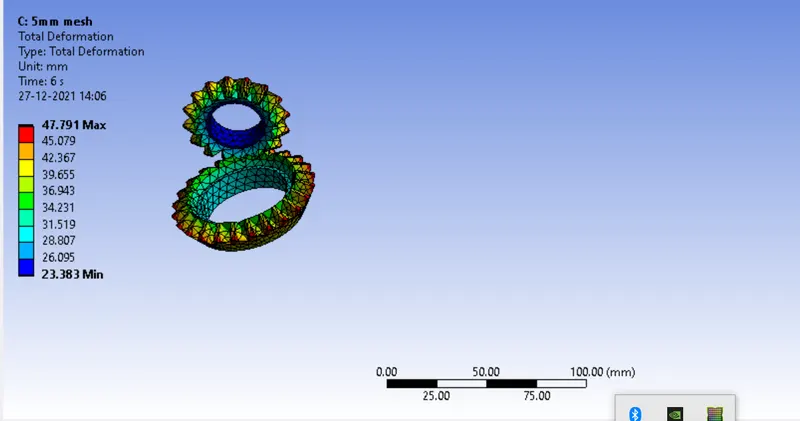
Case2:
Total deformation:
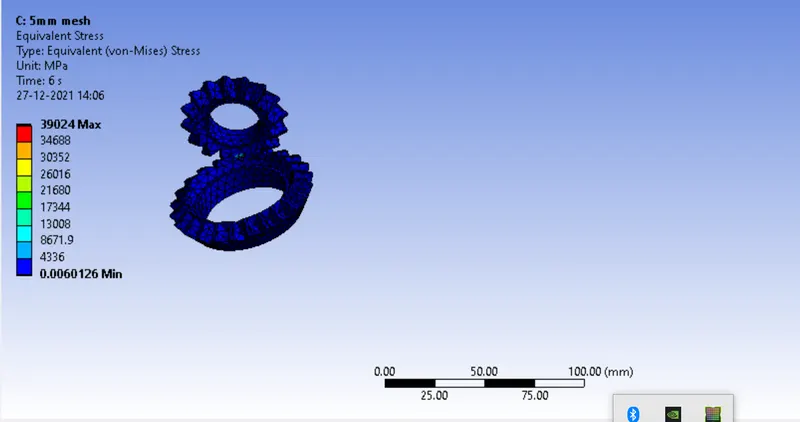
Equivalent stress:
Equivalent strain:
Case3:
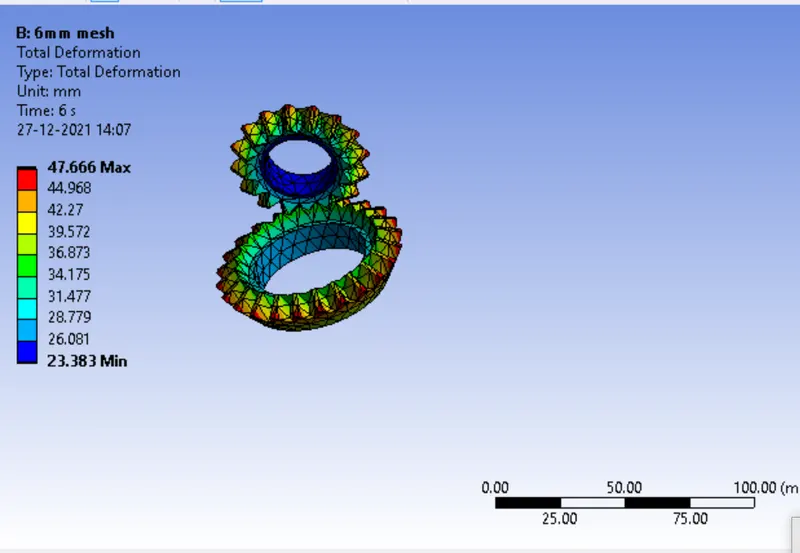
Total deformation:
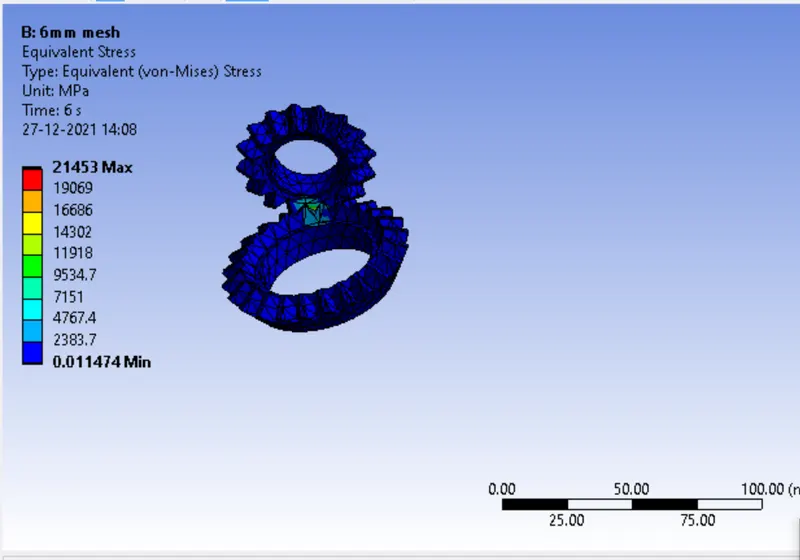
Equivalent stress:
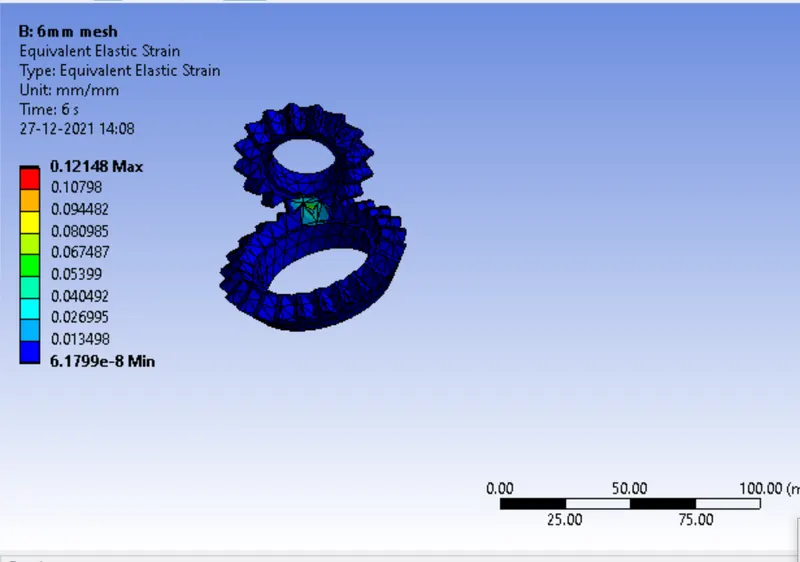
Equivalent strain:
Result comparrison:
| Total Deformation(mm) | Equivalent stress(Mpa) | Equivalent strain | |
| Case1(4mm Mesh size) | 48.087 | 50874 | 0.25489 |
| case2(5mm Mesh size) | 47.791 | 39024 | 0.19537 |
| Case3(6mm Mesh size) | 47.66 | 21453 | 0.12148 |
Discussion:
As the mesh size increases total deformation,equivalent stress,equivalent strain values decreasing