Week-11 Challenge: Braking
1. Process of braking must follow the priciple of conservation of energy which states that the energy cannot be created nor detroyed but bonly it can be converted from one form to another.
Here i have to calculate the energy required for braking for a defined driving cycle. The excel sheet data is as follow.
| TIME | VELOCITY |
| 0 | 0 |
| 1 | 0 |
| 2 | 0 |
| 3 | 0 |
| 4 | 0 |
| 5 | 10 |
| 6 | 10 |
| 7 | 10 |
| 8 | 11 |
| 9 | 12 |
| 10 | 16 |
| 11 | 17 |
| 12 | 0 |
| 13 | 0 |
| 14 | 0 |
| 15 | 0 |
| 16 | 15 |
| 17 | 15 |
| 18 | 15 |
| 19 | 17 |
| 20 | 18 |
| 21 | 19 |
| 22 | 25 |
| 23 | 30 |
| 24 | 18 |
| 25 | 40 |
| 26 | 40 |
| 27 | 40 |
| 28 | 40 |
| 29 | 20 |
| 30 | 10 |
| 31 | 0 |
| 32 | 0 |
The drive cycle data is plotted in a line graph which is shown below:
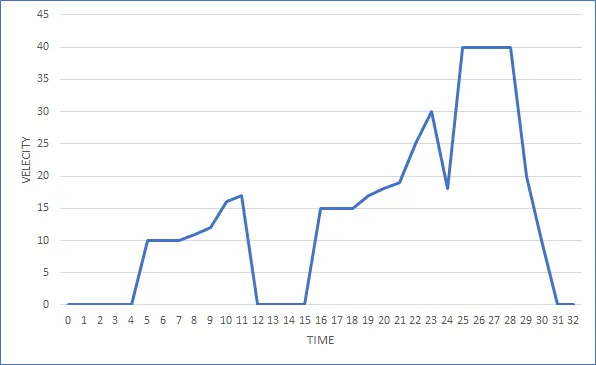
So I am going to calculate the braking energy at the points where there is deacceleration.
Braking energy is nothing but the kenetic energy released during braking.
Initially, speed is reduced from 17m/s to 0 at 12 seconds.
K.E = 0.5*M*V^2
M is the mass in kg
V is the velocity in m/s
Let us assume the total mass of the vehicle is 400kg.
V = initial-final velocity
V = 0-17
M = 400kg
K.E = 0.5 * 400* (0-17)^2
K.E = 57800J or 57.8KJ
Now same from 30m/s to 18m/s
M = 400kg, V = 18-30 = -12
K.E = 0.5* 400* (-12)^2
=28800J or 28.8J
Now from 40m/s to 0m/s that is bringing to rest.
V = 0-40 = -40m/s
K.E = 0.5*400*(-40)^2
K.E = 320KJ
So the total drive cycle braking energy is
= 57.8K + 28.8K + 320K
= 406.6 KJ
2.
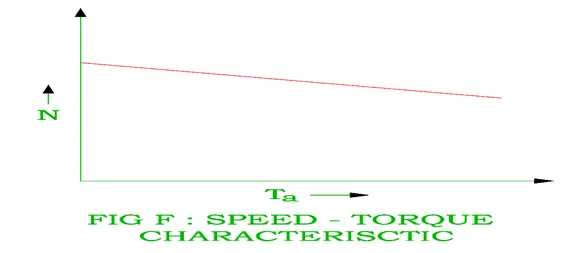
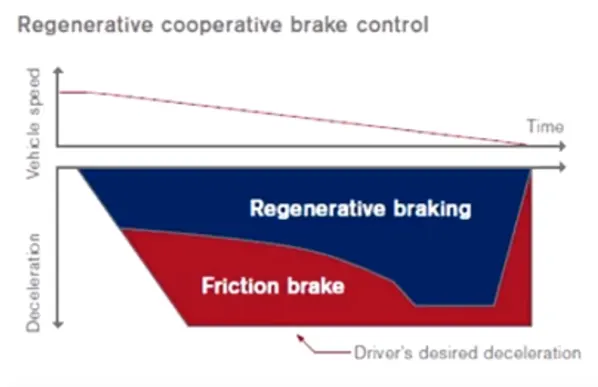
During initial braking time, mechanical brakes are used in large proportion than regenerative braking. Regenerative braking is an effective approach to extend the driving range of anEV. The regenerative braking torque cannot be made large enough to provide all the required braking torque of the vehicle as it might lead to the deterioration in stability of the vehicle. Acceleration torque is higher than deacceleration torque. At high speed, the motor might be in its constant power region which causes less values of torque produced and its limits the amount of braking torque that is used for regeneration. Hence the peak value of acceleration torque and braking torque are not equal.
There are two types of braking used in vehicles:
- Mechanical brakes
- Electrical brakes
Mechanical brakes:
It consist of mechanical elements for the slowing or stopping of shafts in equipment drives.Braking slows or stops the movement of the coupled shafts. It acts by generating frictional forces as two surfaces rub against each other.
Electrical brakes:
Here we use current to control the speed. Mostly regenerative braking is used.
Series braking:
Here brakes are applied one after the other meaning first the electric brakes are applied followed by the mechanical brakes. For example, Suppose if we are driving a vehicle and we are approaching a traffic signal so before reaching the signal if we release the accelerator paddle than the vehicles speed will be reduced and regenerative braking will occur and when we reach near to the signal press the brake paddle which will apply mechanical brakes. So in this way series braking can be done one after the other.
Parallel braking:
Both mechanical and electric brakes re applied at the same time. When the brake paadle is pressed the pressed the brake fluid will reach the brake piston and cause will retard the motion of wheels, there will be some kinetic energy lost. That kinetic energy lost will be reuses at the same time by regenerative braking to charge the power using bi-directional motor/generator so in this Wy both electric and motor will work simultaneously.
3. clc
speed = linspace(1,1500);
torque = linspace(1,350);
kc = 0.1;
ki = 0.007;
kw = 0.00001;
c = 20;
[x,y] = meshgrid(speed, torque);
copper_loss = kc*(y.^2);
iron_loss = ki*x;
windage_loss = kw*(x.^3);
Totalloss = copper_loss + iron_loss + windage_loss + c;
power_out = x.* y;
input_power = power_out + Totalloss;
z = [0.7,0.8,0.85,0.9,0.9,0.91,0.925,0.94,0.95];
eff = power_out./ input_power;
box off
grid off
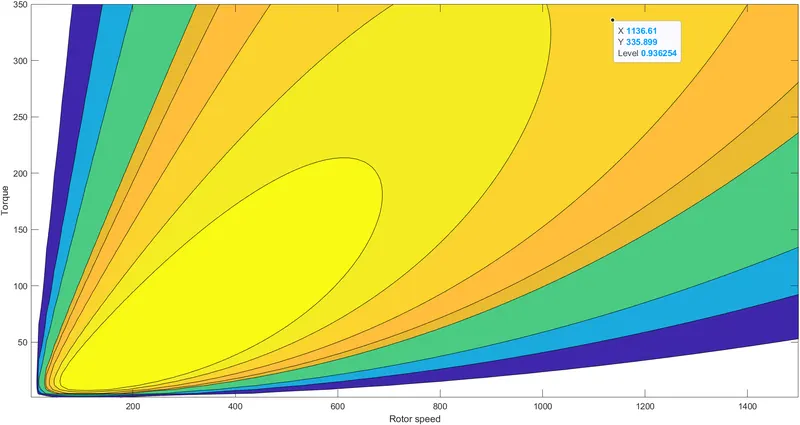
contourf(x,y,eff,z);
xlabel('Rotor speed');
ylabel('Torque');
zlabel('Efficiency');
Output graph is as