Week-11 Challenge: Braking
AIM -
- To Calculate the energy required for braking for a defined Driving cycle.
- To Explain why the electric motor can’t develop braking torque at a high speed similar to starting and How electric and mechanical brakes are coordinated.
- To Make a MATLAB program that plots the contour of given motor speed, torque and efficiency values.
1. For a defined driving cycle, calculate the energy required for braking.
the well-defined driving cycle we have used is UDDS driving cycle and took the values from this link
EXCEL SHEET - https://drive.google.com/file/d/100bi3t4gqBx97c0V01hDKzGkj_KNGsml/view?usp=sharing
the excel sheet is calculated, assuming vehicle mass as 1000kg and taken velocity values from UDDS driving cycle data.
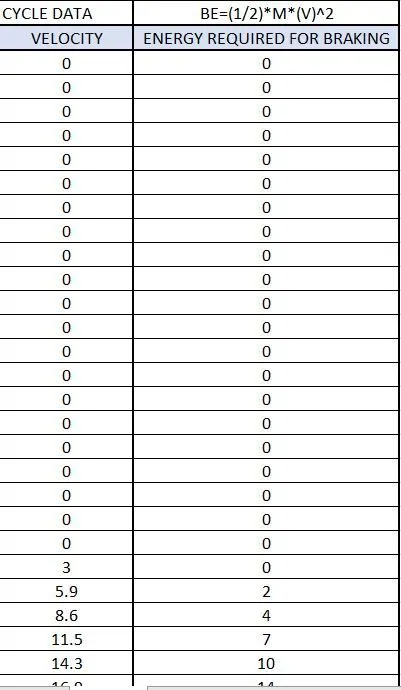 |
To calculate the energy required for braking,
The formula used for the energy required for braking `= ((1)/(2))*mv^2`
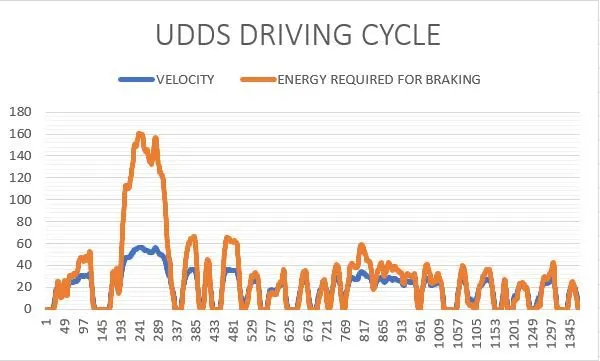 |
The above graph is plotted by using an excel sheet.
suppose if we need to calculate the energy required for braking from 100km/hr To 10 km/hr.
we can use this formula - B.E = `((1)/(2))*m*(v_i - v_f)^2`
where,
`V_i =` initial velocity
`V_f =` Final velocity
m = mass of the vehicle.
here initial velocity is 100km/h and final velocity is 10km/h and the total mass of the vehicle is 1000kg
to convert km/h to m/s, we need to divide the speed by 3.6.
the energy required by the vehicle for deceleration is `(1/2)*(1000)*(27.77-2.77)^2`= 312 kJ`
RESULT - Calculated the energy required for braking for a defined Driving cycle.
2. Why electric motor can’t develop braking torque at a high speed similar to starting? How electric and mechanical brakes are coordinated?
- the electric motor can’t develop braking torque at a high speed similar to starting because the torque of the electric motor is inversely proportional to the square of the rotor speed, (i.e) when the speed of the motor increases then torque decreases. The reason, why electric motor can't develop braking torque at a high speed similar to starting, is because During the starting stage, the speed values are low and thus torque produced is much high and During the braking stage, the speed of the motor is of very high value and sometimes greater the synchronous speed values, thus due to high-speed values the braking torque generated will be a low value only.
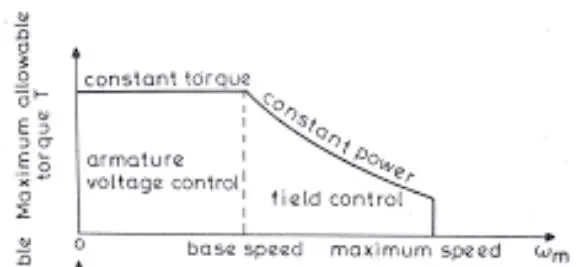 |
In the above, Graph we can clearly see that during starting the torque is high and constant and gradually decreases as speed increases.
- Coordination of electric brake also known as regenerative brake and mechanical braking - Normally in an electric vehicle we can accelerate from 0 to 100km/hr in 10secs but we cannot decelerate from 100-0km/h in 10 seconds because peak acceleration torque and peak deceleration torque are not equal in an electric motor.
- We cannot use regenerative braking alone to stop the vehicle, therefore, there is two control strategy to control the braking of the electric vehicle.
The two electric braking control strategies are series and parallel brake control strategies.
Series Brake Control Strategy -
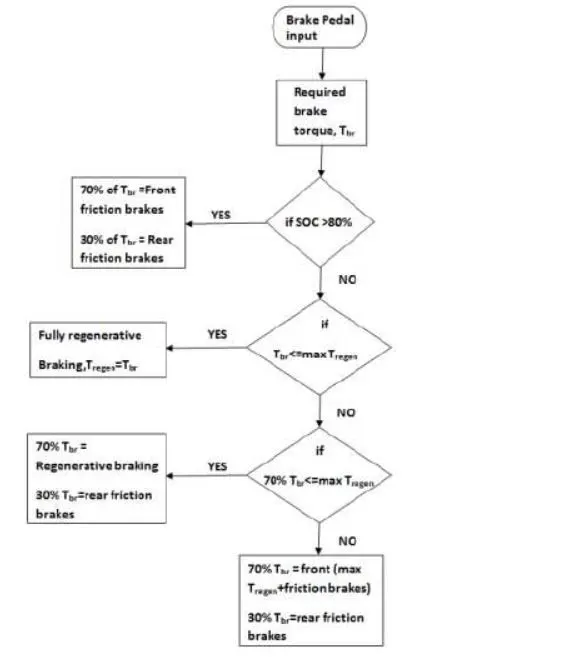
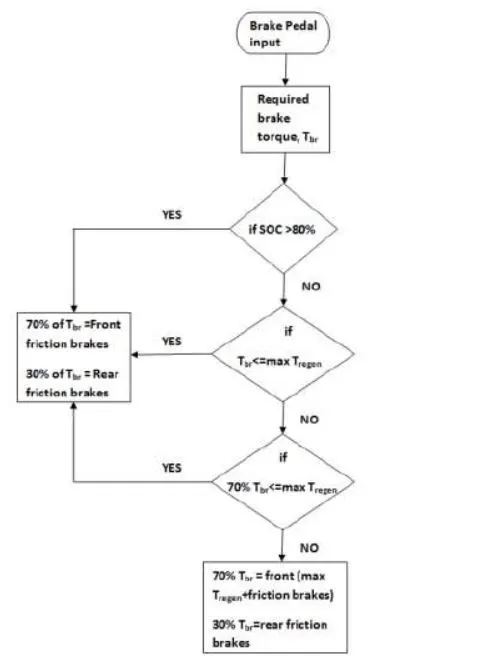
In this type of brake strategy, electric brake and mechanical brake are applied one after the other. Firstly the brake pedal is pressed depending upon the pressing force of the brake pedal the brake control signal is sent. With the help of the control, the signal sent the controller checks for the state of charge of the battery if it is less than 80%, then the battery can be charged, then once the soc of the battery is less than 80% then the controller checks whether the braking torque required by the motor is less than the maximum applicable regenerative braking torque. If required braking torque is less than maximum regenerative braking torque then the vehicle completely uses an electric brake and charges the battery until it reaches 80% soc. if the required braking torque is greater than regenerative braking torque then mechanical brakes come into action.
 |
Parallel brake control strategy -
In this type of brake strategy, electric brake and mechanical brake are applied simultaneously. Firstly the brake pedal is pressed depending upon the pressing force of the brake pedal the brake control signal is sent. the controller checks whether the SOC of the battery is less than 80% if it less than 80% then it will check whether the required braking torque is less than maximum regenerative torque, if yes it will simultaneously apply electric braking while checking for the first condition. if both the conditions are false then it will use 70% front friction brake and 30% rear friction brake and once the required braking torque is less than maximum regenerative braking then electric braking comes into action. all this process takes place parallelly.
 |
Result - Explained why the electric motor can’t develop braking torque at a high speed similar to starting and How electric and mechanical brakes are coordinated.
3. Make a MATLAB program that plots the contour of given motor speed, torque and efficiency values. Attach the code as a .m file attach a screenshot of all the plots.
CODE -
clear all;
close all;
clc;

Torque= linspace(0,400)             %Input Torque
Speed= linspace(0,1000)             %Input Speed
[w,T]= meshgrid (Speed,Torque);      % 2D array Conversion

Kc= 0.3;         % Coppper loss constact
Ki= 0.009;       % Iron loss Constant
Kw= 0.000015;     % Windage loss constat
K=30;            % constant loss

Pout= w.*T;           %Output Power
Copperloss=Kc*(T.^2);
Ironloss=Ki*w;
windageloss=Kw*(w.^3);

Pin=Pout+Copperloss+Ironloss+windageloss+K;    %Input power
eff = Pout./Pin


contour(Speed,Torque,eff)
title('Torque-speed-efficiency Contour of the induction motor');
xlabel('SPEED');
ylabel('TORQUE');
Explanation - Input speed and torque are coded using the linspace command. To Create 2-D grid coordinates with W-coordinates defined by the vector speed and T-coordinates defined by the vector and T-coordinates defined by the vector torque. we have used the mesh grid function. basically, in a motor, there are 4 losses, copper loss, Iron loss, windage loss and last one is constant loss. specifying the loss constants. Output power is equal to W*T and then finding all the losses with help of loss constants. To find the input power we need to sum all the losses and output power and to find the efficiency we need to divide output power by input power.
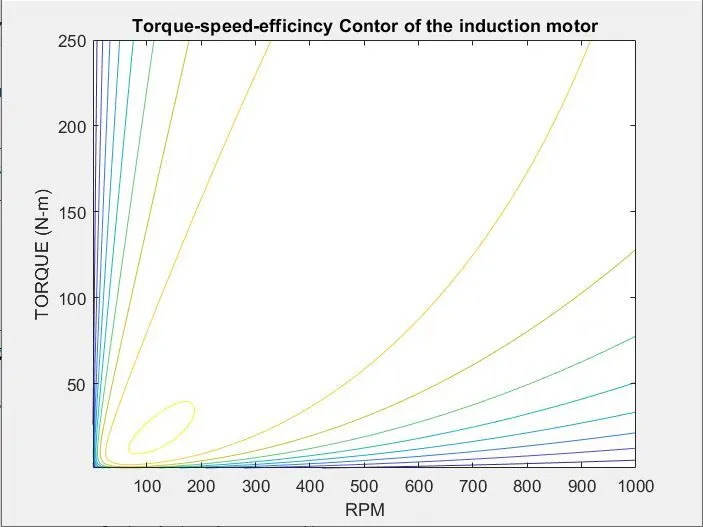 |
From the output graph, you could see that only at a particular speed and torque the efficiency is at maximum.
m-file - https://drive.google.com/file/d/19JxL07tb1YWv-vxeshuATLkMsSkvXJvJ/view?usp=sharing
Result - Made a MATLAB program that plots the contour of given motor speed, torque and efficiency values.