Week-6 Challenge: EV Drivetrain
AIM -
- To explain the types of power converters are employed in an electric and hybrid electric vehicle.
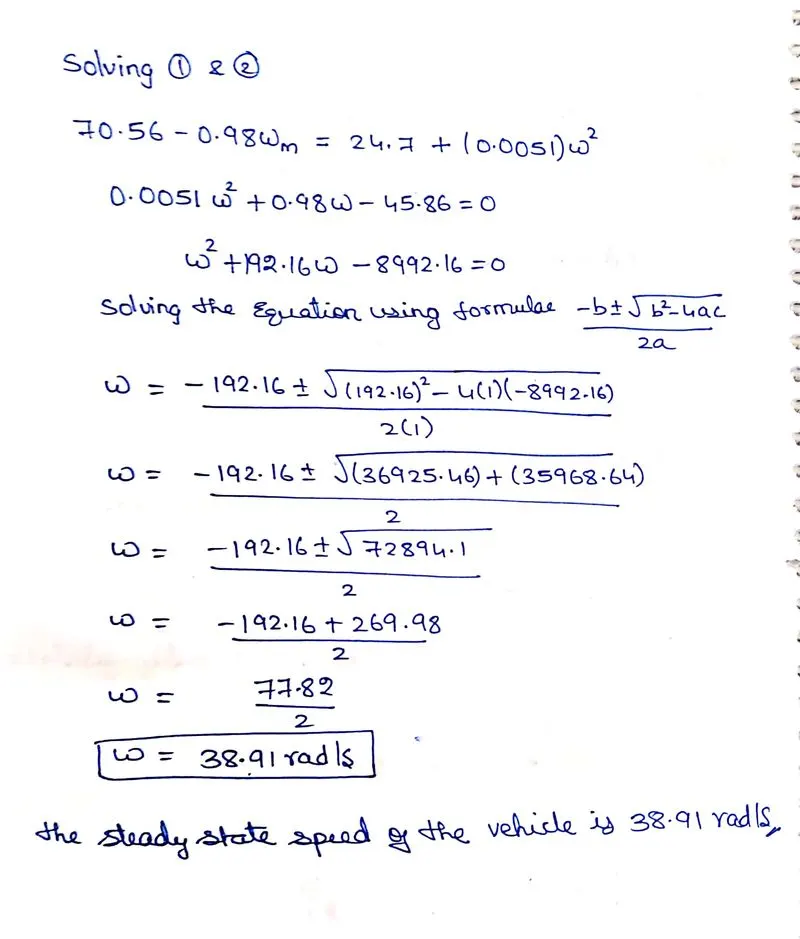
- To Calculate the steady-state speed of the electric vehicle if the duty cycle is 70%, with given details.
- Refer to the blog (https://www.tesla.com/blog/induction-versus-dc-brushless-motors) and explain the author’s perspective.
1. Which types of power converter circuits are employed in an electric and hybrid electric vehicle?
Power converters - Power electronic converters perform various basic power conversion functions. This converter is a single power conversion stage that can perform any of the functions in AC and DC power conversion systems.
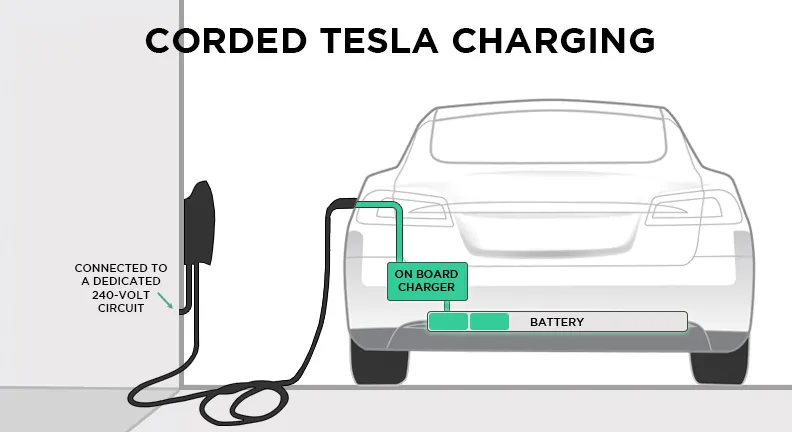
- AC-DC CONVERTER - One major problem with an electric vehicle is its range anxiety hence there is a need for an onboard charger that takes AC and converts it into DC and charges the battery.
 |
- DC-DC CONVERTER - DC-DC converter is used to convert high voltage dc to low voltage. The reason for this conversion is that the converted low voltage DC is used by auxiliary equipment such as headlights, Air conditioner, etc. With a DC-DC converter, we can also step up the voltage if needed. If an EV needs to accelerate faster it will need more voltage the DC-DC converter steps up the voltage level.
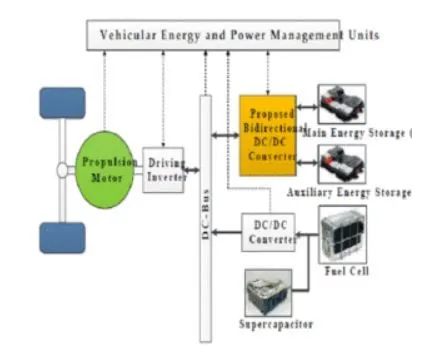 |
- DC-AC CONVERTER - DC-AC converter is also known as inverter which is used to convert power from a battery(DC) to AC which is required by an induction motor(AC motor).
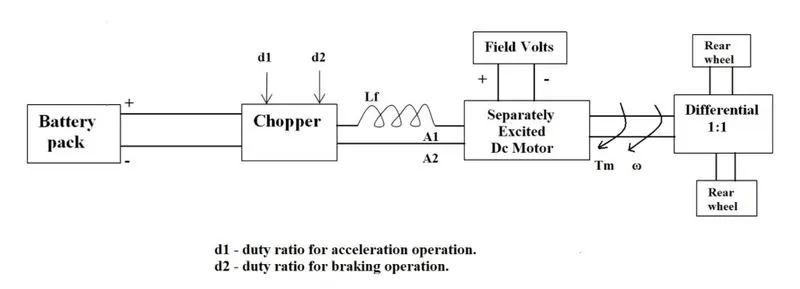
2. An Electric Vehicle's powertrain with a 72V battery pack is shown in the diagram below. The duty ratio for acceleration operation is 'd1' and for the braking operation the duty ratio is 'd2'.
The other parameters of the electric vehicle are given below,
Motor and Controller Parameters:
Rated Armature voltage= 72 V
Rated armature current= 400 A
Ra= 0.5Ω, KΦ= 0.7 Volt second
Chopper Switching frequency= 400 Hz
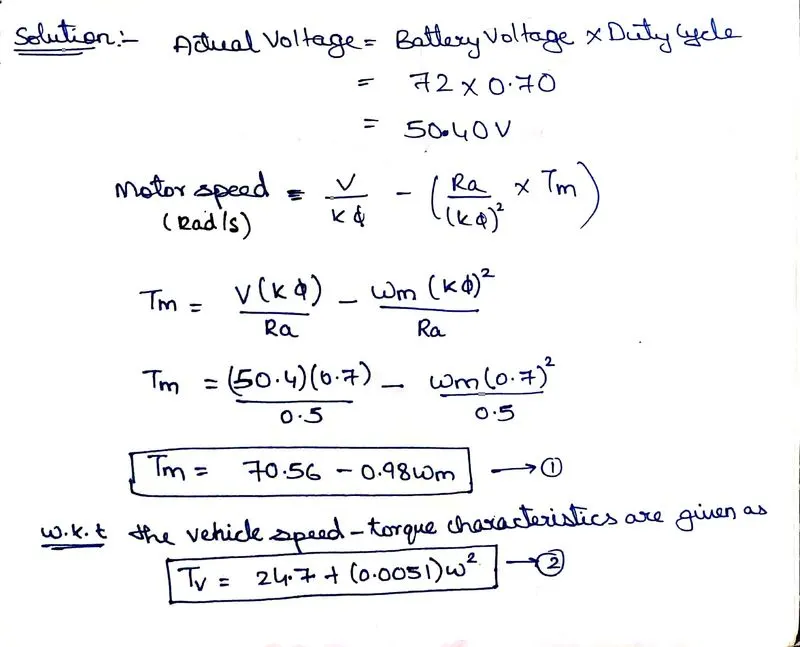
The vehicle speed-torque characteristics are given by the below equation
What is EV steady-state speed if the duty cycle is 70%?
 |
Solution -
 |
 |
3. Refer to the blog on the below topic:
Induction Versus DC brushless motors by Wally Rippel, Tesla
Explain in brief about author’s perspective.
The author wally ripple in this blog explained the working principle of dc brushless and three-phase induction motor and he also said that we can see great advancements for these motors concerning their requirements in the future.
the author starts elaborating the advantages of brushless dc motor and three-phase induction motor
| Brushless dc motor | 3phase induction motor |
| ADVANTAGES | ADVANTAGES |
|
|
| DISADVANTAGES | DISADVANTAGES |
|
|
finally, in the battle between these two motors, there is no winner. Because both are good in their own ways, the author said that DC brushless motor will continue to dominate in hybrid and plug-in hybrid vehicle and whereas when it comes to high-performance pure electric vehicles induction is preferred more.