Week 10 Challenge- Frame analysis and MATLAB Module for Gauss Elimination Method
OBJECTIVE:-
1) Assume a structure frame. Write down a displacement matrix with variables corresponding to pre-selected degrees of freedom and degrees of freedom to be eliminated. Mathematically, derive the process that takes the original set of equations and condense it to the form shown below
Equtaion given is
[k]`[delta]`=[p]
The `[delta(b) delta(c)] =delta`
So we know that
[k] = [kbb kbc;kcb kcc]
[p]=[pb pc]
[kbb kbc;kcb kcc] `[delta(b) delta(c)]` = [pb pc]
So we need to solve the equations above
we get
kbb*`delta(b)` + kbc*`delta(c)`= pb and kcb*`delta(b)` + kcc*`delta(c) = pc`
ON Reducing above equattion in form of `delta(b)`
`delta(b)`= pb/kbb - [kbc*`delta(c)`/kbb]
putting this equation in above equation (a)
So we get the condensed equation
K[condensed]= [kcc -kbc*kbc/kbb]
2) Eliminate the rotational degree of freedom from the system of the structure shown below and express the stiffness matrix in terms of the
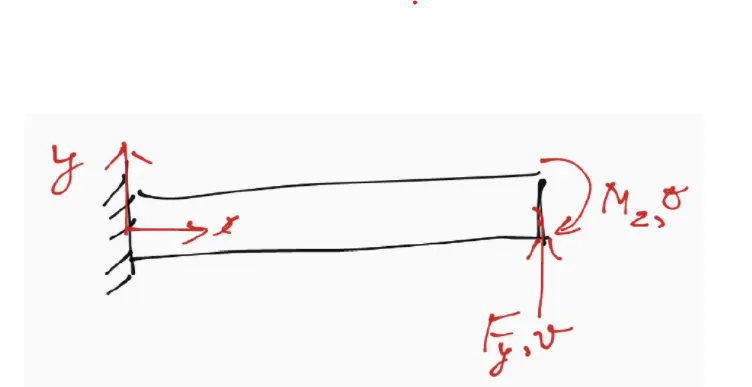
We can say it
K = [AE/L 0 -AE/L 0; 0 3EI/L^2 0 -3EI/L^2; -AE/L 0 AE/L 0;0 -3EI/L^2 0 3EI/L^2]
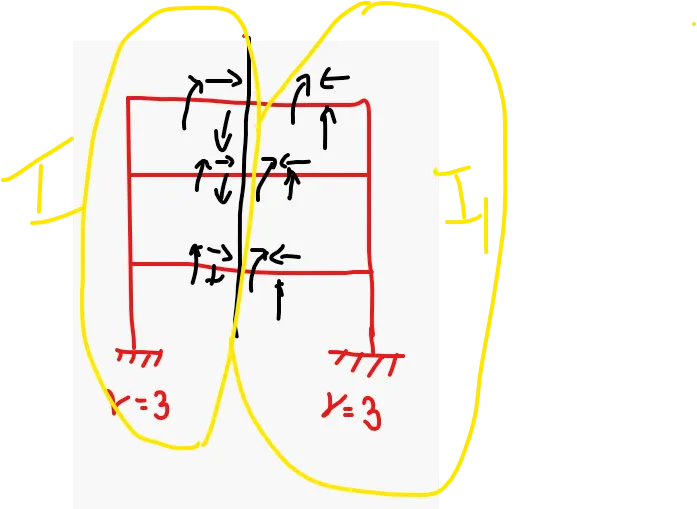
3) Explain the concept of sub structuring with the example of a portal frame given below
Substructuring is a standard technique in Finite Element Analysis Substructuring is one of the two common domain decomposition methods and is also called the Schur Complement domain decomposition method. The basic idea is to treat a group of elements as a single substructure. The use of substructures is attractive in various cases. For example, if many elements in a nonlinear model behave linearly, these elements can be put in a substructure. The internal degrees of freedom in the substructure is then removed by static condensation.
4) Explain the type of flexible connections applied in the structural framing systems
When a vertical load is applied to a horizontal beam it is immediately subjected to bending, this bending creates a rotational moment at the beam end, and to prevent this moment from being transmitted to the supporting beam or column, it’s designed to be flexible. Likewise, if the structure is subject to lateral displacement, due mostly to wind or seismic activity, the flexible connection will not offer significant resistance to the resulting moment. This flexibility is determined by the Rotational Capacity of the connection - which is largely governed by the deformation capacity of the connection components and the ‘slip’ between the connected parts. Therefore, the components of a flexible connection should be as thin as reasonably possible and the bolt-hole cross-centers should be wide enough to prevent the build-up of restraining moments.
1) Unrestrained:-
Moment resistance of cantilever walls
2) Partially restrained
Rigid beam-column connections and Moment resistance of cantilever walls
3)Fully constrained
Pin support and Rigid beam-column connections and Moment resistance of cantilever walls
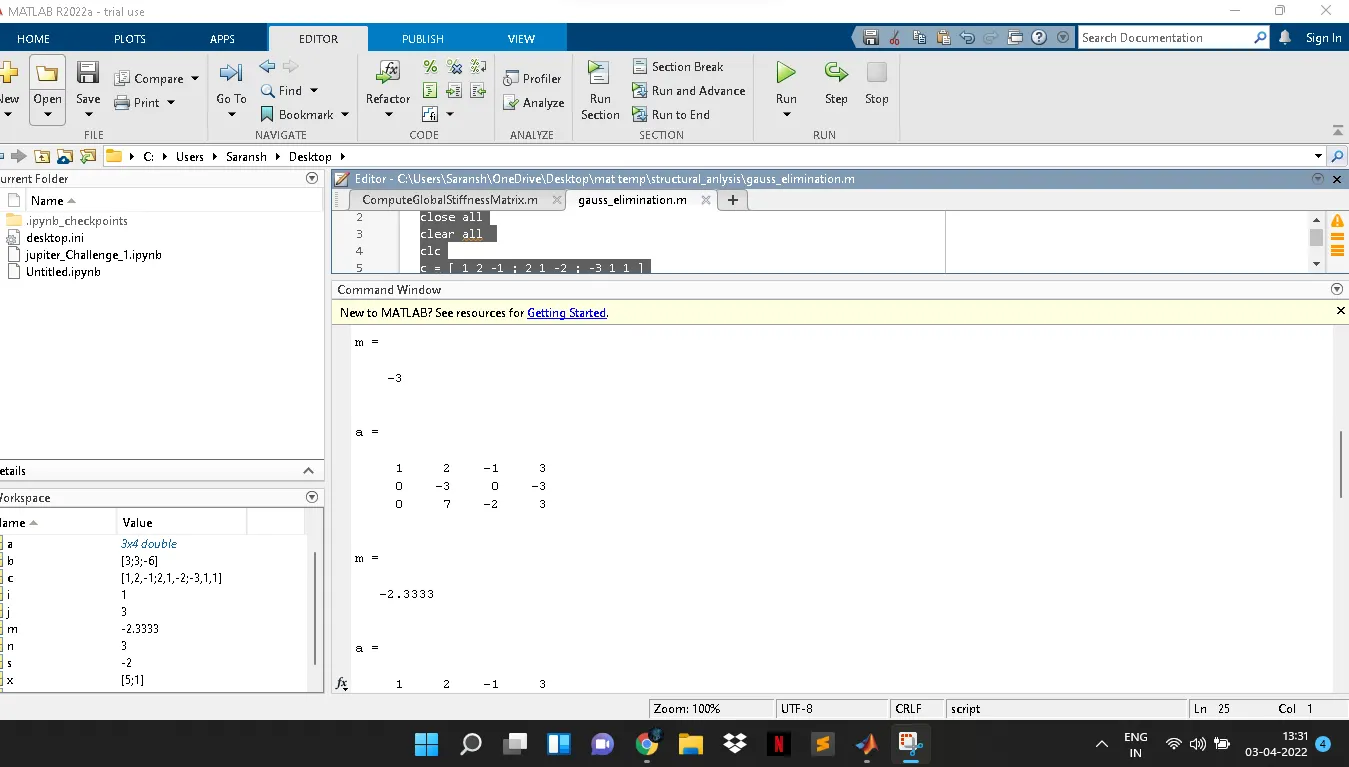
5) Read online about Gauss Elimination Method, Develop a Matlab module to solve linear
equations by the method of Gauss Elimination
In mathematics, Gaussian elimination, also known as row reduction, is an algorithm for solving a system of linear equations. It consists of a sequence of operations performed on the corresponding matrix of coefficients. This method can also be used to compute the rank of a matrix, the determinant of a square matrix, and the inverse of an invertible matrix.
% PROGRAM FOR GAUSS ELIMINATION METHOD
close all
clear all
clc
c = [ 1 2 -1 ; 2 1 -2 ; -3 1 1 ]
b= [ 3 3 -6 ]'

a= [c b];
n = size(a,1);
y = zeros(n,1);
for i=1:n-1
    for j=i+1:n
        m=a(j,i)/a(i,i)
        a(j,:) = a(j,:) - m*a(i,:)
    end
end
y(n) = a(n,n+1)/a(n,n)
for i=n-1:-1:1
s=0
for j=i+1:n
    s=s+a(i,j)*y(j,:)
    x(i,:) = (a(i,n+1)- s)/a(i,i)
    end
end
Conclusion:
https://en.wikipedia.org/wiki/Gaussian_elimination
https://in.mathworks.com/matlabcentral/answers/340236-gaussian-elimination-technique-by-matlab