Week 1 Understanding Different Battery Chemistry
EV BATCH17
AIM:To understanding the different battery chemistry and prepare a table as well as compare the caracteristics.
objective:
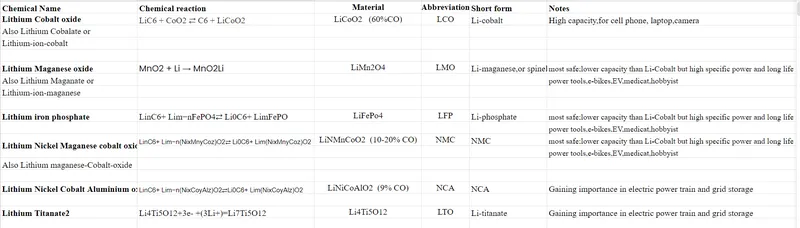
Lithium cobalt oxide:
- Inside a Lithium-ion battery,oxidation-reduction (redox) reactions takes place.
- Reduction takes place at the cathode. There, cobalt oxide combines with lithium ions to form lithium-cobalt oxide (LiCoO2). The half-reaction is:
CoO2 + Li+ + e- → LiCoO2
- Oxidation takes place at the anode. There, the graphite intercalation compound LiC6 forms graphite (C6) and lithium ions. The half-reaction is:
LiC6 → C6 + Li+ + e-
- Here is the full reaction (left to right = discharging, right to left = charging):
LiC6 + CoO2 ⇄ C6 + LiCoO2
- positively charged lithium ions (Li+) move from the negative anode to the positive cathode.
- They do this by moving through the electrolyte until they reach the positive electrode.
- There, they are deposited.
- The electrons, on the other hand, move from the anode to the cathode.
- When you charge a lithium-ion battery, the exact opposite process happens.
- The lithium ions move back from the cathode to the anode. The electrons move from the anode to the cathode.
Lithium magnese oxide:
- Lithium Manganese Dioxide Battery (Li-MnO2 battery) has two different types, cylindrical type and coin type.
- It is a high-reliability and lightweight battery with an operating voltage of 3V. And it has the ability to operate over a wide temperature range.
- It has a wide range of applications, both for powering devices, security equipment and can be used in all types of electronic devices.
The positive active material of Li-MnO2 batteries is Manganese Dioxide (MnO2) while negative active material is Lithium (Li).
- Positive reaction: MnO2 + Li+ + e- → MnO2Li
- Negative reaction: Li → Li+ + e-
- Total reaction: MnO2 + Li → MnO2Li
Lithium iron phosphate:
- When LFP batteries discharge, lithium molecules from the negative electrode detach from layered graphene, becoming lithium ions and electrons.
- The electrons travel out of the battery as lithium ions move across a separator and both integrate into iron phosphates at the positive electrode.
- During charge, lithium separates from the iron phosphate, generating lithium ions and electrons.
- The lithium ions and electrons transfer to the positive electrode and integrate into the graphene structure.
Anode :LinC6→Li0C6+ nLi++ ne−
Cathode: Lim−nFePO4+ nLi++ ne−→LimFePO4
Overall: LinC6+ Lim−nFePO4→Li0C6+ LimFePO
Lithium nickel maganese cobalt oxide:
- NMC is a Li-ion battery with a different type of cathode. Unlike LFP, which possesses good capacity and stability, NMC demonstrates an improved cycle life, thermal stability, and energy density.
-
Its layered cathode structure demonstrates a single-phase intercalation process as opposed to olivine structures with two phases.
-
The cathode of NMC consists of Li(NixMnyCoz)O2 , where the sum of the molar fractions (x, y, z) is equal to one.
-
The discharge chemistry of NMC is similar to LFP, as they are both Li-ion batteries.
-
It follows the process of lithium oxidation on the anode and reduces at the cathode. The discharge reaction proceeds from left to right, whilst the charge reaction proceeds from right to left .
Anode: LinC6→Li0C6+ nLi++ ne−
Cathode :Lim−n(NixMnyCoz)O2+ nLi++ ne−→Lim(NixMnyCoz)O2
Overall :LinC6+ Lim−n(NixMnyCoz)O2→Li0C6+ Lim(NixMnyCoz)O
Lithium nickel cobalt aluminium oxide:
- NCA batteries share many similarities with NMC batteries as they both share the layered cathode structure.
- However, NCA batteries replace the manganese of the NMC batteries with aluminum.
- This improves the specific energy and lifespan when compared to its NMC counterpart.
- NCA batteries also have a high gravimetric capacity of 200 MAh.g−1when compared to the capacities of LMO and LFP batteries at 148 mAh·g−1and 170 mAh·g−1, respectively. Finally, NCA batteries are known to have a long lifespan.
- The main disadvantage of NCA batteries is that they are not as safe as other battery types.
- These batteries require special safety monitoring measures for use in applications such as electric vehicles.
-
The discharge chemistry of NCA batteries closely follows that of the other Li-ion batteries listed above.
-
Lithium undergoes oxidation at the anode and reduction at the cathode, with the discharge reaction occurring from left to right and the charge reaction occurring from right to left. The electrochemical reactions can be seen below
Anode: LinC6→Li0C6+ nLi++ ne−
Cathode: Lim−n(NixCoyAlz)O2+ nLi++ ne−→Lim(NixCoyAlz)O2
Overall: LinC6+ Lim−n(NixCoyAlz)O2→Li0C6+ Lim(NixCoyAlz)O2
Lithium Titanate:
- charged and discharged compound is smaller than 0.1% (8.3595 and 8.3538 Å).
- This determines a high stability of the material during cycling.
- With such close parameters, lithiated and delithiated forms have very low mutual solubility. (7% and 3%, respectively ).
- Thus, during the charge and discharge, phases of the composition Li6.93Ti5O12 and Li4.03Ti5O12 coexist.
- This determines the almost unchanged potential during cycling, which is equal to 1.55 V.
- The major disadvantage of lithium titanate is a low electronic (10−12–10−13 S cm−1) and lithium (3.10−10 S cm−1) conductivity. So Li4Ti5O12 is often obtained in the form of nanomaterials.
overall:Li4Ti5O12+3e- +(3Li+)=Li7Ti5O12
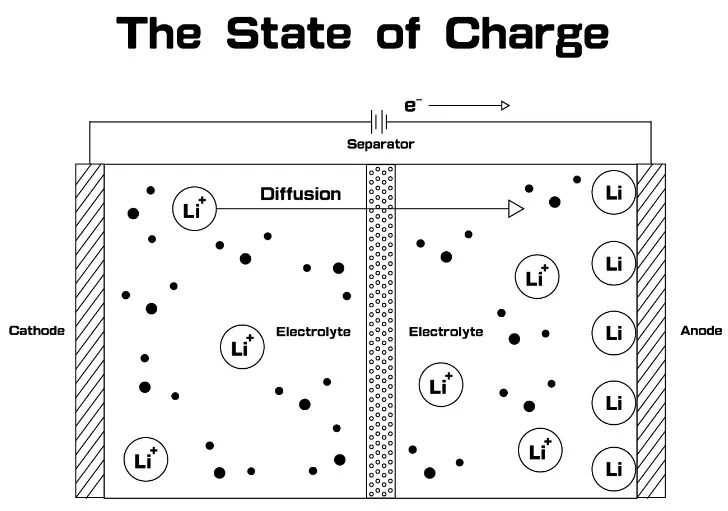
In the charged state:
- To achieve energy storage, Lithium ions will be released from the positive electrode that has lithium-containing.
- At this time, the lithium ions use the electrolyte as a transmission medium to diffusion and through the separator and then embed into the negative electrode material that can receive lithium ions.
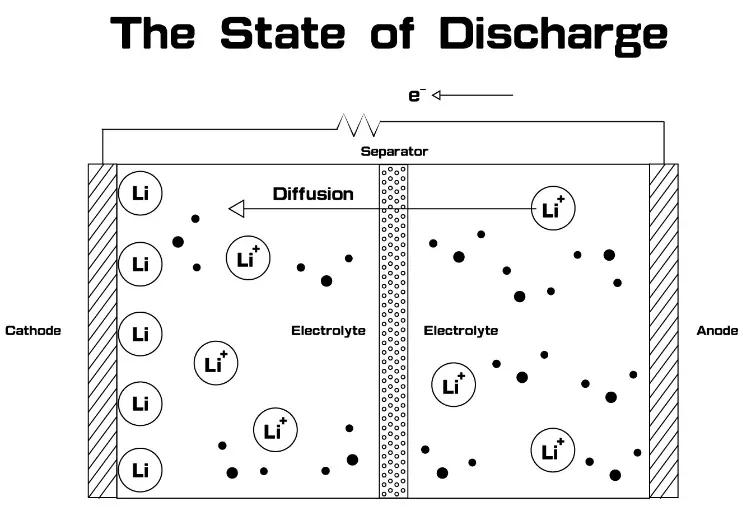
In the discharge state:
- The lithium ions will released from the negative electrode, and use the electrolyte as a transmission medium to diffusion and through the separator, and then return to the positive electrode.
- Therefore, we can be driven by charge/discharge actions during the limited cycle life of the various types of lithium-ion battery devices.
components of lithium ion batteries:
Cathode:
- A conductive aluminum foil is usually used as a current collector, and then a metal-oxide is containing "lithium" is coated with a solvent, a binder, a conductive agent, and add a little conductive material.
- The cycle life of lithium-ion batteries is closely related to the material used in the positive electrode.
Anode:
- As the advantages of stable cost and high safety, up to 90% of lithium-ion batteries on the market use graphite as the anode material. In the lithium-ion battery market (such as smartphones, Tesla, Gogoro, etc.)
- gradually pursuing the development trend of high capacity, many research teams have invested in the development of silicon-based anode materials based on silicon or silicon oxide in order to improve the energy density of the battery.
Separator:
- The microporous film made of polypropylene (PP)/polyethylene (PE) and other plastics, placed between the positive and negative plates to block the positive and negative electrodes to avoid battery self-discharge and short-circuit between the two poles problem.
- The separator is full of dense micropores, in order to make lithium ions can through, allowing the battery to form a complete charge and discharge circuit.
Electrolyte:
- As a medium for the transfer of lithium ions between the positive and negative electrodes, the common main components of lithium ion battery electrolytes, including EC, DMC, and PC, etc., as an extremely important role in the performance of lithium-ion batteries.
- If you want to improve the battery cycle life, safety, and lithium-ion transmission characteristics, you can start to improve the electrolyte formulation and electrolyte additives.
- Proper lithium-ion battery electrolyte can maximize the performance of lithium-ion batteries.
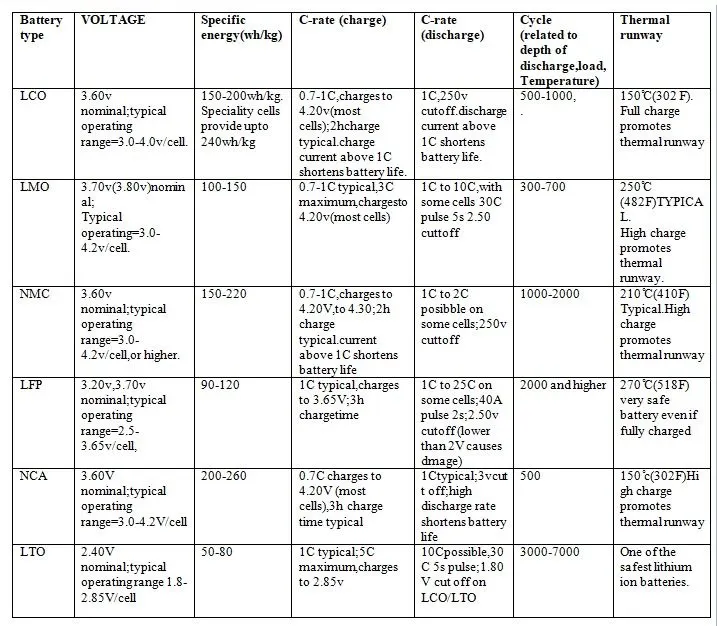
coclusion:
The table and comparison has been described successfully.