Battery Chemistry (Lithium-ion battery)
Battery Chemistry
Aim:
Creating a table to include materials & chemical reactions occurring at the anode and cathode of LCO, LMO, NCA, NMC, LFP, and LTO type of lithium-ion cells.
Theory:
Lithium-ion Battery:
Lithium-ion uses a cathode (positive electrode), an anode (negative electrode), and an electrolyte as a conductor. (The anode of a discharging battery is negative and the cathode positive. The cathode is a metal oxide and the anode consists of porous carbon. During discharge, the ions flow from the anode to the cathode through the electrolyte and separator; charge reverses the direction and the ions flow from the cathode to the anode. Several additives have been tried, including silicon-based alloys, to enhance the performance of the graphite anode. It takes six-carbon (graphite) atoms to bind to a single lithium-ion; a single silicon atom can bind to four lithium ions. This means that the silicon anode could theoretically store over 10 times the energy of graphite, but the expansion of the anode during charge is a problem. Pure silicone anodes are therefore not practical and only 3–5 percent of silicon is typically added to the anode of a silicon-based to achieve good cycle life.
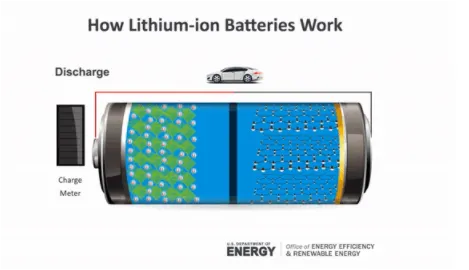
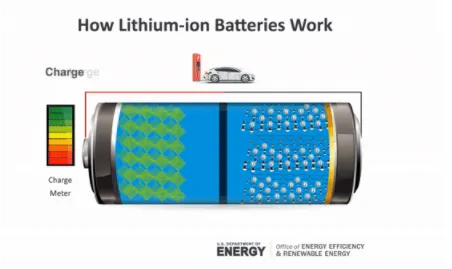
Fig: Discharging and Charing of Lithium-ion Battery
There are three types of crystal structure for the Lithium-ion battery. Crystal structure of the three lithium-insertion compounds in which the Li+ ions are mobile through the 2-D (layered), 3-D (spinel), and 1-D (olivine) frameworks.
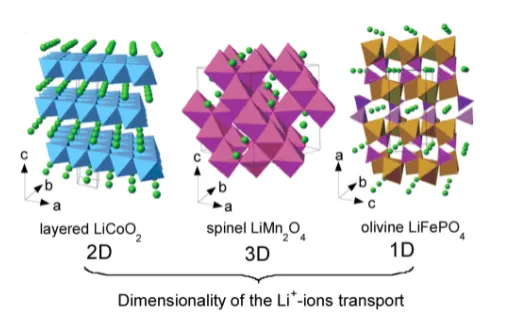
Fig: Types of Structure of Cathode Oxide
Types of Lithium-ion battery are:
1. Lithium Cobalt Oxide (LCO)
The cathode has a layered structure and during discharge, lithium ions move from the anode to the cathode. The flow reverses on a charge. Li-cobalt should not be charged and discharged at a current higher than its C-rating. This means that a 18650 cell with 2,400mAh can only be charged and discharged at 2,400mA. Forcing a fast charge or applying a load higher than 2,400mA causes overheating and undue stress. Li-cobalt excels on high specific energy but offers only moderate performance specific power, safety, and life span.
2. Lithium Manganese Oxide (LMO)
Li-manganese can be discharged at currents of 20–30A with moderate heat buildup. It is also possible to apply one-second load pulses of up to 50A. A continuous high load at this current would cause heat buildup and the cell temperature cannot exceed 80°C (176°F). Although moderate in overall performance, newer designs of Li-manganese offer improvements in specific power, safety, and life span.
3. Lithium Nickel Manganese Cobalt Oxide (NMC)
NMC in a 18650 cell for moderate load condition has a capacity of about 2,800mAh and can deliver 4A to 5A; NMC in the same cell optimized for specific power has a capacity of only about 2,000mAh but delivers a continuous discharge current of 20A. A silicon-based anode will go to 4,000mAh and higher but at reduced loading capability and shorter cycle life. Silicon added to graphite has the drawback that the anode grows and shrinks with charge and discharge, making the cell mechanically unstable. The secret of NMC lies in combining nickel and manganese.NMC has good overall performance and excels on specific energy. This battery is the preferred candidate for the electric vehicle and has the lowest self-heating rate.
4. Lithium Iron Phosphate (LFP)
Li-phosphate has a higher self-discharge than other Li-ion batteries, which can cause balancing issues with aging. Four cells in series produce 12.80V, a similar voltage to six 2V lead-acid cells in series. Vehicles charge lead-acid to 14.40V (2.40V/cell) and maintain a topping charge. Li-phosphate has excellent safety and long life span but moderate specific energy and elevated self-discharge.
5. Lithium Nickel Cobalt Aluminium Oxide (NCA)
It shares similarities with NMC by offering high specific energy, reasonably good specific power, and a long life span. Less flattering are safety and cost. High energy and power densities, as well as a good life span, make NCA a candidate for EV powertrains. High cost and marginal safety are negatives.
6. Lithium Titanate (LTO)
LTO has advantages over the conventional cobalt-blended Li-ion with graphite anode by attaining zero-strain property, no SEI film formation, and no lithium plating when fast charging and charging at low temperature. Thermal stability under high temperature is also better than other Li-ion systems; however, the battery is expensive. At only 65Wh/kg, the specific energy is low, rivaling that of NiCd. Li-titanate charges to 2.80V/cell and the end of discharge is 1.80V/cell. Li-titanate excels in safety, low-temperature performance, and life span. Efforts are being made to improve the specific energy and lower cost.
The following table summarizes the property of the above material.
Notation:
EC: Ethylene Carbonate
PC: Propylene Carbonate
DMC: Dimethyl Carbonate
EMC: Ethyl Methyl Carbonate
DEC: Diethyl carbonate
`LiPF_6` : Lithium Hexafluorophosphate
Electrolyte: The electrolyte is the media that conducts ions between electrodes. It comprises either a salt, an acid, or a base that is dissolved in a solvent. Since lithium reacts violently with water, the electrolyte in a lithium-ion cell is composed of nonaqueous organic solvents plus a lithium salt and acts purely as an ionic conducting medium, not taking part in the chemical reaction. The most commonly used salt is lithium hexafluorophosphate `(LiPF_6)`, which disassociates in the solvent into `Li^+` and `PF^−6`, but other candidates include `LiBF_4` and `LiClO_4`. Common solvents include ethylene carbonate (EC), propylene carbonate (PC), dimethyl carbonate (DMC), ethyl methyl carbonate (EMC), and diethyl carbonate (DEC).
Chemical Reaction:
The chemical reaction taking place at the Anode and Cathode of all the material is;
1. Lithium Cobalt Oxide
At Anode:
`Li_xC_6 rightarrow xLi^+ + xe^- + 6C`
At Cathode:
`Li_(1-x)CoO_2 + xLi^+ + xe^- rightarrow LiCoO_2 `
Overall Reaction:
`C_6 + LiCoO_2 harr Li_xC_6 + Li_(1-x)CoO_2`
2. Lithium Manganese Oxide
At Anode:
`Li_xC_6 rightarrow xLi^+ + xe^- + 6C`
At Cathode:
`Li_(1-x)MnO_2 + xLi^+ + xe^- rightarrow LiMnO_2 `
Overall Reaction:
`C_6 + LiMnO_2 harr Li_xC_6 + Li_(1-x)MnO_2`
3. Lithium Nickel Manganese Cobalt Oxide
At Anode:
`Li_xC_6 rightarrow xLi^+ + xe^- + 6C`
At Cathode:
`Li_(1-x)Ni_(1-x-y)Mn_xCo_yO_2 + xLi^+ + xe^- rightarrow LiNiMnCoO_2 `
Overall Reaction:
`Li_xC_6 + Li_(1-x)Ni_(1-x-y)Mn_xCo_yO_2 harr LiNiMnCoO_2 + 6C`
4. Lithium Iron Phosphate Oxide
At Anode:
`Li_xC_6 rightarrow xLi^+ + xe^- + C_6`
At Cathode:
`LiFe(III)PO_4 + xLi^+ + xe^- rightarrow LiFe(II)PO_4 `
`FePO_4 + Li^+ e^- rightarrow LiFePO_4`
Overall Reaction:
`C_6 + LiFePO_4 harr FePO_4 + LiC_6`
5. Lithium Nickel Cobalt Aluminium Oxide
At Anode:
`Li_xC_6 rightarrow xLi^+ + xe^- + C_6`
At Cathode:
`NiCoAlO_2 + xLi^+ + xe^- rightarrow NiCoAlO_2 `
Overall Reaction:
`C_6 + NiCoAlO_2 harr Li_xC_6 + Li_(1-x)NiCoAlO_2`
6. Lithium Titanate
At Anode:
`Li_7Ti_5O_12 rightarrow Li_4Ti_5O_12 + 3Li^+ + 3e^-`
At Cathode:
`3MnO_2 + 3Li^+ + 3e^- rightarrow 3LiMnO_2 `
Overall Reaction:
`Li_7Ti_5O_12 + 3MnO_2 harr Li_4Ti_5O_12 + 3LiMnO_2`
Conclusion:
Created a table to explain materials used & chemical reactions occurring at the anode and cathode of LCO, LMO, NCA, NMC, LFP, and LTO type of lithium-ion cells.