Braking
Aim:Braking efficiency
objective:
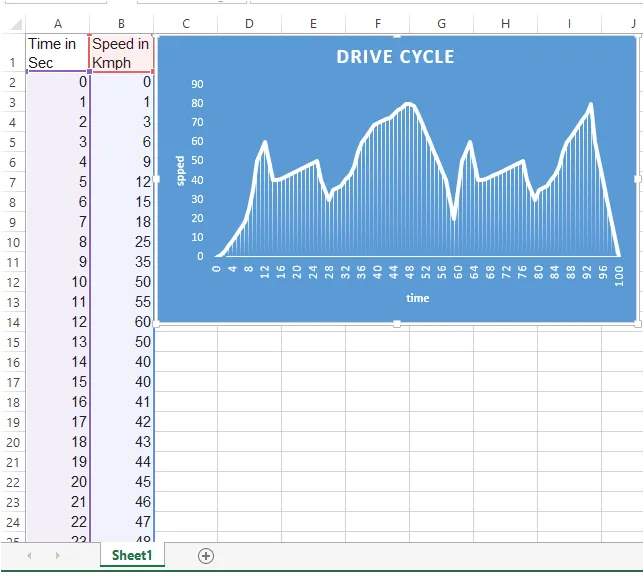
- For a defined driving cycle, calculate the energy required for braking.
- Why electric motor can’t develop braking torque at high speed similar to starting? How electric and mechanical brakes are coordinated?
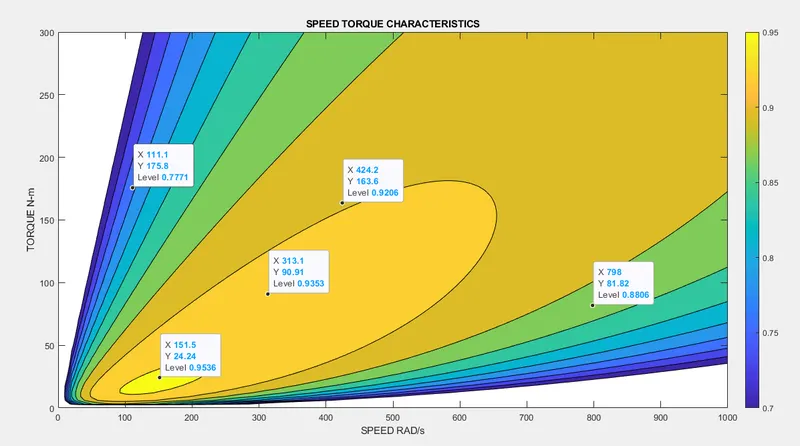
- Make a MATLAB program which plots contour of given motor speed, torque and efficiency values. Attach the code as a .m file attach a screenshot of all the plots.
solution:
1.For a defined driving cycle, calculate the energy required for braking.
2. Why electric motor can’t develop braking torque at high speed similar to starting? How electric and mechanical brakes are coordinated?
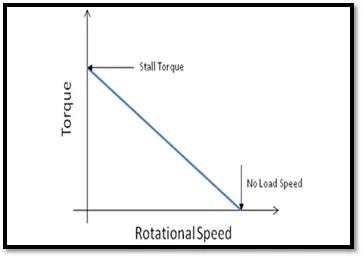
DC motor Torque vs Speed Characteristic
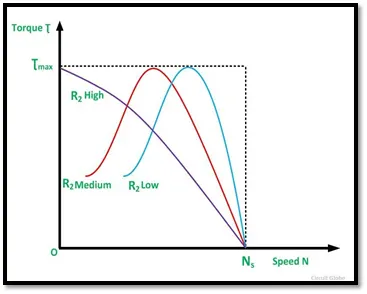
Here for both in case of AC or DC there is no torque at maximum speed, gradually the torque decreases at high speed as the speed tends to be maximum speed. This situation does not occur at the beginning of acceleration because most of the torque is used to increase the kinetic energy of the load (and motor). But when the speed is already high and no extra load is applied it is not possible to increase the torque as well as to develop braking torque. The braking operation happens in the motion which is been distributed as per proportion in the Brake Energy and the regenerative braking.
There are two types of braking:
(i)Mechanical Braking: Mechanical brakes all act by generating frictional forces as two surfaces rub against each other. The stopping power or capacity of a brake depends largely on the surface area of frictional surfaces as well as on the actuation force applied. Mechanical brakes are assemblies consisting of mechanical elements for the slowing or stopping of shafts in equipment drives. They use levers or linkages to transmit force from one point to another. Braking slows or stops the movement of the coupled shafts. There are several types of mechanical brakes.
(ii) Electrical Braking: Electric brakes are devices that use an electrical current or magnetic actuating force to slow or stop the motion of a rotating component. They are used in industrial and vehicular braking applications that require fast response times and precise tension control. The magnet in the backing plate has 2 conductor wires which tap directly into the wiring. When electricity is on, it magnetizes the brake magnet. The magnet is attracted to the drum face. When it contacts this area, the friction causes it to rotate, which moves the actuating arm, and pushes the shoes out against the drum. Those shoe have a special brake pad material on them that resists the heat caused by that friction. When the shoes press against the inside of the drum, they prevent the hub, and consequently the wheel that's touching the ground.
A very beautiful electric braking scheme called Regenerative Braking is now being employed for electric braking. Here during the braking action, the motor is operated as generator. As we know that during generating action, a counter torque is produced. So this counter torque opposes the motion of motor and motor comes to halt. Moreover, the brake energy is converted to electrical energy which can be fed back to the source using power converters.
Electric and Mechanical brake coordination:
There are mainly 2 ways by which the Electric Vehicles could be braked:
- Series- Regenerative braking and mechanical braking both are applied one after another.
- Parallel- Regenerative braking and mechanical braking both are applied simultaneously.
Matlab Code:
% A MATLAB PROGRAMM FOR PLOTTING CONTOUR PLOT OF MOTOR SPEED, TORQUE & Efficiency
clear all
close all
clc

% SPEED ARRAY
w = linspace(0,1000);

% TORQUE ARRAY
T = linspace(0,300);

% LOSS COEFFICIENTS
kc = 0.18;  % COPPER LOSSES
ki = 0.006; % IRON LOSSES
kw = 0.000015; % WINDAGE LOSSES

% MESHGRID
[X,Y] = meshgrid(w,T);
copper_loss = (Y.^2)*kc;
iron_loss = X*ki;
windage_loss = (X.^3)*kw;
K = 20;
output_power = X.*Y;
input_power = (copper_loss)+(iron_loss)+(windage_loss)+(output_power)+K;
Eff = (output_power)./(input_power);
n = linspace(0.7,0.95,10);
contourf(X,Y,Eff,n);
title('SPEED TORQUE CHARACTERISTICS')
xlabel('SPEED rad/s')
ylabel('TORQUE N-m')
Plot results: